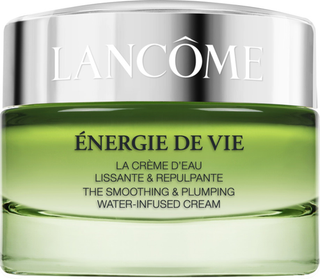
Lancôme Énergie De Vie Water-Infused Moisturizing Cream
Works for
1 of 2 advertised claims delivered
Moisturizing25 ingredients credited for this claimStrong support
“Énergie De Vie Water-Infused Moisturizing Cream”
This product can help improve hydration of the skin with the two types of ingredients.
The first type is called “humectants”:
these ingredients help attract water.
When humectants are on the surface of the skin, they “pull in” the moisture from the outside environment, or from
within deeper layers of the skin. The following ingredients in this product do the job:
glycerin, bis-peg-18 methyl ether dimethyl silane.
This product also contains ingredients called “occlusives”. They help reduce the speed with which our skin loses moisture to the outside environment. These ingredients also help soften the upper layer of the skin, so it feels less tight and nicer to the touch. The following ingredients in this product do the job: squalane, oryza sativa bran oil.
The following ingredients in this product are especially good for supporting the skin barrier and helping with the hydration level: hydroxypalmitoyl sphinganine, urea
Anti-aging3 ingredients credited for this claimLimited support
“Today's signs of fatigue could turn into tomorrow's visible signs of aging.”
This product does not contain ingredients that are able to reduce fine lines and wrinkles or help with skin elasticity, but it can improve the look of the skin temporarily through moisturization. Well-moisturized skin might also be able to repair the sun damage better.
Can it cause trouble?
Irritancy6 strong irritants: Alcohol, Melissa officinalis leaf oil + 4 more — patch-test recommendedHigh risk
Comedogenic3 ingredients rated 2 or more on the 0–5 pore-clogging scale3 flagged

User reviews
Be the first — your take helps the next person decide.
Ingredients
Filter by role to see what each ingredient is doing.
Water~40–60%
Glycerin~4–6%
- Irritation risk
- Low
One of the best moisturizing ingredients. Naturally present in skin. It attracts water to the upper layer of the skin working as a humectant
More about GlycerinCyclohexasiloxane~3.6–5.4%
- Irritation risk
- Low
A silicone that serves as an emollient. Helps create a nice non-greasy feels
More about CyclohexasiloxaneSqualane~2.7–4.1%
- Irritation risk
- Low
An oil naturally present in skin. Works as an emollient to soften the skin and form a protective layer on its surface without a greasy feeling.
More about SqualaneBis-peg-18 methyl ether dimethyl silane~2–3%
- Irritation risk
- Low
A type of silicone that helps soften the upper layer of the skin and create a nice product texture
More about Bis-peg-18 methyl ether dimethyl silaneSucrose stearate~1.6–2.4%
Stearyl alcohol~1.3–2%
- Irritation risk
- Low
An emollient that helps soften the skin
More about Stearyl alcoholPeg-8 stearate~1.2–1.8%
- Irritation risk
- Medium
- Comedogenicity
- 2/5
Helps water and oil mix together
More about Peg-8 stearateUrea~0.9–1.4%
- Irritation risk
- Low
Naturally present in skin (urea makes up about 7% of natural moisturizing factors in skin). Attracts water to the upper layer of the skin. Also has a positive effect on the skin barrier beyond the humectant action. Can enhance penetration of other ingredients. Is an exfoliating ingredient when used in high concentrations
More about UreaMyristyl myristate~0.6–1.4%
- Irritation risk
- Medium
- Comedogenicity
- 3/5
An emollient. Is not recommended for acne-prone skin as it can be comedogenic
More about Myristyl myristatePentaerythrityl tetraethylhexanoate~0.45–1.05%
- Irritation risk
- Low
Used to create a nice product consistency while softening the upper layer of the skin
More about Pentaerythrityl tetraethylhexanoateTocopherol~0.35–0.8%
- Irritation risk
- Low
Pure form of vitamin E. Can help moisturise and protect the skin from free radicals. Often used to help stabilise other ingredients or the formula itself
More about TocopherolAlcohol~0.2–0.75%
- Irritation risk
- High
Can be drying and contribute to skin irritation. Used in formulars to dissolve other ingredients, create a thinner product consistency or for its antibacterial properties
More about AlcoholLycium barbarum fruit extract~0.15–0.6%
- Irritation risk
- Medium
A plant extract that can help neutralize free radicals in skin and attract water to its upper layer
More about Lycium barbarum fruit extractLactic acid~0.15–0.55%
- Irritation risk
- Medium
An exfoliating and moisturizing alpha-hydroxy acid (AHA). Typically causes less irritation than other AHAs, for example, glycolic acid. At high concentrations (about 15%), lactic acid can help reduce lines and wrinkles. Recent studies show that lactic acid can support the "good" bacteria living on skin's surface (healthy skin microbiome)
More about Lactic acidSodium hydroxide~0.15–0.6%
Hydroxypalmitoyl sphinganine~0.15–0.55%
- Irritation risk
- Low
A type of lipid similar to ceramides naturally present in skin. Helps to soften the upper layer of the skin and supports the skin barrier function to keep it hydrated. Can help to prevent inflammation in skin
More about Hydroxypalmitoyl sphinganineSodium benzoate~0.25–0.5%
Phenoxyethanol~0.15–0.5%
- Irritation risk
- Low
A preservative. It helps prevent bacterial growth in cosmetic products
More about PhenoxyethanolOlea europaea fruit oil~0.1–0.45%
- Irritation risk
- Medium
An emollient that helps soften the skin but is not effective for restoring its barrier function. Might be helpful to calm down inflammation
More about Olea europaea fruit oilStearic acid~0.15–0.6%
- Irritation risk
- Low
Helps oil and water mix together and works as an emollient
More about Stearic acidChlorphenesin~0.16–0.32%
Palmitic acid~0.1–0.45%
- Irritation risk
- Low
An emollient that is naturally present in skin and helps soften it
More about Palmitic acidMelissa officinalis leaf oil~0.05–0.25%
- Irritation risk
- High
Tamarindus indica seed gum~0.1–0.3%
- Irritation risk
- Medium
Helps to attract water to the upper layer of the skin and create a nice product finish on the skin
More about Tamarindus indica seed gumLimonene~0.05–0.25%
- Irritation risk
- High
A common frangrance that can easily irritate skin, especially if exposed to air, light or heat
More about LimoneneXanthan gum~0.1–0.35%
- Irritation risk
- Low
Used to create a thicker product consistency
More about Xanthan gumPentaerythrityl tetra-di-t-butyl hydroxyhydrocinnamate~0.1–0.35%
- Irritation risk
- Low
Used to increase stability of product formulations
More about Pentaerythrityl tetra-di-t-butyl hydroxyhydrocinnamatePentylene glycol~0.1–0.4%
- Irritation risk
- Medium
Used to preserve products, dissolve other ingredients and create a nice product texture
More about Pentylene glycolGentiana lutea root extract~0.05–0.3%
- Irritation risk
- Medium
A plant extract that can help strengthen the skin barrier function and improve skin moisture levels
More about Gentiana lutea root extractDioscorea villosa root extract~0.05–0.3%
- Irritation risk
- Low
Persea gratissima oil~0.1–0.4%
- Irritation risk
- Medium
An emollient that helps soften the skin and could be helpful in repairing its barrier function
More about Persea gratissima oilAcrylates/c10-30 alkyl acrylate crosspolymer~0.1–0.35%
- Irritation risk
- Medium
Maintains the texture of skincare products. Allows the product to spread evenly. Helps oil and water mix together
More about Acrylates/c10-30 alkyl acrylate crosspolymerCarbomer~0.1–0.3%
- Irritation risk
- Low
Helps create a thicker or gel-like product texture. It is not a surfactant but can be used in gentle cleansing formulations
More about CarbomerMyristic acid~0.1–0.4%
- Irritation risk
- Medium
- Comedogenicity
- 3/5
Helps oil and water mix together. Could be comedogenic
More about Myristic acidMyristyl alcohol~0.1–0.4%
- Irritation risk
- High
Helps to stabilize the product formulation while softening the upper layer of the skin. Can be irritating
More about Myristyl alcoholDisodium edta~0.05–0.3%
Cetyl alcohol~0.1–0.4%
- Irritation risk
- Low
A non-drying alcohol that works to soften the skin and stabilize product formulations helping oil and water mix together
More about Cetyl alcoholMethylparaben~0.1–0.3%
Bht~0.1–0.3%
Potassium sorbate~0.1–0.35%
Citral~0.05–0.25%
Citronellol~0.05–0.25%
Prunus armeniaca kernel oil~0.1–0.35%
- Irritation risk
- Medium
An emollient that helps soften the skin
More about Prunus armeniaca kernel oilPrunus amygdalus dulcis seed~0.05–0.25%
- Irritation risk
- Low
Helps soften the upper layer of the skin
More about Prunus amygdalus dulcis seedHexyldecanol~0.1–0.35%
- Irritation risk
- Low
Helps soften the upper layer of the skin
More about HexyldecanolGlyceryl stearate~0.1–0.35%
- Irritation risk
- Low
An emollient that softens the skin and forms a protective layer on its surface. Helps water and oil mix together
More about Glyceryl stearateOryza sativa bran oil~0.05–0.2%
- Irritation risk
- Low
Helps soften the upper layer of the skin and might have some anti-oxidant properties
More about Oryza sativa bran oilParfum~0.01–0.05%
- Irritation risk
- High
An aromatic blend of unspecified and possibly irritating ingredients
More about ParfumIngredient list view
Water, Glycerin, Cyclohexasiloxane, Squalane, Bis-peg-18 methyl ether dimethyl silane, Sucrose stearate, Stearyl alcohol, Peg-8 stearate, Urea, Myristyl myristate, Pentaerythrityl tetraethylhexanoate, Tocopherol, Alcohol, Lycium barbarum fruit extract, Lactic acid, Sodium hydroxide, Hydroxypalmitoyl sphinganine, Sodium benzoate, Phenoxyethanol, Olea europaea fruit oil, Stearic acid, Chlorphenesin, Palmitic acid, Melissa officinalis leaf oil, Tamarindus indica seed gum, Limonene, Xanthan gum, Pentaerythrityl tetra-di-t-butyl hydroxyhydrocinnamate, Pentylene glycol, Gentiana lutea root extract, Dioscorea villosa root extract, Persea gratissima oil, Acrylates/c10-30 alkyl acrylate crosspolymer, Carbomer, Myristic acid, Myristyl alcohol, Disodium edta, Cetyl alcohol, Methylparaben, Bht, Potassium sorbate, Citral, Citronellol, Prunus armeniaca kernel oil, Prunus amygdalus dulcis seed, Hexyldecanol, Glyceryl stearate, Oryza sativa bran oil, Parfum
Compare prices
Retailers ranked by price — lowest first.
Worth comparing, line by line.
Match % combines shared ingredients, the first five ingredients, shared actives and hero ingredients, irritancy (lower counts in the alternative's favour), texture and body area. Only products in the same routine step are compared.
| LancômeÉnergie De Vie Water-Infused Moisturizing CreamYOUR PRODUCT | Kiehl'sUltra Facial Cream Holiday Edition | BABORSkinovage Argan Cream | |
|---|---|---|---|
| Match | — | 60% | 50% |
| Price | $57.00 | $32.59−$24.41 | $57.71+$0.71 |
| Shared key ingredients | — | 6 of 10 | 4 of 10 |
| Key difference | — | Glycine Soja Oil | Niacinamide |
| Irritancy | High | Medium | Medium |
| Drying alcohol | Contains drying alcohol | — | Contains drying alcohol |
| View product | Shop | Shop |


Sources cited in this review
Every concentration estimate and effectiveness label is anchored to one of these 22 studies and safety reviews.
- 1
- 2Safety Assessment of PEG Diesters as Used in Cosmeticscir-safety.org
- 3Topical urea in skincare: A reviewpubmed.ncbi.nlm.nih.gov
- 4Safety Assessment of Pentaerythrityl Tetraesters as Used in Cosmeticsjournals.sagepub.com
- 5Vitamin E in dermatologyncbi.nlm.nih.gov
- 6Vitamin E and Skin Healthlpi.oregonstate.edu

Affiliate links · As an Amazon Associate, WIMJ earns from qualifying purchases.