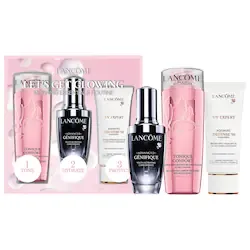
Lancôme Let's Get Glowing Morning Essentials Routine
Works for
4 of 4 advertised claims delivered
Sun protectionSPF 50 · 5 UV filtersBroad spectrum
This product offers a good level of protection against both UVB and UVA rays.
This sunscreen uses organic (so-called "chemical") sunscreen filters. Organic, or "chemical" filters usually provide reliable sun protection and rarely leave a white cast. Sunscreens with organic filters can sting eyes.
Anti-aging4 ingredients credited for this claimStrong support
“The Advanced Génifique Anti-Aging Face Serum contains bifidus prebiotics to target 10 key signs of aging and visibly improve radiance in as few as seven days.”
This product can help reduce and prevent fine lines and wrinkles, improve skin elasticity and firmness because it contains adenosine.
Keep in mind that it typically takes at least 6 weeks to notice any results because the changes that are needed to improve fine lines and elasticity happen in the deeper layers of the skin. No topical anti-aging product can “erase” wrinkles or fully reverse signs of aging.
This product can also help prevent early signs of skin aging because it offers a good level of broad spectrum sun protection. Sun damage is the main cause of premature skin aging, and protecting your skin from the sun is the best anti-aging strategy.
Evens skin tone3 ingredients credited for this claimStrong support
“Participants saw a 42% improvement in skin-tone evenness”
This product offers broad spectrum sun protection. It means that it can prevent hyperpigmentation and help keep the skin tone even (sun damage is the main factor causing age spots, darkening of post-acne marks and other discolorations).
Moisturizing20 ingredients credited for this claimStrong support
“Let's Get Glowing Morning Essentials Routine”
This product can help improve hydration of the skin with the two types of ingredients.
The first type is called “humectants”:
these ingredients help attract water.
When humectants are on the surface of the skin, they “pull in” the moisture from the outside environment, or from
within deeper layers of the skin. The following ingredients in this product do the job:
faex, glycerin.
This product also contains ingredients called “occlusives”. They help reduce the speed with which our skin loses moisture to the outside environment. These ingredients also help soften the upper layer of the skin, so it feels less tight and nicer to the touch. The following ingredients in this product do the job: dimethicone, cyclopentasiloxane.
The following ingredients in this product are especially good for supporting the skin barrier and helping with the hydration level: salicyloyl phytosphingosine
Can it cause trouble?
Irritancy8 strong irritants: Parfum, Hexyl cinnamal + 6 more — patch-test recommendedHigh risk
Comedogenic1 ingredient rated 2 or more on the 0–5 pore-clogging scale1 flagged
User reviews
Be the first — your take helps the next person decide.
Ingredients
Filter by role to see what each ingredient is doing.
Water~45–55%
Butylene glycol~5.8–7.1%
- Irritation risk
- Low
Used to create a nice product texture and help delivery of other ingredients. Might be somewhat helpful in attracting water to the upper layer of the skin
More about Butylene glycolGlycerin~4–4.9%
- Irritation risk
- Low
One of the best moisturizing ingredients. Naturally present in skin. It attracts water to the upper layer of the skin working as a humectant
More about GlycerinCyclopentasiloxane~3–3.7%
- Irritation risk
- Low
A silicone that helps improve the product texture and spreadability. Can absorb oil creating a short-term mattifying effect on the skin
More about CyclopentasiloxanePhenoxyethanol~0.5–1%
- Irritation risk
- Low
A preservative. It helps prevent bacterial growth in cosmetic products
More about PhenoxyethanolIsopropyl palmitate~1.7–2.1%
- Irritation risk
- Medium
- Comedogenicity
- 3/5
Helps soften the upper layer of the skin and create a thicker product consistency
More about Isopropyl palmitatePeg-60 hydrogenated castor oil~1.5–1.8%
- Irritation risk
- Medium
Helps oil and water mix together
More about Peg-60 hydrogenated castor oilTriethanolamine~1.2–1.5%
- Irritation risk
- Medium
Used to adjust pH of the product and can help improve the product's smell
More about TriethanolamineAcrylates/c10-30 alkyl acrylate crosspolymer~1–1.3%
- Irritation risk
- Medium
Maintains the texture of skincare products. Allows the product to spread evenly. Helps oil and water mix together
More about Acrylates/c10-30 alkyl acrylate crosspolymerMethylparaben~0.15–0.3%
Honey~0.5–0.75%
- Irritation risk
- Low
Helps attract water to the skin and might have some anti-bacterial properties. Can be an allergen
More about HoneyMannitol~0.4–0.6%
- Irritation risk
- Low
Helps to attract water to the upper layer of the skin
More about MannitolParfum~0.3–0.55%
- Irritation risk
- High
An aromatic blend of unspecified and possibly irritating ingredients
More about ParfumTocopheryl acetate~0.3–0.55%
- Irritation risk
- Medium
A more stable but less bio-available form of vitamin E compared to Tocopherol. Might help moisturize and protect the skin from free radicals, but mostly used in low concentrations to stabilize other ingredients.
More about Tocopheryl acetatePropylparaben~0.25–0.4%
Sodium hyaluronate~0.25–0.45%
- Irritation risk
- Low
One of the best moisturizing ingredients. Attracts water into the upper layer of the skin
More about Sodium hyaluronateCyclodextrin~0.25–0.45%
- Irritation risk
- Low
A type of sugar that is used to support delivery of active ingredients and can enhance their penetration into the skin without disrupting the skin's barrier
More about CyclodextrinPrunus amygdalus dulcis protein~0.2–0.35%
- Irritation risk
- Low
Hexyl cinnamal~0.15–0.3%
Faex~0.15–0.3%
- Irritation risk
- Low
Yeast extract. Helps to attract water to the upper layer of the skin
More about FaexYeast extract~0.15–0.25%
- Irritation risk
- Low
Helps attract water to the upper layer of the skin and might have some anti-oxidant and skin lightening properties. It can help calm down inflammation in skin
More about Yeast extractAlpha-isomethyl ionone~0.1–0.2%
- Irritation risk
- High
A fragrance. Potential allergen and can be irritating
More about Alpha-isomethyl iononeDisodium succinate~0.15–0.25%
Ci 14700~0.15–0.25%
Water~0.15–0.25%
Bifida ferment lysate~0.1–0.2%
- Irritation risk
- Low
Consists of remains of dead yeast bacteria cells. Helps to hydrate the skin and reduce irritation. Might has some anti-oxidant effect
More about Bifida ferment lysateGlycerin~0.15–0.3%
- Irritation risk
- Low
One of the best moisturizing ingredients. Naturally present in skin. It attracts water to the upper layer of the skin working as a humectant
More about GlycerinAlcohol denat.~0.15–0.25%
- Irritation risk
- High
Produces temporary toning effect. Can help dissolve other ingredients or preserve products
More about Alcohol denat.Dimethicone~0.2–0.35%
- Irritation risk
- Low
A silicone that helps to reduce water loss from the surface of the skin. Can temporarily "fill in" lines and wrinkles, absorb oil, and create a nice product finish
More about DimethiconeHydroxyethylpiperazine ethane sulfonic acid~0.15–0.25%
- Irritation risk
- Medium
Used to regulate product's pH, but can be also used as an exfoliator when included in higher concentrations. There is a controversy about whether it can generate free radicals and induce skin cell damage when used in topical products
More about Hydroxyethylpiperazine ethane sulfonic acidAscorbyl glucoside~0.1–0.25%
- Irritation risk
- Medium
A vitamin C derivative that is more stable but less potent than pure form of vitamin C. Has a potential to boost collagen production, nutralise free radicals and reduce hyperpigmentation, but the required concentration is likely to be much higher than for the pure form of vitamin C, limiting the ingredient's effectiveness in products
More about Ascorbyl glucosideSodium hyaluronate~0.1–0.25%
- Irritation risk
- Low
One of the best moisturizing ingredients. Attracts water into the upper layer of the skin
More about Sodium hyaluronateSodium hydroxide~0.15–0.3%
Sodium benzoate~0.15–0.3%
Phenoxyethanol~0.15–0.3%
- Irritation risk
- Low
A preservative. It helps prevent bacterial growth in cosmetic products
More about PhenoxyethanolAdenosine~0.15–0.3%
- Irritation risk
- Low
Might help improve cell turnover and reduce inflammation in skin. One study shows that the ingredients might be able to help reduce dynamic wrinkles (for example, in the corners of the eyes or on the forehead)
More about AdenosineFaex extract~0.15–0.3%
- Irritation risk
- Low
Yeast extract. Helps attract water to the upper layer of the skin
More about Faex extractYeast extract~0.15–0.3%
- Irritation risk
- Low
Helps attract water to the upper layer of the skin and might have some anti-oxidant and skin lightening properties. It can help calm down inflammation in skin
More about Yeast extractPeg-20 methyl glucose sesquistearate~0.2–0.35%
- Irritation risk
- Medium
Helps oil and water mix together
More about Peg-20 methyl glucose sesquistearatePeg-60 hydrogenated castor oil~0.2–0.35%
- Irritation risk
- Medium
Helps oil and water mix together
More about Peg-60 hydrogenated castor oilSalicyloyl phytosphingosine~0.15–0.3%
- Irritation risk
- Low
Helps attract water to the upper layer of the skin. Might have anti-aging benefits but solid study data is lacking
More about Salicyloyl phytosphingosineAmmonium polyacryloyldimethyl taurate~0.15–0.3%
- Irritation risk
- Low
Used to create a thicker product consistency
More about Ammonium polyacryloyldimethyl taurateLimonene~0.15–0.3%
- Irritation risk
- High
A common frangrance that can easily irritate skin, especially if exposed to air, light or heat
More about LimoneneXanthan gum~0.2–0.35%
- Irritation risk
- Low
Used to create a thicker product consistency
More about Xanthan gumCaprylyl glycol~0.2–0.35%
- Irritation risk
- Medium
Helps preserve products and creates a nice product texture
More about Caprylyl glycolDisodium edta~0.15–0.3%
Octyldodecanol~0.2–0.35%
- Irritation risk
- Low
An emollient that helps to soften the skin and create a pleasant product texture and stabilize the formulation
More about OctyldodecanolCitronellol~0.15–0.3%
Parfum~0.15–0.3%
- Irritation risk
- High
An aromatic blend of unspecified and possibly irritating ingredients
More about ParfumButyl methoxydibenzoylmethane3%
- Irritation risk
- Medium
Avobenzone. An organic, or so-called "chemical" UV filter. Protects against both UVA and UVB rays. Needs to be combined with other filters in a formulation to be stable.
More about Butyl methoxydibenzoylmethaneHomosalate10.7%
- Irritation risk
- Medium
A weak sunscreen that offers some protection against the sun rays that cause sunburn (UVB), but does not offer meaningful protection against protect against the most aging sun rays (UVA). It loses its effectiveness quickly when exposed to sunlight. It is an organic, or so called "chemical" sunscreen. When used in low concentrations, helps to stabilize the product formulation
More about HomosalateEthylhexyl salicylate3.2%
- Irritation risk
- Low
Octisalate. A UV filter. It offers some protection against the sun rays that cause sunburn (UVB), but does not protect against the most aging sun rays (UVA). It loses its effectiveness quickly when exposed to sunlight. It is an organic, or so called "chemical" sunscreen
More about Ethylhexyl salicylateOctocrylene6%
- Irritation risk
- Medium
A weak sunscreen that protects against the sun rays that cause sunburn (UVB) and is somewhat effective against the UVA rays. It is quite stable and can help stabilize other, more vulnerable, sunscreen ingredients like Avobenzone. It is an organic, or so called "chemical" sunscreen
More about OctocryleneBenzophenone-33.9%
- Irritation risk
- High
Same as oxybenzone. Protects in the UVB and short UVA range. In small concentrations, used to stabilize product formulation. Can be irritating. Is shown to be harmful to coral reefs - consider avoiding bathing in coral reef areas when wearing a product with this ingredient. It can penetrate the skin and get absorbed into bloodstream faster than other popular filters available in the US. The study that produced this finding did not address any potential health effects of the absorption
More about Benzophenone-3Water~0.2–0.4%
Dimethicone~0.25–0.5%
- Irritation risk
- Low
A silicone that helps to reduce water loss from the surface of the skin. Can temporarily "fill in" lines and wrinkles, absorb oil, and create a nice product finish
More about DimethiconeAlcohol denat.~0.2–0.4%
- Irritation risk
- High
Produces temporary toning effect. Can help dissolve other ingredients or preserve products
More about Alcohol denat.Styrene/acrylates copolymer~0.2–0.4%
- Irritation risk
- Low
Used to create an even product consistency. Can help boost efficiency of sunscreen filters
More about Styrene/acrylates copolymerAcrylates/dimethicone copolymer~0.25–0.45%
- Irritation risk
- Medium
Used to stabilize product formulation, help create an even product layer over skin (for example, in sunscreen), evenly disperse pigements and create a nice product consistency
More about Acrylates/dimethicone copolymerTocopherol~0.25–0.45%
- Irritation risk
- Low
Pure form of vitamin E. Can help moisturise and protect the skin from free radicals. Often used to help stabilise other ingredients or the formula itself
More about TocopherolSodium polyacrylate~0.25–0.5%
- Irritation risk
- Low
Used to create a gel-like product texture, as well as to stabilize emulsions
More about Sodium polyacrylateSodium dodecylbenzenesulfonate~0.3–0.55%
- Irritation risk
- Medium
Helps oil and water mix together
More about Sodium dodecylbenzenesulfonateSodium benzoate~0.2–0.4%
Phenoxyethanol~0.25–0.45%
- Irritation risk
- Low
A preservative. It helps prevent bacterial growth in cosmetic products
More about PhenoxyethanolPeg-8 laurate~0.25–0.45%
Silica~0.3–0.6%
Pentylene glycol~0.25–0.5%
- Irritation risk
- Medium
Used to preserve products, dissolve other ingredients and create a nice product texture
More about Pentylene glycolMentha piperita extract~0.25–0.5%
Propylene glycol~0.2–0.35%
- Irritation risk
- High
Helps oil and water mix together and can enhance the penetration of other ingredients into the skin. It can be irritating
More about Propylene glycolLeontopodium alpinum flower/leaf extract~0.2–0.4%
- Irritation risk
- Low
Caprylyl glycol~0.25–0.45%
- Irritation risk
- Medium
Helps preserve products and creates a nice product texture
More about Caprylyl glycolC10-30 alkyl acrylate~0.2–0.4%
- Irritation risk
- Low
Sorbitol~0.2–0.4%
- Irritation risk
- Low
Helps attract water to the upper layer of the skin and improves the product texture
More about SorbitolMoringa oleifera seed extract~0.2–0.35%
- Irritation risk
- Medium
Helps soften the upper layer of the skin and might have some antioxidant effect
More about Moringa oleifera seed extractDisodium edta~0.2–0.35%
Rosa gallica flower extract~0.15–0.3%
- Irritation risk
- High
Disodium phosphate~0.15–0.25%
- Irritation risk
- Low
Helps adjust the product pH and stabilize the formulation
More about Disodium phosphateCitric acid~0.15–0.25%
- Irritation risk
- Medium
Can work as an exfoliant but is typically used to adjust the product pH
More about Citric acidPotassium sorbate~0.15–0.3%
Glycerin~0.1–0.2%
- Irritation risk
- Low
One of the best moisturizing ingredients. Naturally present in skin. It attracts water to the upper layer of the skin working as a humectant
More about GlycerinParfum~0.05–0.1%
- Irritation risk
- High
An aromatic blend of unspecified and possibly irritating ingredients
More about ParfumIngredient list view
Water, Butylene glycol, Glycerin, Cyclopentasiloxane, Phenoxyethanol, Isopropyl palmitate, Peg-60 hydrogenated castor oil, Triethanolamine, Acrylates/c10-30 alkyl acrylate crosspolymer, Methylparaben, Honey, Mannitol, Parfum, Tocopheryl acetate, Propylparaben, Sodium hyaluronate, Cyclodextrin, Prunus amygdalus dulcis protein, Hexyl cinnamal, Faex, Yeast extract, Alpha-isomethyl ionone, Disodium succinate, Ci 14700, Water, Bifida ferment lysate, Glycerin, Alcohol denat., Dimethicone, Hydroxyethylpiperazine ethane sulfonic acid, Ascorbyl glucoside, Sodium hyaluronate, Sodium hydroxide, Sodium benzoate, Phenoxyethanol, Adenosine, Faex extract, Yeast extract, Peg-20 methyl glucose sesquistearate, Peg-60 hydrogenated castor oil, Salicyloyl phytosphingosine, Ammonium polyacryloyldimethyl taurate, Limonene, Xanthan gum, Caprylyl glycol, Disodium edta, Octyldodecanol, Citronellol, Parfum, Butyl methoxydibenzoylmethane, Homosalate, Ethylhexyl salicylate, Octocrylene, Benzophenone-3, Water, Dimethicone, Alcohol denat., Styrene/acrylates copolymer, Acrylates/dimethicone copolymer, Tocopherol, Sodium polyacrylate, Sodium dodecylbenzenesulfonate, Sodium benzoate, Phenoxyethanol, Peg-8 laurate, Silica, Pentylene glycol, Mentha piperita extract, Propylene glycol, Leontopodium alpinum flower/leaf extract, Caprylyl glycol, Unknown, C10-30 alkyl acrylate, Sorbitol, Moringa oleifera seed extract, Disodium edta, Rosa gallica flower extract, Disodium phosphate, Citric acid, Potassium sorbate, Glycerin, Parfum
Compare prices
Retailers ranked by price — lowest first.
Worth comparing, line by line.
Match % combines shared ingredients, the first five ingredients, shared actives and hero ingredients, irritancy (lower counts in the alternative's favour), texture and body area. Only products in the same routine step are compared.
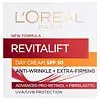
| LancômeLet's Get Glowing Morning Essentials RoutineYOUR PRODUCT | L'Oréal ParisParis Revitalift SPF Anti-Ageing + Firming Pro Retinol Day Cream SPF30 | |
|---|---|---|
| Match | — | 50% |
| Price | $80.00 | $11.45−$68.55 |
| Shared key ingredients | — | 8 of 17 |
| Key difference | — | Retinyl Palmitate |
| Irritancy | High | High |
| SPF | SPF 50 | SPF 30 |
| Drying alcohol | Contains drying alcohol | Contains drying alcohol |
| View product | Shop |

Product summary
Based on the ingredients included, we believe that this product can offer reliable sun protection. We love that it can protect from both UVA and UVB rays (not all sunscreens with SPF ratings give UVA protection. UVA rays do not cause sunburn, but still damage our skin and lead to early aging).
Because it includes good moisturizing ingredients, it can also work as a hydrating day cream. Like all broad-spectrum sunscreens, this product helps prevent early signs of aging.
Sunscreen filters
This sunscreen uses so-called "chemical", or organic UV filters (organic simply means that their molecules contain atoms of carbon). These filters typically give good sun protection and rarely leave a white cast, but they can be irritating for sensitive skin. The UV filters in this sunscreen are: oxybenzone 3.90% (declared), avobenzone 3.00% (declared), octisalate 3.20% (declared), homosalate 10.70% (declared) and octocrylene 6.00% (declared).
Irritation risk
This product contains a bunch of common irritants, including ingredients that do not provide any known benefit for the skin. It might not be the best choice if your skin is sensitive. We assess the overall irritancy of this sunscreen to be high. For a detailed overview of all potential irritants: click here
You can see the detailed formula review with the breakdown of all actives in the product and the full ingredient list with estimated concentrations in the tables below.
Sources cited in this review
Every concentration estimate and effectiveness label is anchored to one of these 29 studies and safety reviews.
- 1
- 2Final Report on the Safety Assessment of Isopropyl Isostearatejournals.sagepub.com
- 3Hyaluronic acid: A key molecule in skin agingncbi.nlm.nih.gov
- 4
- 5
- 6

Affiliate links · As an Amazon Associate, WIMJ earns from qualifying purchases.