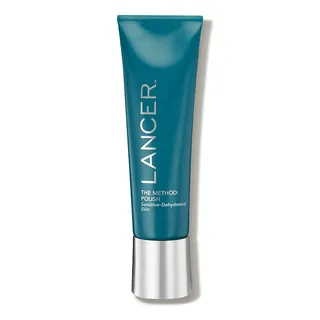
Lancer Skincare The Method: Polish Sensitive-Dehydrated Skin
Works for
Anti-agingRetinyl palmitateMay help
“Infused with antioxidants and magnesium crystals, this face scrub helps slough away dead skin cells to boost skin texture and diminish signs of aging.”
This product contains retinyl palmitate. There is some human evidence that this ingredient helps reduce and prevent fine lines and wrinkles and improve skin elasticity and firmness, though it is smaller or less consistent than the evidence for the best anti-aging ingredients.
MoisturizingGlycerin, Trihydroxystearin + 3 moreWorks
“When you use Lancer Skincare The Method: Polish Sensitive-Dehydrated Skin, you help keep your complexion free of blemishes while imparting soothing moisture.”
This product contains good ingredients to attract water to the upper layer of the skin. These ingredients are called "humectants": glycerin, lactobacillus ferment.
When humectants are on the surface of the skin, they “pull in” the moisture from the outside environment, or from within deeper layers of the skin. If the air is dry, humectants can speed up the moisture loss from the skin. This is why it is a good idea to use another product on top of this one to help "seal in" the moisture (look for ingredients like dimethicone, squalane, oils and butters).
Evens skin toneRetinyl palmitate, Lactobacillus/punica granatum fruit ferment extract + 1 moreMay help
“Improves the tone and texture of skin.”
The following ingredient (ingredients) in this product might be helpful, but there is no evidence to confirm that it actually works: lactobacillus/pumpkin ferment extract, retinyl palmitate.
ExfoliationLactobacillus/punica granatum fruit ferment extract, Lactobacillus/pumpkin ferment extract + 1 moreNot delivered
“Thoroughly exfoliates skin to enhance cell turnover”
This product might help exfoliate the skin with lactobacillus/pumpkin ferment extract, lactobacillus/punica granatum fruit ferment extract, retinyl palmitate, but these ingredients are not the most effective.
Anti-blemishRetinyl palmitateNot delivered
“When you use Lancer Skincare The Method: Polish Sensitive-Dehydrated Skin, you help keep your complexion free of blemishes while imparting soothing moisture.”
This product contains ingredients (retinyl palmitate) that could help reduce blemishes and clogged pores in theory, but there is not enough evidence that they actually work.
Can it cause trouble?
Irritancy4 strong irritants: Retinyl palmitate, Lavandula angustifolia oil + 2 more — patch-test recommendedHigh risk
ComedogenicClean of flagged comedogenic ingredientsNone flagged
User reviews
Be the first — your take helps the next person decide.
Ingredients
Filter by role to see what each ingredient is doing.
Glycerin~22–33%
- Irritation risk
- Low
One of the best moisturizing ingredients. Naturally present in skin. It attracts water to the upper layer of the skin working as a humectant
More about GlycerinPeg-8~4.7–7%
- Irritation risk
- Medium
Used to create a nice product consistency
More about Peg-8Sodium bicarbonate~4.5–6.7%
Magnesium oxide~3.5–5.3%
- Irritation risk
- Low
Oleth-20~2.7–4%
Trihydroxystearin~1.9–2.9%
- Irritation risk
- Low
Helps soften the upper layer of the skin and improve the product texture
More about TrihydroxystearinSilica~1.7–2.5%
Peg-100 stearate~1.3–1.9%
- Irritation risk
- Low
Helps oil and water mix togehter and creates a nice product texture
More about Peg-100 stearateGlyceryl stearate~1.1–1.6%
- Irritation risk
- Low
An emollient that softens the skin and forms a protective layer on its surface. Helps water and oil mix together
More about Glyceryl stearateLactobacillus/punica granatum fruit ferment extract~0.9–1.35%
- Irritation risk
- High
An enzyme-based exfoliant
More about Lactobacillus/punica granatum fruit ferment extractLeuconostoc/radish root ferment filtrate~0.55–1.3%
- Irritation risk
- Medium
A preservative that comes from radishes fermented by a bacteria. New research suggests that the preservation properties in the ingredient come from an ammonium salt that is not present naturally in radish root but used in its cultivation. Is problematic because the exact amount of the preservative agents is difficult to determine
More about Leuconostoc/radish root ferment filtrateLactobacillus ferment~0.45–1.1%
- Irritation risk
- Low
A fermentation product created by bacteria Lactobacillus. The fermented product has anti-bacterial properties and might be helpful in calming down inflammation, but studies are lacking. Helps attract water to the upper layer of the skin. Can be used as a preservative
More about Lactobacillus fermentLactobacillus/pumpkin ferment extract~0.4–0.95%
- Irritation risk
- Medium
An enzyme-based exfoliant
More about Lactobacillus/pumpkin ferment extractRetinyl palmitate~0.3–0.75%
- Irritation risk
- High
Three steps removed from the active form of vitamin A - retinoic acid. To have an effect in the skin, it first needs to be converted twice to become the retinoic acid. This means it is less potent than retinol, but could also be less irritating. Once converted to the retinoic acid in the skin, it helps against all signs of aging, improves skin cell turnover and helps fight blemishes and clogged pores. However, in many cosmetic formulations, it is used in a concentration that is too low to have the full effect
More about Retinyl palmitateTocopheryl acetate~0.3–0.7%
- Irritation risk
- Medium
A more stable but less bio-available form of vitamin E compared to Tocopherol. Might help moisturize and protect the skin from free radicals, but mostly used in low concentrations to stabilize other ingredients.
More about Tocopheryl acetateLavandula angustifolia oil~0.15–0.65%
- Irritation risk
- High
An essential oil. Potential allergen and can be irritating. It has some anti-bacterial properties
More about Lavandula angustifolia oilAnthemis nobilis flower oil~0.15–0.5%
- Irritation risk
- High
An essential oil that is used as a fragrance and can be irritating. It might have some anti-oxidant effect in skin
More about Anthemis nobilis flower oilBisabolol~0.1–0.4%
- Irritation risk
- Low
An active component of chamomile plant that historically has been used to calm down irritated skin. A recent study shows that bisabolol indeed can have some anti-inflammatory effect on skin, even though conclusive data is lacking. Bisabolol has a sweet floral scent and can be added to products for its aromatic properties
More about BisabololZingiber officinale root extract~0.1–0.45%
- Irritation risk
- High
A plant extract that can contain an irritating essential oil. Might have some anti-oxidant effect, but evidence is lacking
More about Zingiber officinale root extractWater~0.1–0.35%
Linalool~0.05–0.25%
Ingredient list view
Glycerin, Peg-8, Sodium bicarbonate, Magnesium oxide, Oleth-20, Trihydroxystearin, Silica, Peg-100 stearate, Glyceryl stearate, Lactobacillus/punica granatum fruit ferment extract, Leuconostoc/radish root ferment filtrate, Lactobacillus ferment, Lactobacillus/pumpkin ferment extract, Retinyl palmitate, Tocopheryl acetate, Lavandula angustifolia oil, Anthemis nobilis flower oil, Bisabolol, Zingiber officinale root extract, Water, Linalool
Compare prices
Retailers ranked by price — lowest first.

Worth comparing, line by line.
Match % combines shared ingredients, the first five ingredients, shared actives and hero ingredients, irritancy (lower counts in the alternative's favour), texture and body area. Only products in the same routine step are compared.
| Lancer SkincareThe Method: Polish Sensitive-Dehydrated SkinYOUR PRODUCT | ZO Skin HealthExfoliating Polish | RapidRenewSkin Perfecting Polish | RapidLashRapidRenew Skin Perfecting Polish | |
|---|---|---|---|---|
| Match | — | 36% | 34% | 34% |
| Price | $80.00 | $65.09−$14.91 | $27.20−$52.80 | $27.20−$52.80 |
| Shared key ingredients | — | 2 of 3 | 2 of 3 | 2 of 3 |
| Key difference | — | Mineral Oil | Myristoyl Pentapeptide-8 | Myristoyl Pentapeptide-8 |
| Irritancy | High | High | High | High |
| Drying alcohol | — | — | Contains drying alcohol | Contains drying alcohol |
| View product | Shop | Shop | Shop |


More alternatives: Ahava Apple of Sodom Enzyme Facial PeelSkinn Mega-Size Non-Negotiables DermAppeal Microdermabrasion Treatment
Sources cited in this review
Every concentration estimate and effectiveness label is anchored to one of these 7 studies and safety reviews.
- 1
- 2
- 3
- 4Use of Probiotics for Dermal Applicationsresearchgate.net
- 5Safety Assessment of Anthemis nobilis– Derived Ingredients as Used in Cosmeticsjournals.sagepub.com
- 6

Affiliate links · As an Amazon Associate, WIMJ earns from qualifying purchases.