Works for
1 of 1 advertised claim delivered
Moisturizing25 ingredients credited for this claimStrong support
“Enriched with 70,000ppm panthenol and ceramide to protect and moisturize the skin.”
This product can help improve hydration of the skin with the two types of ingredients.
The first type is called “humectants”:
these ingredients help attract water.
When humectants are on the surface of the skin, they “pull in” the moisture from the outside environment, or from
within deeper layers of the skin. The following ingredients in this product do the job:
betaine, glycerin.
This product also contains ingredients called “occlusives”. They help reduce the speed with which our skin loses moisture to the outside environment. These ingredients also help soften the upper layer of the skin, so it feels less tight and nicer to the touch. The following ingredients in this product do the job: beeswax, caprylic/capric triglyceride.
The following ingredients in this product are especially good for supporting the skin barrier and helping with the hydration level: ceramide np, madecassoside, panthenol
Anti-oxidationNot advertised by the brand · 6 ingredients credited for this claimStrong support
This product contains antioxidants (asiaticoside, madecassoside) that can help neutralize free radicals in skin. By doing so, they can lessen the damage the skin gets from the UV light (sun).
The following ingredients - ginkgo biloba leaf extract also can have an antioxidant effect, but there is less evidence to confirm their effectiveness in skin.
Anti-agingNot advertised by the brand · 3 ingredients credited for this claimModerate support
This product contains asiaticoside, madecassoside. These ingredients might be able to help reduce and prevent fine lines and wrinkles, improve skin elasticity and firmness, but there is not enough evidence that it actually works.
Can it cause trouble?
Irritancy2 strong irritants: Illicium verum fruit extract, Perilla frutescens leaf extractMedium risk
Comedogenic1 ingredient rated 2 or more on the 0–5 pore-clogging scale1 flagged


User reviews
Be the first — your take helps the next person decide.
Ingredients
Filter by role to see what each ingredient is doing.
Water~45–55%
Panthenol~4.7–5.8%
- Irritation risk
- Low
Helps attract water to the upper layer of the skin and can help improve skin barrier function
More about PanthenolGlycerin~3.9–4.7%
- Irritation risk
- Low
One of the best moisturizing ingredients. Naturally present in skin. It attracts water to the upper layer of the skin working as a humectant
More about GlycerinCetearyl alcohol~2.5–3.1%
- Irritation risk
- Low
- Comedogenicity
- 2/5
A non-drying alcohol. Works as an emollient. Helps water and oil mix together and creates a nice product texture
More about Cetearyl alcoholButylene glycol~2.3–2.8%
- Irritation risk
- Low
Used to create a nice product texture and help delivery of other ingredients. Might be somewhat helpful in attracting water to the upper layer of the skin
More about Butylene glycolDipropylene glycol~1.8–2.2%
- Irritation risk
- Low
Helps to dissolve other ingredients in a formulation. Slows down the rate of product drying
More about Dipropylene glycolCaprylic/capric triglyceride~1.7–2.1%
- Irritation risk
- Medium
A good mix of fatty acids that forms a protective layer on the skin. Improves the shelf life of products. Derived from coconut and glycerin
More about Caprylic/capric triglycerideNeopentyl glycol dicaprate~1.5–1.8%
- Irritation risk
- Low
Helps soften the upper layer of the skin
More about Neopentyl glycol dicaprateHydrogenated polydecene~1.2–1.4%
- Irritation risk
- Low
Helps to soften the upper layer of the skin and create a nice product texture
More about Hydrogenated polydecenePolyglyceryl-3 distearate~0.95–1.15%
Vinyl dimethicone~0.75–1.1%
- Irritation risk
- Low
A type of silicone that helps to create a nice product texture and soften the upper layer of the skin
More about Vinyl dimethiconeBeeswax~0.65–0.95%
- Irritation risk
- Low
Forms a protective barrier that holds water and keeps dry skin hydrated. Keeps an emulsion from separating into its oil and liquid components, and increases the thickness of a product. Can be an allergen
More about BeeswaxCetearyl glucoside~0.55–0.8%
- Irritation risk
- Medium
Helps water and oil in the product mix well together and improves product texture
More about Cetearyl glucosideSucrose polystearate~0.5–0.75%
- Irritation risk
- Medium
Helps oil and water mix together
More about Sucrose polystearate1,2-hexanediol~0.45–0.65%
Caprylyl glycol~0.45–0.7%
- Irritation risk
- Medium
Helps preserve products and creates a nice product texture
More about Caprylyl glycolTromethamine~0.45–0.65%
Glyceryl stearate citrate~0.45–0.65%
- Irritation risk
- Low
Helps oil and water mix together while softening the upper layer of the skin
More about Glyceryl stearate citrateCetyl palmitate~0.4–0.6%
- Irritation risk
- Low
An emollient that helps soften the skin and is used to improve product texture and stability
More about Cetyl palmitateCarbomer~0.3–0.55%
- Irritation risk
- Low
Helps create a thicker or gel-like product texture. It is not a surfactant but can be used in gentle cleansing formulations
More about CarbomerHydrogenated lecithin~0.3–0.55%
- Irritation risk
- Low
Helps to retain moisture by creating a protective barrier on the skin. Rich in fatty acids. Improves product texture and helps with the penetration of other ingredients.
More about Hydrogenated lecithinCeramide np~0.3–0.55%
- Irritation risk
- Low
A type of lipid similar to ceramides naturally present in skin. Helps to soften the upper layer of the skin and supports the skin barrier function to keep it hydrated. Can help to prevent inflammation in skin
More about Ceramide npAcrylates/c10-30 alkyl acrylate crosspolymer~0.25–0.45%
- Irritation risk
- Medium
Maintains the texture of skincare products. Allows the product to spread evenly. Helps oil and water mix together
More about Acrylates/c10-30 alkyl acrylate crosspolymerIllicium verum fruit extract~0.2–0.35%
- Irritation risk
- High
Anise fruit extract. Used as a fragrance. Can be irritating
More about Illicium verum fruit extractGinkgo biloba leaf extract~0.2–0.4%
- Irritation risk
- High
A plant extract that might help neutralize free radicals and reduce inflammation in skin. It can be irritating
More about Ginkgo biloba leaf extractPerilla frutescens leaf extract~0.25–0.45%
- Irritation risk
- High
Used as a fragrance for its mint-like smell
More about Perilla frutescens leaf extractCaesalpinia sappan bark extract~0.2–0.4%
- Irritation risk
- Low
Paeonia lactiflora root extract~0.2–0.4%
- Irritation risk
- Medium
A plant extract that might help neutralize free radicals and reduce hyperpigmentation, but the research on its effectiveness in skin is lacking
More about Paeonia lactiflora root extractCamellia sinensis leaf extract~0.25–0.45%
- Irritation risk
- Low
Can contain potent anti-oxidant compounds (abbreviated ECG, GCG, EGC, and EGCG) that might help protect the skin from free radicals. Can help calm down inflammation and has some anti-bacterial properties. Unfortunately, these antioxidants are unstable and lose their effectiveness very quickly in products. The concentration of the antioxidant compounds in the extract also tends to be low to be effective in topical formulation
More about Camellia sinensis leaf extractMacadamia ternifolia seed oil~0.25–0.5%
- Irritation risk
- Medium
Plant oil from nuts that helps soften the upper layer of the skin. Contains a high concentration of oleic acid that can weaken skin's barrier function and increase water-loss while enhancing penetration of other ingredients
More about Macadamia ternifolia seed oilCalcium chloride~0.2–0.4%
- Irritation risk
- Medium
Helps create a thicker product consistency. Might be irritating
More about Calcium chlorideMagnesium sulfate~0.25–0.45%
Zinc oxide~0.4–0.6%
- Irritation risk
- Low
A broad spectrum sunblock (protects from both UVA and UVB rays). Is suitable for most sensitive skins. In small concentrations, can be used as a colorant
More about Zinc oxideTrehalose~0.2–0.4%
- Irritation risk
- Low
A sugar that attracts water to the upper layer of the skin
More about TrehaloseBetaine~0.2–0.35%
- Irritation risk
- Low
Helps attract water to the upper layer of the skin and improves the product texture
More about BetaineCholesterol~0.25–0.45%
- Irritation risk
- Low
An emollient that is naturally found in skin
More about CholesterolBrassica campestris sterols~0.2–0.4%
- Irritation risk
- Low
Help soften the upper layer of the skin
More about Brassica campestris sterolsDipotassium glycyrrhizate~0.15–0.3%
- Irritation risk
- Low
A salt derived from licorice. Works as an emollient to soften the upper layer of the skin and can help calm down inflammation. Might be helpful for skin lightening
More about Dipotassium glycyrrhizateMadecassoside~0.15–0.3%
- Irritation risk
- Medium
An antioxidant that is typically derived from plant Centella Asiatica. It can help neutralize free radicals in skin and support skin barrier function. It could, however, itself be irritating. It is often unstable in formulations
More about MadecassosideAllantoin~0.15–0.25%
- Irritation risk
- Low
Helps calm down inflammation in skin and can help reduce itching. Helps to repair the skin barrier and keep skin hydrated
More about AllantoinAsiaticoside~0.15–0.25%
- Irritation risk
- Medium
An active compound of Centella Asiatica plant extract. In combination with other active compounds of Centella Asiatica extract (madecasosside, asiatic acid and madecassic acid), asiaticoside has been shown to be helpful in wound-healing, restoring skin barrier function and supporting collagen production in skin. It can, however, itself be irritating
More about AsiaticosideMadecassic acid~0.1–0.2%
- Irritation risk
- Medium
An active compound of Centella Asiatica plant extract. In combination with other active compounds of Centella Asiatica extract (asiaticoside, madecasosside and asiatic acid), madecassic acid has been shown to be helpful in wound-healing, restoring skin barrier function and supporting collagen production in skin. It can, however, itself be irritating
More about Madecassic acidAsiatic acid~0.1–0.15%
- Irritation risk
- Medium
An active compound of Centella Asiatica plant extract. In combination with other active compounds of Centella Asiatica extract (asiaticoside, madecasosside and madecassic acid) asiatic acid has been shown to be helpful in wound-healing, restoring skin barrier function and supporting collagen production in skin. It can, however, itself be irritating
More about Asiatic acidIngredient list view
Water, Panthenol, Glycerin, Cetearyl alcohol, Butylene glycol, Dipropylene glycol, Caprylic/capric triglyceride, Neopentyl glycol dicaprate, Hydrogenated polydecene, Polyglyceryl-3 distearate, Vinyl dimethicone, Beeswax, Cetearyl glucoside, Sucrose polystearate, 1,2-hexanediol, Caprylyl glycol, Tromethamine, Glyceryl stearate citrate, Cetyl palmitate, Carbomer, Hydrogenated lecithin, Ceramide np, Acrylates/c10-30 alkyl acrylate crosspolymer, Illicium verum fruit extract, Ginkgo biloba leaf extract, Perilla frutescens leaf extract, Caesalpinia sappan bark extract, Paeonia lactiflora root extract, Camellia sinensis leaf extract, Macadamia ternifolia seed oil, Calcium chloride, Magnesium sulfate, Zinc oxide, Trehalose, Betaine, Cholesterol, Brassica campestris sterols, Dipotassium glycyrrhizate, Madecassoside, Allantoin, Asiaticoside, Madecassic acid, Asiatic acid
Compare prices
Retailers ranked by price — lowest first.

Worth comparing, line by line.
Match % combines shared ingredients, the first five ingredients, shared actives and hero ingredients, irritancy (lower counts in the alternative's favour), texture and body area. Only products in the same routine step are compared.
| LAGOMCellus Sensitive Cica CreamYOUR PRODUCT | TOSOWOONGDexpanthenol Cream | QUICKFXCeraboost Enriched Shield Cream | Dr.wantMega Moist Cream | |
|---|---|---|---|---|
| Match | — | 62% | 57% | 56% |
| Price | $18.50 | $19.10+$0.60 | — | $17.46−$1.04 |
| Shared key ingredients | — | 15 of 18 | 12 of 18 | 7 of 18 |
| Key difference | — | Niacinamide | Niacinamide | Niacinamide |
| Irritancy | Medium | Medium | Medium | Medium |
| Drying alcohol | — | Contains drying alcohol | — | — |
| View product | Shop | Shop | Shop |


Product summary
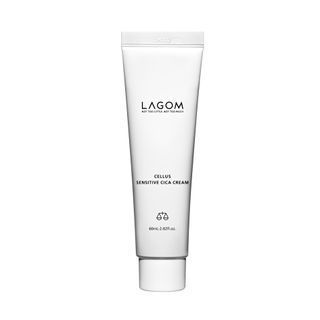
Based on the ingredients included, "LAGOM - Cellus Sensitive Cica Cream" works well for moisturizing the skin. This moisturizer uses a good combo of humectants and emollients. These both types of ingredients are essentials for improving the skin hydration and keeping the skin barrier healthy. Humectants in this product (panthenol, betaine, glycerin, trehalose and butylene glycol) help to increase the water content in the upper layer of the skin. (These ingredients do so by "capturing" water molecules from the outside air or from within the deeper layers of the skin). Emollients in this formulation (ceramide np, cholesterol, vinyl dimethicone, beeswax and caprylic/capric triglyceride) help to reduce the moisture loss from the skin. They also soften the skin surface and relieve the feeling of dryness and tightness.
Ingredient callouts
- Another benefit is that this moisturizer contain ceramides (ceramide np 0.30% - 0.55%). Ceramides are an important part of our natural skin barrier. The Ceramides used in skincare are synthetic or come from plants. They help soften the skin and can help "fill the gaps" in the skin barrier, keeping the skin hydrated and resilient for longer.
- Actives derived from an extract of the Centella Asiatica plant (also known as Gotu Kola) - asiatic acid 0.10% - 0.15%, madecassic acid 0.10% - 0.20%, asiaticoside 0.15% - 0.25% and madecassoside 0.15% - 0.30% The Centella Asiatica Actives help strengthen and restore the skin barrier, decrease inflammation in skin and neutralize free radicals. They also can help to reduce scarring. The good news is that these actives work even in low concentrations.
- An effective concentration of Panthenol (pro-vitamin B5) - about 4.70% - 5.80%. Panthenol helps strengthen the skin barrier, improve hydration and reduce inflammation in skin.
Irritation risk
There are some common irritants in this product, including ingredients that do not have benefits for the skin. We assess the overall irritancy of this moisturizer to be medium. For a detailed overview of all potential irritants: click here
You can see the detailed formula review with the breakdown of all actives in the product and the full ingredient list with estimated concentrations in the tables below.
Price
The product retails for 66.25CA$ in Canada, from 38.00$ up to 43.00$ in the United States and for 25.70£ in the United Kingdom.
For a detailed price comparison: click here.
Sources cited in this review
Every concentration estimate and effectiveness label is anchored to one of these 32 studies and safety reviews.
- 1Skin moisturizing effects of panthenol-based formulationspdfs.semanticscholar.org
- 2
- 3
- 4Safety Assessment of Polyene Group as Used in Cosmeticscir-safety.org
- 5
- 6Safety Assessment of Tromethamine as Used in Cosmeticscir-safety.org

Affiliate links · As an Amazon Associate, WIMJ earns from qualifying purchases.