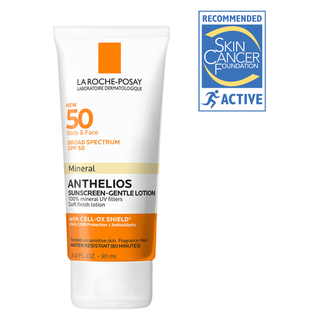
La Roche-Posay Anthelios SPF 50 Mineral Sunscreen - Gentle Lotion
Works for
1 of 1 advertised claim delivered
Sun protectionSPF 50 · 2 UV filtersBroad spectrum
This product offers a good level of protection against both UVB and UVA rays.
It is a mineral sunscreen. In other words, it contains non-organic UV filters. It will probably not sting your eyes but might leave a white cast.
This product can be considered "reef safe" because it does not contain the UV filters (oxybenzone and octinoxate) that can be harmful to coral reefs when present in the water in high concentrations.
Evens skin toneNot advertised by the brand · 1 ingredient credited for this claimStrong support
This product offers broad spectrum sun protection. It means that it can prevent hyperpigmentation and help keep the skin tone even (sun damage is the main factor causing age spots, darkening of post-acne marks and other discolorations).
Anti-agingNot advertised by the brand · 1 ingredient credited for this claimStrong support
This product can help prevent early signs of skin aging because it offers a good level of broad spectrum sun protection. Sun damage is the main cause of premature skin aging, and protecting your skin from the sun is the best anti-aging strategy.
Can it cause trouble?
Irritancy14 flagged ingredientsLow risk
ComedogenicClean of flagged comedogenic ingredientsNone flagged
User reviews
Be the first — your take helps the next person decide.
Ingredients
Filter by role to see what each ingredient is doing.
Titanium dioxide5%
- Irritation risk
- Low
Works as a UV filter when used in high concentrations. It is photostable and is effective mostly against the UVB light, with some protection in the UVA range. In small concentrations, used for its ability to improve the color of cosmetic products. Is usually well tolerated by the skin
More about Titanium dioxideZinc oxide15%
- Irritation risk
- Low
A broad spectrum sunblock (protects from both UVA and UVB rays). Is suitable for most sensitive skins. In small concentrations, can be used as a colorant
More about Zinc oxideWater~45–55%
C12-15 alkyl benzoate~6.4–7.9%
- Irritation risk
- Low
Enhances the product texture and makes it more spreadable. Helps reduce water loss from the outer layer of skin. Extands the shelf life by preventing bacteria growth
More about C12-15 alkyl benzoateIsohexadecane~5.1–6.3%
- Irritation risk
- Low
Improves the texture of the product and helps soften the skin. Helps oil and water mix together and can be used as a cleansing agent
More about IsohexadecaneIsononyl isononanoate~4.8–5.9%
- Irritation risk
- Low
Forms a protective film on the surface of the skin to prevent moisture loss. Gives a velvety feel to products while reducing tackiness
More about Isononyl isononanoateDicaprylyl ether~3.6–4.5%
- Irritation risk
- Low
Helps soften the upper layer of the skin while creating a non-greasy feel on the skin. Helps to dissolve other ingredients
More about Dicaprylyl etherPeg-30 dipolyhydroxystearate~3–3.7%
- Irritation risk
- Medium
Helps oil and water mix together
More about Peg-30 dipolyhydroxystearatePolyglyceryl-4 isostearate~2.6–3.1%
- Irritation risk
- Medium
Helps water and oil mix together
More about Polyglyceryl-4 isostearateDicaprylyl carbonate~2.1–2.6%
- Irritation risk
- Low
Helps products spread more easily and works as an emollient to soften skin
More about Dicaprylyl carbonateEthylene/acrylic acid copolymer~1.7–2.1%
- Irritation risk
- Low
Triethylhexanoin~1.3–1.5%
- Irritation risk
- Medium
Helps soften the upper layer of the skin
More about TriethylhexanoinSilica~1.4–1.7%
Poly c10-30 alkyl acrylate~1–1.3%
- Irritation risk
- Low
Citric acid~1–1.2%
- Irritation risk
- Medium
Can work as an exfoliant but is typically used to adjust the product pH
More about Citric acidPhenoxyethanol~0.5–1%
- Irritation risk
- Low
A preservative. It helps prevent bacterial growth in cosmetic products
More about PhenoxyethanolSodium chloride~0.9–1.15%
- Irritation risk
- Low
Used to stabilize mixtures of oil and water, and create thicker, gel-like product textures
More about Sodium chlorideCaprylyl glycol~0.95–1.15%
- Irritation risk
- Medium
Helps preserve products and creates a nice product texture
More about Caprylyl glycolDiethylhexyl syringylidenemalonate~0.75–1.15%
- Irritation risk
- Medium
Used to stabilize the product formulation
More about Diethylhexyl syringylidenemalonateTriethoxycaprylylsilane~0.75–1.1%
- Irritation risk
- Low
A type of silicone that helps oil and water mix well together. Helps to disperse other ingredients, e.g. pigments, evenly in a formulation
More about TriethoxycaprylylsilaneAluminum hydroxide~0.7–1%
- Irritation risk
- Low
Is used to add opaque (non-transparent) appearance to formulations. Can be used to coat other ingredients for even dispersion. This is a different ingredient compared to the ones used in antipersperants (aluminium chloride and aluminium chlorohydrate)
More about Aluminum hydroxideStearic acid~0.7–1.05%
- Irritation risk
- Low
Helps oil and water mix together and works as an emollient
More about Stearic acidAluminum stearate~0.55–0.8%
- Irritation risk
- Medium
Used to help evenly disperse other ingredients (for example, pigment) in a formulation
More about Aluminum stearateChlorphenesin~0.16–0.32%
Disteardimonium hectorite~0.5–0.75%
- Irritation risk
- Low
A type of clay that is used to thicken the product consistency
More about Disteardimonium hectoriteAlumina~0.6–0.9%
- Irritation risk
- Low
The same compound that is used safely in dental implants and bone cements. In cosmetics, it is used to improve the consistency of products
More about AluminaPolyhydroxystearic acid~0.5–0.7%
- Irritation risk
- Medium
Used to create a thicker product consistency and stabilize the formulation
More about Polyhydroxystearic acidTocopherol~0.4–0.65%
- Irritation risk
- Low
Pure form of vitamin E. Can help moisturise and protect the skin from free radicals. Often used to help stabilise other ingredients or the formula itself
More about TocopherolP-anisic acid~0.35–0.65%
- Irritation risk
- High
Helps preserve products. Can mask unpleasant smell. Could be irritating
More about P-anisic acidCapryloyl salicylic acid~0.3–0.55%
- Irritation risk
- High
Xanthan gum~0.25–0.5%
- Irritation risk
- Low
Used to create a thicker product consistency
More about Xanthan gumDisodium edta~0.2–0.4%
Propylene carbonate~0.25–0.45%
- Irritation risk
- Low
Is used to dissolve other ingredients and create nice product texture
More about Propylene carbonateCaprylic/capric triglyceride~0.25–0.45%
- Irritation risk
- Medium
A good mix of fatty acids that forms a protective layer on the skin. Improves the shelf life of products. Derived from coconut and glycerin
More about Caprylic/capric triglycerideCassia alata leaf extract~0.1–0.2%
- Irritation risk
- Medium
Might have some anti-oxidant properties. Can be used as a fragrance. Can be irritating
More about Cassia alata leaf extractMaltodextrin~0.1–0.2%
- Irritation risk
- Low
Used to stabilize the product formulation and can help absorb oil
More about MaltodextrinIngredient list view
Titanium dioxide, Zinc oxide, Water, C12-15 alkyl benzoate, Isohexadecane, Isononyl isononanoate, Dicaprylyl ether, Peg-30 dipolyhydroxystearate, Polyglyceryl-4 isostearate, Dicaprylyl carbonate, Ethylene/acrylic acid copolymer, Triethylhexanoin, Silica, Poly c10-30 alkyl acrylate, Citric acid, Phenoxyethanol, Sodium chloride, Caprylyl glycol, Diethylhexyl syringylidenemalonate, Triethoxycaprylylsilane, Aluminum hydroxide, Stearic acid, Aluminum stearate, Chlorphenesin, Disteardimonium hectorite, Alumina, Polyhydroxystearic acid, Tocopherol, P-anisic acid, Capryloyl salicylic acid, Xanthan gum, Disodium edta, Propylene carbonate, Caprylic/capric triglyceride, Cassia alata leaf extract, Maltodextrin
Compare prices
Retailers ranked by price — lowest first.


Product summary
We assess that "La Roche-Posay - Anthelios SPF 50 Mineral Sunscreen - Gentle Lotion" can provide reliable sun protection based on the ingredient list. It can protect from both UVA and UVB rays. This is great news because not all sunscreens with SPF ratings give UVA protection. (UVA rays do not cause sunburn, but still damage our skin and lead to early aging).
This product prevents early signs of aging by protecting against sun damage (all broad spectrum sunscreens do that).
Sunscreen filters
This product is a mineral sunscreen. It uses titanium dioxide and zinc oxide for sun protection. Both titanium dioxide and zinc oxide almost never irritate even the most sensitive skin and eyes, but can leave a white cast.
Irritation risk
This formulation includes some common irritants, including ingredients that do not provide a benefit for the skin. We assess the overall irritancy of this product to be low. For a detailed overview of all potential irritants: click here
You can see the detailed formula review with the breakdown of all actives in the product and the full ingredient list with estimated concentrations in the tables below.
Price
The product retails from 25.99$ up to 32.00$ in the United States.
For a detailed price comparison: click here.
Sources cited in this review
Every concentration estimate and effectiveness label is anchored to one of these 10 studies and safety reviews.
- 1A review of inorganic UV filters zinc oxide and titanium dioxideonlinelibrary.wiley.com
- 2
- 3
- 4
- 5
- 6

Affiliate links · As an Amazon Associate, WIMJ earns from qualifying purchases.