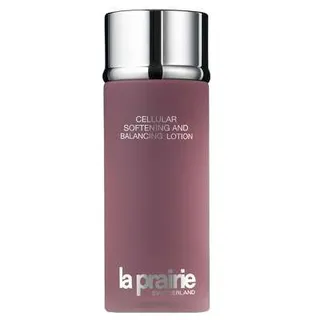
La Prairie Cellular Softening and Balancing Lotion
Works for
MoisturizingPanthenol, Glycoproteins + 10 moreWorks well
“Formulated with balancing witch hazel distillate and a soothing, moisturising blend of allantoin, panthenol, hyaluronic acid, and bisabolol, as well as La Prairie’s Exclusive Cellular Complex for protective and renewing actions.”
This product can help improve hydration of the skin with the two types of ingredients.
The first type is called “humectants”:
these ingredients help attract water.
When humectants are on the surface of the skin, they “pull in” the moisture from the outside environment, or from
within deeper layers of the skin. The following ingredients in this product do the job:
glycerin, lactobacillus ferment.
This product also contains ingredients called “occlusives”. They help reduce the speed with which our skin loses moisture to the outside environment. These ingredients also help soften the upper layer of the skin, so it feels less tight and nicer to the touch. The following ingredients in this product do the job: borago officinalis seed oil, pentylene glycol.
The following ingredients in this product are especially good for supporting the skin barrier and helping with the hydration level: panthenol
Evens skin toneSide benefit · Retinyl palmitateMay help
The following ingredient (ingredients) in this product might be helpful, but there is no evidence to confirm that it actually works: retinyl palmitate.
Anti-agingSide benefit · Retinyl palmitate, Ascorbyl palmitateMay help
This product contains retinyl palmitate. There is some human evidence that this ingredient helps reduce and prevent fine lines and wrinkles and improve skin elasticity and firmness, though it is smaller or less consistent than the evidence for the best anti-aging ingredients.
Can it cause trouble?
Irritancy9 strong irritants: Equisetum arvense extract, Hamamelis virginiana leaf extract + 7 more — patch-test recommendedHigh risk
ComedogenicClean of flagged comedogenic ingredientsNone flagged

User reviews
Be the first — your take helps the next person decide.
Ingredients
Filter by role to see what each ingredient is doing.
Water~45–55%
Pentylene glycol~5.1–6.2%
- Irritation risk
- Medium
Used to preserve products, dissolve other ingredients and create a nice product texture
More about Pentylene glycolPropanediol~4–4.9%
- Irritation risk
- Low
Acts as a solvent for other ingredients. Speeds up the absorption of other ingredients into the skin
More about PropanediolGlycoproteins~3–3.7%
Panax ginseng root extract~2.3–2.9%
- Irritation risk
- High
A plant extract that might have some anti-inflammatory properties, but solid evidence is lacking. It can be irritating
More about Panax ginseng root extractEquisetum arvense extract~1.9–2.3%
- Irritation risk
- High
A plant extract that might have anti-oxidant properties. Can be irritating
More about Equisetum arvense extractSaccharomyces cerevisiae extract~1.6–1.9%
- Irritation risk
- Medium
A moisturizing ingredient that works as a humectant to attract water to the upper layer of the skin.
More about Saccharomyces cerevisiae extractLactobacillus ferment~1.4–1.7%
- Irritation risk
- Low
A fermentation product created by bacteria Lactobacillus. The fermented product has anti-bacterial properties and might be helpful in calming down inflammation, but studies are lacking. Helps attract water to the upper layer of the skin. Can be used as a preservative
More about Lactobacillus fermentSodium hyaluronate~1.1–1.4%
- Irritation risk
- Low
One of the best moisturizing ingredients. Attracts water into the upper layer of the skin
More about Sodium hyaluronateHamamelis virginiana leaf extract~0.95–1.15%
- Irritation risk
- High
A plant extract that can help calm down inflammation in skin. Can, however, itself be irritating
More about Hamamelis virginiana leaf extractBorago officinalis seed oil~0.7–1.1%
- Irritation risk
- Low
A plant oil that is effective in reducing irritation in skin, restore the barrier function and support its hydration
More about Borago officinalis seed oilRetinyl palmitate~0.55–0.85%
- Irritation risk
- High
Three steps removed from the active form of vitamin A - retinoic acid. To have an effect in the skin, it first needs to be converted twice to become the retinoic acid. This means it is less potent than retinol, but could also be less irritating. Once converted to the retinoic acid in the skin, it helps against all signs of aging, improves skin cell turnover and helps fight blemishes and clogged pores. However, in many cosmetic formulations, it is used in a concentration that is too low to have the full effect
More about Retinyl palmitateAscorbyl palmitate~0.55–0.8%
- Irritation risk
- Medium
Being a lipid soluble form of vitamin C, it is more stable and can penetrate the skin better than L-Ascorbic acid. It is effective in protecting the skin from free radicals, as well as evening the skin tone, but is less effective in stimulating collagen production compared to L-Ascorbic acid.
More about Ascorbyl palmitateTocopheryl acetate~0.5–0.75%
- Irritation risk
- Medium
A more stable but less bio-available form of vitamin E compared to Tocopherol. Might help moisturize and protect the skin from free radicals, but mostly used in low concentrations to stabilize other ingredients.
More about Tocopheryl acetateAllantoin~0.45–0.7%
- Irritation risk
- Low
Helps calm down inflammation in skin and can help reduce itching. Helps to repair the skin barrier and keep skin hydrated
More about AllantoinBisabolol~0.45–0.65%
- Irritation risk
- Low
An active component of chamomile plant that historically has been used to calm down irritated skin. A recent study shows that bisabolol indeed can have some anti-inflammatory effect on skin, even though conclusive data is lacking. Bisabolol has a sweet floral scent and can be added to products for its aromatic properties
More about BisabololPanthenol~0.45–0.7%
- Irritation risk
- Low
Helps attract water to the upper layer of the skin and can help improve skin barrier function
More about PanthenolPantolactone~0.4–0.6%
- Irritation risk
- Low
Helps attract water to the upper layer of the skin
More about PantolactonePolyglyceryl-4 caprate~0.45–0.65%
Polyglyceryl-6 caprylate~0.4–0.6%
- Irritation risk
- Medium
Helps oil and water mix together
More about Polyglyceryl-6 caprylatePolyglyceryl-10 isostearate~0.3–0.6%
- Irritation risk
- Low
Lecithin~0.35–0.65%
- Irritation risk
- Low
Used mostly for creating emulsions - helping oil and water mix together. Helps soften the upper layer of the skin
More about LecithinGlycerin~0.3–0.6%
- Irritation risk
- Low
One of the best moisturizing ingredients. Naturally present in skin. It attracts water to the upper layer of the skin working as a humectant
More about GlycerinCaprylic/capric triglyceride~0.35–0.65%
- Irritation risk
- Medium
A good mix of fatty acids that forms a protective layer on the skin. Improves the shelf life of products. Derived from coconut and glycerin
More about Caprylic/capric triglycerideXanthan gum~0.3–0.55%
- Irritation risk
- Low
Used to create a thicker product consistency
More about Xanthan gumEthylhexylglycerin~0.3–0.55%
Sodium dilauramidoglutamide lysine~0.3–0.5%
- Irritation risk
- Low
Sodium phytate~0.3–0.5%
Diethylhexyl syringylidenemalonate~0.25–0.5%
- Irritation risk
- Medium
Used to stabilize the product formulation
More about Diethylhexyl syringylidenemalonateCitric acid~0.25–0.45%
- Irritation risk
- Medium
Can work as an exfoliant but is typically used to adjust the product pH
More about Citric acidAlcohol~0.25–0.45%
- Irritation risk
- High
Can be drying and contribute to skin irritation. Used in formulars to dissolve other ingredients, create a thinner product consistency or for its antibacterial properties
More about AlcoholParfum~0.2–0.4%
- Irritation risk
- High
An aromatic blend of unspecified and possibly irritating ingredients
More about ParfumLimonene~0.2–0.35%
- Irritation risk
- High
A common frangrance that can easily irritate skin, especially if exposed to air, light or heat
More about LimoneneAlpha-isomethyl ionone~0.15–0.3%
- Irritation risk
- High
A fragrance. Potential allergen and can be irritating
More about Alpha-isomethyl iononeGeraniol~0.15–0.25%
Citronellol~0.1–0.2%
Sodium benzoate~0.1–0.15%
Sodium dehydroacetate~0.1–0.2%
Potassium sorbate~0.1–0.15%
Phenoxyethanol~0.1–0.2%
- Irritation risk
- Low
A preservative. It helps prevent bacterial growth in cosmetic products
More about PhenoxyethanolCi 17200~0.05–0.1%
Ingredient list view
Water, Pentylene glycol, Propanediol, Unknown, Glycoproteins, Panax ginseng root extract, Equisetum arvense extract, Saccharomyces cerevisiae extract, Lactobacillus ferment, Sodium hyaluronate, Hamamelis virginiana leaf extract, Borago officinalis seed oil, Retinyl palmitate, Ascorbyl palmitate, Tocopheryl acetate, Allantoin, Bisabolol, Panthenol, Pantolactone, Polyglyceryl-4 caprate, Polyglyceryl-6 caprylate, Polyglyceryl-10 isostearate, Lecithin, Glycerin, Caprylic/capric triglyceride, Xanthan gum, Ethylhexylglycerin, Sodium dilauramidoglutamide lysine, Sodium phytate, Diethylhexyl syringylidenemalonate, Citric acid, Alcohol, Parfum, Limonene, Alpha-isomethyl ionone, Geraniol, Citronellol, Sodium benzoate, Sodium dehydroacetate, Potassium sorbate, Phenoxyethanol, Ci 17200
Compare prices
Retailers ranked by price — lowest first.

Worth comparing, line by line.
Match % combines shared ingredients, the first five ingredients, shared actives and hero ingredients, irritancy (lower counts in the alternative's favour), texture and body area. Only products in the same routine step are compared.
| La PrairieCellular Softening and Balancing LotionYOUR PRODUCT | COSRX5 PDRN B5 Vital Soothing Toner | SKIN&LABEctoin Milky Cream Toner | UNPALacto Cica Soothing Toner | |
|---|---|---|---|---|
| Match | — | 57% | 57% | 57% |
| Price | $225.00 | $23.00−$202.00 | $21.06−$203.94 | $22.60−$202.40 |
| Shared key ingredients | — | 5 of 12 | 4 of 12 | 3 of 12 |
| Key difference | — | Niacinamide | Niacinamide | Madecassoside |
| Irritancy | High | Medium | Low | Medium |
| Drying alcohol | Contains drying alcohol | — | — | — |
| View product | Shop | Shop | Shop |

More alternatives: Pacifica Beauty Matcha Tea Energizing Barrier EssenceAbib Rebalancing toner Skin booster
Sources cited in this review
Every concentration estimate and effectiveness label is anchored to one of these 17 studies and safety reviews.
- 1Ginseng in Dermatology: A Reviewncbi.nlm.nih.gov
- 2
- 3
- 4
- 5Use of Probiotics for Dermal Applicationsresearchgate.net
- 6Hyaluronic acid: A key molecule in skin agingncbi.nlm.nih.gov

Affiliate links · As an Amazon Associate, WIMJ earns from qualifying purchases.