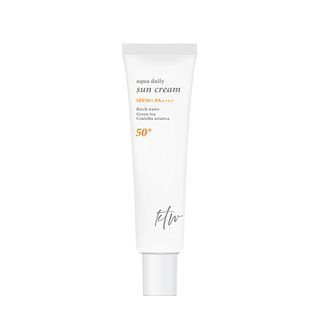
KTW Aqua Daily Sun Cream
Works for
2 of 2 advertised claims delivered
Sun protectionSPF 50 · 7 UV filtersBroad spectrum
This product offers a good level of protection against both UVB and UVA rays.
This sunscreen uses organic (so-called "chemical") sunscreen filters. Organic, or "chemical" filters usually provide reliable sun protection and rarely leave a white cast. Sunscreens with organic filters can sting eyes.
This product can be considered "reef safe" because it does not contain the UV filters (oxybenzone and octinoxate) that can be harmful to coral reefs when present in the water in high concentrations.
Moisturizing17 ingredients credited for this claimStrong support
“Contains Panthenol to restore the moisture-and-oil balance in skin.”
This product contains good ingredients to attract water to the upper layer of the skin. These ingredients are called "humectants": fructooligosaccharides, fructose.
When humectants are on the surface of the skin, they “pull in” the moisture from the outside environment, or from within deeper layers of the skin. If the air is dry, humectants can speed up the moisture loss from the skin. This is why it is a good idea to use another product on top of this one to help "seal in" the moisture (look for ingredients like dimethicone, squalane, oils and butters).
The following ingredients in this product are especially good for supporting the skin barrier and helping with the hydration level: panthenol
Anti-agingNot advertised by the brand · 2 ingredients credited for this claimStrong support
This product can help prevent early signs of skin aging because it offers a good level of broad spectrum sun protection. Sun damage is the main cause of premature skin aging, and protecting your skin from the sun is the best anti-aging strategy.
Evens skin toneNot advertised by the brand · 1 ingredient credited for this claimStrong support
This product offers broad spectrum sun protection. It means that it can prevent hyperpigmentation and help keep the skin tone even (sun damage is the main factor causing age spots, darkening of post-acne marks and other discolorations).
Can it cause trouble?
Irritancy2 strong irritants: Eucalyptus globulus leaf oil, Lavandula angustifolia oilMedium risk
Comedogenic1 ingredient rated 2 or more on the 0–5 pore-clogging scale1 flagged


User reviews
Be the first — your take helps the next person decide.
Ingredients
Filter by role to see what each ingredient is doing.
Betula platyphylla japonica juice~25–31%
- Irritation risk
- Low
Water~13–16%
Butyloctyl salicylate~6.1–7.5%
- Irritation risk
- Medium
A synthetic ester of salicylic acid that is used to help disperse pigments and boost effectiveness of sunscreen ingredients. It is able to absorb UV light (working as an organic, or chemical filter), but is not approved as a sunscreen ingredient on its own
More about Butyloctyl salicylateDibutyl adipate~4.5–5.5%
- Irritation risk
- Low
Helps soften the upper layer of the skin and create a nice product consistency
More about Dibutyl adipateDipropylene glycol~2.9–3.5%
- Irritation risk
- Low
Helps to dissolve other ingredients in a formulation. Slows down the rate of product drying
More about Dipropylene glycolGlycerin~2.4–2.9%
- Irritation risk
- Low
One of the best moisturizing ingredients. Naturally present in skin. It attracts water to the upper layer of the skin working as a humectant
More about GlycerinTitanium dioxide~2.2–2.7%
- Irritation risk
- Low
Works as a UV filter when used in high concentrations. It is photostable and is effective mostly against the UVB light, with some protection in the UVA range. In small concentrations, used for its ability to improve the color of cosmetic products. Is usually well tolerated by the skin
More about Titanium dioxideCi 77891~1.6–2%
- Irritation risk
- Low
Isononyl isononanoate~1.7–2%
- Irritation risk
- Low
Forms a protective film on the surface of the skin to prevent moisture loss. Gives a velvety feel to products while reducing tackiness
More about Isononyl isononanoateDiethylamino hydroxybenzoyl hexyl benzoate~1.6–2%
- Irritation risk
- Medium
Uvinul A Plus. A new generation broad spectrum sunscreen that offers an effective protection especially in the UVA range. It is stable in formulations. Unfortunately, is not approved by the FDA (US) yet
More about Diethylamino hydroxybenzoyl hexyl benzoatePhenethyl benzoate~1.1–1.3%
Polyglyceryl-3 distearate~0.95–1.15%
Polymethylsilsesquioxane~1–1.2%
- Irritation risk
- Low
A silicone that improves product texture and helps dissolve other ingredients. Can form a non-greasy film on the skin to prevent moisture loss
More about PolymethylsilsesquioxaneSilica~1.2–1.4%
Polyglyceryl-6 stearate~0.75–1.15%
- Irritation risk
- Low
Helps soften the upper layer of the skin
More about Polyglyceryl-6 stearate1,2-hexanediol~0.7–1.05%
Bis-ethylhexyloxyphenol methoxyphenyl triazine~0.75–1.15%
- Irritation risk
- Medium
Tinosorb S. One of the most effective broad spectrum sunscreen ingredients. Protects from both UVA and UVB rays. It is photostable. Unfortunately, not approved by FDA (US) yet.
More about Bis-ethylhexyloxyphenol methoxyphenyl triazineEthylhexyl triazone~0.75–1.1%
- Irritation risk
- Medium
Uvinul T. A UV filter. Effective against UVB rays. It is photostable. Can increase water resistance properties of the sunscreen. Unfortunately, not approved by the FDA (US) yet
More about Ethylhexyl triazonePolysilicone-15~0.75–1.1%
- Irritation risk
- Medium
A UV filter. Effective against UVB rays, but does not protect against the most aging UVA light
More about Polysilicone-15Terephthalylidene dicamphor sulfonic acid~0.7–1.05%
- Irritation risk
- Medium
Ecamsule, Mexoryl SX. A UV filter. Is effective mostly against the UVA rays. It is legally marketed in the US with the FDA approval since 2006, even though the ingredient is not on the official FDA list of the approved sunscreen active ingredients. It is photostable
More about Terephthalylidene dicamphor sulfonic acidSodium acrylates crosspolymer-2~0.6–0.9%
- Irritation risk
- Low
Tromethamine~0.55–0.85%
Potassium cetyl phosphate~0.6–0.9%
- Irritation risk
- Medium
Helps oil and water mix together
More about Potassium cetyl phosphatePolyhydroxystearic acid~0.6–0.9%
- Irritation risk
- Medium
Used to create a thicker product consistency and stabilize the formulation
More about Polyhydroxystearic acidChlorella vulgaris extract~0.55–0.8%
- Irritation risk
- Medium
- Comedogenicity
- 3/5
A plant extract that can help to attract water to the upper layer of the skin and might have some anti-oxidant and anti-inflammatory properties
More about Chlorella vulgaris extractGlucose~0.55–0.85%
- Irritation risk
- Low
Helps attract water to the upper layer of the skin. Could be helpful in restoring the skin barrier function
More about GlucoseSodium citrate~0.55–0.8%
- Irritation risk
- Medium
Helps to control the skin's pH level. Maintains the skin's natural film of amino-lactic acids and oils. Helps to preserve products
More about Sodium citrateAluminum hydroxide~0.6–0.9%
- Irritation risk
- Low
Is used to add opaque (non-transparent) appearance to formulations. Can be used to coat other ingredients for even dispersion. This is a different ingredient compared to the ones used in antipersperants (aluminium chloride and aluminium chlorohydrate)
More about Aluminum hydroxideAcrylates/c10-30 alkyl acrylate crosspolymer~0.65–0.95%
- Irritation risk
- Medium
Maintains the texture of skincare products. Allows the product to spread evenly. Helps oil and water mix together
More about Acrylates/c10-30 alkyl acrylate crosspolymerHydroxyacetophenone~0.55–0.8%
Stearic acid~0.65–0.95%
- Irritation risk
- Low
Helps oil and water mix together and works as an emollient
More about Stearic acidButylene glycol~0.5–0.8%
- Irritation risk
- Low
Used to create a nice product texture and help delivery of other ingredients. Might be somewhat helpful in attracting water to the upper layer of the skin
More about Butylene glycolFructooligosaccharides~0.5–0.75%
- Irritation risk
- Low
Help attract water to the upper layer of the skin
More about FructooligosaccharidesFructose~0.5–0.75%
- Irritation risk
- Low
Helps attract water to the upper layer of the skin
More about FructosePanthenol~0.5–0.75%
- Irritation risk
- Low
Helps attract water to the upper layer of the skin and can help improve skin barrier function
More about PanthenolSodium polyacryloyldimethyl taurate~0.5–0.75%
- Irritation risk
- Medium
Helps oil and water mix together
More about Sodium polyacryloyldimethyl taurateCitric acid~0.5–0.75%
- Irritation risk
- Medium
Can work as an exfoliant but is typically used to adjust the product pH
More about Citric acidPolyglyceryl-6 behenate~0.5–0.75%
Glyceryl caprylate~0.55–0.8%
- Irritation risk
- Low
An emollient that can also help water and oil mix together, as well as prevent bacteria growth in products
More about Glyceryl caprylateGlyceryl stearate citrate~0.5–0.7%
- Irritation risk
- Low
Helps oil and water mix together while softening the upper layer of the skin
More about Glyceryl stearate citratePolyglyceryl-2 dipolyhydroxystearate~0.35–0.65%
- Irritation risk
- Low
Helps to soften the upper layer of the skin
More about Polyglyceryl-2 dipolyhydroxystearateDisodium edta~0.2–0.4%
Eucalyptus globulus leaf oil~0.2–0.35%
- Irritation risk
- High
An essential oil that can be very irritating. Has some anti-bacterial properties
More about Eucalyptus globulus leaf oilLavandula angustifolia oil~0.2–0.4%
- Irritation risk
- High
An essential oil. Potential allergen and can be irritating. It has some anti-bacterial properties
More about Lavandula angustifolia oilEthylhexylglycerin~0.2–0.35%
Camellia sinensis leaf extract~0.2–0.35%
- Irritation risk
- Low
Can contain potent anti-oxidant compounds (abbreviated ECG, GCG, EGC, and EGCG) that might help protect the skin from free radicals. Can help calm down inflammation and has some anti-bacterial properties. Unfortunately, these antioxidants are unstable and lose their effectiveness very quickly in products. The concentration of the antioxidant compounds in the extract also tends to be low to be effective in topical formulation
More about Camellia sinensis leaf extractCentella asiatica extract~0.25–0.4%
- Irritation risk
- Medium
A plant extract that has been shown to be able to reduce inflammation in skin, support restoration of skin barrier function, as well as support collagen production. Contains active compounds called centelloids: asiaticoside, madecasosside, asiatic acid and madecassic acid. Might be helpful in preventing stretch marks. It can be itself be irritating though.
More about Centella asiatica extractIngredient list view
Betula platyphylla japonica juice, Water, Butyloctyl salicylate, Dibutyl adipate, Dipropylene glycol, Glycerin, Titanium dioxide, Ci 77891, Isononyl isononanoate, Diethylamino hydroxybenzoyl hexyl benzoate, Phenethyl benzoate, Polyglyceryl-3 distearate, Polymethylsilsesquioxane, Silica, Polyglyceryl-6 stearate, 1,2-hexanediol, Bis-ethylhexyloxyphenol methoxyphenyl triazine, Ethylhexyl triazone, Polysilicone-15, Terephthalylidene dicamphor sulfonic acid, Sodium acrylates crosspolymer-2, Tromethamine, Potassium cetyl phosphate, Polyhydroxystearic acid, Chlorella vulgaris extract, Glucose, Sodium citrate, Aluminum hydroxide, Acrylates/c10-30 alkyl acrylate crosspolymer, Hydroxyacetophenone, Stearic acid, Butylene glycol, Fructooligosaccharides, Fructose, Panthenol, Sodium polyacryloyldimethyl taurate, Citric acid, Polyglyceryl-6 behenate, Glyceryl caprylate, Glyceryl stearate citrate, Polyglyceryl-2 dipolyhydroxystearate, Disodium edta, Eucalyptus globulus leaf oil, Lavandula angustifolia oil, Ethylhexylglycerin, Camellia sinensis leaf extract, Centella asiatica extract
Compare prices
Retailers ranked by price — lowest first.

Affiliate links · prices updated regularly
Worth comparing, line by line.
Match % combines shared ingredients, the first five ingredients, shared actives and hero ingredients, irritancy (lower counts in the alternative's favour), texture and body area. Only products in the same routine step are compared.
| KTWAqua Daily Sun CreamYOUR PRODUCT | KAINEGreen Fit Pro Sun SPF 50+ Sunscreen | KlairsAll-day Airy Sunscreen | OPTMZD.SKINBLEMISH AND PROTECT DAY CREAM SPF30 | |
|---|---|---|---|---|
| Match | — | 59% | 58% | 57% |
| Price | $15.70 | $10.54−$5.16 | $17.48+$1.78 | — |
| Shared key ingredients | — | 12 of 15 | 8 of 15 | 6 of 15 |
| Key difference | — | Ectoin | Niacinamide | Pantolactone |
| Irritancy | Medium | Medium | Low | Low |
| SPF | SPF 50 | SPF 50 | SPF 50 | SPF 30 |
| Drying alcohol | — | — | — | — |
| View product | Shop | Shop | Shop |


Product summary
We assess that "KTW - Aqua Daily Sun Cream" can provide reliable sun protection based on the ingredient list. We love that it can protect from both UVA and UVB rays (not all sunscreens with SPF ratings give UVA protection. UVA rays do not cause sunburn, but still damage our skin and lead to early aging).
This moisturizer should also be hydrating enough to use without an additional moisturizer during the day. Like all broad-spectrum sunscreens, this product helps prevent early signs of aging.
Sunscreen filters
This is a "mixed" sunscreen in the sense that it uses both mineral and organic (so-called "chemical") sun filters. Here are the organic filters this product uses: tinosorb s, butyloctyl salicylate, uvinul a plus, uvinul t, polysilicone-15 and terephthalylidene dicamphor sulfonic acid. As for the mineral filters, this sunscreen uses titanium dioxide.
Irritation risk
This formulation includes some common irritants, including ingredients that do not provide a benefit for the skin. We assess the overall irritancy of this moisturizer to be medium. For a detailed overview of all potential irritants: click here
You can see the detailed formula review with the breakdown of all actives in the product and the full ingredient list with estimated concentrations in the tables below.
Price
The product retails for 15.70$ in the United States.
For a detailed price comparison: click here.
Sources cited in this review
Every concentration estimate and effectiveness label is anchored to one of these 15 studies and safety reviews.
- 1
- 2
- 3
- 4Safety Assessment of Tromethamine as Used in Cosmeticscir-safety.org
- 5
- 6

Affiliate links · As an Amazon Associate, WIMJ earns from qualifying purchases.