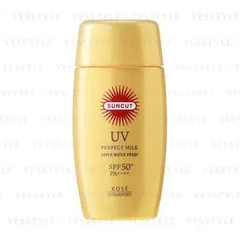
Works for:
based on ingredients and %- Sun protection
- Evens skin tone
- Anti-aging
- Moisturizing
Can it cause trouble?
- Irritation risk: high
- Comedogenic risk ingredients: 1
Key actives

Product Summary
Based on the ingredients included, we believe that "Kose - Suncut UV Perfect Milk Super Water Proof SPF 50+ PA++++" can offer reliable sun protection. It can protect from both UVA and UVB rays. This is great news because not all sunscreens with SPF ratings give UVA protection. (UVA rays do not cause sunburn, but still damage our skin and lead to early aging).
It contains good moisturizing ingredients and can double as a hydrating day cream. This product prevents early signs of aging by protecting against sun damage (all broad spectrum sunscreens do that).
Sunscreen filters
This sunscreen uses so-called "chemical", or organic UV filters (organic simply means that their molecules contain atoms of carbon). These filters typically give good sun protection and rarely leave a white cast, but they can be irritating for sensitive skin. Here are the exact UV filters in this sunscreen: tinosorb s 1.70% - 2.10%, uvinul a plus 1.90% - 2.40%, octinoxate 4.60% - 5.60% and polysilicone-15 3.10% - 3.80%.
Irritation risk
We assess the overall irritancy of this product to be high. For a detailed overview of all potential irritants: click here
You can see the detailed formula review with the breakdown of all actives in the product and the full ingredient list with estimated concentrations in the tables below.
Price
The product retails at around 19.94£ in the United Kingdom and at around 12.33$ in the United States.
For a detailed price comparison: click here.
Anti-aging
This product can help prevent early signs of skin aging because it offers a good level of broad spectrum sun protection. Sun damage is the main cause of premature skin aging, and protecting your skin from the sun is the best anti-aging strategy.
Plant extract that helps the skin to attract water and make it more smooth for touch. Also shows promise of anti-aging properties, but research is not extensive yet
Evens skin tone
This product offers broad spectrum sun protection. It means that it can prevent hyperpigmentation and help keep the skin tone even (sun damage is the main factor causing age spots, darkening of post-acne marks and other discolorations).
Sun protection
This product offers a good level of protection against both UVB and UVA rays.
This sunscreen uses organic (so-called "chemical") sunscreen filters. Organic, or "chemical" filters usually provide reliable sun protection and rarely leave a white cast. Sunscreens with organic filters can sting eyes.
Uvinul A Plus. A new generation broad spectrum sunscreen that offers an effective protection especially in the UVA range. It is stable in formulations. Unfortunately, is not approved by the FDA (US) yet
Tinosorb S. One of the most effective broad spectrum sunscreen ingredients. Protects from both UVA and UVB rays. It is photostable. Unfortunately, not approved by FDA (US) yet.
Octinoxate. When used in higher concentrations, works as a sunscreen protecting the skin from UVB rays. When used in lower concentration, helps to preserve the product formulation. Is shown to be harmful to coral reefs - consider avoiding bathing in coral reef areas when wearing a product with this ingredient. It can be irritating
A UV filter. Effective against UVB rays, but does not protect against the most aging UVA light
Moisturizing
What does the product description say?
Slather on for a protective and hydrating boost.
Source: Yesstyle
This product can help improve hydration of the skin with the two types of ingredients.
The first type is called “humectants”:
these ingredients help attract water.
When humectants are on the surface of the skin, they “pull in” the moisture from the outside environment, or from
within deeper layers of the skin. The following ingredients in this product do the job:
algae extract, sodium hyaluronate.
This product also contains ingredients called “occlusives”. They help reduce the speed with which our skin loses moisture to the outside environment. These ingredients also help soften the upper layer of the skin, so it feels less tight and nicer to the touch. The following ingredients in this product do the job: squalane, algae extract.
Helps attract water to the upper layer of the skin. Is claimed to support the growth of "good" bacteria in skin (as a "prebiotic"), but the research is lacking
One of the best moisturizing ingredients. Attracts water into the upper layer of the skin
A typically plant-derived compound that is supposed mimic human collagen. Cannot penetrate the skin barrier so is not particularly useful in skincare products beyond attracting water to the upper layer of the skin
An oil naturally present in skin. Works as an emollient to soften the skin and form a protective layer on its surface without a greasy feeling.
Plant extract that helps the skin to attract water and make it more smooth for touch. Also shows promise of anti-aging properties, but research is not extensive yet
An emollient that helps soften the skin and can decrease moisture loss. Helps create a nice product texture
Helps oil and water mix together and can enhance the penetration of other ingredients into the skin. It can be irritating
Used to create a nice product texture and help delivery of other ingredients. Might be somewhat helpful in attracting water to the upper layer of the skin
Helps oil and water mix together and works as an emollient
How honest is this product?
| Promise | Can it deliver? |
|---|---|
| Sun protection |
Total Promises Fulfilled score: 90/100.
We receive a small commission for purchases made through these links at no cost for you. Thank you for your support! Learn more
Potential irritants
Comedogenic ingredients
User reviews (2)
Averages from community submissions.
How would you describe the finish?
How would you describe the texture?
How much white cast does it leave?
How much does it sting eyes?
How much does it pill under makeup?
How much does this product clog pores?
How would you describe the smell?
Tried this product?
Help capture what the ingredient list can't—texture, finish, pilling, scent, and more. Answer what you can, skip the rest.
Takes ~30 seconds.
Reviews are shown in aggregate. No personal details.
Key Actives
Plant extract that helps the skin to attract water and make it more smooth for touch. Also shows promise of anti-aging properties, but research is not extensive yet
Helps attract water to the upper layer of the skin. Is claimed to support the growth of "good" bacteria in skin (as a "prebiotic"), but the research is lacking
Octinoxate. When used in higher concentrations, works as a sunscreen protecting the skin from UVB rays. When used in lower concentration, helps to preserve the product formulation. Is shown to be harmful to coral reefs - consider avoiding bathing in coral reef areas when wearing a product with this ingredient. It can be irritating
A UV filter. Effective against UVB rays, but does not protect against the most aging UVA light
Uvinul A Plus. A new generation broad spectrum sunscreen that offers an effective protection especially in the UVA range. It is stable in formulations. Unfortunately, is not approved by the FDA (US) yet
Tinosorb S. One of the most effective broad spectrum sunscreen ingredients. Protects from both UVA and UVB rays. It is photostable. Unfortunately, not approved by FDA (US) yet.
One of the best moisturizing ingredients. Attracts water into the upper layer of the skin
A typically plant-derived compound that is supposed mimic human collagen. Cannot penetrate the skin barrier so is not particularly useful in skincare products beyond attracting water to the upper layer of the skin
An oil naturally present in skin. Works as an emollient to soften the skin and form a protective layer on its surface without a greasy feeling.
Potential irritants
Can be drying and contribute to skin irritation. Used in formulars to dissolve other ingredients, create a thinner product consistency or for its antibacterial properties
Octinoxate. When used in higher concentrations, works as a sunscreen protecting the skin from UVB rays. When used in lower concentration, helps to preserve the product formulation. Is shown to be harmful to coral reefs - consider avoiding bathing in coral reef areas when wearing a product with this ingredient. It can be irritating
Plant extract that can have healing and anti-inflammatory properties. It is a potential allergen and can be irritating
A plant extract that might have anti-oxidant properties. Can be irritating
A plant extract (perforate St John's-wort) that might have some anti-oxidant effect. Can be used as a fragrance and be irritating
A plant extract that has some anti-oxidant and anti-bacterial properties. Can be irritating
A plant extract that might have antibacterial effect and help neutralize free radicals
A plant extract that one one hand, can contain compounds that can help calm down skin irritation, but, on the other hand, its other compounds (especially fragrant ones) can themselves be irritating
Helps oil and water mix together and can enhance the penetration of other ingredients into the skin. It can be irritating
A UV filter. Effective against UVB rays, but does not protect against the most aging UVA light
Uvinul A Plus. A new generation broad spectrum sunscreen that offers an effective protection especially in the UVA range. It is stable in formulations. Unfortunately, is not approved by the FDA (US) yet
Tinosorb S. One of the most effective broad spectrum sunscreen ingredients. Protects from both UVA and UVB rays. It is photostable. Unfortunately, not approved by FDA (US) yet.
Maintains the texture of skincare products. Allows the product to spread evenly. Helps oil and water mix together
Used to stabilize product formulation, help create an even product layer over skin (for example, in sunscreen) and create a thicker product consistency
Used to create a thicker product consistency and stabilize the formulation
Comedogenic ingredients
Plant extract that helps the skin to attract water and make it more smooth for touch. Also shows promise of anti-aging properties, but research is not extensive yet
All ingredients
Can be drying and contribute to skin irritation. Used in formulars to dissolve other ingredients, create a thinner product consistency or for its antibacterial properties
Octinoxate. When used in higher concentrations, works as a sunscreen protecting the skin from UVB rays. When used in lower concentration, helps to preserve the product formulation. Is shown to be harmful to coral reefs - consider avoiding bathing in coral reef areas when wearing a product with this ingredient. It can be irritating
An emollient that helps soften the skin and can decrease moisture loss. Helps create a nice product texture
A UV filter. Effective against UVB rays, but does not protect against the most aging UVA light
Uvinul A Plus. A new generation broad spectrum sunscreen that offers an effective protection especially in the UVA range. It is stable in formulations. Unfortunately, is not approved by the FDA (US) yet
Tinosorb S. One of the most effective broad spectrum sunscreen ingredients. Protects from both UVA and UVB rays. It is photostable. Unfortunately, not approved by FDA (US) yet.
Helps to dissolve other ingredients in a formulation. Slows down the rate of product drying
Plant extract that can have healing and anti-inflammatory properties. It is a potential allergen and can be irritating
A plant extract that might have anti-oxidant properties. Can be irritating
A plant extract (perforate St John's-wort) that might have some anti-oxidant effect. Can be used as a fragrance and be irritating
A plant extract that has some anti-oxidant and anti-bacterial properties. Can be irritating
One of the best moisturizing ingredients. Attracts water into the upper layer of the skin
A plant extract that might have antibacterial effect and help neutralize free radicals
A plant extract that one one hand, can contain compounds that can help calm down skin irritation, but, on the other hand, its other compounds (especially fragrant ones) can themselves be irritating
Plant extract that helps the skin to attract water and make it more smooth for touch. Also shows promise of anti-aging properties, but research is not extensive yet
A typically plant-derived compound that is supposed mimic human collagen. Cannot penetrate the skin barrier so is not particularly useful in skincare products beyond attracting water to the upper layer of the skin
Used to create a nice product texture and help delivery of other ingredients. Might be somewhat helpful in attracting water to the upper layer of the skin
Maintains the texture of skincare products. Allows the product to spread evenly. Helps oil and water mix together
Used to stabilize product formulation, help create an even product layer over skin (for example, in sunscreen) and create a thicker product consistency
Helps oil and water mix together and can enhance the penetration of other ingredients into the skin. It can be irritating
An oil naturally present in skin. Works as an emollient to soften the skin and form a protective layer on its surface without a greasy feeling.
Helps attract water to the upper layer of the skin. Is claimed to support the growth of "good" bacteria in skin (as a "prebiotic"), but the research is lacking
Used to create a thicker product consistency and stabilize the formulation
A preservative. It helps prevent bacterial growth in cosmetic products
Ingredient list view
Water, Alcohol, Ethylhexyl methoxycinnamate, Isododecane, Polysilicone-15, Silica, Diethylamino hydroxybenzoyl hexyl benzoate, Bis-ethylhexyloxyphenol methoxyphenyl triazine, Dipropylene glycol, Chamomilla recutita flower extract, Unknown, Equisetum arvense extract, Hypericum perforatum flower/leaf/stem extract, Astragalus membranaceus extract, Calendula officinalis flower extract, Sodium hyaluronate, Unknown, Centaurea cyanus flower extract, Anthemis nobilis flower extract, Algae extract, Soluble collagen, Butylene glycol, Bht, Disodium edta, Peg-10 hydrogenated castor oil, Peg-40 hydrogenated castor oil, Unknown, Acrylates/c10-30 alkyl acrylate crosspolymer, Acrylates copolymer, Xanthan gum, Capric acid, Propylene glycol, Silica, Squalane, Stearic acid, Inulin, Polyhydroxystearic acid, Phenoxyethanol, Methylparaben
- Medical Attributes of St. John’s Wort (Hypericum perforatum)
- Topical application of Calendula officinalis (L.): Formulation and evaluation of hydrophilic cream with antioxidant activity
- The seamy side of natural medicines: contact sensitization to arnica (Arnica montana L.) and marigold (Calendula officinalis L.)
- Final report on the safety assessment of Calendula officinalis extract and Calendula officinalis
- Contact dermatitis as an adverse reaction to some topically used European herbal medicinal products – part 1: Achillea millefolium–Curcuma longa
- Hyaluronic acid: A key molecule in skin aging
- Hyaluronan (Hyaluronic Acid): a natural moisturizer for skin care
- Amended Safety Assessment of PEGylated Oils as Used in Cosmetics
- Final Report on the Safety Assessment of Acrylates Copolymer and 33 Related Cosmetic Ingredients
- Amended Safety Assessment of Acrylates Copolymers as Used in Cosmetics
- Surfactants and experimental irritant contact dermatitis
- Propylene Glycol
- Skin-sensitizing and irritant properties of propylene glycol
- Probiotics and prebiotics potential for the care of skin, female urogenital tract, and respiratory tract