Works for
1 of 1 advertised claim delivered
Moisturizing5 ingredients credited for this claimGood support
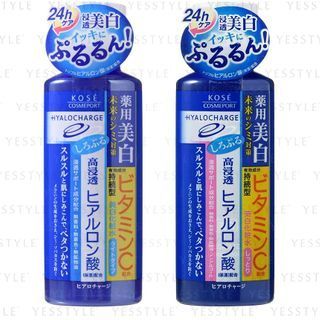
“Hyalocharge White Lotion .”
This product contains good ingredients to attract water to the upper layer of the skin. These ingredients are called "humectants": glycerin, hydrolyzed hyaluronic acid.
When humectants are on the surface of the skin, they “pull in” the moisture from the outside environment, or from within deeper layers of the skin. If the air is dry, humectants can speed up the moisture loss from the skin. This is why it is a good idea to use another product on top of this one to help "seal in" the moisture (look for ingredients like dimethicone, squalane, oils and butters).
Anti-agingNot advertised by the brand · 1 ingredient credited for this claimModerate support
This product contains ascorbyl glucoside. This ingredient might be able to help reduce and prevent fine lines and wrinkles, improve skin elasticity and firmness, but there is not enough evidence that it actually works.
Evens skin toneNot advertised by the brand · 1 ingredient credited for this claimModerate support
The following ingredient (ingredients) in this product might be helpful, but there is no evidence to confirm that it actually works: ascorbyl glucoside.
Anti-oxidationNot advertised by the brand · 1 ingredient credited for this claimModerate support
This product contains antioxidants (ascorbyl glucoside) that might be able to help neutralize free radicals in skin to lessen the damage it gets from the UV light (sun). There is not enough evidence to confirm their effectiveness in skin though.
Can it cause trouble?
Irritancy1 strong irritant: Citrus aurantium dulcis oilMedium risk
Comedogenic1 ingredient rated 2 or more on the 0–5 pore-clogging scale1 flagged
User reviews
Be the first — your take helps the next person decide.
Ingredients
Filter by role to see what each ingredient is doing.
Ascorbyl glucoside~23–34%
- Irritation risk
- Medium
A vitamin C derivative that is more stable but less potent than pure form of vitamin C. Has a potential to boost collagen production, nutralise free radicals and reduce hyperpigmentation, but the required concentration is likely to be much higher than for the pure form of vitamin C, limiting the ingredient's effectiveness in products
More about Ascorbyl glucosideWater~12–18%
Butylene glycol~5.2–7.8%
- Irritation risk
- Low
Used to create a nice product texture and help delivery of other ingredients. Might be somewhat helpful in attracting water to the upper layer of the skin
More about Butylene glycolGlycerin~3.5–5.3%
- Irritation risk
- Low
One of the best moisturizing ingredients. Naturally present in skin. It attracts water to the upper layer of the skin working as a humectant
More about GlycerinDipropylene glycol~2.6–3.9%
- Irritation risk
- Low
Helps to dissolve other ingredients in a formulation. Slows down the rate of product drying
More about Dipropylene glycolCitrus aurantium dulcis oil~2–3%
- Irritation risk
- High
Used as a fragrance. It can be irritating and cause photosensitivity
More about Citrus aurantium dulcis oilSodium hyaluronate~1.6–2.3%
- Irritation risk
- Low
One of the best moisturizing ingredients. Attracts water into the upper layer of the skin
More about Sodium hyaluronateHydrolyzed hyaluronic acid~1.4–2%
- Irritation risk
- Low
One of the best moisturizing ingredients. Attracts water into the upper layer of the skin. A version of it is naturally present in skin
More about Hydrolyzed hyaluronic acidEdta~0.5–1%
Oleyl alcohol~1.1–1.6%
Polyethylene~1.2–1.7%
Phosphoric acid~0.8–1.2%
Polyethylene~0.95–1.45%
Hydrogenated castor oil~0.55–1.3%
- Irritation risk
- Medium
A plant oil that can help soften the skin. It might be helpful in calming down inflammation, but solid research is lacking. Is often used in lip products to create the needed product consistency
More about Hydrogenated castor oilHydrogen~0.35–0.85%
- Irritation risk
- Low
Hydrogen~0.15–0.65%
- Irritation risk
- Low
Sodium hydroxide~0.1–0.4%
Methylparaben~0.15–0.3%
Ingredient list view
Ascorbyl glucoside, Water, Butylene glycol, Glycerin, Dipropylene glycol, Citrus aurantium dulcis oil, Sodium hyaluronate, Hydrolyzed hyaluronic acid, Edta, Oleyl alcohol, Polyethylene, Unknown, Phosphoric acid, Polyethylene, Hydrogenated castor oil, Unknown, Hydrogen, Unknown, Hydrogen, Unknown, Sodium hydroxide, Methylparaben
Compare prices
Retailers ranked by price — lowest first.

Affiliate links · prices updated regularly
Sources cited in this review
Every concentration estimate and effectiveness label is anchored to one of these 13 studies and safety reviews.
- 1The Roles of Vitamin C in Skin Healthncbi.nlm.nih.gov
- 2
- 3
- 4
- 5
- 6Air oxidation increases skin irritation from fragrance terpenesonlinelibrary.wiley.com

Affiliate links · As an Amazon Associate, WIMJ earns from qualifying purchases.