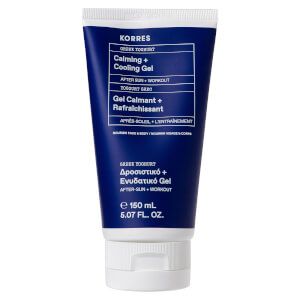
KORRES Greek Yoghurt Calming and Cooling Gel
Works for
1 of 1 advertised claim delivered
Moisturizing15 ingredients credited for this claimStrong support
“Greek Yoghurt works to naturally hydrate and instantly soothe the skin.”
This product can help improve hydration of the skin with the two types of ingredients.
The first type is called “humectants”:
these ingredients help attract water.
When humectants are on the surface of the skin, they “pull in” the moisture from the outside environment, or from
within deeper layers of the skin. The following ingredients in this product do the job:
glycerin, butylene glycol.
This product also contains ingredients called “occlusives”. They help reduce the speed with which our skin loses moisture to the outside environment. These ingredients also help soften the upper layer of the skin, so it feels less tight and nicer to the touch. The following ingredients in this product do the job: helianthus annuus seed oil, glycine soja oil.
The following ingredients in this product are especially good for supporting the skin barrier and helping with the hydration level: panthenol
Anti-oxidationNot advertised by the brand · 3 ingredients credited for this claimModerate support
This product contains antioxidants (epilobium angustifolium flower/leaf/stem extract) that might be able to help neutralize free radicals in skin to lessen the damage it gets from the UV light (sun). There is not enough evidence to confirm their effectiveness in skin though.
Can it cause trouble?
Irritancy14 strong irritants: Menthyl lactate, Calendula officinalis flower extract + 12 more — patch-test recommendedHigh risk
Comedogenic1 ingredient rated 2 or more on the 0–5 pore-clogging scale1 flagged
User reviews
Be the first — your take helps the next person decide.
Ingredients
Filter by role to see what each ingredient is doing.
Water~45–55%
Glycerin~4.7–5.8%
- Irritation risk
- Low
One of the best moisturizing ingredients. Naturally present in skin. It attracts water to the upper layer of the skin working as a humectant
More about GlycerinYogurt~4.3–5.3%
- Irritation risk
- Low
Hydrogenated polyisobutene~3.4–4.2%
- Irritation risk
- Low
Used to improve the product consistency and soften the upper layer of the skin
More about Hydrogenated polyisobuteneButylene glycol~2.7–3.3%
- Irritation risk
- Low
Used to create a nice product texture and help delivery of other ingredients. Might be somewhat helpful in attracting water to the upper layer of the skin
More about Butylene glycolDicaprylyl carbonate~2.3–2.8%
- Irritation risk
- Low
Helps products spread more easily and works as an emollient to soften skin
More about Dicaprylyl carbonatePentylene glycol~1.9–2.3%
- Irritation risk
- Medium
Used to preserve products, dissolve other ingredients and create a nice product texture
More about Pentylene glycolSodium acrylates copolymer~1.6–2%
- Irritation risk
- Medium
Used to create a thicker product consistency
More about Sodium acrylates copolymerPanthenol~1.4–1.7%
- Irritation risk
- Low
Helps attract water to the upper layer of the skin and can help improve skin barrier function
More about PanthenolHydrogenated polydecene~1.1–1.4%
- Irritation risk
- Low
Helps to soften the upper layer of the skin and create a nice product texture
More about Hydrogenated polydeceneLaureth-9~0.95–1.15%
Menthyl lactate~0.75–1.1%
Prunus amygdalus dulcis seed~0.7–1.05%
- Irritation risk
- Low
Helps soften the upper layer of the skin
More about Prunus amygdalus dulcis seedAmorphophallus konjac root extract~0.7–1%
- Irritation risk
- Low
Calendula officinalis flower extract~0.6–0.9%
- Irritation risk
- High
A plant extract that has some anti-oxidant and anti-bacterial properties. Can be irritating
More about Calendula officinalis flower extractCeratonia siliqua gum~0.7–1.05%
- Irritation risk
- Medium
Used to stabilize product formulations and create thicker consistency
More about Ceratonia siliqua gumCitric acid~0.6–0.9%
- Irritation risk
- Medium
Can work as an exfoliant but is typically used to adjust the product pH
More about Citric acidEpilobium angustifolium flower/leaf/stem extract~0.55–0.85%
- Irritation risk
- High
A plant extract that might contain antioxidants
More about Epilobium angustifolium flower/leaf/stem extractEthylhexylglycerin~0.5–0.75%
Foeniculum vulgare seed extract~0.45–0.65%
- Irritation risk
- Low
Glyceryl polyacrylate~0.45–0.7%
- Irritation risk
- Low
Helps to create a nice product texture and spread the product more easily on the skin
More about Glyceryl polyacrylateGlycine soja oil~0.45–0.65%
- Irritation risk
- Medium
- Comedogenicity
- 2/5
A good emollient that helps soften the skin and helps repair its barrier function. It can clog pores if used in high concentrations.
More about Glycine soja oilHelianthus annuus seed oil~0.45–0.65%
- Irritation risk
- Low
A great emollient due to its high linoleic acid content. One of the most effective plant oils in helping skin hydration and repairing skin barrier function
More about Helianthus annuus seed oilHydrolyzed jojoba esters~0.4–0.6%
- Irritation risk
- Low
Helps soften the upper layer of the skin
More about Hydrolyzed jojoba estersLactic acid~0.35–0.65%
- Irritation risk
- Medium
An exfoliating and moisturizing alpha-hydroxy acid (AHA). Typically causes less irritation than other AHAs, for example, glycolic acid. At high concentrations (about 15%), lactic acid can help reduce lines and wrinkles. Recent studies show that lactic acid can support the "good" bacteria living on skin's surface (healthy skin microbiome)
More about Lactic acidPhospholipids~0.35–0.6%
- Irritation risk
- Low
Emollients that are naturaly present in skin. In addition, they help water and oil mix together in the product
More about PhospholipidsPolyglyceryl-10 stearate~0.35–0.6%
- Irritation risk
- Medium
Helps water and oil mix together and softens the upper layer of the skin
More about Polyglyceryl-10 stearateTocopherol~0.35–0.6%
- Irritation risk
- Low
Pure form of vitamin E. Can help moisturise and protect the skin from free radicals. Often used to help stabilise other ingredients or the formula itself
More about TocopherolBenzyl alcohol~0.3–0.55%
- Irritation risk
- High
A preservative. Can be used to mask unpleasant smell. Can be irritating
More about Benzyl alcoholPhenoxyethanol~0.3–0.6%
- Irritation risk
- Low
A preservative. It helps prevent bacterial growth in cosmetic products
More about PhenoxyethanolPotassium sorbate~0.25–0.45%
Sodium benzoate~0.25–0.45%
Sodium dehydroacetate~0.25–0.5%
Sodium metabisulfite~0.1–0.2%
Alpha-isomethyl ionone~0.2–0.4%
- Irritation risk
- High
A fragrance. Potential allergen and can be irritating
More about Alpha-isomethyl iononeAmyl cinnamal~0.2–0.4%
- Irritation risk
- High
Benzyl salicylate~0.2–0.35%
Citronellol~0.2–0.35%
Coumarin~0.2–0.35%
Geraniol~0.15–0.3%
Hexyl cinnamal~0.15–0.3%
Hydroxycitronellal~0.15–0.25%
- Irritation risk
- High
A fragrance. A likely allergen and can be irritating
More about HydroxycitronellalIsoeugenol~0.15–0.3%
- Irritation risk
- High
Limonene~0.15–0.3%
- Irritation risk
- High
A common frangrance that can easily irritate skin, especially if exposed to air, light or heat
More about LimoneneLinalool~0.1–0.2%
Parfum~0.1–0.15%
- Irritation risk
- High
An aromatic blend of unspecified and possibly irritating ingredients
More about ParfumIngredient list view
Water, Glycerin, Yogurt, Hydrogenated polyisobutene, Butylene glycol, Dicaprylyl carbonate, Pentylene glycol, Sodium acrylates copolymer, Panthenol, Hydrogenated polydecene, Laureth-9, Menthyl lactate, Prunus amygdalus dulcis seed, Amorphophallus konjac root extract, Calendula officinalis flower extract, Ceratonia siliqua gum, Citric acid, Epilobium angustifolium flower/leaf/stem extract, Ethylhexylglycerin, Foeniculum vulgare seed extract, Glyceryl polyacrylate, Glycine soja oil, Helianthus annuus seed oil, Hydrolyzed jojoba esters, Lactic acid, Phospholipids, Polyglyceryl-10 stearate, Tocopherol, Benzyl alcohol, Phenoxyethanol, Potassium sorbate, Sodium benzoate, Sodium dehydroacetate, Sodium metabisulfite, Alpha-isomethyl ionone, Amyl cinnamal, Benzyl salicylate, Citronellol, Coumarin, Geraniol, Hexyl cinnamal, Hydroxycitronellal, Isoeugenol, Limonene, Linalool, Parfum
Compare prices
Retailers ranked by price — lowest first.

Product summary
"KORRES - Greek Yoghurt Calming and Cooling Gel" is a well-rounded moisturizing product. This moisturizer uses a good combo of humectants and emollients. These both types of ingredients are essentials for improving the skin hydration and keeping the skin barrier healthy. Humectants in this product (panthenol, glycerin and butylene glycol) help to increase the water content in the upper layer of the skin. (These ingredients do so by "capturing" water molecules from the outside air or from within the deeper layers of the skin). Emollients in this formulation (glycine soja oil, helianthus annuus seed oil, dicaprylyl carbonate, hydrogenated polydecene and pentylene glycol) help to reduce the moisture loss from the skin. They also soften the skin surface and relieve the feeling of dryness and tightness.
Ingredient callouts
- An effective concentration of Panthenol (pro-vitamin B5) - about 1.40% - 1.70%. Panthenol helps strengthen the skin barrier, improve hydration and reduce inflammation in skin.
Irritation risk
There are quite a few common irritants in this product, including ingredients without particular skin benefits. We would not recommend it for sensitive skin. We assess the overall irritancy of this moisturizer to be high. For a detailed overview of all potential irritants: click here
You can see the detailed formula review with the breakdown of all actives in the product and the full ingredient list with estimated concentrations in the tables below.
About the brand
According to Cruelty-Free Kitty "KORRES" is cruelty free, but its parent company is not.
Price
The product retails from 17.85£ up to 24.99£ in the United Kingdom, from 14.00$ up to 28.00$ in the United States and for 35.28CA$ in Canada.
For a detailed price comparison: click here.
Sources cited in this review
Every concentration estimate and effectiveness label is anchored to one of these 24 studies and safety reviews.
- 1
- 2
- 3
- 4Skin moisturizing effects of panthenol-based formulationspdfs.semanticscholar.org
- 5
- 6Safety Assessment of Polyene Group as Used in Cosmeticscir-safety.org

Affiliate links · As an Amazon Associate, WIMJ earns from qualifying purchases.