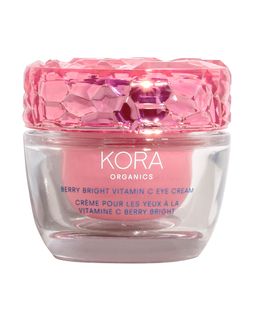
KORA Organics Berry Bright Vitamin C Eye Cream
Works for
3 of 3 advertised claims delivered
Anti-agingAscorbyl glucoside, Butyrospermum parkii butter + 3 moreModerate evidence
“This eye cream is formulated with kangaroo paw flower, Kakadu plum, cloudberry and red ginseng, which help to improve the appearance of fine lines, wrinkles and imperfections.”
This product contains ascorbyl glucoside. This ingredient might be able to help reduce and prevent fine lines and wrinkles, improve skin elasticity and firmness, but there is not enough evidence that it actually works.
Evens skin toneAscorbyl glucosideModerate evidence
“Berry Bright Vitamin C Eye Cream”
The following ingredient (ingredients) in this product might be helpful, but there is no evidence to confirm that it actually works: ascorbyl glucoside.
MoisturizingCocos nucifera fruit extract, Chenopodium quinoa seed extract + 17 moreGood evidence
“Harness the power of vitamins and minerals with Kora Organics Berry Bright Vitamin C Eye Cream, a nourishing eye cream that helps to minimise the signs of ageing.”
This product can help improve hydration of the skin with the two types of ingredients.
The first type is called “humectants”:
these ingredients help attract water.
When humectants are on the surface of the skin, they “pull in” the moisture from the outside environment, or from
within deeper layers of the skin. The following ingredients in this product do the job:
glycerin, lactobacillus ferment.
This product also contains ingredients called “occlusives”. They help reduce the speed with which our skin loses moisture to the outside environment. These ingredients also help soften the upper layer of the skin, so it feels less tight and nicer to the touch. The following ingredients in this product do the job: butyrospermum parkii butter, helianthus annuus seed oil.
Anti-oxidationNot advertised by the brand · Ascorbyl glucoside, Eclipta prostrata extract + 8 moreModerate evidence
This product contains antioxidants (ascorbyl glucoside) that might be able to help neutralize free radicals in skin to lessen the damage it gets from the UV light (sun). There is not enough evidence to confirm their effectiveness in skin though.
Can it cause trouble?
Irritancy3 strong irritants: Balanites roxburghii seed oil, Anigozanthos flavidus extract + 1 more — patch-test recommendedHigh risk
Comedogenic4 ingredients rated 2 or more on the 0–5 pore-clogging scale4 flagged
User reviews
Be the first — your take helps the next person decide.
Ingredients
Filter by role to see what each ingredient is doing.
Aloe barbadensis leaf juice~26–31%
- Irritation risk
- Medium
Traditionally used to treat sunburns, dermatitis and inflammation, but evidence for its effectiveness is lacking. The extract can contain humectants that help attract water into the skin
More about Aloe barbadensis leaf juiceRosa canina seed oil~11–13%
- Irritation risk
- Medium
A plant oil that helps soften the upper layer of the skin. It might have anti-oxidant properties. Might help reduce inflammation in skin and help against blemishes
More about Rosa canina seed oilGlycerin~5.9–7.3%
- Irritation risk
- Low
One of the best moisturizing ingredients. Naturally present in skin. It attracts water to the upper layer of the skin working as a humectant
More about GlycerinBalanites roxburghii seed oil~4.8–5.9%
- Irritation risk
- High
An emollient. Could be irritating
More about Balanites roxburghii seed oilCetearyl alcohol~3.8–4.6%
- Irritation risk
- Low
- Comedogenicity
- 2/5
A non-drying alcohol. Works as an emollient. Helps water and oil mix together and creates a nice product texture
More about Cetearyl alcoholWater~2.8–3.4%
Coconut alkanes~2.4–2.9%
- Irritation risk
- Medium
- Comedogenicity
- 2/5
An emollient that helps soften the skin
More about Coconut alkanesLactobacillus ferment~1.9–2.3%
- Irritation risk
- Low
A fermentation product created by bacteria Lactobacillus. The fermented product has anti-bacterial properties and might be helpful in calming down inflammation, but studies are lacking. Helps attract water to the upper layer of the skin. Can be used as a preservative
More about Lactobacillus fermentOleic/linoleic/linolenic polyglycerides~1.6–1.9%
- Irritation risk
- Low
Helps soften the upper layer of the skin
More about Oleic/linoleic/linolenic polyglyceridesCetearyl olivate~1.2–1.5%
Sorbitan olivate~1–1.3%
Propanediol~0.9–1.1%
- Irritation risk
- Low
Acts as a solvent for other ingredients. Speeds up the absorption of other ingredients into the skin
More about PropanediolAscorbyl glucoside~0.7–1.1%
- Irritation risk
- Medium
A vitamin C derivative that is more stable but less potent than pure form of vitamin C. Has a potential to boost collagen production, nutralise free radicals and reduce hyperpigmentation, but the required concentration is likely to be much higher than for the pure form of vitamin C, limiting the ingredient's effectiveness in products
More about Ascorbyl glucosidePersea gratissima oil~0.8–1.2%
- Irritation risk
- Medium
An emollient that helps soften the skin and could be helpful in repairing its barrier function
More about Persea gratissima oilHelianthus annuus seed oil~0.7–1.1%
- Irritation risk
- Low
A great emollient due to its high linoleic acid content. One of the most effective plant oils in helping skin hydration and repairing skin barrier function
More about Helianthus annuus seed oilLactobacillus~0.65–0.95%
- Irritation risk
- Low
A non-living ingredient made by fermentation with the bacteria Lactobacillus. It can help attract water to the upper layer of the skin and might help reduce inflammation
More about LactobacillusButyrospermum parkii butter~0.7–1.1%
- Irritation risk
- Low
- Comedogenicity
- 3/5
A great moisturising ingredient that softens the skin and reduces water loss from its upper layer. It also can be helpful in protecting skin from free radicals
More about Butyrospermum parkii butterCoco-caprylate/caprate~0.65–1%
- Irritation risk
- Low
Helps to soften the upper layer of the skin without creating a greasy texture
More about Coco-caprylate/capratePotassium sorbate~0.3–0.6%
Eclipta prostrata extract~0.55–0.8%
- Irritation risk
- High
A plant extract that might help neutralize free radicals in skin. It can be irritating
More about Eclipta prostrata extractCocos nucifera fruit extract~0.6–0.9%
- Irritation risk
- Low
- Comedogenicity
- 3/5
An emollient. Found to be as effective as a moisturizer for dry skin as mineral oil. Could be comedogenic
More about Cocos nucifera fruit extractChenopodium quinoa seed extract~0.5–0.75%
- Irritation risk
- Low
Helps soften the upper layer of the skin
More about Chenopodium quinoa seed extractPanax ginseng root extract~0.6–0.85%
- Irritation risk
- High
A plant extract that might have some anti-inflammatory properties, but solid evidence is lacking. It can be irritating
More about Panax ginseng root extractSclerotium gum~0.5–0.75%
- Irritation risk
- Low
Used to create gel-like formulas and stabilize emulsions
More about Sclerotium gumRubus chamaemorus fruit extract~0.5–0.75%
- Irritation risk
- Low
Morinda citrifolia fruit extract~0.5–0.75%
- Irritation risk
- Low
Sodium phytate~0.5–0.75%
Anigozanthos flavidus extract~0.45–0.7%
- Irritation risk
- High
Claimed to have anti-oxidant properties but no evidence is available
More about Anigozanthos flavidus extractMelia azadirachta leaf extract~0.5–0.7%
- Irritation risk
- High
A plant extract that has anti-bacterial properties. Can be used to preserve the product. Can be irritating
More about Melia azadirachta leaf extractTerminalia ferdinandiana fruit extract~0.5–0.75%
- Irritation risk
- Medium
A plant extract that might have some anti-oxidant effect in skin, but evidence is lacking
More about Terminalia ferdinandiana fruit extractSodium benzoate~0.25–0.5%
Potassium hydroxide~0.5–0.75%
Hippophae rhamnoides fruit oil~0.45–0.65%
- Irritation risk
- High
A plant oil that might somewhat help to neutralize free radicals. It could be irritating
More about Hippophae rhamnoides fruit oilTocopherol~0.45–0.65%
- Irritation risk
- Low
Pure form of vitamin E. Can help moisturise and protect the skin from free radicals. Often used to help stabilise other ingredients or the formula itself
More about TocopherolMoringa oleifera seed oil~0.5–0.75%
- Irritation risk
- Medium
A plant oil that helps soften the upper layer of the skin. Is unlikely to be helpful in restoring skin barrier function due to the low content of linoleic acid
More about Moringa oleifera seed oilAlcohol~0.3–0.6%
- Irritation risk
- High
Can be drying and contribute to skin irritation. Used in formulars to dissolve other ingredients, create a thinner product consistency or for its antibacterial properties
More about AlcoholIngredient list view
Aloe barbadensis leaf juice, Rosa canina seed oil, Glycerin, Balanites roxburghii seed oil, Cetearyl alcohol, Water, Coconut alkanes, Lactobacillus ferment, Oleic/linoleic/linolenic polyglycerides, Cetearyl olivate, Sorbitan olivate, Propanediol, Ascorbyl glucoside, Persea gratissima oil, Helianthus annuus seed oil, Lactobacillus, Butyrospermum parkii butter, Coco-caprylate/caprate, Potassium sorbate, Eclipta prostrata extract, Cocos nucifera fruit extract, Chenopodium quinoa seed extract, Panax ginseng root extract, Sclerotium gum, Rubus chamaemorus fruit extract, Morinda citrifolia fruit extract, Sodium phytate, Anigozanthos flavidus extract, Melia azadirachta leaf extract, Terminalia ferdinandiana fruit extract, Sodium benzoate, Potassium hydroxide, Hippophae rhamnoides fruit oil, Tocopherol, Moringa oleifera seed oil, Alcohol
Compare prices
Retailers ranked by price — lowest first.

Sources cited in this review
Every concentration estimate and effectiveness label is anchored to one of these 24 studies and safety reviews.
- 1Nutrient composition of rose (Rosa canina L.) seed and oilsncbi.nlm.nih.gov
- 2
- 3
- 4
- 5
- 6

Affiliate links · As an Amazon Associate, WIMJ earns from qualifying purchases.