Works for
1 of 1 advertised claim delivered
Moisturizing11 ingredients credited for this claimStrong support
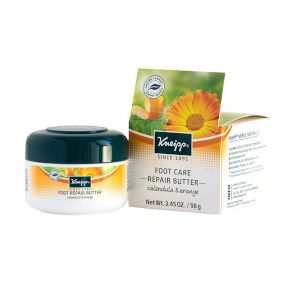
“The Kneipp Soothing Calendula & Orange Foot Repair Butter is a rich moisturizer that turns cracked, itchy feet into healthy-looking feet.”
This product can help improve hydration of the skin with the two types of ingredients.
The first type is called “humectants”:
these ingredients help attract water.
When humectants are on the surface of the skin, they “pull in” the moisture from the outside environment, or from
within deeper layers of the skin. The following ingredients in this product do the job:
glycerin, caprylyl glycol.
This product also contains ingredients called “occlusives”. They help reduce the speed with which our skin loses moisture to the outside environment. These ingredients also help soften the upper layer of the skin, so it feels less tight and nicer to the touch. The following ingredients in this product do the job: butyrospermum parkii butter, myristyl myristate.
The following ingredients in this product are especially good for supporting the skin barrier and helping with the hydration level: panthenol, urea
Can it cause trouble?
Irritancy12 strong irritants: Calendula officinalis flower extract, Citrus aurantium dulcis peel oil + 10 more — patch-test recommendedHigh risk
Comedogenic3 ingredients rated 2 or more on the 0–5 pore-clogging scale3 flagged


User reviews
Be the first — your take helps the next person decide.
Ingredients
Filter by role to see what each ingredient is doing.
Water~45–55%
Butyrospermum parkii butter~5.7–6.9%
- Irritation risk
- Low
- Comedogenicity
- 3/5
A great moisturising ingredient that softens the skin and reduces water loss from its upper layer. It also can be helpful in protecting skin from free radicals
More about Butyrospermum parkii butterUrea~4.2–5.1%
- Irritation risk
- Low
Naturally present in skin (urea makes up about 7% of natural moisturizing factors in skin). Attracts water to the upper layer of the skin. Also has a positive effect on the skin barrier beyond the humectant action. Can enhance penetration of other ingredients. Is an exfoliating ingredient when used in high concentrations
More about UreaGlycerin~3.4–4.1%
- Irritation risk
- Low
One of the best moisturizing ingredients. Naturally present in skin. It attracts water to the upper layer of the skin working as a humectant
More about GlycerinCetearyl alcohol~2.8–3.4%
- Irritation risk
- Low
- Comedogenicity
- 2/5
A non-drying alcohol. Works as an emollient. Helps water and oil mix together and creates a nice product texture
More about Cetearyl alcoholPrunus amygdalus dulcis oil~2.3–2.8%
- Irritation risk
- Low
An emollient that softens the skin
More about Prunus amygdalus dulcis oilPalmitic/stearic triglyceride~1.9–2.3%
- Irritation risk
- Low
Myristyl myristate~1.7–2.1%
- Irritation risk
- Medium
- Comedogenicity
- 3/5
An emollient. Is not recommended for acne-prone skin as it can be comedogenic
More about Myristyl myristateGlyceryl stearate citrate~1.3–1.6%
- Irritation risk
- Low
Helps oil and water mix together while softening the upper layer of the skin
More about Glyceryl stearate citrateCalendula officinalis flower extract~1–1.3%
- Irritation risk
- High
A plant extract that has some anti-oxidant and anti-bacterial properties. Can be irritating
More about Calendula officinalis flower extractCitrus aurantium dulcis peel oil~0.75–1.15%
- Irritation risk
- High
An essentil oil from orange peel. Potential allergen and can be irritating
More about Citrus aurantium dulcis peel oilTocopheryl acetate~0.7–1.05%
- Irritation risk
- Medium
A more stable but less bio-available form of vitamin E compared to Tocopherol. Might help moisturize and protect the skin from free radicals, but mostly used in low concentrations to stabilize other ingredients.
More about Tocopheryl acetatePanthenol~0.65–0.95%
- Irritation risk
- Low
Helps attract water to the upper layer of the skin and can help improve skin barrier function
More about PanthenolRosmarinus officinalis leaf oil~0.6–0.85%
- Irritation risk
- High
A plant oil with high content of volatile compounds that can irritate the skin. Can be used as a fragrance. Has anti-bacterial properties and might help neutralize free radicals on the surface of the skin
More about Rosmarinus officinalis leaf oilMenthol~0.55–0.8%
- Irritation risk
- High
Litsea cubeba fruit oil~0.45–0.65%
- Irritation risk
- High
An essential oil with a lemon-like smell that is extracted from a fruit grown in Asia. Used as a fragrance
More about Litsea cubeba fruit oilCitral~0.4–0.6%
Limonene~0.35–0.65%
- Irritation risk
- High
A common frangrance that can easily irritate skin, especially if exposed to air, light or heat
More about LimoneneGeraniol~0.3–0.55%
Citronellol~0.3–0.5%
Linalool~0.25–0.5%
Eugenol~0.2–0.4%
P-anisic acid~0.2–0.35%
- Irritation risk
- High
Helps preserve products. Can mask unpleasant smell. Could be irritating
More about P-anisic acidParfum~0.15–0.3%
- Irritation risk
- High
An aromatic blend of unspecified and possibly irritating ingredients
More about ParfumCaprylyl glycol~0.2–0.4%
- Irritation risk
- Medium
Helps preserve products and creates a nice product texture
More about Caprylyl glycolXanthan gum~0.15–0.3%
- Irritation risk
- Low
Used to create a thicker product consistency
More about Xanthan gumAcrylates/c10-30 alkyl acrylate crosspolymer~0.15–0.25%
- Irritation risk
- Medium
Maintains the texture of skincare products. Allows the product to spread evenly. Helps oil and water mix together
More about Acrylates/c10-30 alkyl acrylate crosspolymerGlyceryl caprylate~0.15–0.3%
- Irritation risk
- Low
An emollient that can also help water and oil mix together, as well as prevent bacteria growth in products
More about Glyceryl caprylateTriacetin~0.1–0.2%
Tocopherol~0.05–0.15%
- Irritation risk
- Low
Pure form of vitamin E. Can help moisturise and protect the skin from free radicals. Often used to help stabilise other ingredients or the formula itself
More about TocopherolIngredient list view
Water, Butyrospermum parkii butter, Urea, Glycerin, Cetearyl alcohol, Prunus amygdalus dulcis oil, Palmitic/stearic triglyceride, Myristyl myristate, Glyceryl stearate citrate, Calendula officinalis flower extract, Citrus aurantium dulcis peel oil, Tocopheryl acetate, Panthenol, Rosmarinus officinalis leaf oil, Menthol, Litsea cubeba fruit oil, Citral, Limonene, Geraniol, Citronellol, Linalool, Eugenol, P-anisic acid, Parfum, Caprylyl glycol, Xanthan gum, Acrylates/c10-30 alkyl acrylate crosspolymer, Glyceryl caprylate, Triacetin, Tocopherol
Compare prices
Retailers ranked by price — lowest first.
Worth comparing, line by line.
Match % combines shared ingredients, the first five ingredients, shared actives and hero ingredients, irritancy (lower counts in the alternative's favour), texture and body area. Only products in the same routine step are compared.
| KneippCalendula and Orange Foot CreamYOUR PRODUCT | common hausFresh Foot Cream | MONSTER FACTORYFoot Cream | SVRXERIAL 30 Feet Cream | |
|---|---|---|---|---|
| Match | — | 68% | 68% | 67% |
| Price | $22.00 | $17.00−$5.00 | $17.00−$5.00 | $14.54−$7.46 |
| Shared key ingredients | — | 4 of 5 | 4 of 5 | 4 of 5 |
| Key difference | — | Salicylic Acid | Salicylic Acid | Salicylic Acid |
| Irritancy | High | Medium | Medium | Low |
| Drying alcohol | — | — | — | — |
| View product | Shop | Shop | Shop |


Product summary
Based on the ingredient list, "Kneipp - Calendula and Orange Foot Cream" can work well for skin moisturization. This moisturizer uses a good combo of humectants and emollients. These both types of ingredients are essentials for improving the skin hydration and keeping the skin barrier healthy. Humectants in this product (panthenol, urea, glycerin and caprylyl glycol) help to increase the water content in the upper layer of the skin. (These ingredients do so by "capturing" water molecules from the outside air or from within the deeper layers of the skin). Emollients in this formulation (butyrospermum parkii butter, myristyl myristate, cetearyl alcohol, caprylyl glycol and glyceryl caprylate) help to reduce the moisture loss from the skin. They also soften the skin surface and relieve the feeling of dryness and tightness.
Ingredient callouts
- This formulation also uses an effective concentration of panthenol (pro-vitamin B5) - about 0.65% - 0.95%. Panthenol helps strengthen the skin barrier, improve hydration and reduce inflammation in skin.
Irritation risk
This moisturizer contains a bunch of common irritants, including ingredients that do not provide any known benefit for the skin. It might not be the best choice if your skin is sensitive. We assess the overall irritancy of this moisturizer to be high. For a detailed overview of all potential irritants: click here
You can see the detailed formula review with the breakdown of all actives in the product and the full ingredient list with estimated concentrations in the tables below.
Price
The product retails for 22.00$ in the United States.
For a detailed price comparison: click here.
Sources cited in this review
Every concentration estimate and effectiveness label is anchored to one of these 21 studies and safety reviews.
- 1Topical urea in skincare: A reviewpubmed.ncbi.nlm.nih.gov
- 2
- 3
- 4
- 5
- 6

Affiliate links · As an Amazon Associate, WIMJ earns from qualifying purchases.