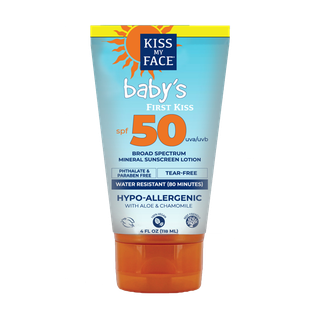
Kiss My Face Baby’s First Kiss SPF 50 Broad Spectrum Mineral Sunscreen Lotion, ., Safe for Baby’s Skin, Mineral Active Ingredients, Moisturizing Lotion, Safe Suncare
Works for
0 of 1 advertised claim delivered
Sun protectionSPF 50 · 2 UV filters · Partial spectrumWeak protection
This product does not offer good protection against UVA rays.
This product can be considered "reef safe" because it does not contain the UV filters (oxybenzone and octinoxate) that can be harmful to coral reefs when present in the water in high concentrations.
MoisturizingNot advertised by the brand · 12 ingredients credited for this claimGood support
This product can help improve hydration of the skin with the two types of ingredients.
The first type is called “humectants”:
these ingredients help attract water.
When humectants are on the surface of the skin, they “pull in” the moisture from the outside environment, or from
within deeper layers of the skin. The following ingredients in this product do the job:
glycerin, aloe barbadensis leaf extract.
This product also contains ingredients called “occlusives”. They help reduce the speed with which our skin loses moisture to the outside environment. These ingredients also help soften the upper layer of the skin, so it feels less tight and nicer to the touch. The following ingredients in this product do the job: cocos nucifera oil, helianthus annuus seed oil.
Can it cause trouble?
Irritancy2 strong irritants: Calendula officinalis flower extract, Lavandula angustifolia flower extractMedium risk
Comedogenic3 ingredients rated 2 or more on the 0–5 pore-clogging scale3 flagged
User reviews
Be the first — your take helps the next person decide.
Ingredients
Filter by role to see what each ingredient is doing.
Titanium dioxide6%
- Irritation risk
- Low
Works as a UV filter when used in high concentrations. It is photostable and is effective mostly against the UVB light, with some protection in the UVA range. In small concentrations, used for its ability to improve the color of cosmetic products. Is usually well tolerated by the skin
More about Titanium dioxideAloe barbadensis leaf extract~23–35%
- Irritation risk
- Medium
Traditionally used to treat sunburns, dermatitis and inflammation, but evidence for its effectiveness is lacking. The extract can contain humectants that help attract water into the skin
More about Aloe barbadensis leaf extractBisabolol~5.6–8.4%
- Irritation risk
- Low
An active component of chamomile plant that historically has been used to calm down irritated skin. A recent study shows that bisabolol indeed can have some anti-inflammatory effect on skin, even though conclusive data is lacking. Bisabolol has a sweet floral scent and can be added to products for its aromatic properties
More about BisabololButyloctyl salicylate~4.5–6.7%
- Irritation risk
- Medium
A synthetic ester of salicylic acid that is used to help disperse pigments and boost effectiveness of sunscreen ingredients. It is able to absorb UV light (working as an organic, or chemical filter), but is not approved as a sunscreen ingredient on its own
More about Butyloctyl salicylateCalendula officinalis flower extract~3.2–4.8%
- Irritation risk
- High
A plant extract that has some anti-oxidant and anti-bacterial properties. Can be irritating
More about Calendula officinalis flower extractChamomilla recutita flower extract~2.3–3.5%
- Irritation risk
- High
Plant extract that can have healing and anti-inflammatory properties. It is a potential allergen and can be irritating
More about Chamomilla recutita flower extractCocos nucifera oil~2.2–3.3%
- Irritation risk
- Low
- Comedogenicity
- 3/5
An emollient. Found to be as effective as a moisturizer for dry skin as mineral oil. Could be comedogenic
More about Cocos nucifera oilGlycerin~1.6–2.4%
- Irritation risk
- Low
One of the best moisturizing ingredients. Naturally present in skin. It attracts water to the upper layer of the skin working as a humectant
More about GlycerinGlycine soja oil~1.4–2.1%
- Irritation risk
- Medium
- Comedogenicity
- 2/5
A good emollient that helps soften the skin and helps repair its barrier function. It can clog pores if used in high concentrations.
More about Glycine soja oilHelianthus annuus seed oil~1.3–2%
- Irritation risk
- Low
A great emollient due to its high linoleic acid content. One of the most effective plant oils in helping skin hydration and repairing skin barrier function
More about Helianthus annuus seed oilHydrogenated vegetable oil~1–1.5%
- Irritation risk
- Low
- Comedogenicity
- 2/5
An oil from a mixture of different vegetables. Helps soften the upper layer of the skin
More about Hydrogenated vegetable oilJojoba esters~0.85–1.3%
- Irritation risk
- Medium
An emollient made of jojoba oil. Helps soften the skin and support its barrier function
More about Jojoba estersLavandula angustifolia flower extract~0.6–1.4%
- Irritation risk
- High
Essential oil that can be irritating
More about Lavandula angustifolia flower extractOryzanol~0.45–1.05%
- Irritation risk
- Low
An anti-oxidant that helps stabilize product formulations. Might help neutralise free radicals in skin
More about OryzanolPersea gratissima oil~0.4–1%
- Irritation risk
- Medium
An emollient that helps soften the skin and could be helpful in repairing its barrier function
More about Persea gratissima oilPrunus armeniaca kernel oil~0.4–0.9%
- Irritation risk
- Medium
An emollient that helps soften the skin
More about Prunus armeniaca kernel oilSilica~0.4–0.95%
Simmondsia chinensis seed oil~0.3–0.7%
- Irritation risk
- Medium
Softens the upper layer of skin and helps restore the healthy skin barrier. Has shown to help calm down inflammation in skin. It is a stable oil, meaning that it retains its properties even when exposed to air.
More about Simmondsia chinensis seed oilTocopherol~0.1–0.4%
- Irritation risk
- Low
Pure form of vitamin E. Can help moisturise and protect the skin from free radicals. Often used to help stabilise other ingredients or the formula itself
More about TocopherolVitis vinifera seed oil~0.15–0.55%
- Irritation risk
- Medium
A great emollient that can also have anti-oxidant properties
More about Vitis vinifera seed oilWater~0.05–0.3%
Xanthan gum~0.05–0.25%
- Irritation risk
- Low
Used to create a thicker product consistency
More about Xanthan gumIngredient list view
Titanium dioxide, Aloe barbadensis leaf extract, Bisabolol, Butyloctyl salicylate, Calendula officinalis flower extract, Chamomilla recutita flower extract, Cocos nucifera oil, Glycerin, Glycine soja oil, Helianthus annuus seed oil, Hydrogenated vegetable oil, Jojoba esters, Lavandula angustifolia flower extract, Oryzanol, Persea gratissima oil, Prunus armeniaca kernel oil, Silica, Simmondsia chinensis seed oil, Tocopherol, Vitis vinifera seed oil, Water, Xanthan gum
Compare prices
Retailers ranked by price — lowest first.

Affiliate links · prices updated regularly
Product summary
"Kiss My Face - Baby’s First Kiss SPF 50 Broad Spectrum Mineral Sunscreen Lotion, Safe for Baby’s Skin, Mineral Active Ingredients, Moisturizing Lotion, Safe Suncare" does not provide enough UVA protection. UVA rays do not cause sunburn, but still damage the skin, leading to early signs of aging and pigmentation issues.
It contains good moisturizing ingredients and can double as a hydrating day cream.
Sunscreen filters
This is a "mixed" sunscreen in the sense that it uses both mineral and organic (so-called "chemical") sun filters. Here are the organic filters this product uses: butyloctyl salicylate. As for the mineral filters, this sunscreen uses titanium dioxide.
Irritation risk
This moisturizer contains some common irritants, including those without a benefit for the skin. We assess the overall irritancy of this moisturizer to be medium. For a detailed overview of all potential irritants: click here
You can see the detailed formula review with the breakdown of all actives in the product and the full ingredient list with estimated concentrations in the tables below.
About the brand
According to Cruelty-Free Kitty "Kiss My Face" is cruelty free and so is its parent company.
Price
The product retails for 15.99$ in the United States.
For a detailed price comparison: click here.
Sources cited in this review
Every concentration estimate and effectiveness label is anchored to one of these 17 studies and safety reviews.
- 1
- 2
- 3
- 4
- 5
- 6

Affiliate links · As an Amazon Associate, WIMJ earns from qualifying purchases.