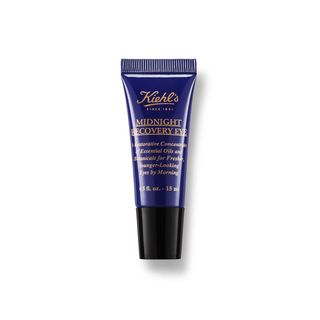
Works for
2 of 2 advertised claims delivered
Anti-aging3 ingredients credited for this claimStrong evidence
“Specifically formulated for the delicate under-eye area to achieve fresher, younger looking eyes by morning by reducing the appearance of fine lines and wrinkles.”
This product can help reduce and prevent fine lines and wrinkles, improve skin elasticity and firmness because it contains adenosine.
Keep in mind that it typically takes at least 6 weeks to notice any results because the changes that are needed to improve fine lines and elasticity happen in the deeper layers of the skin. No topical anti-aging product can “erase” wrinkles or fully reverse signs of aging.
Moisturizing13 ingredients credited for this claimGood evidence
“Hydrates and nourishes the delicate under-eye skin, leaving it feeling strengthened and replenished”
This product can help soften the skin and reduce its moisture loss with emollients and occlusives: helianthus annuus seed oil, simmondsia chinensis seed oil.
Keep in mind that this product does not contain effective ingredients to attract water to the upper layer of the skin. This is why an additional product with humectants like glycerin or hyaluronic acid can be helpful (apply it before this product for the best results).
Can it cause trouble?
Irritancy13 strong irritants: Alcohol denat., Lavandula angustifolia oil + 11 more — patch-test recommendedHigh risk
Comedogenic3 ingredients rated 2 or more on the 0–5 pore-clogging scale3 flagged


User reviews
Be the first — your take helps the next person decide.
Ingredients
Filter by role to see what each ingredient is doing.
Water~45–55%
Helianthus annuus seed oil~5.9–7.2%
- Irritation risk
- Low
A great emollient due to its high linoleic acid content. One of the most effective plant oils in helping skin hydration and repairing skin barrier function
More about Helianthus annuus seed oilSimmondsia chinensis seed oil~4.3–5.2%
- Irritation risk
- Medium
Softens the upper layer of skin and helps restore the healthy skin barrier. Has shown to help calm down inflammation in skin. It is a stable oil, meaning that it retains its properties even when exposed to air.
More about Simmondsia chinensis seed oilPrunus armeniaca kernel oil~3.1–3.8%
- Irritation risk
- Medium
An emollient that helps soften the skin
More about Prunus armeniaca kernel oilSqualane~2.4–2.9%
- Irritation risk
- Low
An oil naturally present in skin. Works as an emollient to soften the skin and form a protective layer on its surface without a greasy feeling.
More about SqualaneAlcohol denat.~1.9–2.3%
- Irritation risk
- High
Produces temporary toning effect. Can help dissolve other ingredients or preserve products
More about Alcohol denat.Cetearyl alcohol~1.6–2%
- Irritation risk
- Low
- Comedogenicity
- 2/5
A non-drying alcohol. Works as an emollient. Helps water and oil mix together and creates a nice product texture
More about Cetearyl alcoholGlyceryl stearate~1.4–1.7%
- Irritation risk
- Low
An emollient that softens the skin and forms a protective layer on its surface. Helps water and oil mix together
More about Glyceryl stearateStearyl alcohol~1.2–1.5%
- Irritation risk
- Low
An emollient that helps soften the skin
More about Stearyl alcoholCetearyl glucoside~0.9–1.15%
- Irritation risk
- Medium
Helps water and oil in the product mix well together and improves product texture
More about Cetearyl glucosideOenothera biennis oil~0.7–1.05%
- Irritation risk
- Medium
Helps soften the upper layer of the skin and can support skin barrier function
More about Oenothera biennis oilButyrospermum parkii butter~0.6–0.9%
- Irritation risk
- Low
- Comedogenicity
- 3/5
A great moisturising ingredient that softens the skin and reduces water loss from its upper layer. It also can be helpful in protecting skin from free radicals
More about Butyrospermum parkii butterPhenoxyethanol~0.5–0.75%
- Irritation risk
- Low
A preservative. It helps prevent bacterial growth in cosmetic products
More about PhenoxyethanolLithium magnesium sodium silicate~0.5–0.75%
- Irritation risk
- Low
Chlorphenesin~0.16–0.32%
Xanthan gum~0.45–0.65%
- Irritation risk
- Low
Used to create a thicker product consistency
More about Xanthan gumRuscus aculeatus root extract~0.4–0.6%
- Irritation risk
- Low
Aloe barbadensis leaf juice powder~0.3–0.6%
- Irritation risk
- Medium
Traditionally used to treat sunburns, dermatitis and inflammation, but evidence for its effectiveness is lacking. The extract can contain humectants that help attract water into the skin
More about Aloe barbadensis leaf juice powderTocopherol~0.3–0.6%
- Irritation risk
- Low
Pure form of vitamin E. Can help moisturise and protect the skin from free radicals. Often used to help stabilise other ingredients or the formula itself
More about TocopherolLavandula angustifolia oil~0.3–0.55%
- Irritation risk
- High
An essential oil. Potential allergen and can be irritating. It has some anti-bacterial properties
More about Lavandula angustifolia oilAdenosine~0.25–0.5%
- Irritation risk
- Low
Might help improve cell turnover and reduce inflammation in skin. One study shows that the ingredients might be able to help reduce dynamic wrinkles (for example, in the corners of the eyes or on the forehead)
More about AdenosineLinalool~0.25–0.5%
Rosmarinus officinalis leaf oil~0.25–0.5%
- Irritation risk
- High
A plant oil with high content of volatile compounds that can irritate the skin. Can be used as a fragrance. Has anti-bacterial properties and might help neutralize free radicals on the surface of the skin
More about Rosmarinus officinalis leaf oilPelargonium graveolens flower oil~0.25–0.5%
- Irritation risk
- High
An essential oil. Can be irritating. Can become an allergen with oxidation
More about Pelargonium graveolens flower oilGlycine soja oil~0.25–0.5%
- Irritation risk
- Medium
- Comedogenicity
- 2/5
A good emollient that helps soften the skin and helps repair its barrier function. It can clog pores if used in high concentrations.
More about Glycine soja oilCitronellol~0.2–0.4%
Geraniol~0.2–0.35%
Lavandula hybrida oil~0.25–0.45%
- Irritation risk
- High
Plant extract that can be irritating and is a known allergen
More about Lavandula hybrida oilCucumis sativus fruit extract~0.2–0.4%
- Irritation risk
- Medium
Might be somewhat helpful in reducing hyperpigmentation and neutralizing free radicals but its typical concentration in a product is too low for having an effect
More about Cucumis sativus fruit extractLimonene~0.15–0.3%
- Irritation risk
- High
A common frangrance that can easily irritate skin, especially if exposed to air, light or heat
More about LimoneneCitral~0.15–0.25%
Curcuma longa root extract~0.1–0.2%
- Irritation risk
- High
A plant extract that can contain an active compound curcumin, that may have some anti-inflammatory properties when applied to the skin, but solid research is lacking and the typical concentration used in skincare products is too low. Can be an irritant
More about Curcuma longa root extractSclareolide~0.1–0.2%
- Irritation risk
- High
Derived from clary sage. Used as a fragrance. Can be irritating
More about SclareolideRose flower oil~0.1–0.15%
- Irritation risk
- High
Flower oil that is used as a fragrance
More about Rose flower oilJasminum officinale extract~0.05–0.1%
Citric acid~0.01–0.05%
- Irritation risk
- Medium
Can work as an exfoliant but is typically used to adjust the product pH
More about Citric acidIngredient list view
Water, Helianthus annuus seed oil, Simmondsia chinensis seed oil, Prunus armeniaca kernel oil, Squalane, Alcohol denat., Cetearyl alcohol, Glyceryl stearate, Stearyl alcohol, Cetearyl glucoside, Oenothera biennis oil, Butyrospermum parkii butter, Phenoxyethanol, Lithium magnesium sodium silicate, Chlorphenesin, Xanthan gum, Ruscus aculeatus root extract, Aloe barbadensis leaf juice powder, Tocopherol, Lavandula angustifolia oil, Adenosine, Linalool, Rosmarinus officinalis leaf oil, Pelargonium graveolens flower oil, Glycine soja oil, Citronellol, Geraniol, Lavandula hybrida oil, Cucumis sativus fruit extract, Limonene, Citral, Curcuma longa root extract, Sclareolide, Rose flower oil, Jasminum officinale extract, Citric acid
Compare prices
Retailers ranked by price — lowest first.


Worth comparing, line by line.
Match % combines shared ingredients, the first five ingredients, shared actives and hero ingredients, irritancy (lower counts in the alternative's favour), texture and body area. Only products in the same routine step are compared.
| Kiehl'sMidnight Recovery EyeYOUR PRODUCT | PixiRetinol Eye Cream | THE FACE SHOPDr Belmeur Advanced Cica Eye Cream | DECLEORPeony Eye Cream Absolute | |
|---|---|---|---|---|
| Match | — | 58% | 58% | 58% |
| Price | $30.02 | $22.00−$8.02 | $20.10−$9.92 | $64.80+$34.78 |
| Shared key ingredients | — | 6 of 9 | 4 of 9 | 5 of 9 |
| Key difference | — | Retinol | Madecassoside | Capryloyl Salicylic Acid |
| Irritancy | High | Medium | Medium | Medium |
| Drying alcohol | Contains drying alcohol | — | — | Contains drying alcohol |
| View product | Shop | Shop | Shop |


Product summary
"Kiehl's - Midnight Recovery Eye" is effective for: Anti-aging
This product could be helpful for: Moisturizing, but its actives are not the most effective or are not well-studied.
Ingredient callouts
- Adenosine 0.25% - 0.50%. It is a chemical present inside our skin cells. A clinical trial confirmed that topical application of Adenosine in a low concentration can reduce dynamic wrinkles (these are the wrinkles that appear with age in a places where our mimic is the most active, for example, in the corners of the eyes or on the forehead).
Price
The product retails from 29.86$ up to 44.00$ in the United States, for 70.05CA$ in Canada, from 79.28A$ up to 169.00A$ in Australia and from 22.40£ up to 31.00£ in the United Kingdom.
For a detailed price comparison: click here.
Sources cited in this review
Every concentration estimate and effectiveness label is anchored to one of these 16 studies and safety reviews.
- 1
- 2
- 3Effect of topically applied lipids on surfactant-irritated skinonlinelibrary.wiley.com
- 4
- 5Vitamin E in dermatologyncbi.nlm.nih.gov
- 6Vitamin E and Skin Healthlpi.oregonstate.edu

Affiliate links · As an Amazon Associate, WIMJ earns from qualifying purchases.