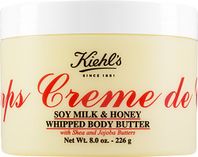
Kiehl's Creme de Corps Soy Milk & Honey Whipped Body Butter
Works for
1 of 1 advertised claim delivered
Moisturizing12 ingredients credited for this claimGood support
“Luxuriously air-whipped, this body butter absorbs quickly and moisturizes.”
This product can help improve hydration of the skin with the two types of ingredients.
The first type is called “humectants”:
these ingredients help attract water.
When humectants are on the surface of the skin, they “pull in” the moisture from the outside environment, or from
within deeper layers of the skin. The following ingredients in this product do the job:
glycerin.
This product also contains ingredients called “occlusives”. They help reduce the speed with which our skin loses moisture to the outside environment. These ingredients also help soften the upper layer of the skin, so it feels less tight and nicer to the touch. The following ingredients in this product do the job: butyrospermum parkii butter, caprylic/capric triglyceride.
Can it cause trouble?
Irritancy3 strong irritants: Parfum, Coumarin + 1 more — patch-test recommendedHigh risk
Comedogenic2 ingredients rated 2 or more on the 0–5 pore-clogging scale2 flagged
User reviews
Be the first — your take helps the next person decide.
Ingredients
Filter by role to see what each ingredient is doing.
Water~40–60%
Glycerin~4.1–6.1%
- Irritation risk
- Low
One of the best moisturizing ingredients. Naturally present in skin. It attracts water to the upper layer of the skin working as a humectant
More about GlycerinCaprylic/capric triglyceride~3.7–5.5%
- Irritation risk
- Medium
A good mix of fatty acids that forms a protective layer on the skin. Improves the shelf life of products. Derived from coconut and glycerin
More about Caprylic/capric triglycerideNylon-66~2.7–4.1%
- Irritation risk
- Low
Butyrospermum parkii butter~2.1–3.1%
- Irritation risk
- Low
- Comedogenicity
- 3/5
A great moisturising ingredient that softens the skin and reduces water loss from its upper layer. It also can be helpful in protecting skin from free radicals
More about Butyrospermum parkii butterGlyceryl stearate~1.7–2.5%
- Irritation risk
- Low
An emollient that softens the skin and forms a protective layer on its surface. Helps water and oil mix together
More about Glyceryl stearatePeg-7 glyceryl cocoate~1.4–2.1%
- Irritation risk
- Medium
Helps oils and water mix together and works as a cleansing agent
More about Peg-7 glyceryl cocoatePeg-40 stearate~1.2–1.8%
Squalane~1.1–1.6%
- Irritation risk
- Low
An oil naturally present in skin. Works as an emollient to soften the skin and form a protective layer on its surface without a greasy feeling.
More about SqualaneMyristyl myristate~0.85–1.3%
- Irritation risk
- Medium
- Comedogenicity
- 3/5
An emollient. Is not recommended for acne-prone skin as it can be comedogenic
More about Myristyl myristateAmmonium polyacryloyldimethyl taurate~0.45–1.1%
- Irritation risk
- Low
Used to create a thicker product consistency
More about Ammonium polyacryloyldimethyl taurateSimmondsia chinensis butter~0.35–0.85%
- Irritation risk
- Medium
Helps soften the upper layer of the skin
More about Simmondsia chinensis butterSorbitan tristearate~0.35–0.8%
- Irritation risk
- Medium
Helps oil and water mix together
More about Sorbitan tristearateParfum~0.2–0.8%
- Irritation risk
- High
An aromatic blend of unspecified and possibly irritating ingredients
More about ParfumUndecane~0.2–0.8%
- Irritation risk
- Medium
Helps create a non-greasy finish on the skin
More about UndecanePhenoxyethanol~0.2–0.75%
- Irritation risk
- Low
A preservative. It helps prevent bacterial growth in cosmetic products
More about PhenoxyethanolCetyl alcohol~0.3–0.7%
- Irritation risk
- Low
A non-drying alcohol that works to soften the skin and stabilize product formulations helping oil and water mix together
More about Cetyl alcoholTridecane~0.15–0.6%
Tocopherol~0.15–0.6%
- Irritation risk
- Low
Pure form of vitamin E. Can help moisturise and protect the skin from free radicals. Often used to help stabilise other ingredients or the formula itself
More about TocopherolSorbic acid~0.15–0.55%
Trisodium ethylenediamine disuccinate~0.1–0.45%
- Irritation risk
- Medium
Used to improve stability of the formulation
More about Trisodium ethylenediamine disuccinateChlorhexidine digluconate~0.15–0.3%
Pentaerythrityl tetra-di-t-butyl hydroxyhydrocinnamate~0.1–0.4%
- Irritation risk
- Low
Used to increase stability of product formulations
More about Pentaerythrityl tetra-di-t-butyl hydroxyhydrocinnamateT-butyl alcohol~0.1–0.3%
- Irritation risk
- Medium
Used to dissolve other ingredients and to improve smell of products. It could be irritating
More about T-butyl alcoholSodium hydroxide~0.1–0.35%
Coumarin~0.05–0.3%
Stearyl alcohol~0.1–0.45%
- Irritation risk
- Low
An emollient that helps soften the skin
More about Stearyl alcoholMyristyl alcohol~0.1–0.4%
- Irritation risk
- High
Helps to stabilize the product formulation while softening the upper layer of the skin. Can be irritating
More about Myristyl alcoholBenzyl alcohol~0.05–0.15%
- Irritation risk
- High
A preservative. Can be used to mask unpleasant smell. Can be irritating
More about Benzyl alcoholHelianthus annuus seed oil~0.1–0.3%
- Irritation risk
- Low
A great emollient due to its high linoleic acid content. One of the most effective plant oils in helping skin hydration and repairing skin barrier function
More about Helianthus annuus seed oilLimonene~0.05–0.15%
- Irritation risk
- High
A common frangrance that can easily irritate skin, especially if exposed to air, light or heat
More about LimoneneCi 75130~0.05–0.1%
- Irritation risk
- Low
Citric acid~0.01–0.05%
- Irritation risk
- Medium
Can work as an exfoliant but is typically used to adjust the product pH
More about Citric acidIngredient list view
Water, Glycerin, Caprylic/capric triglyceride, Nylon-66, Butyrospermum parkii butter, Glyceryl stearate, Peg-7 glyceryl cocoate, Peg-40 stearate, Squalane, Myristyl myristate, Ammonium polyacryloyldimethyl taurate, Simmondsia chinensis butter, Sorbitan tristearate, Parfum, Undecane, Phenoxyethanol, Cetyl alcohol, Tridecane, Tocopherol, Sorbic acid, Trisodium ethylenediamine disuccinate, Chlorhexidine digluconate, Pentaerythrityl tetra-di-t-butyl hydroxyhydrocinnamate, T-butyl alcohol, Sodium hydroxide, Coumarin, Stearyl alcohol, Myristyl alcohol, Benzyl alcohol, Helianthus annuus seed oil, Limonene, Ci 75130, Citric acid
Compare prices
Retailers ranked by price — lowest first.


Sources cited in this review
Every concentration estimate and effectiveness label is anchored to one of these 14 studies and safety reviews.
- 1
- 2
- 3
- 4Vitamin E in dermatologyncbi.nlm.nih.gov
- 5Vitamin E and Skin Healthlpi.oregonstate.edu
- 6

Affiliate links · As an Amazon Associate, WIMJ earns from qualifying purchases.