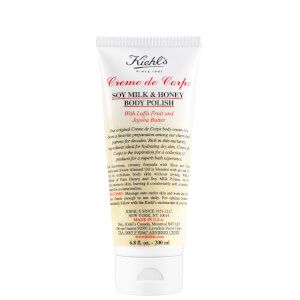
Kiehl's Creme de Corps Soy Milk and Honey Body Polish
Works for
1 of 2 advertised claims delivered
Moisturizing17 ingredients credited for this claimGood support
“Infused with honey, the body polish helps to drench your skin in hydration, which is emphasised by nourishing shea butter.”
This product can help improve hydration of the skin with the two types of ingredients.
The first type is called “humectants”:
these ingredients help attract water.
When humectants are on the surface of the skin, they “pull in” the moisture from the outside environment, or from
within deeper layers of the skin. The following ingredients in this product do the job:
glycerin, honey.
This product also contains ingredients called “occlusives”. They help reduce the speed with which our skin loses moisture to the outside environment. These ingredients also help soften the upper layer of the skin, so it feels less tight and nicer to the touch. The following ingredients in this product do the job: hydrogenated jojoba oil, isopropyl myristate.
Exfoliation2 ingredients credited for this claimWeak support
“A boost of soy milk protein assists with locking in softness, as the body polish provides a gentle exfoliation.”
This product does not contain effective exfoliating ingredients. It might be able to deliver physical exfoliation, that is scrub off some of the dead cells on the surface of the skin. We do not recommend physical exfoliation, because it is not uniform (some bits of skin can get exfoliated too much while others not at all). It can also traumatize the skin and aggrevate acne and other skin conditions.
Can it cause trouble?
Irritancy2 strong irritants: Parfum, CoumarinMedium risk
Comedogenic5 ingredients rated 2 or more on the 0–5 pore-clogging scale5 flagged


User reviews
Be the first — your take helps the next person decide.
Ingredients
Filter by role to see what each ingredient is doing.
Water~45–55%
Hydrogenated castor oil~4.3–5.3%
- Irritation risk
- Medium
A plant oil that can help soften the skin. It might be helpful in calming down inflammation, but solid research is lacking. Is often used in lip products to create the needed product consistency
More about Hydrogenated castor oilSodium laureth sulfate~5.4–6.6%
- Irritation risk
- High
- Comedogenicity
- 2/5
Works as a foaming cleansing agent
More about Sodium laureth sulfateSodium coco-sulfate~3.3–4%
Glycerin~2.4–2.9%
- Irritation risk
- Low
One of the best moisturizing ingredients. Naturally present in skin. It attracts water to the upper layer of the skin working as a humectant
More about GlycerinPrunus armeniaca seed powder~2–2.4%
- Irritation risk
- Low
Polysorbate 20~1.6–2%
Acrylates copolymer~1.4–1.7%
- Irritation risk
- Medium
Used to stabilize product formulation, help create an even product layer over skin (for example, in sunscreen) and create a thicker product consistency
More about Acrylates copolymerCocamide mipa~1.1–1.4%
- Irritation risk
- Low
Surfactant - foam booster, viscosity increasing agent - aqueous, emulsifying, emulsion stabilising, foam boosting, surfactant, and viscosity controlling. Comes from coconut acid. Doesn't appear to be a common irritant
More about Cocamide mipaGlyceryl stearate~1–1.2%
- Irritation risk
- Low
An emollient that softens the skin and forms a protective layer on its surface. Helps water and oil mix together
More about Glyceryl stearateGlycol distearate~0.75–1.1%
- Irritation risk
- Medium
Helps water and oil mix together
More about Glycol distearateLaureth-2~0.65–0.95%
Oryza sativa starch~0.5–0.8%
- Irritation risk
- Low
Triethanolamine~0.45–0.7%
- Irritation risk
- Medium
Used to adjust pH of the product and can help improve the product's smell
More about TriethanolamineParfum~0.4–0.6%
- Irritation risk
- High
An aromatic blend of unspecified and possibly irritating ingredients
More about ParfumPeg-20 methyl glucose sesquistearate~0.45–0.7%
- Irritation risk
- Medium
Helps oil and water mix together
More about Peg-20 methyl glucose sesquistearateHydrogenated jojoba oil~0.5–0.75%
- Irritation risk
- Low
Helps soften the upper layer of the skin
More about Hydrogenated jojoba oilCitric acid~0.35–0.6%
- Irritation risk
- Medium
Can work as an exfoliant but is typically used to adjust the product pH
More about Citric acidCi 77891~0.4–0.6%
- Irritation risk
- Low
Titanium dioxide~0.45–0.7%
- Irritation risk
- Low
Works as a UV filter when used in high concentrations. It is photostable and is effective mostly against the UVB light, with some protection in the UVA range. In small concentrations, used for its ability to improve the color of cosmetic products. Is usually well tolerated by the skin
More about Titanium dioxideSodium benzoate~0.25–0.5%
Hydroxypropyl methylcellulose~0.3–0.55%
- Irritation risk
- Medium
Used to create a thicker product consistency and stabilize the formulation
More about Hydroxypropyl methylcelluloseMethyl glucose sesquistearate~0.3–0.55%
- Irritation risk
- Medium
Helps water and oil mix together
More about Methyl glucose sesquistearatePropylene glycol~0.25–0.5%
- Irritation risk
- High
Helps oil and water mix together and can enhance the penetration of other ingredients into the skin. It can be irritating
More about Propylene glycolLuffa cylindrica~0.35–0.6%
- Irritation risk
- Low
Luffa cylindrica fruit~0.35–0.65%
- Irritation risk
- Low
Salicylic acid~0.25–0.5%
- Irritation risk
- High
Used for skin exfoliation. It has an anti-inflammatory and anti-bacterial effect, helps to unclog pores, prevent blemishes and speed up healing of the existing ones. Sometimes referred to as a BHA (beta-hydroxy acid)
More about Salicylic acidMel~0.3–0.55%
- Irritation risk
- Low
Helps to soften the upper layer of the skin and attract water to it
More about MelHoney~0.25–0.5%
- Irritation risk
- Low
Helps attract water to the skin and might have some anti-bacterial properties. Can be an allergen
More about HoneyCoconut alcohol~0.3–0.6%
Sodium sulfate~0.25–0.45%
- Irritation risk
- Medium
Used to improve the product consistency and stabilize formulations
More about Sodium sulfateSodium chloride~0.25–0.5%
- Irritation risk
- Low
Used to stabilize mixtures of oil and water, and create thicker, gel-like product textures
More about Sodium chlorideCoumarin~0.25–0.45%
Isopropyl palmitate~0.25–0.5%
- Irritation risk
- Medium
- Comedogenicity
- 3/5
Helps soften the upper layer of the skin and create a thicker product consistency
More about Isopropyl palmitateZea mays germ oil~0.3–0.5%
- Irritation risk
- Low
- Comedogenicity
- 2/5
Allantoin~0.2–0.4%
- Irritation risk
- Low
Helps calm down inflammation in skin and can help reduce itching. Helps to repair the skin barrier and keep skin hydrated
More about AllantoinSesamum indicum seed oil~0.25–0.5%
- Irritation risk
- Low
A good moisturizing plant oil. Due to the high linoleic acid content, it helps soften the upper layer of the skin, reduce water loss and support skin barrier function
More about Sesamum indicum seed oilSimmondsia chinensis butter~0.2–0.4%
- Irritation risk
- Medium
Helps soften the upper layer of the skin
More about Simmondsia chinensis butterPrunus amygdalus dulcis seed~0.2–0.4%
- Irritation risk
- Low
Helps soften the upper layer of the skin
More about Prunus amygdalus dulcis seedButyrospermum parkii butter~0.25–0.45%
- Irritation risk
- Low
- Comedogenicity
- 3/5
A great moisturising ingredient that softens the skin and reduces water loss from its upper layer. It also can be helpful in protecting skin from free radicals
More about Butyrospermum parkii butterIsopropyl myristate~0.2–0.35%
- Irritation risk
- Low
- Comedogenicity
- 3/5
An emollient that helps soften the skin. Could be comedogenic
More about Isopropyl myristateHydrolyzed soy protein~0.15–0.25%
- Irritation risk
- Low
Helps attract water to the upper layer of the skin. Might have some anti-aging, anti-oxidant, and skin lightening properties, but solid evidence is missing
More about Hydrolyzed soy proteinSorbitol~0.15–0.25%
- Irritation risk
- Low
Helps attract water to the upper layer of the skin and improves the product texture
More about SorbitolAloe barbadensis leaf extract~0.15–0.3%
- Irritation risk
- Medium
Traditionally used to treat sunburns, dermatitis and inflammation, but evidence for its effectiveness is lacking. The extract can contain humectants that help attract water into the skin
More about Aloe barbadensis leaf extractTocopherol~0.1–0.15%
- Irritation risk
- Low
Pure form of vitamin E. Can help moisturise and protect the skin from free radicals. Often used to help stabilise other ingredients or the formula itself
More about TocopherolIngredient list view
Water, Hydrogenated castor oil, Sodium laureth sulfate, Sodium coco-sulfate, Glycerin, Prunus armeniaca seed powder, Unknown, Polysorbate 20, Acrylates copolymer, Cocamide mipa, Glyceryl stearate, Glycol distearate, Laureth-2, Oryza sativa starch, Triethanolamine, Parfum, Peg-20 methyl glucose sesquistearate, Hydrogenated jojoba oil, Citric acid, Ci 77891, Titanium dioxide, Sodium benzoate, Hydroxypropyl methylcellulose, Methyl glucose sesquistearate, Propylene glycol, Luffa cylindrica, Luffa cylindrica fruit, Salicylic acid, Mel, Honey, Coconut alcohol, Sodium sulfate, Sodium chloride, Coumarin, Isopropyl palmitate, Zea mays germ oil, Unknown, Allantoin, Sesamum indicum seed oil, Simmondsia chinensis butter, Prunus amygdalus dulcis seed, Butyrospermum parkii butter, Isopropyl myristate, Hydrolyzed soy protein, Sorbitol, Aloe barbadensis leaf extract, Tocopherol
Compare prices
Retailers ranked by price — lowest first.

Worth comparing, line by line.
Match % combines shared ingredients, the first five ingredients, shared actives and hero ingredients, irritancy (lower counts in the alternative's favour), texture and body area. Only products in the same routine step are compared.
| Kiehl'sCreme de Corps Soy Milk and Honey Body PolishYOUR PRODUCT | Vita LiberataFabulous Self Tanning Gradual Lotion | SVRXERIAL 30 Body Cream | Paula's choiceSkin Revealing Body Lotion 10% AHA | |
|---|---|---|---|---|
| Match | — | 82% | 81% | 80% |
| Price | $33.05 | $9.89−$23.16 | $19.83−$13.22 | $22.40−$10.65 |
| Shared key ingredients | — | 3 of 10 | 4 of 10 | 2 of 10 |
| Key difference | — | Panthenol | Mineral Oil | Tetrahexyldecyl Ascorbate |
| Irritancy | Medium | Low | Low | Low |
| Drying alcohol | — | — | — | — |
| View product | Shop | Shop | Shop |


Sources cited in this review
Every concentration estimate and effectiveness label is anchored to one of these 24 studies and safety reviews.
- 1
- 2
- 3
- 4Surfactants and experimental irritant contact dermatitisncbi.nlm.nih.gov
- 5
- 6

Affiliate links · As an Amazon Associate, WIMJ earns from qualifying purchases.