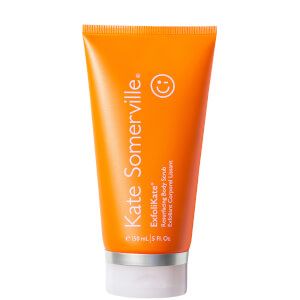
Kate Somerville ExfoliKate™ Resurfacing Body Scrub
Works for
2 of 2 advertised claims delivered
Exfoliation3 ingredients credited for this claimStrong support
“triple-action exfoliating body scrub + peel + mask”
This product can help exfoliate the skin. In other words, it helps break down the bonds between dead cells on the surface of the skin and speed up the skin turnover. Skin often appears softer and brighter after exfoliation, but overdoing it can result in disrupted skin barrier. The following ingredient is doing the exfoliating job in this product: lactic acid.
Moisturizing7 ingredients credited for this claimGood support
“nourishing botanical enzymes”
This product can help improve hydration of the skin with the two types of ingredients.
The first type is called “humectants”:
these ingredients help attract water.
When humectants are on the surface of the skin, they “pull in” the moisture from the outside environment, or from
within deeper layers of the skin. The following ingredients in this product do the job:
glycerin, lactic acid.
This product also contains ingredients called “occlusives”. They help reduce the speed with which our skin loses moisture to the outside environment. These ingredients also help soften the upper layer of the skin, so it feels less tight and nicer to the touch. The following ingredients in this product do the job: glycine soja oil, cetearyl alcohol.
Evens skin toneNot advertised by the brand · 2 ingredients credited for this claimStrong support
This product can help reduce hypepigmentation and even out the skin tone because it contains the following effective ingredients: lactic acid
Keep in mind that you would need to apply any topical skincare targetted at hypigmentation consistently for a couple of months to get a result. No topical skincare product can help get rid of hyperpigmentation (including post-acne marks and age spots) instantly.
Anti-agingNot advertised by the brand · 1 ingredient credited for this claimModerate support
This product contains lactic acid. This ingredient might be able to help reduce and prevent fine lines and wrinkles, improve skin elasticity and firmness, but there is not enough evidence that it actually works.
Can it cause trouble?
Irritancy7 strong irritants: Lavandula angustifolia oil, Aniba rosodora wood oil + 5 more — patch-test recommendedHigh risk
Comedogenic4 ingredients rated 2 or more on the 0–5 pore-clogging scale4 flagged


User reviews
Be the first — your take helps the next person decide.
Ingredients
Filter by role to see what each ingredient is doing.
Water~45–55%
Pumice~4.6–5.6%
- Irritation risk
- Low
Milled volcanic rock. Used as an abrasive for physical exfoliation
More about PumiceLactic acid~3.8–4.7%
- Irritation risk
- Medium
An exfoliating and moisturizing alpha-hydroxy acid (AHA). Typically causes less irritation than other AHAs, for example, glycolic acid. At high concentrations (about 15%), lactic acid can help reduce lines and wrinkles. Recent studies show that lactic acid can support the "good" bacteria living on skin's surface (healthy skin microbiome)
More about Lactic acidGlycine soja oil~3–3.7%
- Irritation risk
- Medium
- Comedogenicity
- 2/5
A good emollient that helps soften the skin and helps repair its barrier function. It can clog pores if used in high concentrations.
More about Glycine soja oilSodium cocoyl isethionate~2.5–3%
- Irritation risk
- Medium
Helps water and oil mix together. Can be used as a cleansing agent
More about Sodium cocoyl isethionateGlycerin~2–2.5%
- Irritation risk
- Low
One of the best moisturizing ingredients. Naturally present in skin. It attracts water to the upper layer of the skin working as a humectant
More about GlycerinCetearyl alcohol~1.7–2.1%
- Irritation risk
- Low
- Comedogenicity
- 2/5
A non-drying alcohol. Works as an emollient. Helps water and oil mix together and creates a nice product texture
More about Cetearyl alcoholSodium hydroxide~1.4–1.8%
Stearyl alcohol~1.3–1.6%
- Irritation risk
- Low
An emollient that helps soften the skin
More about Stearyl alcoholCapryloyl glycerin/sebacic acid copolymer~1–1.2%
- Irritation risk
- Low
Helps soften the upper layer of the skin
More about Capryloyl glycerin/sebacic acid copolymerGlyceryl stearate~0.75–1.15%
- Irritation risk
- Low
An emollient that softens the skin and forms a protective layer on its surface. Helps water and oil mix together
More about Glyceryl stearate1,2-hexanediol~0.6–0.9%
Caffeine~0.55–0.85%
- Irritation risk
- Medium
Might be helpful in neutralizing free radicals. Can have a dehydration effect that might somewhat decrease the look of puffy eyes
More about CaffeineLactobacillus/pumpkin fruit ferment filtrate~0.5–0.75%
- Irritation risk
- Low
Leuconostoc/radish root ferment filtrate~0.5–0.75%
- Irritation risk
- Medium
A preservative that comes from radishes fermented by a bacteria. New research suggests that the preservation properties in the ingredient come from an ammonium salt that is not present naturally in radish root but used in its cultivation. Is problematic because the exact amount of the preservative agents is difficult to determine
More about Leuconostoc/radish root ferment filtrateAloe barbadensis leaf extract~0.55–0.8%
- Irritation risk
- Medium
Traditionally used to treat sunburns, dermatitis and inflammation, but evidence for its effectiveness is lacking. The extract can contain humectants that help attract water into the skin
More about Aloe barbadensis leaf extractBromelain~0.45–0.7%
- Irritation risk
- Low
Papain~0.45–0.65%
- Irritation risk
- High
An enzyme extracted from papaya fruit. Can have an exfoliating effect on the skin. Can be irritating
More about PapainSodium acrylate/sodium acryloyldimethyl taurate copolymer~0.4–0.6%
- Irritation risk
- Low
Used to create a thicker product consistency
More about Sodium acrylate/sodium acryloyldimethyl taurate copolymerSalicylic acid~0.35–0.6%
- Irritation risk
- High
Used for skin exfoliation. It has an anti-inflammatory and anti-bacterial effect, helps to unclog pores, prevent blemishes and speed up healing of the existing ones. Sometimes referred to as a BHA (beta-hydroxy acid)
More about Salicylic acidPolyisobutene~0.4–0.6%
Maltodextrin~0.35–0.6%
- Irritation risk
- Low
Used to stabilize the product formulation and can help absorb oil
More about MaltodextrinCoconut acid~0.45–0.7%
Sodium isethionate~0.35–0.65%
- Irritation risk
- Low
Lavandula angustifolia oil~0.3–0.55%
- Irritation risk
- High
An essential oil. Potential allergen and can be irritating. It has some anti-bacterial properties
More about Lavandula angustifolia oilCeteareth-20~0.45–0.65%
- Irritation risk
- Medium
- Comedogenicity
- 2/5
Helps oil and water mix together. Has some emollient properties
More about Ceteareth-20Caprylyl/capryl glucoside~0.4–0.65%
- Irritation risk
- Medium
Helps oil and water mix together. Can be used as a cleansing agent
More about Caprylyl/capryl glucosidePeg-40 stearate~0.3–0.6%
Aniba rosodora wood oil~0.3–0.55%
Citrus aurantium bergamia fruit oil~0.25–0.45%
- Irritation risk
- High
A plant oil with a high content of volatile compounds that can irritate the skin and lead to allergic reactions. Can lead to photosensitivity
More about Citrus aurantium bergamia fruit oilPelargonium graveolens flower oil~0.3–0.55%
- Irritation risk
- High
An essential oil. Can be irritating. Can become an allergen with oxidation
More about Pelargonium graveolens flower oilCitrus aurantium dulcis peel oil~0.25–0.5%
- Irritation risk
- High
An essentil oil from orange peel. Potential allergen and can be irritating
More about Citrus aurantium dulcis peel oilSorbitan oleate~0.25–0.5%
- Irritation risk
- Medium
- Comedogenicity
- 2/5
Helps oil and water mix together
More about Sorbitan oleatePotassium sorbate~0.25–0.45%
Xanthan gum~0.25–0.4%
- Irritation risk
- Low
Used to create a thicker product consistency
More about Xanthan gumDisodium edta~0.2–0.35%
Phenoxyethanol~0.15–0.25%
- Irritation risk
- Low
A preservative. It helps prevent bacterial growth in cosmetic products
More about PhenoxyethanolEthylhexylglycerin~0.15–0.25%
Citric acid~0.1–0.2%
- Irritation risk
- Medium
Can work as an exfoliant but is typically used to adjust the product pH
More about Citric acidLimonene~0.1–0.2%
- Irritation risk
- High
A common frangrance that can easily irritate skin, especially if exposed to air, light or heat
More about LimoneneLinalool~0.05–0.15%
Ci 75810~0.05–0.15%
- Irritation risk
- Low
Ingredient list view
Water, Pumice, Lactic acid, Glycine soja oil, Sodium cocoyl isethionate, Glycerin, Cetearyl alcohol, Sodium hydroxide, Stearyl alcohol, Capryloyl glycerin/sebacic acid copolymer, Glyceryl stearate, 1,2-hexanediol, Caffeine, Lactobacillus/pumpkin fruit ferment filtrate, Leuconostoc/radish root ferment filtrate, Aloe barbadensis leaf extract, Bromelain, Papain, Unknown, Sodium acrylate/sodium acryloyldimethyl taurate copolymer, Salicylic acid, Polyisobutene, Maltodextrin, Coconut acid, Sodium isethionate, Lavandula angustifolia oil, Ceteareth-20, Caprylyl/capryl glucoside, Peg-40 stearate, Aniba rosodora wood oil, Citrus aurantium bergamia fruit oil, Pelargonium graveolens flower oil, Citrus aurantium dulcis peel oil, Sorbitan oleate, Potassium sorbate, Xanthan gum, Disodium edta, Phenoxyethanol, Ethylhexylglycerin, Citric acid, Limonene, Linalool, Ci 75810
Compare prices
Retailers ranked by price — lowest first.


Worth comparing, line by line.
Match % combines shared ingredients, the first five ingredients, shared actives and hero ingredients, irritancy (lower counts in the alternative's favour), texture and body area. Only products in the same routine step are compared.
| Kate SomervilleExfoliKate™ Resurfacing Body ScrubYOUR PRODUCT | PacificaGlow Baby Body Peel | DermadoctorKP Duty High Potency Daily Body Peel | StackedSkincareTCA Lactic & Glycolic Body Peel | |
|---|---|---|---|---|
| Match | — | 88% | 87% | 86% |
| Price | $56.00 | $9.80−$46.20 | $54.95−$1.05 | $109.00+$53.00 |
| Shared key ingredients | — | 3 of 5 | 3 of 5 | 3 of 5 |
| Key difference | — | Glycolic Acid | Lactobionic Acid | Glycolic Acid |
| Irritancy | High | Medium | Medium | Medium |
| Drying alcohol | — | — | — | Contains drying alcohol |
| View product | Shop | Shop | Shop |


Product summary
"Kate Somerville - ExfoliKate™ Resurfacing Body Scrub" is effective for: Exfoliation and Evens skin tone
This product could be helpful for: Moisturizing and Anti-aging, but its actives are not the most effective or are not well-studied.
Ingredient callouts
- This product contains acids (lactic acid 3.80% - 4.70%). Their concentration is low, and they will not have a strong exfoliating effect. Instead, they work to support the skin natural acid mantle and to attract water (as humectants). Lactic acid is particularly good in attracting water to the upper layer of the skin and improving the skin barrier.
- Humectants (glycerin 2.00% - 2.50% and lactic acid 3.80% - 4.70%). These ingredients help attract water to the upper layer of the skin and improve the skin hydration.
About the brand
According to Cruelty-Free Kitty "Kate Somerville" is cruelty free, but its parent company is not.
Price
The product retails from 56.00$ up to 66.30$ in the United States, for 48.00£ in the United Kingdom and for 74.00CA$ in Canada.
For a detailed price comparison: click here.
Sources cited in this review
Every concentration estimate and effectiveness label is anchored to one of these 15 studies and safety reviews.
- 1Epidermal and dermal effects of topical lactic acidncbi.nlm.nih.gov
- 2Dual Effects of Alpha-Hydroxy Acids on the Skinpdfs.semanticscholar.org
- 3Final Report on the Safety Assessment of Sodium Cocoyl Isethionatejournals.sagepub.com
- 4
- 5
- 6Salicylic acid as a peeling agent: a comprehensive reviewncbi.nlm.nih.gov

Affiliate links · As an Amazon Associate, WIMJ earns from qualifying purchases.