Works for
1 of 2 advertised claims delivered
Moisturizing5 ingredients credited for this claimGood support
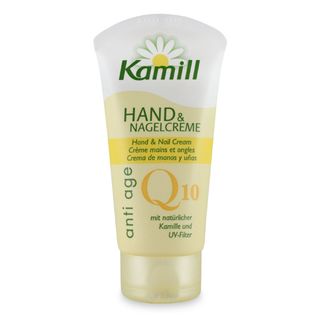
“Anti Age Q10 Hand + Nail Cream”
This product contains good ingredients to attract water to the upper layer of the skin. These ingredients are called "humectants": glycerin, glucose.
When humectants are on the surface of the skin, they “pull in” the moisture from the outside environment, or from within deeper layers of the skin. If the air is dry, humectants can speed up the moisture loss from the skin. This is why it is a good idea to use another product on top of this one to help "seal in" the moisture (look for ingredients like dimethicone, squalane, oils and butters).
Anti-aging2 ingredients credited for this claimWeak support
“Anti Age Q10 Hand + Nail Cream”
Effective ingredients missing or their concentration is too low.
Can it cause trouble?
Irritancy2 strong irritants: Alcohol, Parfum — patch-test recommendedHigh risk
ComedogenicClean of flagged comedogenic ingredientsNone flagged
User reviews
Be the first — your take helps the next person decide.
Ingredients
Filter by role to see what each ingredient is doing.
Water~40–60%
Ethylhexyl stearate~5.4–8.1%
- Irritation risk
- Low
Helps soften the upper layer of the skin
More about Ethylhexyl stearateGlycerin~3.6–5.4%
- Irritation risk
- Low
One of the best moisturizing ingredients. Naturally present in skin. It attracts water to the upper layer of the skin working as a humectant
More about GlycerinAlcohol~2.8–4.1%
- Irritation risk
- High
Can be drying and contribute to skin irritation. Used in formulars to dissolve other ingredients, create a thinner product consistency or for its antibacterial properties
More about AlcoholGlyceryl stearate~2–3.1%
- Irritation risk
- Low
An emollient that softens the skin and forms a protective layer on its surface. Helps water and oil mix together
More about Glyceryl stearateGlycine soja extract~1.6–2.5%
- Irritation risk
- Low
Chamomilla recutita extract~1.4–2.1%
- Irritation risk
- High
Plant extract that can have healing and anti-inflammatory properties. It is a potential allergen and can be irritating
More about Chamomilla recutita extractBisabolol~1.2–1.8%
- Irritation risk
- Low
An active component of chamomile plant that historically has been used to calm down irritated skin. A recent study shows that bisabolol indeed can have some anti-inflammatory effect on skin, even though conclusive data is lacking. Bisabolol has a sweet floral scent and can be added to products for its aromatic properties
More about BisabololGlucose~1–1.5%
- Irritation risk
- Low
Helps attract water to the upper layer of the skin. Could be helpful in restoring the skin barrier function
More about GlucoseTocopheryl acetate~0.55–1.3%
- Irritation risk
- Medium
A more stable but less bio-available form of vitamin E compared to Tocopherol. Might help moisturize and protect the skin from free radicals, but mostly used in low concentrations to stabilize other ingredients.
More about Tocopheryl acetateSodium ascorbyl phosphate~0.45–1%
- Irritation risk
- Medium
A stable derivative of vitamin C. It is oil-soluble which means it is more likely to penetrate the skin compared to the pure form of vitamin C (which is water-soluble), but it is less bio-available and is way less effective in stimulating collagen and reducing wrinkles compared to the pure form of vitamin C (L-ascorbic acid) and its other derivatives (for example, magnesium ascorbyl phosphate). At the same time, this vitamin C derivative has been shown in studies to be effective in reducing acne, blemishes and clogged pores. It is less irritating then the pure form of vitamin C
More about Sodium ascorbyl phosphateAscorbyl palmitate~0.35–0.8%
- Irritation risk
- Medium
Being a lipid soluble form of vitamin C, it is more stable and can penetrate the skin better than L-Ascorbic acid. It is effective in protecting the skin from free radicals, as well as evening the skin tone, but is less effective in stimulating collagen production compared to L-Ascorbic acid.
More about Ascorbyl palmitateTitanium dioxide~0.45–1.05%
- Irritation risk
- Low
Works as a UV filter when used in high concentrations. It is photostable and is effective mostly against the UVB light, with some protection in the UVA range. In small concentrations, used for its ability to improve the color of cosmetic products. Is usually well tolerated by the skin
More about Titanium dioxideCyclopentasiloxane~0.3–0.75%
- Irritation risk
- Low
A silicone that helps improve the product texture and spreadability. Can absorb oil creating a short-term mattifying effect on the skin
More about CyclopentasiloxaneCarbomer~0.15–0.6%
- Irritation risk
- Low
Helps create a thicker or gel-like product texture. It is not a surfactant but can be used in gentle cleansing formulations
More about CarbomerAlcohol~0.1–0.5%
- Irritation risk
- High
Can be drying and contribute to skin irritation. Used in formulars to dissolve other ingredients, create a thinner product consistency or for its antibacterial properties
More about AlcoholParfum~0.1–0.35%
- Irritation risk
- High
An aromatic blend of unspecified and possibly irritating ingredients
More about ParfumSodium hydroxide~0.1–0.35%
Phenoxyethanol~0.05–0.2%
- Irritation risk
- Low
A preservative. It helps prevent bacterial growth in cosmetic products
More about PhenoxyethanolMethylparaben~0.05–0.1%
Ethylparaben~0.05–0.2%
Butylparaben~0.05–0.15%
Propylparaben~0.05–0.15%
Isobutylparaben~0.01–0.1%
Ingredient list view
Water, Ethylhexyl stearate, Glycerin, Unknown, Alcohol, Glyceryl stearate, Glycine soja extract, Chamomilla recutita extract, Bisabolol, Glucose, Tocopheryl acetate, Sodium ascorbyl phosphate, Ascorbyl palmitate, Titanium dioxide, Cyclopentasiloxane, Carbomer, Alcohol, Parfum, Sodium hydroxide, Phenoxyethanol, Methylparaben, Ethylparaben, Butylparaben, Propylparaben, Isobutylparaben
Compare prices
Retailers ranked by price — lowest first.
.png)
Sources cited in this review
Every concentration estimate and effectiveness label is anchored to one of these 11 studies and safety reviews.
- 1
- 2
- 3
- 4
- 5Sodium ascorbyl phosphate in topical microemulsionssciencedirect.com
- 6

Affiliate links · As an Amazon Associate, WIMJ earns from qualifying purchases.