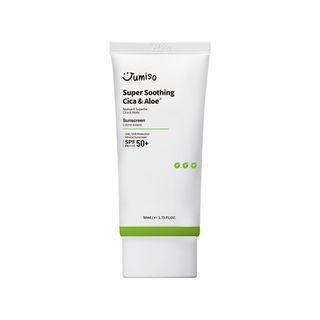
JUMISO Super Soothing Cica & Aloe Sunscreen
Works for
1 of 1 advertised claim delivered
Sun protectionSPF 50 · 3 UV filtersBroad spectrum
This product offers a good level of protection against both UVB and UVA rays.
This sunscreen uses organic (so-called "chemical") sunscreen filters. Organic, or "chemical" filters usually provide reliable sun protection and rarely leave a white cast. Sunscreens with organic filters can sting eyes.
This product can be considered "reef safe" because it does not contain the UV filters (oxybenzone and octinoxate) that can be harmful to coral reefs when present in the water in high concentrations.
Evens skin toneNot advertised by the brand · No ingredient credited for this claimStrong evidence
This product offers broad spectrum sun protection. It means that it can prevent hyperpigmentation and help keep the skin tone even (sun damage is the main factor causing age spots, darkening of post-acne marks and other discolorations).
Anti-agingNot advertised by the brand · Centella asiatica extract, Tocopherol + 1 moreStrong evidence
This product can help prevent early signs of skin aging because it offers a good level of broad spectrum sun protection. Sun damage is the main cause of premature skin aging, and protecting your skin from the sun is the best anti-aging strategy.
These ingredients in the product might also be helpful for reducing and preventing fine lines, wrinkles, and skin elasticity, even though there is no conclusive evidence for their effectiveness: centella asiatica extract.
Anti-oxidationNot advertised by the brand · Centella asiatica extract, Ascorbyl palmitate + 1 moreModerate evidence
This product contains antioxidants (centella asiatica extract) that might be able to help neutralize free radicals in skin to lessen the damage it gets from the UV light (sun). There is not enough evidence to confirm their effectiveness in skin though.
Can it cause trouble?
Irritancy15 flagged ingredientsLow risk
ComedogenicClean of flagged comedogenic ingredientsNone flagged
User reviews
Be the first — your take helps the next person decide.
Ingredients
Filter by role to see what each ingredient is doing.
Water~45–55%
Zinc oxide~10–13%
- Irritation risk
- Low
A broad spectrum sunblock (protects from both UVA and UVB rays). Is suitable for most sensitive skins. In small concentrations, can be used as a colorant
More about Zinc oxideCi 77947~5.7–7%
- Irritation risk
- Low
Isononyl isononanoate~4.1–5%
- Irritation risk
- Low
Forms a protective film on the surface of the skin to prevent moisture loss. Gives a velvety feel to products while reducing tackiness
More about Isononyl isononanoateButyloctyl salicylate~3.4–4.1%
- Irritation risk
- Medium
A synthetic ester of salicylic acid that is used to help disperse pigments and boost effectiveness of sunscreen ingredients. It is able to absorb UV light (working as an organic, or chemical filter), but is not approved as a sunscreen ingredient on its own
More about Butyloctyl salicylateCaprylyl methicone~2.8–3.5%
- Irritation risk
- Low
A type of silicone that helps to soften the upper layer of the skin and create a nice product finish on the skin
More about Caprylyl methiconeHexyl laurate~2.5–3.1%
- Irritation risk
- Medium
Helps soften the upper layer of the skin and create a nice product consistency
More about Hexyl lauratePentaerythrityl tetraethylhexanoate~2.1–2.6%
- Irritation risk
- Low
Used to create a nice product consistency while softening the upper layer of the skin
More about Pentaerythrityl tetraethylhexanoateDicaprylyl carbonate~1.6–1.9%
- Irritation risk
- Low
Helps products spread more easily and works as an emollient to soften skin
More about Dicaprylyl carbonateTitanium dioxide~1.7–2.1%
- Irritation risk
- Low
Works as a UV filter when used in high concentrations. It is photostable and is effective mostly against the UVB light, with some protection in the UVA range. In small concentrations, used for its ability to improve the color of cosmetic products. Is usually well tolerated by the skin
More about Titanium dioxideCi 77891~1.1–1.3%
- Irritation risk
- Low
Acrylates copolymer~1–1.2%
- Irritation risk
- Medium
Used to stabilize product formulation, help create an even product layer over skin (for example, in sunscreen) and create a thicker product consistency
More about Acrylates copolymerDipropylene glycol~0.8–1.2%
- Irritation risk
- Low
Helps to dissolve other ingredients in a formulation. Slows down the rate of product drying
More about Dipropylene glycolPropanediol~0.95–1.15%
- Irritation risk
- Low
Acts as a solvent for other ingredients. Speeds up the absorption of other ingredients into the skin
More about PropanediolIsododecane~0.75–1.15%
- Irritation risk
- Low
An emollient that helps soften the skin and can decrease moisture loss. Helps create a nice product texture
More about IsododecaneDisteardimonium hectorite~0.8–1.15%
- Irritation risk
- Low
A type of clay that is used to thicken the product consistency
More about Disteardimonium hectoritePolyglyceryl-4 diisostearate/polyhydroxystearate/sebacate~0.8–1.2%
- Irritation risk
- Medium
Helps water and oil mix together
More about Polyglyceryl-4 diisostearate/polyhydroxystearate/sebacatePolyglyceryl-6 polyhydroxystearate~0.75–1.15%
- Irritation risk
- Medium
Helps oil and water mix together
More about Polyglyceryl-6 polyhydroxystearateCentella asiatica extract~0.7–1.05%
- Irritation risk
- Medium
A plant extract that has been shown to be able to reduce inflammation in skin, support restoration of skin barrier function, as well as support collagen production. Contains active compounds called centelloids: asiaticoside, madecasosside, asiatic acid and madecassic acid. Might be helpful in preventing stretch marks. It can be itself be irritating though.
More about Centella asiatica extractAloe barbadensis leaf extract~0.7–1.05%
- Irritation risk
- Medium
Traditionally used to treat sunburns, dermatitis and inflammation, but evidence for its effectiveness is lacking. The extract can contain humectants that help attract water into the skin
More about Aloe barbadensis leaf extractTrimethylsiloxysilicate~0.65–0.95%
- Irritation risk
- Low
A type of silicone that helps create a nice product consistency and support the delivery of other ingredients
More about TrimethylsiloxysilicatePolyglyceryl-3 polydimethylsiloxyethyl dimethicone~0.6–0.95%
- Irritation risk
- Low
Polyhydroxystearic acid~0.6–0.95%
- Irritation risk
- Medium
Used to create a thicker product consistency and stabilize the formulation
More about Polyhydroxystearic acidMagnesium sulfate~0.55–0.85%
Polyglyceryl-2 isostearate~0.6–0.9%
Dimethicone/vinyl dimethicone crosspolymer~0.55–0.85%
- Irritation risk
- Low
Used to stabilize product formulations and create a nice product texture
More about Dimethicone/vinyl dimethicone crosspolymerTriethoxycaprylylsilane~0.6–0.9%
- Irritation risk
- Low
A type of silicone that helps oil and water mix well together. Helps to disperse other ingredients, e.g. pigments, evenly in a formulation
More about TriethoxycaprylylsilanePolyglyceryl-6 polyricinoleate~0.6–0.9%
- Irritation risk
- Medium
Helps oil and water mix together
More about Polyglyceryl-6 polyricinoleate1,2-hexanediol~0.55–0.8%
Coco-caprylate/caprate~0.5–0.75%
- Irritation risk
- Low
Helps to soften the upper layer of the skin without creating a greasy texture
More about Coco-caprylate/capratePoly c10-30 alkyl acrylate~0.5–0.75%
- Irritation risk
- Low
Aluminum hydroxide~0.5–0.75%
- Irritation risk
- Low
Is used to add opaque (non-transparent) appearance to formulations. Can be used to coat other ingredients for even dispersion. This is a different ingredient compared to the ones used in antipersperants (aluminium chloride and aluminium chlorohydrate)
More about Aluminum hydroxideStearic acid~0.55–0.85%
- Irritation risk
- Low
Helps oil and water mix together and works as an emollient
More about Stearic acidPolyglyceryl-2 dipolyhydroxystearate~0.45–0.7%
- Irritation risk
- Low
Helps to soften the upper layer of the skin
More about Polyglyceryl-2 dipolyhydroxystearateVinyl dimethicone/methicone silsesquioxane crosspolymer~0.45–0.65%
- Irritation risk
- Low
A type of silicone that create a smooth product finish and can create an optical soft-focus effect on the skin. Helps to thicken the product consistency
More about Vinyl dimethicone/methicone silsesquioxane crosspolymerSorbitan isostearate~0.4–0.65%
- Irritation risk
- Low
Helps oil and water mix together
More about Sorbitan isostearateCetyl palmitate~0.4–0.6%
- Irritation risk
- Low
An emollient that helps soften the skin and is used to improve product texture and stability
More about Cetyl palmitateHydroxyacetophenone~0.3–0.55%
Sorbitan olivate~0.3–0.55%
Sorbitan palmitate~0.25–0.5%
- Irritation risk
- Medium
Helps water and oil mix together and stabilize the product formulation
More about Sorbitan palmitateButylene glycol~0.2–0.35%
- Irritation risk
- Low
Used to create a nice product texture and help delivery of other ingredients. Might be somewhat helpful in attracting water to the upper layer of the skin
More about Butylene glycolTrisodium ethylenediamine disuccinate~0.2–0.4%
- Irritation risk
- Medium
Used to improve stability of the formulation
More about Trisodium ethylenediamine disuccinatePolyglycerin-6~0.2–0.35%
- Irritation risk
- Medium
Helps attract water to the upper layer of the skin
More about Polyglycerin-6Tocopherol~0.15–0.25%
- Irritation risk
- Low
Pure form of vitamin E. Can help moisturise and protect the skin from free radicals. Often used to help stabilise other ingredients or the formula itself
More about TocopherolAscorbyl palmitate~0.1–0.2%
- Irritation risk
- Medium
Being a lipid soluble form of vitamin C, it is more stable and can penetrate the skin better than L-Ascorbic acid. It is effective in protecting the skin from free radicals, as well as evening the skin tone, but is less effective in stimulating collagen production compared to L-Ascorbic acid.
More about Ascorbyl palmitateIngredient list view
Water, Zinc oxide, Ci 77947, Isononyl isononanoate, Butyloctyl salicylate, Caprylyl methicone, Hexyl laurate, Pentaerythrityl tetraethylhexanoate, Dicaprylyl carbonate, Titanium dioxide, Ci 77891, Acrylates copolymer, Dipropylene glycol, Propanediol, Isododecane, Disteardimonium hectorite, Polyglyceryl-4 diisostearate/polyhydroxystearate/sebacate, Polyglyceryl-6 polyhydroxystearate, Centella asiatica extract, Aloe barbadensis leaf extract, Trimethylsiloxysilicate, Polyglyceryl-3 polydimethylsiloxyethyl dimethicone, Polyhydroxystearic acid, Magnesium sulfate, Polyglyceryl-2 isostearate, Dimethicone/vinyl dimethicone crosspolymer, Triethoxycaprylylsilane, Polyglyceryl-6 polyricinoleate, 1,2-hexanediol, Coco-caprylate/caprate, Poly c10-30 alkyl acrylate, Aluminum hydroxide, Stearic acid, Polyglyceryl-2 dipolyhydroxystearate, Vinyl dimethicone/methicone silsesquioxane crosspolymer, Sorbitan isostearate, Cetyl palmitate, Hydroxyacetophenone, Sorbitan olivate, Sorbitan palmitate, Butylene glycol, Trisodium ethylenediamine disuccinate, Polyglycerin-6, Tocopherol, Ascorbyl palmitate
Compare prices
Retailers ranked by price — lowest first.

Affiliate links · prices updated regularly
Product summary
We believe that "JUMISO - Super Soothing Cica & Aloe Sunscreen" can provide reliable sun protection based on the ingredients listed. It can protect from both UVA and UVB rays. This is great news because not all sunscreens with SPF ratings give UVA protection. (UVA rays do not cause sunburn, but still damage our skin and lead to early aging).
This product prevents early signs of aging by protecting against sun damage (all broad spectrum sunscreens do that).
Sunscreen filters
This sunscreen uses a mixture of both mineral and organic (so-called "chemical") UV filters. The organic filters in the product are: butyloctyl salicylate. As for the mineral filters, this sunscreen uses both titanium dioxide and zinc oxide.
Irritation risk
This product does not contain known common irritants and is suitable for sensitive skin. We assess the overall irritancy of this moisturizer to be low. For a detailed overview of all potential irritants: click here
You can see the detailed formula review with the breakdown of all actives in the product and the full ingredient list with estimated concentrations in the tables below.
Price
The product retails from 14.80$ up to 19.80$ in the United States.
For a detailed price comparison: click here.
Sources cited in this review
Every concentration estimate and effectiveness label is anchored to one of these 22 studies and safety reviews.
- 1A review of inorganic UV filters zinc oxide and titanium dioxideonlinelibrary.wiley.com
- 2
- 3
- 4
- 5
- 6

Affiliate links · As an Amazon Associate, WIMJ earns from qualifying purchases.