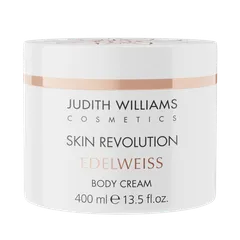
Works for:
based on ingredients and %- Moisturizing
Doesn't work for:
based on ingredients and %- Anti-aging
Can it cause trouble?
- Irritation risk: high
- Comedogenic risk ingredients: 5
Key actives
Moisturizing
What does the product description say?
Skin Revolution Edelweiss Body Cream
Source: From product name
This product can help improve hydration of the skin with the two types of ingredients.
The first type is called “humectants”:
these ingredients help attract water.
When humectants are on the surface of the skin, they “pull in” the moisture from the outside environment, or from
within deeper layers of the skin. The following ingredients in this product do the job:
algae extract, glycerin.
This product also contains ingredients called “occlusives”. They help reduce the speed with which our skin loses moisture to the outside environment. These ingredients also help soften the upper layer of the skin, so it feels less tight and nicer to the touch. The following ingredients in this product do the job: butyrospermum parkii butter, caprylic/capric triglyceride.
One of the best moisturizing ingredients. Attracts water into the upper layer of the skin
A great moisturising ingredient that softens the skin and reduces water loss from its upper layer. It also can be helpful in protecting skin from free radicals
One of the best moisturizing ingredients. Naturally present in skin. It attracts water to the upper layer of the skin working as a humectant
A good mix of fatty acids that forms a protective layer on the skin. Improves the shelf life of products. Derived from coconut and glycerin
Plant extract that helps the skin to attract water and make it more smooth for touch. Also shows promise of anti-aging properties, but research is not extensive yet
Helps soften the upper layer of the skin
An emollient that helps soften the skin and create a nice product texture
A non-drying alcohol. Works as an emollient. Helps water and oil mix together and creates a nice product texture
Helps oil and water mix together and can enhance the penetration of other ingredients into the skin. It can be irritating
An emollient that softens the skin and forms a protective layer on its surface. Helps water and oil mix together
Helps oil and water mix together and works as an emollient
Pure form of vitamin E. Can help moisturise and protect the skin from free radicals. Often used to help stabilise other ingredients or the formula itself
Anti-aging
What does the product description say?
Skin type all skin types Effect soothing Consistency creamy JUDITH WILLIAMS EDELWEISS EXTRACT ✓ soothes & strengthens blood vessels ✓ helps strengthen collagen structure ✓ has an antioxidant effect & protects against free radicals NATURAL FIRMING COMPLEX ✓ helps visibly smooth fine lines and wrinkles ✓ promotes a firmed, youthfully toned complexion NATURAL PROTECTING & SMOOTHING COMPLEX ✓ counteracts photo-aging ✓ supports the skin's own repair mechanisms ✓ has a positive effect on the micro-relief of the skin CALENDULA WATER ✓ has a protective & calming effect ✓ can support the regeneration of the skin ✓ gives delicate skin feeling ARNICA EXTRACT ✓ has a decongestant & calming effect ✓ helps to alleviate skin redness ✓ moisturizing & nourishing VITAMIN E ✓ helps to soften wrinkles ✓ can stimulate the enzyme activity of the skin ✓ helps improve skin elasticity SHEA BUTTER ✓ nutrient-rich moisturizer ✓ promotes healthy skin radiance & silky skin feel HYALURONIC ACID ✓ intensively moisturizes ✓ Promotes plump & smooth skin texture COFFIN ✓ improves cell metabolism ✓ supports visually firmer & smoother skin appearance
Source: N/A
This product does not contain ingredients that are able to reduce fine lines and wrinkles or help with skin elasticity, but it can improve the look of the skin temporarily through moisturization. Well-moisturized skin might also be able to repair the sun damage better.This ingredient - butyrospermum parkii butter - could be helpful for preventing or repairing signs of aging in theory, but there is no evidence that it actually works.
A great moisturising ingredient that softens the skin and reduces water loss from its upper layer. It also can be helpful in protecting skin from free radicals
Plant extract that helps the skin to attract water and make it more smooth for touch. Also shows promise of anti-aging properties, but research is not extensive yet
Pure form of vitamin E. Can help moisturise and protect the skin from free radicals. Often used to help stabilise other ingredients or the formula itself
Being a lipid soluble form of vitamin C, it is more stable and can penetrate the skin better than L-Ascorbic acid. It is effective in protecting the skin from free radicals, as well as evening the skin tone, but is less effective in stimulating collagen production compared to L-Ascorbic acid.
How honest is this product?
| Promise | Can it deliver? |
|---|---|
| Moisturizing | |
| Anti-aging |
Total Promises Fulfilled score: 62/100.
We receive a small commission for purchases made through these links at no cost for you. Thank you for your support! Learn more
Affiliate link · supports WIMJ at no cost to you
Potential irritants
Comedogenic ingredients
User reviews (0)
Averages from community submissions.
No reviews yet for this product.
Be the first to share your experience!
Tried this product?
Help capture what the ingredient list can't—texture, finish, pilling, scent, and more. Answer what you can, skip the rest.
Takes ~30 seconds.
Reviews are shown in aggregate. No personal details.
Key Actives
A great moisturising ingredient that softens the skin and reduces water loss from its upper layer. It also can be helpful in protecting skin from free radicals
Might be helpful in neutralizing free radicals. Can have a dehydration effect that might somewhat decrease the look of puffy eyes
Plant extract that helps the skin to attract water and make it more smooth for touch. Also shows promise of anti-aging properties, but research is not extensive yet
A good mix of fatty acids that forms a protective layer on the skin. Improves the shelf life of products. Derived from coconut and glycerin
One of the best moisturizing ingredients. Naturally present in skin. It attracts water to the upper layer of the skin working as a humectant
One of the best moisturizing ingredients. Attracts water into the upper layer of the skin
Potential irritants
Helps oil and water mix together and can enhance the penetration of other ingredients into the skin. It can be irritating
A plant extract that can be irritating. It can have some anti-bacterial properties, but there are no evidence of a beneficial effect for skin
An aromatic blend of unspecified and possibly irritating ingredients
A common frangrance that can easily irritate skin, especially if exposed to air, light or heat
A good mix of fatty acids that forms a protective layer on the skin. Improves the shelf life of products. Derived from coconut and glycerin
Helps water and oil in the product mix well together and improves product texture
Might be helpful in neutralizing free radicals. Can have a dehydration effect that might somewhat decrease the look of puffy eyes
Might have some anti-oxidant properties. Can be used as a fragrance. Can be irritating
A more stable but less bio-available form of vitamin E compared to Tocopherol. Might help moisturize and protect the skin from free radicals, but mostly used in low concentrations to stabilize other ingredients.
Being a lipid soluble form of vitamin C, it is more stable and can penetrate the skin better than L-Ascorbic acid. It is effective in protecting the skin from free radicals, as well as evening the skin tone, but is less effective in stimulating collagen production compared to L-Ascorbic acid.
A preservative that comes from radishes fermented by a bacteria. New research suggests that the preservation properties in the ingredient come from an ammonium salt that is not present naturally in radish root but used in its cultivation. Is problematic because the exact amount of the preservative agents is difficult to determine
Can work as an exfoliant but is typically used to adjust the product pH
Comedogenic ingredients
A great moisturising ingredient that softens the skin and reduces water loss from its upper layer. It also can be helpful in protecting skin from free radicals
An emollient that helps soften the skin and create a nice product texture
A non-drying alcohol. Works as an emollient. Helps water and oil mix together and creates a nice product texture
Plant extract that helps the skin to attract water and make it more smooth for touch. Also shows promise of anti-aging properties, but research is not extensive yet
All ingredients
A great moisturising ingredient that softens the skin and reduces water loss from its upper layer. It also can be helpful in protecting skin from free radicals
A good mix of fatty acids that forms a protective layer on the skin. Improves the shelf life of products. Derived from coconut and glycerin
An emollient that helps soften the skin and create a nice product texture
One of the best moisturizing ingredients. Naturally present in skin. It attracts water to the upper layer of the skin working as a humectant
An emollient that softens the skin and forms a protective layer on its surface. Helps water and oil mix together
A non-drying alcohol. Works as an emollient. Helps water and oil mix together and creates a nice product texture
Helps water and oil in the product mix well together and improves product texture
Helps oil and water mix together and can enhance the penetration of other ingredients into the skin. It can be irritating
Might be helpful in neutralizing free radicals. Can have a dehydration effect that might somewhat decrease the look of puffy eyes
A plant extract that can be irritating. It can have some anti-bacterial properties, but there are no evidence of a beneficial effect for skin
Might have some anti-oxidant properties. Can be used as a fragrance. Can be irritating
Plant extract that helps the skin to attract water and make it more smooth for touch. Also shows promise of anti-aging properties, but research is not extensive yet
One of the best moisturizing ingredients. Attracts water into the upper layer of the skin
A more stable but less bio-available form of vitamin E compared to Tocopherol. Might help moisturize and protect the skin from free radicals, but mostly used in low concentrations to stabilize other ingredients.
Increases thickness of a product. Texture enhancer for oil-in-water emulsions
Being a lipid soluble form of vitamin C, it is more stable and can penetrate the skin better than L-Ascorbic acid. It is effective in protecting the skin from free radicals, as well as evening the skin tone, but is less effective in stimulating collagen production compared to L-Ascorbic acid.
An aromatic blend of unspecified and possibly irritating ingredients
A common frangrance that can easily irritate skin, especially if exposed to air, light or heat
A preservative. It helps prevent bacterial growth in cosmetic products
A preservative that comes from radishes fermented by a bacteria. New research suggests that the preservation properties in the ingredient come from an ammonium salt that is not present naturally in radish root but used in its cultivation. Is problematic because the exact amount of the preservative agents is difficult to determine
Pure form of vitamin E. Can help moisturise and protect the skin from free radicals. Often used to help stabilise other ingredients or the formula itself
Can work as an exfoliant but is typically used to adjust the product pH
Helps soften the upper layer of the skin
Ingredient list view
Water, Butyrospermum parkii butter, Caprylic/capric triglyceride, Stearyl alcohol, Ethylhexyl palmitate, Glycerin, Glyceryl stearate, Cetearyl alcohol, Decyl oleate, Cetearyl glucoside, Propylene glycol, Leontopodium alpinum flower extract, Caffeine, Arnica montana flower extract, Calendula officinalis flower water, Hydrolyzed manihot esculenta tuber extract, Cassia alata leaf extract, Algae extract, Sodium hyaluronate, Ethylhexylglycerin, Tocopheryl acetate, Ammonium acryloyldimethyltaurate/vp copolymer, Sodium lauroyl glutamate, Stearic acid, Ascorbyl palmitate, Parfum, Linalool, Limonene, Geraniol, Hexyl cinnamal, Amyl cinnamal, Phenoxyethanol, Leuconostoc/radish root ferment filtrate, Sodium benzoate, Potassium sorbate, Tocopherol, Citric acid, Hydrogenated palm glycerides citrate
- Glycerol and the skin: holistic approach to its origin and functions
- Surfactants and experimental irritant contact dermatitis
- Propylene Glycol
- Skin-sensitizing and irritant properties of propylene glycol
- Effects of Topical Arnica Gel on Post-Laser Treatment Bruises
- Effects of microcurrent application alone or in combination with topical Hypericum perforatum L. and Arnica montana L. on surgically induced wound healing in Wistar rats
- The seamy side of natural medicines: contact sensitization to arnica (Arnica montana L.) and marigold (Calendula officinalis L.)
- Accelerated resolution of laser‐induced bruising with topical 20% arnica: a rater‐blinded randomized controlled trial
- Hyaluronic acid: A key molecule in skin aging
- Hyaluronan (Hyaluronic Acid): a natural moisturizer for skin care
- Annex I: Clinical evidence regarding sensitisation to individual fragrance chemicals and to natural extracts
- Vitamin E in dermatology
- Vitamin E and Skin Health