Works for
MoisturizingGlycerin, 3-glyceryl ascorbate + 11 moreWorks
“Moisturizes and prepares smooth skin with inconspicuous pores.”
This product can help improve hydration of the skin with the two types of ingredients.
The first type is called “humectants”:
these ingredients help attract water.
When humectants are on the surface of the skin, they “pull in” the moisture from the outside environment, or from
within deeper layers of the skin. The following ingredients in this product do the job:
3-glyceryl ascorbate, glycerin.
This product also contains ingredients called “occlusives”. They help reduce the speed with which our skin loses moisture to the outside environment. These ingredients also help soften the upper layer of the skin, so it feels less tight and nicer to the touch. The following ingredients in this product do the job: squalane, cetearyl alcohol.
Anti-oxidationSide benefit · 3-glyceryl ascorbate, Ascorbyl tetraisopalmitate + 2 moreWorks well
This product contains antioxidants (3-glyceryl ascorbate) that can help neutralize free radicals in skin. By doing so, they can lessen the damage the skin gets from the UV light (sun).
Evens skin toneSide benefit · 3-glyceryl ascorbate, Ascorbyl tetraisopalmitate + 1 moreWorks well
This product can help reduce hypepigmentation and even out the skin tone because it contains the following effective ingredients: 3-glyceryl ascorbate
Keep in mind that you would need to apply any topical skincare targetted at hypigmentation consistently for a couple of months to get a result. No topical skincare product can help get rid of hyperpigmentation (including post-acne marks and age spots) instantly.
Anti-agingSide benefit · 3-glyceryl ascorbate, Tocopherol + 2 moreMay help
This product contains 3-glyceryl ascorbate. There is some human evidence that this ingredient helps reduce and prevent fine lines and wrinkles and improve skin elasticity and firmness, though it is smaller or less consistent than the evidence for the best anti-aging ingredients.
Can it cause trouble?
Irritancy13 flagged ingredientsLow risk
Comedogenic2 ingredients rated 2 or more on the 0–5 pore-clogging scale2 flagged
User reviews
Be the first — your take helps the next person decide.
Ingredients
Filter by role to see what each ingredient is doing.
Water~40–60%
Glycerin~4.3–6.4%
- Irritation risk
- Low
One of the best moisturizing ingredients. Naturally present in skin. It attracts water to the upper layer of the skin working as a humectant
More about Glycerin3-glyceryl ascorbate~3.5–5.3%
- Irritation risk
- High
A moisturizing vitamin C derivative. It is considered to be one of the most stable ones. It is effective in neutralizing free radicals and can help to even out the skin tone if used in high enough concentration
More about 3-glyceryl ascorbateButylene glycol~2.5–3.8%
- Irritation risk
- Low
Used to create a nice product texture and help delivery of other ingredients. Might be somewhat helpful in attracting water to the upper layer of the skin
More about Butylene glycolSodium acrylate/sodium acryloyldimethyl taurate copolymer~1.8–2.6%
- Irritation risk
- Low
Used to create a thicker product consistency
More about Sodium acrylate/sodium acryloyldimethyl taurate copolymerPentylene glycol~1.6–2.4%
- Irritation risk
- Medium
Used to preserve products, dissolve other ingredients and create a nice product texture
More about Pentylene glycolCetearyl alcohol~1.3–2%
- Irritation risk
- Low
- Comedogenicity
- 2/5
A non-drying alcohol. Works as an emollient. Helps water and oil mix together and creates a nice product texture
More about Cetearyl alcoholSqualane~1.3–2%
- Irritation risk
- Low
An oil naturally present in skin. Works as an emollient to soften the skin and form a protective layer on its surface without a greasy feeling.
More about SqualaneTriethylhexanoin~1–1.45%
- Irritation risk
- Medium
Helps soften the upper layer of the skin
More about TriethylhexanoinIsohexadecane~1–1.5%
- Irritation risk
- Low
Improves the texture of the product and helps soften the skin. Helps oil and water mix together and can be used as a cleansing agent
More about IsohexadecaneSodium citrate~0.5–1.15%
- Irritation risk
- Medium
Helps to control the skin's pH level. Maintains the skin's natural film of amino-lactic acids and oils. Helps to preserve products
More about Sodium citrateAscorbyl tetraisopalmitate~0.4–1%
- Irritation risk
- Medium
A vitamin C derivative. Studies show that is might be effective in reducing hyperpigmentation, but there are no studies confirming that it is effectively converted into the bioavailable form of Vitamin C in skin. It is not clear how this derivative compares in effectiveness to the topical application of bioavailable form of vitamin C (L-ascorbic acid)
More about Ascorbyl tetraisopalmitateAscorbic acid~0.35–0.85%
- Irritation risk
- High
The most well-researched antioxidant that works in skin. Helps neutralize free radicals supporting collagen production, helping to even out the skin tone and preventing early signs of aging
More about Ascorbic acidCitric acid~0.35–0.75%
- Irritation risk
- Medium
Can work as an exfoliant but is typically used to adjust the product pH
More about Citric acidTocopherol~0.3–0.7%
- Irritation risk
- Low
Pure form of vitamin E. Can help moisturise and protect the skin from free radicals. Often used to help stabilise other ingredients or the formula itself
More about TocopherolZea mays starch~0.2–0.75%
- Irritation risk
- Medium
- Comedogenicity
- 3/5
Used to thicken the product's consistency
More about Zea mays starchSucrose~0.2–0.7%
- Irritation risk
- Low
Can help attract water to the upper layer of the skin. In crystal form, it can work as a gentle exfoliant, gentler than the salt scrub. Helps stabilize the emulsion
More about SucroseCaprylic/capric triglyceride~0.3–0.7%
- Irritation risk
- Medium
A good mix of fatty acids that forms a protective layer on the skin. Improves the shelf life of products. Derived from coconut and glycerin
More about Caprylic/capric triglycerideDiethylhexyl syringylidenemalonate~0.15–0.55%
- Irritation risk
- Medium
Used to stabilize the product formulation
More about Diethylhexyl syringylidenemalonateEthylhexyl methoxycinnamate~0.3–0.7%
- Irritation risk
- High
Octinoxate. When used in higher concentrations, works as a sunscreen protecting the skin from UVB rays. When used in lower concentration, helps to preserve the product formulation. Is shown to be harmful to coral reefs - consider avoiding bathing in coral reef areas when wearing a product with this ingredient. It can be irritating
More about Ethylhexyl methoxycinnamateDiethylamino hydroxybenzoyl hexyl benzoate~0.2–0.75%
- Irritation risk
- Medium
Uvinul A Plus. A new generation broad spectrum sunscreen that offers an effective protection especially in the UVA range. It is stable in formulations. Unfortunately, is not approved by the FDA (US) yet
More about Diethylamino hydroxybenzoyl hexyl benzoateMannitol~0.1–0.4%
- Irritation risk
- Low
Helps to attract water to the upper layer of the skin
More about MannitolPolysorbate 80~0.1–0.4%
Microcrystalline cellulose~0.1–0.4%
Titanium dioxide~0.1–0.45%
- Irritation risk
- Low
Works as a UV filter when used in high concentrations. It is photostable and is effective mostly against the UVB light, with some protection in the UVA range. In small concentrations, used for its ability to improve the color of cosmetic products. Is usually well tolerated by the skin
More about Titanium dioxideIron oxides~0.05–0.2%
- Irritation risk
- Low
An umbrella term for the following three colorants: CI 77491, CI 77492, CI 77499. They might be able to offer some protection against visible light, but the degree of the protection is not clear
More about Iron oxidesSodium metabisulfite~0.05–0.2%
Phenoxyethanol~0.05–0.2%
- Irritation risk
- Low
A preservative. It helps prevent bacterial growth in cosmetic products
More about PhenoxyethanolIngredient list view
Water, Glycerin, 3-glyceryl ascorbate, Butylene glycol, Sodium acrylate/sodium acryloyldimethyl taurate copolymer, Pentylene glycol, Cetearyl alcohol, Squalane, Triethylhexanoin, Isohexadecane, Sodium citrate, Ascorbyl tetraisopalmitate, Ascorbic acid, Citric acid, Tocopherol, Unknown, Zea mays starch, Sucrose, Caprylic/capric triglyceride, Diethylhexyl syringylidenemalonate, Ethylhexyl methoxycinnamate, Diethylamino hydroxybenzoyl hexyl benzoate, Mannitol, Polysorbate 80, Microcrystalline cellulose, Titanium dioxide, Iron oxides, Sodium metabisulfite, Phenoxyethanol
Compare prices
Retailers ranked by price — lowest first.

Product summary
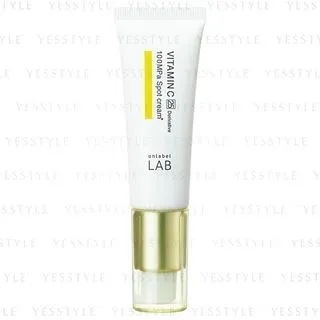
"JPS LABO - Unlabel Lab Vitamin C Spot Cream" could be helpful for: Moisturizing, but its actives are not the most effective or are not well-studied.
Ingredient callouts
- This product also contains Vitamin C (Ascorbic Acid). It can be an effective active for anti-aging and evening out the skin tone, but in this product it is used for stabilizing other ingredients in the formulation. In this concentration (0.35% - 0.85%) it cannot have a noticeable benefit for the skin.
- Humectants (mannitol 0.10% - 0.45%, sucrose 0.15% - 0.65% and glycerin 4.30% - 6.40%). These ingredients help attract water to the upper layer of the skin and improve the skin hydration.
Price
The product retails for 31.20$ in the United States.
For a detailed price comparison: click here.
Sources cited in this review
Every concentration estimate and effectiveness label is anchored to one of these 12 studies and safety reviews.
- 1
- 2
- 3
- 4
- 5
- 6

Affiliate links · As an Amazon Associate, WIMJ earns from qualifying purchases.