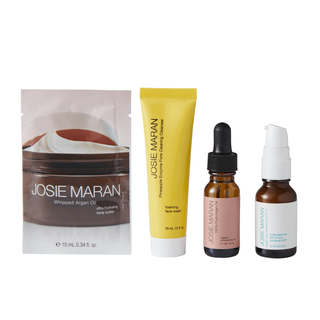
Josie Maran Cosmetics Cleanse Nourish Protect
Works for
1 of 2 advertised claims delivered
Sun protectionSPF 47 · 2 UV filtersNot rated
This formula relies on 2 UV filters for its sun protection. Their UV coverage is shown below, with amounts where the ingredient list lets us estimate them.
Cleansing13 ingredients credited for this claimStrong support
“Cleanse Nourish Protect”
This product works by removing dirt and oil from the surface of the skin. It uses a combination of mild cleansing agents (cera alba, coco-glucoside, decyl glucoside, disodium coco-glucoside citrate, disodium cocoyl glutamate, glyceryl oleate, laureth-12, polyglyceryl-10 laurate, polyglyceryl-6 polyricinoleate, polyhydroxystearic acid, sodium cocoyl glutamate, sodium lauroyl lactylate, xanthan gum) and should be able to cleanse the skin gently. Still keep in mind that any cleansing can disrupt the skin barrier, and most people do not need to cleanse their skin more than once per day.
Even though this formulation is mild, the following cleansing agents could trigger an irritation or allergy for some people: coco-glucoside, decyl glucoside, glyceryl oleate
Exfoliation2 ingredients credited for this claimWeak support
“Pineapple Enzyme Pore Clearing Cleanser • A refreshing two-in-one daily cleansing foam and exfoliator that purifies and balances • Pineapple fruit extract enzymes and lactic acid work to dissolve dead skin, environmental buildup, and other pore-clogging impurities • Gently cleanses for a brighter, smoother, more revitalized-looking complexion Pure Argan Oil • Organic multitasker • Nature's richest source of essential fatty acids, antioxidants, and vitamin E • Nourishes dry, sensitive, and normal skin Argan Daily Moisturizer SPF 47 • Chemical-free SPF 47 powered by zinc oxide and titanium dioxide provides powerful UVA/UVB protection • Antioxidant-rich Argan Oil and SunBoost ATBTM boosts skin's resilience against environmental damage • Lightweight, quick-absorbing hydration”
This product does not contain effective exfoliating ingredients. It might be able to deliver physical exfoliation, that is scrub off some of the dead cells on the surface of the skin. We do not recommend physical exfoliation, because it is not uniform (some bits of skin can get exfoliated too much while others not at all). It can also traumatize the skin and aggrevate acne and other skin conditions.
Can it cause trouble?
Irritancy1 strong irritant: Parfum — patch-test recommendedHigh risk
Comedogenic1 ingredient rated 2 or more on the 0–5 pore-clogging scale1 flagged
User reviews
Be the first — your take helps the next person decide.
Ingredients
Filter by role to see what each ingredient is doing.
Titanium dioxide5.1%
- Irritation risk
- Low
Works as a UV filter when used in high concentrations. It is photostable and is effective mostly against the UVB light, with some protection in the UVA range. In small concentrations, used for its ability to improve the color of cosmetic products. Is usually well tolerated by the skin
More about Titanium dioxideZinc oxide6.4%
- Irritation risk
- Low
A broad spectrum sunblock (protects from both UVA and UVB rays). Is suitable for most sensitive skins. In small concentrations, can be used as a colorant
More about Zinc oxideWater~45–55%
Glycerin~6.7–8.2%
- Irritation risk
- Low
One of the best moisturizing ingredients. Naturally present in skin. It attracts water to the upper layer of the skin working as a humectant
More about GlycerinDecyl glucoside~6.6–8.1%
- Irritation risk
- High
Helps oil and water mix together. Can be irritating
More about Decyl glucosideDisodium coco-glucoside citrate~4.3–5.2%
Disodium cocoyl glutamate~3.4–4.2%
- Irritation risk
- Medium
Helps water and oil mix together and works as a cleansing agent
More about Disodium cocoyl glutamatePolyglyceryl-10 laurate~3–3.7%
- Irritation risk
- Medium
Helps water and oil mix together
More about Polyglyceryl-10 laurateXanthan gum~2.6–3.1%
- Irritation risk
- Low
Used to create a thicker product consistency
More about Xanthan gumAnanas sativus fruit extract~2.1–2.6%
- Irritation risk
- Medium
A fruit extract that might help to attract water to the upper layer of the skin, but there is no evidence for any other benefits to the skin
More about Ananas sativus fruit extractArgania spinosa kernel oil~1.7–2%
- Irritation risk
- Medium
An emollient that helps soften the upper layer of the skin. Might have some weak anti-oxidant properties
More about Argania spinosa kernel oilSalix alba bark extract~1.2–1.5%
- Irritation risk
- High
A plant extract that can help neutralize free radicals in skin. It contains a compound salicin that can theoretically be converted into salicylic acid that, in turn, helps reduce inflammation in skin, but the evidence of effectiveness in skin is lacking and the extract is usually not used in a concentration that would enable an exfoliating effect
More about Salix alba bark extractAlthaea officinalis root extract~1.1–1.3%
- Irritation risk
- High
A plant extract that can help attract water to the upper layer of the skin and might help to reduce inflammation
More about Althaea officinalis root extractAloe barbadensis leaf juice~1–1.2%
- Irritation risk
- Medium
Traditionally used to treat sunburns, dermatitis and inflammation, but evidence for its effectiveness is lacking. The extract can contain humectants that help attract water into the skin
More about Aloe barbadensis leaf juiceParfum~0.95–1.15%
- Irritation risk
- High
An aromatic blend of unspecified and possibly irritating ingredients
More about ParfumSodium cocoyl glutamate~1–1.2%
- Irritation risk
- Medium
Helps oil and water mix together
More about Sodium cocoyl glutamateSodium lauroyl lactylate~0.95–1.15%
- Irritation risk
- Medium
Helps water and oil mix together
More about Sodium lauroyl lactylatePhenoxyethanol~0.5–1%
- Irritation risk
- Low
A preservative. It helps prevent bacterial growth in cosmetic products
More about PhenoxyethanolSaccharide isomerate~0.75–1.15%
- Irritation risk
- Low
Helps attract water to the upper layer of the skin
More about Saccharide isomerateCoco-glucoside~0.8–1.2%
- Irritation risk
- High
Used as a cleansing agent (surfactant) in cleansers. Helps water and oil mix together in lotions. Can be irritating
More about Coco-glucosideGlyceryl oleate~0.75–1.1%
- Irritation risk
- High
Helps oil and water mix together. Can be irritating
More about Glyceryl oleateEthylhexylglycerin~0.65–1%
Lactic acid~0.6–0.95%
- Irritation risk
- Medium
An exfoliating and moisturizing alpha-hydroxy acid (AHA). Typically causes less irritation than other AHAs, for example, glycolic acid. At high concentrations (about 15%), lactic acid can help reduce lines and wrinkles. Recent studies show that lactic acid can support the "good" bacteria living on skin's surface (healthy skin microbiome)
More about Lactic acidCitric acid~0.65–0.95%
- Irritation risk
- Medium
Can work as an exfoliant but is typically used to adjust the product pH
More about Citric acidLactobacillus ferment~0.6–0.9%
- Irritation risk
- Low
A fermentation product created by bacteria Lactobacillus. The fermented product has anti-bacterial properties and might be helpful in calming down inflammation, but studies are lacking. Helps attract water to the upper layer of the skin. Can be used as a preservative
More about Lactobacillus fermentSodium citrate~0.6–0.95%
- Irritation risk
- Medium
Helps to control the skin's pH level. Maintains the skin's natural film of amino-lactic acids and oils. Helps to preserve products
More about Sodium citratePotassium sorbate~0.3–0.6%
Sodium benzoate~0.25–0.5%
Tocopherol~0.6–0.95%
- Irritation risk
- Low
Pure form of vitamin E. Can help moisturise and protect the skin from free radicals. Often used to help stabilise other ingredients or the formula itself
More about TocopherolHydrogenated palm glycerides citrate~0.65–1%
- Irritation risk
- Low
Helps soften the upper layer of the skin
More about Hydrogenated palm glycerides citrateWater~0.65–0.95%
Ethylhexyl palmitate~0.7–1.05%
- Irritation risk
- Low
- Comedogenicity
- 3/5
An emollient that helps soften the skin and create a nice product texture
More about Ethylhexyl palmitateCaprylic/capric triglyceride~0.7–1.05%
- Irritation risk
- Medium
A good mix of fatty acids that forms a protective layer on the skin. Improves the shelf life of products. Derived from coconut and glycerin
More about Caprylic/capric triglycerideAloe barbadensis leaf juice~0.6–0.9%
- Irritation risk
- Medium
Traditionally used to treat sunburns, dermatitis and inflammation, but evidence for its effectiveness is lacking. The extract can contain humectants that help attract water into the skin
More about Aloe barbadensis leaf juicePolyglyceryl-6 polyricinoleate~0.65–1%
- Irritation risk
- Medium
Helps oil and water mix together
More about Polyglyceryl-6 polyricinoleateCyclopentasiloxane~0.7–1.05%
- Irritation risk
- Low
A silicone that helps improve the product texture and spreadability. Can absorb oil creating a short-term mattifying effect on the skin
More about CyclopentasiloxanePolysilicone-11~0.65–1%
- Irritation risk
- Low
A silicone that forms a light film on the skin surface helping to bind water and temporarily absorb oils creating a matt and powdery feel
More about Polysilicone-11Glycerin~0.65–0.95%
- Irritation risk
- Low
One of the best moisturizing ingredients. Naturally present in skin. It attracts water to the upper layer of the skin working as a humectant
More about GlycerinArgania spinosa kernel oil~0.65–1%
- Irritation risk
- Medium
An emollient that helps soften the upper layer of the skin. Might have some weak anti-oxidant properties
More about Argania spinosa kernel oilTocopheryl acetate~0.65–0.95%
- Irritation risk
- Medium
A more stable but less bio-available form of vitamin E compared to Tocopherol. Might help moisturize and protect the skin from free radicals, but mostly used in low concentrations to stabilize other ingredients.
More about Tocopheryl acetateCera alba~0.75–1.15%
- Irritation risk
- Medium
Forms a protective barrier that holds water and keeps dry skin hydrated. Keeps an emulsion from separating into its oil and liquid components, and increases the thickness of a product. Can be an allergen
More about Cera albaBeeswax~0.7–1.05%
- Irritation risk
- Low
Forms a protective barrier that holds water and keeps dry skin hydrated. Keeps an emulsion from separating into its oil and liquid components, and increases the thickness of a product. Can be an allergen
More about BeeswaxCoco-caprylate/caprate~0.65–1%
- Irritation risk
- Low
Helps to soften the upper layer of the skin without creating a greasy texture
More about Coco-caprylate/capratePhenoxyethanol~0.6–0.95%
- Irritation risk
- Low
A preservative. It helps prevent bacterial growth in cosmetic products
More about PhenoxyethanolPolyhydroxystearic acid~0.65–1%
- Irritation risk
- Medium
Used to create a thicker product consistency and stabilize the formulation
More about Polyhydroxystearic acidHydrogen dimethicone~0.65–0.95%
- Irritation risk
- Low
Helps the function of sunscreen and pigment ingredients in the formulation
More about Hydrogen dimethiconeAlumina~0.7–1.05%
- Irritation risk
- Low
The same compound that is used safely in dental implants and bone cements. In cosmetics, it is used to improve the consistency of products
More about AluminaSodium chloride~0.5–0.8%
- Irritation risk
- Low
Used to stabilize mixtures of oil and water, and create thicker, gel-like product textures
More about Sodium chlorideTriethoxycaprylylsilane~0.5–0.8%
- Irritation risk
- Low
A type of silicone that helps oil and water mix well together. Helps to disperse other ingredients, e.g. pigments, evenly in a formulation
More about TriethoxycaprylylsilanePolyglyceryl-10 laurate~0.55–0.8%
- Irritation risk
- Medium
Helps water and oil mix together
More about Polyglyceryl-10 laurateParfum~0.45–0.7%
- Irritation risk
- High
An aromatic blend of unspecified and possibly irritating ingredients
More about ParfumBisabolol~0.45–0.7%
- Irritation risk
- Low
An active component of chamomile plant that historically has been used to calm down irritated skin. A recent study shows that bisabolol indeed can have some anti-inflammatory effect on skin, even though conclusive data is lacking. Bisabolol has a sweet floral scent and can be added to products for its aromatic properties
More about BisabololSimmondsia chinensis seed oil~0.55–0.85%
- Irritation risk
- Medium
Softens the upper layer of skin and helps restore the healthy skin barrier. Has shown to help calm down inflammation in skin. It is a stable oil, meaning that it retains its properties even when exposed to air.
More about Simmondsia chinensis seed oilDimethicone~0.55–0.8%
- Irritation risk
- Low
A silicone that helps to reduce water loss from the surface of the skin. Can temporarily "fill in" lines and wrinkles, absorb oil, and create a nice product finish
More about DimethiconeCyclohexasiloxane~0.5–0.75%
- Irritation risk
- Low
A silicone that serves as an emollient. Helps create a nice non-greasy feels
More about CyclohexasiloxaneLaureth-12~0.35–0.65%
Ethylhexylglycerin~0.3–0.55%
Cyclotetrasiloxane~0.3–0.6%
- Irritation risk
- Low
Camellia sinensis leaf extract~0.25–0.45%
- Irritation risk
- Low
Can contain potent anti-oxidant compounds (abbreviated ECG, GCG, EGC, and EGCG) that might help protect the skin from free radicals. Can help calm down inflammation and has some anti-bacterial properties. Unfortunately, these antioxidants are unstable and lose their effectiveness very quickly in products. The concentration of the antioxidant compounds in the extract also tends to be low to be effective in topical formulation
More about Camellia sinensis leaf extractParfum~0.2–0.35%
- Irritation risk
- High
An aromatic blend of unspecified and possibly irritating ingredients
More about ParfumCitric acid~0.15–0.3%
- Irritation risk
- Medium
Can work as an exfoliant but is typically used to adjust the product pH
More about Citric acidPotassium sorbate~0.15–0.3%
Sodium benzoate~0.15–0.25%
Ingredient list view
Titanium dioxide, Zinc oxide, Water, Glycerin, Decyl glucoside, Disodium coco-glucoside citrate, Disodium cocoyl glutamate, Polyglyceryl-10 laurate, Xanthan gum, Ananas sativus fruit extract, Argania spinosa kernel oil, Salix alba bark extract, Althaea officinalis root extract, Aloe barbadensis leaf juice, Parfum, Sodium cocoyl glutamate, Sodium lauroyl lactylate, Phenoxyethanol, Saccharide isomerate, Coco-glucoside, Glyceryl oleate, Ethylhexylglycerin, Lactic acid, Citric acid, Lactobacillus ferment, Sodium citrate, Potassium sorbate, Sodium benzoate, Tocopherol, Hydrogenated palm glycerides citrate, Water, Ethylhexyl palmitate, Caprylic/capric triglyceride, Aloe barbadensis leaf juice, Polyglyceryl-6 polyricinoleate, Cyclopentasiloxane, Polysilicone-11, Glycerin, Argania spinosa kernel oil, Tocopheryl acetate, Cera alba, Beeswax, Coco-caprylate/caprate, Phenoxyethanol, Polyhydroxystearic acid, Hydrogen dimethicone, Alumina, Sodium chloride, Triethoxycaprylylsilane, Polyglyceryl-10 laurate, Parfum, Bisabolol, Simmondsia chinensis seed oil, Dimethicone, Cyclohexasiloxane, Laureth-12, Ethylhexylglycerin, Cyclotetrasiloxane, Camellia sinensis leaf extract, Parfum, Citric acid, Potassium sorbate, Sodium benzoate
Compare prices
Retailers ranked by price — lowest first.
Affiliate links · prices updated regularly
Sources cited in this review
Every concentration estimate and effectiveness label is anchored to one of these 28 studies and safety reviews.
- 1A review of inorganic UV filters zinc oxide and titanium dioxideonlinelibrary.wiley.com
- 2
- 3
- 4
- 5
- 6

Affiliate links · As an Amazon Associate, WIMJ earns from qualifying purchases.