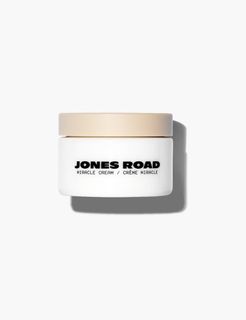
Jones Road Beauty Miracle Cream
Works for
1 of 1 advertised claim delivered
Moisturizing13 ingredients credited for this claimGood support
“intense and nourishing moisture”
This product can help improve hydration of the skin with the two types of ingredients.
The first type is called “humectants”:
these ingredients help attract water.
When humectants are on the surface of the skin, they “pull in” the moisture from the outside environment, or from
within deeper layers of the skin. The following ingredients in this product do the job:
glycerin, caprylyl glycol.
This product also contains ingredients called “occlusives”. They help reduce the speed with which our skin loses moisture to the outside environment. These ingredients also help soften the upper layer of the skin, so it feels less tight and nicer to the touch. The following ingredients in this product do the job: bis-diglyceryl polyacyladipate-2, butyrospermum parkii butter.
Can it cause trouble?
Irritancy3 strong irritants: Citrus aurantium dulcis peel oil, Citrus paradisi peel oil + 1 more — patch-test recommendedHigh risk
Comedogenic2 ingredients rated 2 or more on the 0–5 pore-clogging scale2 flagged
User reviews
Be the first — your take helps the next person decide.
Ingredients
Filter by role to see what each ingredient is doing.
Water~40–60%
Hydrogenated vegetable oil~5.1–7.6%
- Irritation risk
- Low
- Comedogenicity
- 2/5
An oil from a mixture of different vegetables. Helps soften the upper layer of the skin
More about Hydrogenated vegetable oilBis-diglyceryl polyacyladipate-2~3.8–5.6%
- Irritation risk
- Low
Helps soften the upper layer of the skin and reduce water loss from its surface
More about Bis-diglyceryl polyacyladipate-2Butyrospermum parkii butter~2.9–4.3%
- Irritation risk
- Low
- Comedogenicity
- 3/5
A great moisturising ingredient that softens the skin and reduces water loss from its upper layer. It also can be helpful in protecting skin from free radicals
More about Butyrospermum parkii butterC15-19 alkane~2.1–3.1%
- Irritation risk
- Low
Helps soften the upper layer of the skin and create a nice product texture
More about C15-19 alkaneStearyl behenate~1.8–2.7%
- Irritation risk
- Low
Helps soften the upper layer of the skin
More about Stearyl behenatePolyglyceryl-3 polyricinoleate~1.5–2.2%
- Irritation risk
- Medium
Helps oil and water mix together
More about Polyglyceryl-3 polyricinoleatePolyglyceryl-6 polyricinoleate~1.3–2%
- Irritation risk
- Medium
Helps oil and water mix together
More about Polyglyceryl-6 polyricinoleateStearic acid~1.3–1.9%
- Irritation risk
- Low
Helps oil and water mix together and works as an emollient
More about Stearic acidPolyglyceryl-6 polyhydroxystearate~0.9–1.3%
- Irritation risk
- Medium
Helps oil and water mix together
More about Polyglyceryl-6 polyhydroxystearateC10-18 triglycerides~0.55–1.25%
- Irritation risk
- Low
Helps soften the skin and attract water to its upper layer. Helps create nice product texture
More about C10-18 triglyceridesGlycerin~0.45–1.1%
- Irritation risk
- Low
One of the best moisturizing ingredients. Naturally present in skin. It attracts water to the upper layer of the skin working as a humectant
More about GlycerinBehenyl alcohol~0.45–1%
- Irritation risk
- Low
Non-drying alcohol that helps water and oil mix together. Also serves as an emollient
More about Behenyl alcoholHelianthus annuus seed oil~0.35–0.85%
- Irritation risk
- Low
A great emollient due to its high linoleic acid content. One of the most effective plant oils in helping skin hydration and repairing skin barrier function
More about Helianthus annuus seed oilPolyhydroxystearic acid~0.35–0.8%
- Irritation risk
- Medium
Used to create a thicker product consistency and stabilize the formulation
More about Polyhydroxystearic acidSodium chloride~0.35–0.8%
- Irritation risk
- Low
Used to stabilize mixtures of oil and water, and create thicker, gel-like product textures
More about Sodium chloridePersea gratissima oil~0.35–0.8%
- Irritation risk
- Medium
An emollient that helps soften the skin and could be helpful in repairing its barrier function
More about Persea gratissima oilPolyglyceryl-2 isostearate~0.2–0.8%
Disteardimonium hectorite~0.15–0.6%
- Irritation risk
- Low
A type of clay that is used to thicken the product consistency
More about Disteardimonium hectorite1,2-hexanediol~0.1–0.5%
Caprylyl glycol~0.15–0.55%
- Irritation risk
- Medium
Helps preserve products and creates a nice product texture
More about Caprylyl glycolTocopherol~0.1–0.4%
- Irritation risk
- Low
Pure form of vitamin E. Can help moisturise and protect the skin from free radicals. Often used to help stabilise other ingredients or the formula itself
More about TocopherolCitrus aurantium dulcis peel oil~0.1–0.35%
- Irritation risk
- High
An essentil oil from orange peel. Potential allergen and can be irritating
More about Citrus aurantium dulcis peel oilCitrus paradisi peel oil~0.05–0.25%
Citric acid~0.05–0.25%
- Irritation risk
- Medium
Can work as an exfoliant but is typically used to adjust the product pH
More about Citric acidAscorbyl palmitate~0.05–0.15%
- Irritation risk
- Medium
Being a lipid soluble form of vitamin C, it is more stable and can penetrate the skin better than L-Ascorbic acid. It is effective in protecting the skin from free radicals, as well as evening the skin tone, but is less effective in stimulating collagen production compared to L-Ascorbic acid.
More about Ascorbyl palmitateLimonene~0.05–0.15%
- Irritation risk
- High
A common frangrance that can easily irritate skin, especially if exposed to air, light or heat
More about LimoneneIngredient list view
Water, Hydrogenated vegetable oil, Bis-diglyceryl polyacyladipate-2, Butyrospermum parkii butter, C15-19 alkane, Stearyl behenate, Polyglyceryl-3 polyricinoleate, Polyglyceryl-6 polyricinoleate, Stearic acid, Polyglyceryl-6 polyhydroxystearate, C10-18 triglycerides, Glycerin, Behenyl alcohol, Helianthus annuus seed oil, Polyhydroxystearic acid, Sodium chloride, Persea gratissima oil, Polyglyceryl-2 isostearate, Disteardimonium hectorite, 1,2-hexanediol, Caprylyl glycol, Unknown, Tocopherol, Citrus aurantium dulcis peel oil, Citrus paradisi peel oil, Citric acid, Ascorbyl palmitate, Limonene
Compare prices
Retailers ranked by price — lowest first.

Sources cited in this review
Every concentration estimate and effectiveness label is anchored to one of these 9 studies and safety reviews.
- 1
- 2
- 3
- 4
- 5Effect of topically applied lipids on surfactant-irritated skinonlinelibrary.wiley.com
- 6

Affiliate links · As an Amazon Associate, WIMJ earns from qualifying purchases.