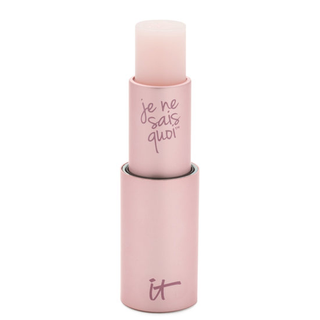
It Cosmetics Je Ne Sais Quoi Lip Treatment
Works for
1 of 1 advertised claim delivered
Moisturizing18 ingredients credited for this claimStrong support
“What it is: An innovative, lip-reviving, color-infused balm that provides hydration and a naturally flushed lip color.”
This product can help improve hydration of the skin with the two types of ingredients.
The first type is called “humectants”:
these ingredients help attract water.
When humectants are on the surface of the skin, they “pull in” the moisture from the outside environment, or from
within deeper layers of the skin. The following ingredients in this product do the job:
hyaluronic acid, butylene glycol.
This product also contains ingredients called “occlusives”. They help reduce the speed with which our skin loses moisture to the outside environment. These ingredients also help soften the upper layer of the skin, so it feels less tight and nicer to the touch. The following ingredients in this product do the job: cera alba, ricinus communis seed oil.
The following ingredients in this product are especially good for supporting the skin barrier and helping with the hydration level: palmitoyl tripeptide-1
Anti-oxidationNot advertised by the brand · 12 ingredients credited for this claimStrong support
This product contains antioxidants (camellia oleifera leaf extract, vitis vinifera seed extract) that can help neutralize free radicals in skin. By doing so, they can lessen the damage the skin gets from the UV light (sun).
The following ingredients - camellia sinensis leaf extract, punica granatum extract also can have an antioxidant effect, but there is less evidence to confirm their effectiveness in skin.
Anti-agingNot advertised by the brand · 8 ingredients credited for this claimModerate support
This product contains palmitoyl tripeptide-1, retinyl palmitate, vitis vinifera seed extract. These ingredients might be able to help reduce and prevent fine lines and wrinkles, improve skin elasticity and firmness, but there is not enough evidence that it actually works.
Can it cause trouble?
Irritancy1 strong irritant: Retinyl palmitateMedium risk
Comedogenic2 ingredients rated 2 or more on the 0–5 pore-clogging scale2 flagged
User reviews
Be the first — your take helps the next person decide.
Ingredients
Filter by role to see what each ingredient is doing.
Polybutene~22–34%
Hydrogenated polyisobutene~4.5–6.7%
- Irritation risk
- Low
Used to improve the product consistency and soften the upper layer of the skin
More about Hydrogenated polyisobuteneOctyldodecanol~4.6–6.9%
- Irritation risk
- Low
An emollient that helps to soften the skin and create a pleasant product texture and stabilize the formulation
More about OctyldodecanolCera alba~3.6–5.4%
- Irritation risk
- Medium
Forms a protective barrier that holds water and keeps dry skin hydrated. Keeps an emulsion from separating into its oil and liquid components, and increases the thickness of a product. Can be an allergen
More about Cera albaOzokerite~2.4–3.6%
Trihydroxystearin~1.9–2.9%
- Irritation risk
- Low
Helps soften the upper layer of the skin and improve the product texture
More about TrihydroxystearinPolyethylene~1.8–2.8%
Ricinus communis seed oil~1.5–2.2%
- Irritation risk
- Medium
A plant oil that can help soften the skin. It might be helpful in calming down inflammation, but solid research is lacking. Is often used in lip products to create the needed product consistency
More about Ricinus communis seed oilEthylhexyl palmitate~1.1–1.7%
- Irritation risk
- Low
- Comedogenicity
- 3/5
An emollient that helps soften the skin and create a nice product texture
More about Ethylhexyl palmitateTribehenin~0.9–1.35%
- Irritation risk
- Low
Used to create a thicker product consistency and soften the upper layer of the skin
More about TribeheninSorbitan isostearate~0.5–1.15%
- Irritation risk
- Low
Helps oil and water mix together
More about Sorbitan isostearatePalmitoyl tripeptide-1~0.45–1.1%
- Irritation risk
- Low
A type of peptide. Peptides are excellent moisturizers and might be able support collagen production reducing fine lines and wrinkles
More about Palmitoyl tripeptide-1Pentaerythrityl tetra-di-t-butyl hydroxyhydrocinnamate~0.4–0.9%
- Irritation risk
- Low
Used to increase stability of product formulations
More about Pentaerythrityl tetra-di-t-butyl hydroxyhydrocinnamateCarthamus tinctorius seed oil~0.4–0.9%
- Irritation risk
- Low
An emollient that helps soften the skin and might help calm down inflammation
More about Carthamus tinctorius seed oilTocopheryl acetate~0.3–0.75%
- Irritation risk
- Medium
A more stable but less bio-available form of vitamin E compared to Tocopherol. Might help moisturize and protect the skin from free radicals, but mostly used in low concentrations to stabilize other ingredients.
More about Tocopheryl acetateTocopherol~0.3–0.7%
- Irritation risk
- Low
Pure form of vitamin E. Can help moisturise and protect the skin from free radicals. Often used to help stabilise other ingredients or the formula itself
More about TocopherolRetinyl palmitate~0.2–0.75%
- Irritation risk
- High
Three steps removed from the active form of vitamin A - retinoic acid. To have an effect in the skin, it first needs to be converted twice to become the retinoic acid. This means it is less potent than retinol, but could also be less irritating. Once converted to the retinoic acid in the skin, it helps against all signs of aging, improves skin cell turnover and helps fight blemishes and clogged pores. However, in many cosmetic formulations, it is used in a concentration that is too low to have the full effect
More about Retinyl palmitateAscorbyl palmitate~0.15–0.7%
- Irritation risk
- Medium
Being a lipid soluble form of vitamin C, it is more stable and can penetrate the skin better than L-Ascorbic acid. It is effective in protecting the skin from free radicals, as well as evening the skin tone, but is less effective in stimulating collagen production compared to L-Ascorbic acid.
More about Ascorbyl palmitateButyrospermum parkii butter~0.3–0.75%
- Irritation risk
- Low
- Comedogenicity
- 3/5
A great moisturising ingredient that softens the skin and reduces water loss from its upper layer. It also can be helpful in protecting skin from free radicals
More about Butyrospermum parkii butterPrunus domestica seed oil~0.15–0.6%
- Irritation risk
- Medium
Helps soften the upper layer of the skin
More about Prunus domestica seed oilPrunus cerasus seed oil~0.2–0.7%
- Irritation risk
- Low
Argania spinosa kernel oil~0.15–0.7%
- Irritation risk
- Medium
An emollient that helps soften the upper layer of the skin. Might have some weak anti-oxidant properties
More about Argania spinosa kernel oilVitis vinifera seed extract~0.15–0.55%
- Irritation risk
- Low
A plant extract that contains resveratrol and other anti-oxidant compounds that can help neutralize free radicals, reduce inflammation in skin and even out its tone. Can be also used to stabilize the product formulation
More about Vitis vinifera seed extractPunica granatum extract~0.1–0.5%
- Irritation risk
- Medium
A plant extract that can help neutralize free radicals in skin and even out the skin tone, but is typically used in products in a concentration that is too low to be effective
More about Punica granatum extractCamellia oleifera leaf extract~0.15–0.5%
- Irritation risk
- Low
A plant extract that can help neutralize free radicals and reduce inflammation, even though it is not usually used in sufficient concentration in cosmetics
More about Camellia oleifera leaf extractAloe barbadensis leaf extract~0.2–0.7%
- Irritation risk
- Medium
Traditionally used to treat sunburns, dermatitis and inflammation, but evidence for its effectiveness is lacking. The extract can contain humectants that help attract water into the skin
More about Aloe barbadensis leaf extractCamellia sinensis leaf extract~0.15–0.55%
- Irritation risk
- Low
Can contain potent anti-oxidant compounds (abbreviated ECG, GCG, EGC, and EGCG) that might help protect the skin from free radicals. Can help calm down inflammation and has some anti-bacterial properties. Unfortunately, these antioxidants are unstable and lose their effectiveness very quickly in products. The concentration of the antioxidant compounds in the extract also tends to be low to be effective in topical formulation
More about Camellia sinensis leaf extractSilica dimethyl silylate~0.15–0.65%
Butylene glycol~0.1–0.5%
- Irritation risk
- Low
Used to create a nice product texture and help delivery of other ingredients. Might be somewhat helpful in attracting water to the upper layer of the skin
More about Butylene glycolHyaluronic acid~0.1–0.5%
- Irritation risk
- Low
One of the best moisturizing ingredients. Attracts water into the upper layer of the skin. Naturally present in skin. Typically has large molecule size unless advertised otherwise on the product label. Helps support skin's barrier function and may help to reduce inflammation
More about Hyaluronic acidCitric acid~0.1–0.45%
- Irritation risk
- Medium
Can work as an exfoliant but is typically used to adjust the product pH
More about Citric acidCholesteryl oleyl carbonate~0.1–0.5%
- Irritation risk
- Low
Cholesteryl nonanoate~0.15–0.6%
- Irritation risk
- Low
Cholesteryl chloride~0.1–0.5%
- Irritation risk
- Low
Lonicera caprifolium flower extract~0.1–0.4%
- Irritation risk
- High
A plant extract that might help neutralize free radicals in skin. Can contain volalite oils and be irritating
More about Lonicera caprifolium flower extractLonicera japonica flower extract~0.1–0.45%
- Irritation risk
- High
A plant extract that might help neutralize free radicals in skin. Can contain volalite oils and be irritating
More about Lonicera japonica flower extractSimmondsia chinensis seed oil~0.15–0.65%
- Irritation risk
- Medium
Softens the upper layer of skin and helps restore the healthy skin barrier. Has shown to help calm down inflammation in skin. It is a stable oil, meaning that it retains its properties even when exposed to air.
More about Simmondsia chinensis seed oilTitanium dioxide~0.15–0.6%
- Irritation risk
- Low
Works as a UV filter when used in high concentrations. It is photostable and is effective mostly against the UVB light, with some protection in the UVA range. In small concentrations, used for its ability to improve the color of cosmetic products. Is usually well tolerated by the skin
More about Titanium dioxideIron oxides~0.05–0.3%
- Irritation risk
- Low
An umbrella term for the following three colorants: CI 77491, CI 77492, CI 77499. They might be able to offer some protection against visible light, but the degree of the protection is not clear
More about Iron oxidesCi 15850~0.1–0.3%
Ci 19140~0.05–0.15%
Ingredient list view
Polybutene, Hydrogenated polyisobutene, Octyldodecanol, Cera alba, Ozokerite, Trihydroxystearin, Polyethylene, Ricinus communis seed oil, Ethylhexyl palmitate, Tribehenin, Sorbitan isostearate, Palmitoyl tripeptide-1, Pentaerythrityl tetra-di-t-butyl hydroxyhydrocinnamate, Carthamus tinctorius seed oil, Tocopheryl acetate, Tocopherol, Retinyl palmitate, Ascorbyl palmitate, Butyrospermum parkii butter, Prunus domestica seed oil, Prunus cerasus seed oil, Argania spinosa kernel oil, Vitis vinifera seed extract, Punica granatum extract, Camellia oleifera leaf extract, Aloe barbadensis leaf extract, Camellia sinensis leaf extract, Silica dimethyl silylate, Butylene glycol, Hyaluronic acid, Citric acid, Cholesteryl oleyl carbonate, Cholesteryl nonanoate, Cholesteryl chloride, Lonicera caprifolium flower extract, Lonicera japonica flower extract, Simmondsia chinensis seed oil, Titanium dioxide, Iron oxides, Ci 15850, Unknown, Ci 19140, Unknown
Compare prices
Retailers ranked by price — lowest first.
Affiliate links · prices updated regularly · As an Amazon Associate, WIMJ earns from qualifying purchases.
Worth comparing, line by line.
Match % combines shared ingredients, the first five ingredients, shared actives and hero ingredients, irritancy (lower counts in the alternative's favour), texture and body area. Only products in the same routine step are compared.
| It CosmeticsJe Ne Sais Quoi Lip TreatmentYOUR PRODUCT | Paula's choicePro-Collagen Peptide Plumping Gloss Balm Lip Treatment | Rhodepeptide lip tint raspberry jelly | |
|---|---|---|---|
| Match | — | 55% | 54% |
| Price | $21.28 | $19.20−$2.08 | — |
| Shared key ingredients | — | 3 of 15 | 3 of 15 |
| Key difference | — | Palmitoyl Tripeptide-38 | Lactic Acid |
| Irritancy | Medium | Low | Low |
| Drying alcohol | — | — | — |
| View product | Shop | Shop |

Sources cited in this review
Every concentration estimate and effectiveness label is anchored to one of these 21 studies and safety reviews.
- 1
- 2
- 3
- 4
- 5
- 6

Affiliate links · As an Amazon Associate, WIMJ earns from qualifying purchases.