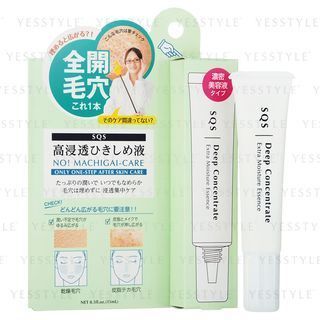
Ishizawa-Lab SQS Deep Moisture Astringent Essence
Works for
1 of 1 advertised claim delivered
Moisturizing9 ingredients credited for this claimGood support
“SQS Deep Moisture Astringent Essence”
This product can help improve hydration of the skin with the two types of ingredients.
The first type is called “humectants”:
these ingredients help attract water.
When humectants are on the surface of the skin, they “pull in” the moisture from the outside environment, or from
within deeper layers of the skin. The following ingredients in this product do the job:
glycerin, hydrolyzed hyaluronic acid.
This product also contains ingredients called “occlusives”. They help reduce the speed with which our skin loses moisture to the outside environment. These ingredients also help soften the upper layer of the skin, so it feels less tight and nicer to the touch. The following ingredients in this product do the job: phytosteryl/octyldodecyl lauroyl glutamate, mel.
Can it cause trouble?
Irritancy3 strong irritants: Alcohol, Menthol + 1 more — patch-test recommendedHigh risk
Comedogenic1 ingredient rated 2 or more on the 0–5 pore-clogging scale1 flagged
User reviews
Be the first — your take helps the next person decide.
Ingredients
Filter by role to see what each ingredient is doing.
Water~45–55%
Dimethicone/vinyl dimethicone crosspolymer~6.9–8.5%
- Irritation risk
- Low
Used to stabilize product formulations and create a nice product texture
More about Dimethicone/vinyl dimethicone crosspolymerAlcohol~4.9–6%
- Irritation risk
- High
Can be drying and contribute to skin irritation. Used in formulars to dissolve other ingredients, create a thinner product consistency or for its antibacterial properties
More about AlcoholButylene glycol~3.3–4.1%
- Irritation risk
- Low
Used to create a nice product texture and help delivery of other ingredients. Might be somewhat helpful in attracting water to the upper layer of the skin
More about Butylene glycolZea mays starch~2.7–3.3%
- Irritation risk
- Medium
- Comedogenicity
- 3/5
Used to thicken the product's consistency
More about Zea mays starchPentylene glycol~2.4–2.9%
- Irritation risk
- Medium
Used to preserve products, dissolve other ingredients and create a nice product texture
More about Pentylene glycolGlycerin~2.1–2.6%
- Irritation risk
- Low
One of the best moisturizing ingredients. Naturally present in skin. It attracts water to the upper layer of the skin working as a humectant
More about GlycerinHydrolyzed hyaluronic acid~1.7–2.1%
- Irritation risk
- Low
One of the best moisturizing ingredients. Attracts water into the upper layer of the skin. A version of it is naturally present in skin
More about Hydrolyzed hyaluronic acidSodium hyaluronate~1.5–1.8%
- Irritation risk
- Low
One of the best moisturizing ingredients. Attracts water into the upper layer of the skin
More about Sodium hyaluronateSoluble collagen~1.3–1.6%
- Irritation risk
- Low
A typically plant-derived compound that is supposed mimic human collagen. Cannot penetrate the skin barrier so is not particularly useful in skincare products beyond attracting water to the upper layer of the skin
More about Soluble collagenAscorbyl glucoside~0.75–1.15%
- Irritation risk
- Medium
A vitamin C derivative that is more stable but less potent than pure form of vitamin C. Has a potential to boost collagen production, nutralise free radicals and reduce hyperpigmentation, but the required concentration is likely to be much higher than for the pure form of vitamin C, limiting the ingredient's effectiveness in products
More about Ascorbyl glucosideMel~0.7–1.05%
- Irritation risk
- Low
Helps to soften the upper layer of the skin and attract water to it
More about MelBrain extract~0.55–0.8%
- Irritation risk
- Low
Sodium bicarbonate~0.65–0.95%
Hydrogenated lecithin~0.45–0.7%
- Irritation risk
- Low
Helps to retain moisture by creating a protective barrier on the skin. Rich in fatty acids. Improves product texture and helps with the penetration of other ingredients.
More about Hydrogenated lecithinPeg-40 hydrogenated castor oil~0.45–0.7%
- Irritation risk
- Medium
Helps oil and water mix together
More about Peg-40 hydrogenated castor oilPeg-60 hydrogenated castor oil~0.45–0.7%
- Irritation risk
- Medium
Helps oil and water mix together
More about Peg-60 hydrogenated castor oilAcrylates/c10-30 alkyl acrylate crosspolymer~0.4–0.65%
- Irritation risk
- Medium
Maintains the texture of skincare products. Allows the product to spread evenly. Helps oil and water mix together
More about Acrylates/c10-30 alkyl acrylate crosspolymerPhytosteryl/octyldodecyl lauroyl glutamate~0.4–0.6%
- Irritation risk
- Low
A mix of amino acids and plant-based lipids. Helps to soften the upper layer of the skin and reduce water loss over time
More about Phytosteryl/octyldodecyl lauroyl glutamateHydroxyethylcellulose~0.35–0.6%
- Irritation risk
- Low
Used to thicken product formulations and create gel-like textures
More about HydroxyethylcellulosePolyglutamic acid~0.3–0.6%
- Irritation risk
- Low
Helps attract water to the upper layer of the skin.
More about Polyglutamic acidCarbomer~0.3–0.55%
- Irritation risk
- Low
Helps create a thicker or gel-like product texture. It is not a surfactant but can be used in gentle cleansing formulations
More about CarbomerCellulose gum~0.3–0.55%
- Irritation risk
- Low
Used to create thicker product consistency and stabilize emulsions
More about Cellulose gumIsoceteth-10~0.3–0.55%
Isoceteth-25~0.3–0.55%
Potassium hydroxide~0.3–0.5%
Tetrasodium etidronate~0.25–0.45%
Sodium citrate~0.2–0.4%
- Irritation risk
- Medium
Helps to control the skin's pH level. Maintains the skin's natural film of amino-lactic acids and oils. Helps to preserve products
More about Sodium citrateCitric acid~0.2–0.35%
- Irritation risk
- Medium
Can work as an exfoliant but is typically used to adjust the product pH
More about Citric acidMenthol~0.15–0.25%
- Irritation risk
- High
Menthoxypropanediol~0.15–0.25%
Platinum~0.15–0.3%
- Irritation risk
- Low
Silver~0.1–0.2%
- Irritation risk
- Low
Phenoxyethanol~0.15–0.25%
- Irritation risk
- Low
A preservative. It helps prevent bacterial growth in cosmetic products
More about PhenoxyethanolIngredient list view
Water, Dimethicone/vinyl dimethicone crosspolymer, Alcohol, Butylene glycol, Zea mays starch, Unknown, Pentylene glycol, Glycerin, Hydrolyzed hyaluronic acid, Sodium hyaluronate, Unknown, Soluble collagen, Ascorbyl glucoside, Unknown, Mel, Unknown, Brain extract, Sodium bicarbonate, Hydrogenated lecithin, Peg-40 hydrogenated castor oil, Peg-60 hydrogenated castor oil, Acrylates/c10-30 alkyl acrylate crosspolymer, Unknown, Phytosteryl/octyldodecyl lauroyl glutamate, Hydroxyethylcellulose, Polyglutamic acid, Carbomer, Cellulose gum, Isoceteth-10, Isoceteth-25, Potassium hydroxide, Tetrasodium etidronate, Sodium citrate, Citric acid, Menthol, Menthoxypropanediol, Platinum, Silver, Phenoxyethanol
Compare prices
Retailers ranked by price — lowest first.

Affiliate links · prices updated regularly
Sources cited in this review
Every concentration estimate and effectiveness label is anchored to one of these 10 studies and safety reviews.
- 1
- 2Efficacy of a New Topical Nano-hyaluronic Acid in Humansncbi.nlm.nih.gov
- 3Physiochemical properties and application of hyaluronic acid: a systematic reviewonlinelibrary.wiley.com
- 4Hyaluronic acid: A key molecule in skin agingncbi.nlm.nih.gov
- 5
- 6The Roles of Vitamin C in Skin Healthncbi.nlm.nih.gov

Affiliate links · As an Amazon Associate, WIMJ earns from qualifying purchases.