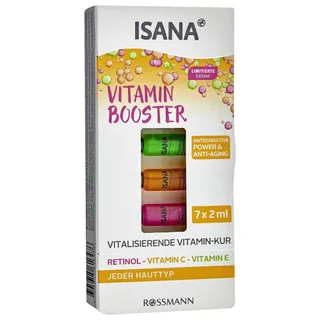
Works for
MoisturizingPanthenol, Vitis vinifera seed oil + 6 moreWorks well
“The ISANA Vitamin C concentrate provides your skin with valuable moisture and care substances.”
This product can help improve hydration of the skin with the two types of ingredients.
The first type is called “humectants”:
these ingredients help attract water.
When humectants are on the surface of the skin, they “pull in” the moisture from the outside environment, or from
within deeper layers of the skin. The following ingredients in this product do the job:
betaine, biosaccharide gum-1.
This product also contains ingredients called “occlusives”. They help reduce the speed with which our skin loses moisture to the outside environment. These ingredients also help soften the upper layer of the skin, so it feels less tight and nicer to the touch. The following ingredients in this product do the job: helianthus annuus seed oil, vitis vinifera seed oil.
The following ingredients in this product are especially good for supporting the skin barrier and helping with the hydration level: panthenol
Anti-agingRetinyl palmitate, 3-o-ethyl ascorbic acid + 1 moreMay help
“The skin is effectively protected against free radicals * The vitamin C derivative can stimulate the skin's own collagen production with regular use and protects against environmental, oxidative skin damage.”
This product contains retinyl palmitate. There is some human evidence that this ingredient helps reduce and prevent fine lines and wrinkles and improve skin elasticity and firmness, though it is smaller or less consistent than the evidence for the best anti-aging ingredients.
Anti-oxidationSide benefit · 3-o-ethyl ascorbic acid, Tocopherol + 1 moreWorks well
This product contains antioxidants (tocopherol) that can help neutralize free radicals in skin. By doing so, they can lessen the damage the skin gets from the UV light (sun).
The following ingredients - 3-o-ethyl ascorbic acid also can have an antioxidant effect, but there is less evidence to confirm their effectiveness in skin.
Evens skin toneSide benefit · Retinyl palmitate, 3-o-ethyl ascorbic acidMay help
The following ingredient (ingredients) in this product might be helpful, but there is no evidence to confirm that it actually works: 3-o-ethyl ascorbic acid, retinyl palmitate.
Can it cause trouble?
Irritancy7 strong irritants: Retinyl palmitate, Parfum + 5 more — patch-test recommendedHigh risk
ComedogenicClean of flagged comedogenic ingredientsNone flagged

User reviews
Be the first — your take helps the next person decide.
Ingredients
Filter by role to see what each ingredient is doing.
Water~45–55%
Glycerin~5.5–6.7%
- Irritation risk
- Low
One of the best moisturizing ingredients. Naturally present in skin. It attracts water to the upper layer of the skin working as a humectant
More about GlycerinBetaine~4.4–5.3%
- Irritation risk
- Low
Helps attract water to the upper layer of the skin and improves the product texture
More about BetaineMethylpropanediol~3.3–4.1%
Vitis vinifera seed oil~2.5–3.1%
- Irritation risk
- Medium
A great emollient that can also have anti-oxidant properties
More about Vitis vinifera seed oilPanthenol~2–2.4%
- Irritation risk
- Low
Helps attract water to the upper layer of the skin and can help improve skin barrier function
More about PanthenolRetinyl palmitate~1.6–2%
- Irritation risk
- High
Three steps removed from the active form of vitamin A - retinoic acid. To have an effect in the skin, it first needs to be converted twice to become the retinoic acid. This means it is less potent than retinol, but could also be less irritating. Once converted to the retinoic acid in the skin, it helps against all signs of aging, improves skin cell turnover and helps fight blemishes and clogged pores. However, in many cosmetic formulations, it is used in a concentration that is too low to have the full effect
More about Retinyl palmitateTocopherol~1.4–1.8%
- Irritation risk
- Low
Pure form of vitamin E. Can help moisturise and protect the skin from free radicals. Often used to help stabilise other ingredients or the formula itself
More about TocopherolPhenoxyethanol~0.5–1%
- Irritation risk
- Low
A preservative. It helps prevent bacterial growth in cosmetic products
More about PhenoxyethanolAcrylates/c10-30 alkyl acrylate crosspolymer~1–1.2%
- Irritation risk
- Medium
Maintains the texture of skincare products. Allows the product to spread evenly. Helps oil and water mix together
More about Acrylates/c10-30 alkyl acrylate crosspolymerParfum~0.65–0.95%
- Irritation risk
- High
An aromatic blend of unspecified and possibly irritating ingredients
More about ParfumDisodium edta~0.55–0.8%
Ethylhexylglycerin~0.5–0.7%
Sodium hydroxide~0.45–0.65%
Pantolactone~0.35–0.65%
- Irritation risk
- Low
Helps attract water to the upper layer of the skin
More about PantolactoneCitric acid~0.4–0.6%
- Irritation risk
- Medium
Can work as an exfoliant but is typically used to adjust the product pH
More about Citric acidWater~0.35–0.65%
3-o-ethyl ascorbic acid~0.3–0.55%
- Irritation risk
- High
A vitamin C derivative that is more stable but less potent than pure form of vitamin C. Can help neutralize free radicals and help reduce hyperpigmentation, but the required concentration is likely to be much higher than for the pure form of vitamin C, limiting the ingredient's effectiveness in products
More about 3-o-ethyl ascorbic acidBetaine~0.25–0.5%
- Irritation risk
- Low
Helps attract water to the upper layer of the skin and improves the product texture
More about BetaineGlycerin~0.3–0.55%
- Irritation risk
- Low
One of the best moisturizing ingredients. Naturally present in skin. It attracts water to the upper layer of the skin working as a humectant
More about GlycerinCaprylyl/capryl glucoside~0.35–0.65%
- Irritation risk
- Medium
Helps oil and water mix together. Can be used as a cleansing agent
More about Caprylyl/capryl glucosidePanthenol~0.25–0.45%
- Irritation risk
- Low
Helps attract water to the upper layer of the skin and can help improve skin barrier function
More about PanthenolCitric acid~0.25–0.45%
- Irritation risk
- Medium
Can work as an exfoliant but is typically used to adjust the product pH
More about Citric acidBiosaccharide gum-1~0.25–0.4%
- Irritation risk
- Low
Helps attract water to the upper layer of the skin and is claimed to provide a longer-lasting hydration because of its ability to create a water-binding film on the surface of the skin
More about Biosaccharide gum-1Phenoxyethanol~0.25–0.45%
- Irritation risk
- Low
A preservative. It helps prevent bacterial growth in cosmetic products
More about PhenoxyethanolDisodium phosphate~0.25–0.45%
- Irritation risk
- Low
Helps adjust the product pH and stabilize the formulation
More about Disodium phosphateXanthan gum~0.25–0.45%
- Irritation risk
- Low
Used to create a thicker product consistency
More about Xanthan gumParfum~0.2–0.4%
- Irritation risk
- High
An aromatic blend of unspecified and possibly irritating ingredients
More about ParfumEthylhexylglycerin~0.25–0.4%
Benzyl alcohol~0.2–0.35%
- Irritation risk
- High
A preservative. Can be used to mask unpleasant smell. Can be irritating
More about Benzyl alcoholPantolactone~0.2–0.4%
- Irritation risk
- Low
Helps attract water to the upper layer of the skin
More about PantolactoneBenzyl salicylate~0.2–0.4%
Alpha-isomethyl ionone~0.2–0.35%
- Irritation risk
- High
A fragrance. Potential allergen and can be irritating
More about Alpha-isomethyl iononeLimonene~0.2–0.4%
- Irritation risk
- High
A common frangrance that can easily irritate skin, especially if exposed to air, light or heat
More about LimoneneCitronellol~0.2–0.4%
Water~0.2–0.4%
Glycerin~0.25–0.5%
- Irritation risk
- Low
One of the best moisturizing ingredients. Naturally present in skin. It attracts water to the upper layer of the skin working as a humectant
More about GlycerinBetaine~0.25–0.4%
- Irritation risk
- Low
Helps attract water to the upper layer of the skin and improves the product texture
More about BetaineMethylpropanediol~0.2–0.4%
Helianthus annuus seed oil~0.25–0.45%
- Irritation risk
- Low
A great emollient due to its high linoleic acid content. One of the most effective plant oils in helping skin hydration and repairing skin barrier function
More about Helianthus annuus seed oilTocopherol~0.2–0.4%
- Irritation risk
- Low
Pure form of vitamin E. Can help moisturise and protect the skin from free radicals. Often used to help stabilise other ingredients or the formula itself
More about TocopherolPanthenol~0.2–0.4%
- Irritation risk
- Low
Helps attract water to the upper layer of the skin and can help improve skin barrier function
More about PanthenolPhenoxyethanol~0.2–0.4%
- Irritation risk
- Low
A preservative. It helps prevent bacterial growth in cosmetic products
More about PhenoxyethanolAcrylates/c10-30 alkyl acrylate crosspolymer~0.2–0.4%
- Irritation risk
- Medium
Maintains the texture of skincare products. Allows the product to spread evenly. Helps oil and water mix together
More about Acrylates/c10-30 alkyl acrylate crosspolymerParfum~0.15–0.3%
- Irritation risk
- High
An aromatic blend of unspecified and possibly irritating ingredients
More about ParfumDisodium edta~0.15–0.3%
Ethylhexylglycerin~0.15–0.25%
Sodium hydroxide~0.15–0.3%
Pantolactone~0.15–0.25%
- Irritation risk
- Low
Helps attract water to the upper layer of the skin
More about PantolactoneGeraniol~0.1–0.15%
Citric acid~0.05–0.1%
- Irritation risk
- Medium
Can work as an exfoliant but is typically used to adjust the product pH
More about Citric acidIngredient list view
Water, Glycerin, Betaine, Methylpropanediol, Vitis vinifera seed oil, Panthenol, Retinyl palmitate, Tocopherol, Phenoxyethanol, Acrylates/c10-30 alkyl acrylate crosspolymer, Parfum, Disodium edta, Ethylhexylglycerin, Sodium hydroxide, Pantolactone, Citric acid, Water, 3-o-ethyl ascorbic acid, Betaine, Glycerin, Caprylyl/capryl glucoside, Panthenol, Citric acid, Biosaccharide gum-1, Phenoxyethanol, Disodium phosphate, Xanthan gum, Parfum, Ethylhexylglycerin, Benzyl alcohol, Pantolactone, Benzyl salicylate, Alpha-isomethyl ionone, Limonene, Citronellol, Water, Glycerin, Betaine, Methylpropanediol, Helianthus annuus seed oil, Tocopherol, Panthenol, Phenoxyethanol, Acrylates/c10-30 alkyl acrylate crosspolymer, Parfum, Disodium edta, Ethylhexylglycerin, Sodium hydroxide, Pantolactone, Geraniol, Citric acid
Compare prices
Retailers ranked by price — lowest first.
Worth comparing, line by line.
Match % combines shared ingredients, the first five ingredients, shared actives and hero ingredients, irritancy (lower counts in the alternative's favour), texture and body area. Only products in the same routine step are compared.
| ISANAVitamin Booster Serum ConcentrateYOUR PRODUCT | BABORDaily Bright Serum | Make P:remGlutamin Antioxidant Radiance Serum | SKIN&LABVitamin C Brightening Serum | |
|---|---|---|---|---|
| Match | — | 61% | 61% | 61% |
| Price | — | — | $19.94 | $12.54 |
| Shared key ingredients | — | 4 of 10 | 5 of 10 | 4 of 10 |
| Key difference | — | Centella Asiatica Leaf Extract | Niacinamide | Retinol |
| Irritancy | High | Medium | Medium | Medium |
| Drying alcohol | — | Contains drying alcohol | — | — |
| View product | Shop | Shop | Shop |


More alternatives: innisfree Vitamin C Green Tea Enzyme Brightening SerumChick Cosmetics Glow Boost Serum - 10% Vitamin C + Vitamin B5
Product summary
"ISANA - Vitamin Booster Serum Concentrate" is effective for: Moisturizing
This product could be helpful for: Anti-aging and Evens skin tone, but its actives are not the most effective or are not well-studied.
Ingredient callouts
- this product includes a form of Retinoids (vitamin A) - retinyl palmitate 1.60% - 2.00%, but this type of vitamin A is not very effective. It could in theory help with fine lines and wrinkles, but the effect is most likely minimal.
- An effective concentration of Panthenol (pro-vitamin B5) - about 2.00% - 2.40%. Panthenol helps strengthen the skin barrier, improve hydration and reduce inflammation in skin.
- Humectants (pantolactone 0.15% - 0.25%, panthenol 0.20% - 0.40%, betaine 0.25% - 0.40%, glycerin 0.25% - 0.50%, pantolactone 0.20% - 0.40%, biosaccharide gum-1 0.25% - 0.40%, panthenol 0.25% - 0.45%, glycerin 0.30% - 0.55%, betaine 0.25% - 0.50%, pantolactone 0.35% - 0.65%, panthenol 2.00% - 2.40%, betaine 4.40% - 5.30% and glycerin 5.50% - 6.70%). These ingredients help attract water to the upper layer of the skin and improve the skin hydration.
Price
The product retails for 5.99$ in the United States.
For a detailed price comparison: click here.
Sources cited in this review
Every concentration estimate and effectiveness label is anchored to one of these 12 studies and safety reviews.
- 1
- 2Skin moisturizing effects of panthenol-based formulationspdfs.semanticscholar.org
- 3
- 4Vitamin E in dermatologyncbi.nlm.nih.gov
- 5Vitamin E and Skin Healthlpi.oregonstate.edu
- 6

Affiliate links · As an Amazon Associate, WIMJ earns from qualifying purchases.