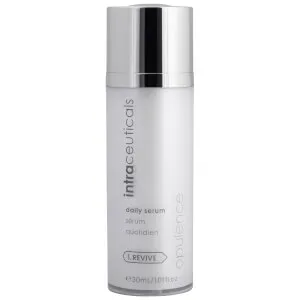
Intraceuticals Opulence Daily Serum

Intraceuticals Opulence Daily Serum

Efficacy83/100IrritancyMedium

Works for

Moisturizing
Nonapeptide-1, Caprylic/capric triglyceride + 10 more
Works well
What the product description says
“Revives skin hydration and delivers outstanding skin brightening ingredients.”
Source: Recreate Yourself

This product can help improve hydration of the skin with the two types of ingredients.

The first type is called “humectants”:
these ingredients help attract water. When humectants are on the surface of the skin, they “pull in” the moisture from the outside environment, or from within deeper layers of the skin. The following ingredients in this product do the job: dextran, glycerin.

This product also contains ingredients called “occlusives”. They help reduce the speed with which our skin loses moisture to the outside environment. These ingredients also help soften the upper layer of the skin, so it feels less tight and nicer to the touch. The following ingredients in this product do the job: caprylic/capric triglyceride, squalane.

The following ingredients in this product are especially good for supporting the skin barrier and helping with the hydration level: nonapeptide-1

Nonapeptide-1HeroEffect: HighA type of peptide. Peptides are excellent moisturizers and might be able support collagen production reducing fine lines and wrinkles~0.01–0.1%
Caprylic/capric triglycerideKey active· Emollient, OcclusiveEffect: HighA good mix of fatty acids that forms a protective layer on the skin. Improves the shelf life of products. Derived from coconut and glycerin~6.1–9.1%
Methyl gluceth-20Key active· HumectantEffect: MediumHelps attract water to the upper layer of the skin and soften it~3.5–5.3%
SqualaneKey active· Emollient, OcclusiveEffect: HighAn oil naturally present in skin. Works as an emollient to soften the skin and form a protective layer on its surface without a greasy feeling.~2.9–4.3%
GlycerinKey active· HumectantEffect: HighOne of the best moisturizing ingredients. Naturally present in skin. It attracts water to the upper layer of the skin working as a humectant~1.5–2.2%
DextranKey active· HumectantEffect: HighHelps attract water to the most upper layer of the skin. Derived from sugar~0.05–0.1%
Sodium hyaluronateKey active· HumectantEffect: HighOne of the best moisturizing ingredients. Attracts water into the upper layer of the skin~0.05–0.25%
Butylene glycol· HumectantEffect: LowUsed to create a nice product texture and help delivery of other ingredients. Might be somewhat helpful in attracting water to the upper layer of the skin~2.1–3.1%
Caprylyl glycol· Humectant, EmollientEffect: LowHelps preserve products and creates a nice product texture~0.4–0.9%
Camellia sinensis leaf extractEffect: LowCan contain potent anti-oxidant compounds (abbreviated ECG, GCG, EGC, and EGCG) that might help protect the skin from free radicals. Can help calm down inflammation and has some anti-bacterial properties. Unfortunately, these antioxidants are unstable and lose their effectiveness very quickly in products. The concentration of the antioxidant compounds in the extract also tends to be low to be effective in topical formulation~0.35–0.75%
BiotinEffect: LowMight have some moisturising properties. Is not effective when applied topically beyond some moisturizing effect~0.15–0.65%
Ascorbyl tetraisopalmitateEffect: Low, below effective doseA vitamin C derivative. Studies show that is might be effective in reducing hyperpigmentation, but there are no studies confirming that it is effectively converted into the bioavailable form of Vitamin C in skin. It is not clear how this derivative compares in effectiveness to the topical application of bioavailable form of vitamin C (L-ascorbic acid)~0.95–1.45%
Evens skin tone
Retinyl palmitate, Camellia sinensis leaf extract + 1 more
May help
What the product description says
“Refines and reveals a brighter, even and more translucent skin tone.”
Source: Recreate Yourself

The following ingredient (ingredients) in this product might be helpful, but there is no evidence to confirm that it actually works: retinyl palmitate.

Retinyl palmitateKey activeEffect: MediumThree steps removed from the active form of vitamin A - retinoic acid. To have an effect in the skin, it first needs to be converted twice to become the retinoic acid. This means it is less potent than retinol, but could also be less irritating. Once converted to the retinoic acid in the skin, it helps against all signs of aging, improves skin cell turnover and helps fight blemishes and clogged pores. However, in many cosmetic formulations, it is used in a concentration that is too low to have the full effect~1.2–1.7%
Camellia sinensis leaf extractEffect: LowCan contain potent anti-oxidant compounds (abbreviated ECG, GCG, EGC, and EGCG) that might help protect the skin from free radicals. Can help calm down inflammation and has some anti-bacterial properties. Unfortunately, these antioxidants are unstable and lose their effectiveness very quickly in products. The concentration of the antioxidant compounds in the extract also tends to be low to be effective in topical formulation~0.35–0.75%
Ascorbyl tetraisopalmitateUnder-dosedA vitamin C derivative. Studies show that is might be effective in reducing hyperpigmentation, but there are no studies confirming that it is effectively converted into the bioavailable form of Vitamin C in skin. It is not clear how this derivative compares in effectiveness to the topical application of bioavailable form of vitamin C (L-ascorbic acid)~0.95–1.45%
Anti-aging
Retinyl palmitate, Nonapeptide-1 + 3 more
May help
What the product description says
“Antioxidants help protect against the visible signs of premature ageing”
Source: Recreate Yourself

This product contains nonapeptide-1, retinyl palmitate. There is some human evidence that these ingredients help reduce and prevent fine lines and wrinkles and improve skin elasticity and firmness, though it is smaller or less consistent than the evidence for the best anti-aging ingredients.

Retinyl palmitateKey activeEffect: MediumThree steps removed from the active form of vitamin A - retinoic acid. To have an effect in the skin, it first needs to be converted twice to become the retinoic acid. This means it is less potent than retinol, but could also be less irritating. Once converted to the retinoic acid in the skin, it helps against all signs of aging, improves skin cell turnover and helps fight blemishes and clogged pores. However, in many cosmetic formulations, it is used in a concentration that is too low to have the full effect~1.2–1.7%
Nonapeptide-1Key activeEffect: MediumA type of peptide. Peptides are excellent moisturizers and might be able support collagen production reducing fine lines and wrinkles~0.01–0.1%
Camellia sinensis leaf extractEffect: LowCan contain potent anti-oxidant compounds (abbreviated ECG, GCG, EGC, and EGCG) that might help protect the skin from free radicals. Can help calm down inflammation and has some anti-bacterial properties. Unfortunately, these antioxidants are unstable and lose their effectiveness very quickly in products. The concentration of the antioxidant compounds in the extract also tends to be low to be effective in topical formulation~0.35–0.75%
Sodium ascorbyl phosphateEffect: Low, below effective doseA stable derivative of vitamin C. It is oil-soluble which means it is more likely to penetrate the skin compared to the pure form of vitamin C (which is water-soluble), but it is less bio-available and is way less effective in stimulating collagen and reducing wrinkles compared to the pure form of vitamin C (L-ascorbic acid) and its other derivatives (for example, magnesium ascorbyl phosphate). At the same time, this vitamin C derivative has been shown in studies to be effective in reducing acne, blemishes and clogged pores. It is less irritating then the pure form of vitamin C~0.1–0.5%
Ascorbyl tetraisopalmitateUnder-dosedA vitamin C derivative. Studies show that is might be effective in reducing hyperpigmentation, but there are no studies confirming that it is effectively converted into the bioavailable form of Vitamin C in skin. It is not clear how this derivative compares in effectiveness to the topical application of bioavailable form of vitamin C (L-ascorbic acid)~0.95–1.45%
Anti-oxidation
Side benefit · Camellia sinensis leaf extract, Bisabolol + 4 more
May help

This product contains antioxidants (camellia sinensis leaf extract) that can help neutralize free radicals in skin to lessen the damage it gets from the UV light (sun). There is some human evidence for this effect in skin, though it is smaller or less consistent than the evidence for the best antioxidants.

Camellia sinensis leaf extractKey activeEffect: MediumCan contain potent anti-oxidant compounds (abbreviated ECG, GCG, EGC, and EGCG) that might help protect the skin from free radicals. Can help calm down inflammation and has some anti-bacterial properties. Unfortunately, these antioxidants are unstable and lose their effectiveness very quickly in products. The concentration of the antioxidant compounds in the extract also tends to be low to be effective in topical formulation~0.35–0.75%
BisabololEffect: LowAn active component of chamomile plant that historically has been used to calm down irritated skin. A recent study shows that bisabolol indeed can have some anti-inflammatory effect on skin, even though conclusive data is lacking. Bisabolol has a sweet floral scent and can be added to products for its aromatic properties~0.55–1.25%
Tocopheryl acetateEffect: LowA more stable but less bio-available form of vitamin E compared to Tocopherol. Might help moisturize and protect the skin from free radicals, but mostly used in low concentrations to stabilize other ingredients.~0.45–1.05%
Zingiber officinale root extractEffect: LowA plant extract that can contain an irritating essential oil. Might have some anti-oxidant effect, but evidence is lacking~0.01–0.1%
Ascorbyl tetraisopalmitateUnder-dosedA vitamin C derivative. Studies show that is might be effective in reducing hyperpigmentation, but there are no studies confirming that it is effectively converted into the bioavailable form of Vitamin C in skin. It is not clear how this derivative compares in effectiveness to the topical application of bioavailable form of vitamin C (L-ascorbic acid)~0.95–1.45%
Sodium ascorbyl phosphateUnder-dosedA stable derivative of vitamin C. It is oil-soluble which means it is more likely to penetrate the skin compared to the pure form of vitamin C (which is water-soluble), but it is less bio-available and is way less effective in stimulating collagen and reducing wrinkles compared to the pure form of vitamin C (L-ascorbic acid) and its other derivatives (for example, magnesium ascorbyl phosphate). At the same time, this vitamin C derivative has been shown in studies to be effective in reducing acne, blemishes and clogged pores. It is less irritating then the pure form of vitamin C~0.1–0.5%

Can it cause trouble?

Irritancy
2 strong irritants: Retinyl palmitate, Zingiber officinale root extract
Medium risk
We flagged 10 ingredients with irritancy potential. Severity depends on your sensitivity threshold; the table lists the worst offenders first.
IngredientFunctionIrritationEst. amount
Retinyl palmitateThree steps removed from the active form of vitamin A - retinoic acid. To have an effect in the skin, it first needs to be converted twice to become the retinoic acid. This means it is less potent than retinol, but could also be less irritating. Once converted to the retinoic acid in the skin, it helps against all signs of aging, improves skin cell turnover and helps fight blemishes and clogged pores. However, in many cosmetic formulations, it is used in a concentration that is too low to have the full effectHigh~1.2–1.7%est.
Zingiber officinale root extractA plant extract that can contain an irritating essential oil. Might have some anti-oxidant effect, but evidence is lackingHigh~0.01–0.1%est.
Caprylic/capric triglycerideA good mix of fatty acids that forms a protective layer on the skin. Improves the shelf life of products. Derived from coconut and glycerinMedium~6.1–9.1%est.
Ceteareth-20Helps oil and water mix together. Has some emollient propertiesMedium~1.8–2.6%est.
Ascorbyl tetraisopalmitateA vitamin C derivative. Studies show that is might be effective in reducing hyperpigmentation, but there are no studies confirming that it is effectively converted into the bioavailable form of Vitamin C in skin. It is not clear how this derivative compares in effectiveness to the topical application of bioavailable form of vitamin C (L-ascorbic acid)Medium~0.95–1.45%est.
Tocopheryl acetateA more stable but less bio-available form of vitamin E compared to Tocopherol. Might help moisturize and protect the skin from free radicals, but mostly used in low concentrations to stabilize other ingredients.Medium~0.45–1.05%est.
Caprylyl glycolHelps preserve products and creates a nice product textureMedium~0.4–0.9%est.
Sodium ascorbyl phosphateA stable derivative of vitamin C. It is oil-soluble which means it is more likely to penetrate the skin compared to the pure form of vitamin C (which is water-soluble), but it is less bio-available and is way less effective in stimulating collagen and reducing wrinkles compared to the pure form of vitamin C (L-ascorbic acid) and its other derivatives (for example, magnesium ascorbyl phosphate). At the same time, this vitamin C derivative has been shown in studies to be effective in reducing acne, blemishes and clogged pores. It is less irritating then the pure form of vitamin CMedium~0.1–0.5%est.
1,2-hexanediolA preservativeMedium~0.1–0.35%est.
Acrylates/c10-30 alkyl acrylate crosspolymerMaintains the texture of skincare products. Allows the product to spread evenly. Helps oil and water mix togetherMedium~0.1–0.35%est.
Comedogenic
1 ingredient rated 2 or more on the 0–5 pore-clogging scale
1 flagged
These ingredients have a comedogenic rating of 2 or more on a 0–5 scale; the table shows each one's rating. In leave-on products they can clog pores in acne-prone skin.
IngredientFunctionRatingEst. amount
Ceteareth-20Helps oil and water mix together. Has some emollient properties2/5~1.8–2.6%est.
Did this help you decide?

User reviews

Would you recommend?
No community reviews yet.

Be the first — your take helps the next person decide.

Ingredients

Filter by role to see what each ingredient is doing.

Water~40–60%
Formula
Irritation risk
Low

Plain old water

More about Water
Caprylic/capric triglyceride~6.1–9.1%
Key activeIrritant · medium
Irritation risk
Medium
Works for
Moisturizing

A good mix of fatty acids that forms a protective layer on the skin. Improves the shelf life of products. Derived from coconut and glycerin

More about Caprylic/capric triglyceride
Methyl gluceth-20~3.5–5.3%
Key active
Irritation risk
Low
Works for
Moisturizing

Helps attract water to the upper layer of the skin and soften it

More about Methyl gluceth-20
Squalane~2.9–4.3%
Key active
Irritation risk
Low
Works for
Moisturizing

An oil naturally present in skin. Works as an emollient to soften the skin and form a protective layer on its surface without a greasy feeling.

More about Squalane
Butylene glycol~2.1–3.1%
Formula
Irritation risk
Low
Works for
Moisturizing

Used to create a nice product texture and help delivery of other ingredients. Might be somewhat helpful in attracting water to the upper layer of the skin

More about Butylene glycol
Ceteareth-20~1.8–2.6%
Comedogenic 2/5Irritant · medium
Irritation risk
Medium
Comedogenicity
2/5
Works for
Cleansing

Helps oil and water mix together. Has some emollient properties

More about Ceteareth-20
Glycerin~1.5–2.2%
Key active
Irritation risk
Low
Works for
Moisturizing

One of the best moisturizing ingredients. Naturally present in skin. It attracts water to the upper layer of the skin working as a humectant

More about Glycerin
Retinyl palmitate~1.2–1.7%
Key activeIrritant · high
Irritation risk
High
Works for
Evens skin toneAnti-blemishAnti-agingExfoliation

Three steps removed from the active form of vitamin A - retinoic acid. To have an effect in the skin, it first needs to be converted twice to become the retinoic acid. This means it is less potent than retinol, but could also be less irritating. Once converted to the retinoic acid in the skin, it helps against all signs of aging, improves skin cell turnover and helps fight blemishes and clogged pores. However, in many cosmetic formulations, it is used in a concentration that is too low to have the full effect

More about Retinyl palmitate
Carrot polypeptide
Not recognized
Ascorbyl tetraisopalmitate~0.95–1.45%
Under-dosedIrritant · medium
Irritation risk
Medium
Works for
Anti-oxidationEvens skin toneAnti-agingMoisturizing

A vitamin C derivative. Studies show that is might be effective in reducing hyperpigmentation, but there are no studies confirming that it is effectively converted into the bioavailable form of Vitamin C in skin. It is not clear how this derivative compares in effectiveness to the topical application of bioavailable form of vitamin C (L-ascorbic acid)

More about Ascorbyl tetraisopalmitate
Bisabolol~0.55–1.25%
Formula
Irritation risk
Low
Works for
Reduces irritationAnti-inflammatoryAnti-oxidation

An active component of chamomile plant that historically has been used to calm down irritated skin. A recent study shows that bisabolol indeed can have some anti-inflammatory effect on skin, even though conclusive data is lacking. Bisabolol has a sweet floral scent and can be added to products for its aromatic properties

More about Bisabolol
Tocopheryl acetate~0.45–1.05%
Irritant · medium
Irritation risk
Medium
Works for
Anti-oxidation

A more stable but less bio-available form of vitamin E compared to Tocopherol. Might help moisturize and protect the skin from free radicals, but mostly used in low concentrations to stabilize other ingredients.

More about Tocopheryl acetate
Caprylyl glycol~0.4–0.9%
Irritant · medium
Irritation risk
Medium
Works for
Moisturizing

Helps preserve products and creates a nice product texture

More about Caprylyl glycol
Camellia sinensis leaf extract~0.35–0.75%
Key active
Irritation risk
Low
Works for
Anti-oxidationAntibacterialAnti-agingMoisturizingAnti-blemishEvens skin tone

Can contain potent anti-oxidant compounds (abbreviated ECG, GCG, EGC, and EGCG) that might help protect the skin from free radicals. Can help calm down inflammation and has some anti-bacterial properties. Unfortunately, these antioxidants are unstable and lose their effectiveness very quickly in products. The concentration of the antioxidant compounds in the extract also tends to be low to be effective in topical formulation

More about Camellia sinensis leaf extract
Tetrasodium glutamate diacetate~0.2–0.75%
Formula
Irritation risk
Low

Helps stabilize the product formulation

More about Tetrasodium glutamate diacetate
Biotin~0.15–0.65%
Formula
Irritation risk
Low
Works for
Moisturizing

Might have some moisturising properties. Is not effective when applied topically beyond some moisturizing effect

More about Biotin
Carbomer~0.15–0.55%
Formula
Irritation risk
Low
Works for
Cleansing

Helps create a thicker or gel-like product texture. It is not a surfactant but can be used in gentle cleansing formulations

More about Carbomer
Sodium ascorbyl phosphate~0.1–0.5%
Under-dosedIrritant · medium
Irritation risk
Medium
Works for
Anti-blemishAnti-oxidationAnti-aging

A stable derivative of vitamin C. It is oil-soluble which means it is more likely to penetrate the skin compared to the pure form of vitamin C (which is water-soluble), but it is less bio-available and is way less effective in stimulating collagen and reducing wrinkles compared to the pure form of vitamin C (L-ascorbic acid) and its other derivatives (for example, magnesium ascorbyl phosphate). At the same time, this vitamin C derivative has been shown in studies to be effective in reducing acne, blemishes and clogged pores. It is less irritating then the pure form of vitamin C

More about Sodium ascorbyl phosphate
1,2-hexanediol~0.1–0.35%
Irritant · medium
Irritation risk
Medium

A preservative

More about 1,2-hexanediol
Acrylates/c10-30 alkyl acrylate crosspolymer~0.1–0.35%
Irritant · medium
Irritation risk
Medium

Maintains the texture of skincare products. Allows the product to spread evenly. Helps oil and water mix together

More about Acrylates/c10-30 alkyl acrylate crosspolymer
Rumex occidentalis extract~0.05–0.25%
Formula
Sodium hyaluronate~0.05–0.25%
Key active
Irritation risk
Low
Works for
Moisturizing

One of the best moisturizing ingredients. Attracts water into the upper layer of the skin

More about Sodium hyaluronate
Zingiber officinale root extract~0.01–0.1%
Irritant · high
Irritation risk
High
Works for
Anti-oxidation

A plant extract that can contain an irritating essential oil. Might have some anti-oxidant effect, but evidence is lacking

More about Zingiber officinale root extract
Dextran~0.05–0.1%
Key active
Irritation risk
Low
Works for
Moisturizing

Helps attract water to the most upper layer of the skin. Derived from sugar

More about Dextran
Nonapeptide-1~0.01–0.1%
Hero · Moisturizing
Irritation risk
Low
Works for
MoisturizingAnti-aging

A type of peptide. Peptides are excellent moisturizers and might be able support collagen production reducing fine lines and wrinkles

More about Nonapeptide-1
Ingredient list view

Water, Caprylic/capric triglyceride, Methyl gluceth-20, Squalane, Butylene glycol, Ceteareth-20, Glycerin, Retinyl palmitate, Unknown, Ascorbyl tetraisopalmitate, Bisabolol, Tocopheryl acetate, Caprylyl glycol, Camellia sinensis leaf extract, Tetrasodium glutamate diacetate, Biotin, Carbomer, Sodium ascorbyl phosphate, 1,2-hexanediol, Acrylates/c10-30 alkyl acrylate crosspolymer, Rumex occidentalis extract, Sodium hyaluronate, Zingiber officinale root extract, Dextran, Nonapeptide-1

Compare prices

Retailers ranked by price — lowest first.

Amazon US
Price unavailable Out of stock
Check

Affiliate links · As an Amazon Associate, WIMJ earns from qualifying purchases.

Worth comparing, line by line.

Match % combines shared ingredients, the first five ingredients, shared actives and hero ingredients, irritancy (lower counts in the alternative's favour), texture and body area. Only products in the same routine step are compared.

Side-by-side comparison of this product against its closest alternatives
IntraceuticalsOpulence Daily SerumYOUR PRODUCTNiche Beauty labDERMA - PEPTIDES 22% Multi-Peptide TreatmentTheramidDERMA - PEPTIDES 35%ZelensPower C - Collagen-boosting & Brightening
Match—48%48%48%
Price——$41.40$61.81
Shared key ingredients—5 of 105 of 104 of 10
Key difference—N-Prolyl Palmitoyl Tripeptide-56 AcetateN-Prolyl Palmitoyl Tripeptide-56 AcetateSaccharomyces Ferment Lysate Filtrate
Irritancy Medium Medium Medium Low
Drying alcohol————
View product Shop Shop Shop

More alternatives: Formulyst Luminous Skin SerumClarityRx Let There Be Light Powerful Lightening Serum

Cheaper alternatives? See how this stacks up against similar formulas.
We compare ingredient profiles across our catalog — pick the closest match for your budget.
Open dupe finder

Sources cited in this review

Every concentration estimate and effectiveness label is anchored to one of these 17 studies and safety reviews.

  1. 1
  2. 2
  3. 3
  4. 4
  5. 5
  6. 6
Intraceuticals Opulence Daily Serum
IntraceuticalsOpulence Daily Serum

Affiliate links · As an Amazon Associate, WIMJ earns from qualifying purchases.

As an Amazon Associate, WIMJ earns from qualifying purchases.