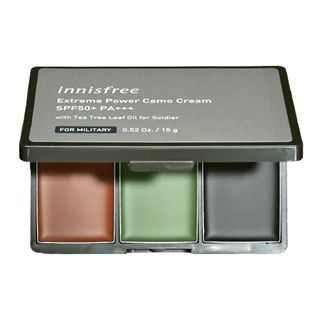
innisfree Extreme Power Camo Cream SPF50+ PA+++
Works for
1 of 1 advertised claim delivered
Sun protectionSPF 50 · 6 UV filtersBroad spectrum
This product offers a good level of protection against both UVB and UVA rays.
This sunscreen uses organic (so-called "chemical") sunscreen filters. Organic, or "chemical" filters usually provide reliable sun protection and rarely leave a white cast. Sunscreens with organic filters can sting eyes.
Anti-agingNot advertised by the brand · 1 ingredient credited for this claimStrong support
This product can help reduce and prevent fine lines and wrinkles, improve skin elasticity and firmness because it contains adenosine.
Keep in mind that it typically takes at least 6 weeks to notice any results because the changes that are needed to improve fine lines and elasticity happen in the deeper layers of the skin. No topical anti-aging product can “erase” wrinkles or fully reverse signs of aging.
This product can also help prevent early signs of skin aging because it offers a good level of broad spectrum sun protection. Sun damage is the main cause of premature skin aging, and protecting your skin from the sun is the best anti-aging strategy.
Evens skin toneNot advertised by the brand · 1 ingredient credited for this claimStrong support
This product offers broad spectrum sun protection. It means that it can prevent hyperpigmentation and help keep the skin tone even (sun damage is the main factor causing age spots, darkening of post-acne marks and other discolorations).
MoisturizingNot advertised by the brand · 12 ingredients credited for this claimGood support
This product can help improve hydration of the skin with the two types of ingredients.
The first type is called “humectants”:
these ingredients help attract water.
When humectants are on the surface of the skin, they “pull in” the moisture from the outside environment, or from
within deeper layers of the skin. The following ingredients in this product do the job:
glycerin, butylene glycol.
This product also contains ingredients called “occlusives”. They help reduce the speed with which our skin loses moisture to the outside environment. These ingredients also help soften the upper layer of the skin, so it feels less tight and nicer to the touch. The following ingredients in this product do the job: copernicia cerifera wax, ethylhexyl palmitate.
Can it cause trouble?
Irritancy2 strong irritants: Sorbitan sesquioleate, Melaleuca alternifolia leaf oilMedium risk
Comedogenic1 ingredient rated 2 or more on the 0–5 pore-clogging scale1 flagged

User reviews
Be the first — your take helps the next person decide.
Ingredients
Filter by role to see what each ingredient is doing.
Ethylhexyl palmitate~22–33%
- Irritation risk
- Low
- Comedogenicity
- 3/5
An emollient that helps soften the skin and create a nice product texture
More about Ethylhexyl palmitateCeresin~3.9–5.8%
Microcrystalline wax~4.5–6.8%
Ethylhexyl methoxycinnamate~3.9–5.9%
- Irritation risk
- High
Octinoxate. When used in higher concentrations, works as a sunscreen protecting the skin from UVB rays. When used in lower concentration, helps to preserve the product formulation. Is shown to be harmful to coral reefs - consider avoiding bathing in coral reef areas when wearing a product with this ingredient. It can be irritating
More about Ethylhexyl methoxycinnamateKaolin~2.8–4.2%
- Irritation risk
- Low
A type of clay that consists mainly of aluminum silicate. Helps absorb oil and creates a thicker product consistency. Can be used to add a white color
More about KaolinZinc oxide~2.8–4.1%
- Irritation risk
- Low
A broad spectrum sunblock (protects from both UVA and UVB rays). Is suitable for most sensitive skins. In small concentrations, can be used as a colorant
More about Zinc oxideCi 77947~1.8–2.7%
- Irritation risk
- Low
Talc~1.6–2.4%
Octyldodecanol~1.1–1.6%
- Irritation risk
- Low
An emollient that helps to soften the skin and create a pleasant product texture and stabilize the formulation
More about OctyldodecanolIron oxides~0.9–1.3%
- Irritation risk
- Low
An umbrella term for the following three colorants: CI 77491, CI 77492, CI 77499. They might be able to offer some protection against visible light, but the degree of the protection is not clear
More about Iron oxidesCi 77491~0.5–1.15%
- Irritation risk
- Low
A red colorant made of iron oxide. Typically is not irritating
More about Ci 77491Ethylhexyl salicylate~0.6–1.35%
- Irritation risk
- Low
Octisalate. A UV filter. It offers some protection against the sun rays that cause sunburn (UVB), but does not protect against the most aging sun rays (UVA). It loses its effectiveness quickly when exposed to sunlight. It is an organic, or so called "chemical" sunscreen
More about Ethylhexyl salicylateTitanium dioxide~0.55–1.25%
- Irritation risk
- Low
Works as a UV filter when used in high concentrations. It is photostable and is effective mostly against the UVB light, with some protection in the UVA range. In small concentrations, used for its ability to improve the color of cosmetic products. Is usually well tolerated by the skin
More about Titanium dioxideCi 77891~0.35–0.85%
- Irritation risk
- Low
Iron oxides~0.35–0.8%
- Irritation risk
- Low
An umbrella term for the following three colorants: CI 77491, CI 77492, CI 77499. They might be able to offer some protection against visible light, but the degree of the protection is not clear
More about Iron oxidesCi 77492~0.3–0.7%
Octocrylene~0.4–1%
- Irritation risk
- Medium
A weak sunscreen that protects against the sun rays that cause sunburn (UVB) and is somewhat effective against the UVA rays. It is quite stable and can help stabilize other, more vulnerable, sunscreen ingredients like Avobenzone. It is an organic, or so called "chemical" sunscreen
More about OctocryleneIron oxides~0.3–0.7%
- Irritation risk
- Low
An umbrella term for the following three colorants: CI 77491, CI 77492, CI 77499. They might be able to offer some protection against visible light, but the degree of the protection is not clear
More about Iron oxidesCi 77499~0.15–0.7%
Sorbitan sesquioleate~0.15–0.65%
- Irritation risk
- High
Used to help oil and water mix together. Can be irritating
More about Sorbitan sesquioleateSilica~0.35–0.85%
Bis-ethylhexyloxyphenol methoxyphenyl triazine~0.35–0.8%
- Irritation risk
- Medium
Tinosorb S. One of the most effective broad spectrum sunscreen ingredients. Protects from both UVA and UVB rays. It is photostable. Unfortunately, not approved by FDA (US) yet.
More about Bis-ethylhexyloxyphenol methoxyphenyl triazineCaprylic/capric triglyceride~0.2–0.75%
- Irritation risk
- Medium
A good mix of fatty acids that forms a protective layer on the skin. Improves the shelf life of products. Derived from coconut and glycerin
More about Caprylic/capric triglycerideCopernicia cerifera wax~0.35–0.75%
- Irritation risk
- Low
Helps to soften the upper layer of the skin and create a nice product consistency
More about Copernicia cerifera waxGlycerin~0.15–0.6%
- Irritation risk
- Low
One of the best moisturizing ingredients. Naturally present in skin. It attracts water to the upper layer of the skin working as a humectant
More about GlycerinDipropylene glycol~0.1–0.5%
- Irritation risk
- Low
Helps to dissolve other ingredients in a formulation. Slows down the rate of product drying
More about Dipropylene glycolTriethoxycaprylylsilane~0.15–0.55%
- Irritation risk
- Low
A type of silicone that helps oil and water mix well together. Helps to disperse other ingredients, e.g. pigments, evenly in a formulation
More about TriethoxycaprylylsilaneWater~0.15–0.55%
Aluminum hydroxide~0.15–0.7%
- Irritation risk
- Low
Is used to add opaque (non-transparent) appearance to formulations. Can be used to coat other ingredients for even dispersion. This is a different ingredient compared to the ones used in antipersperants (aluminium chloride and aluminium chlorohydrate)
More about Aluminum hydroxide1,2-hexanediol~0.15–0.5%
Stearic acid~0.3–0.7%
- Irritation risk
- Low
Helps oil and water mix together and works as an emollient
More about Stearic acidHydrogen dimethicone~0.2–0.7%
- Irritation risk
- Low
Helps the function of sunscreen and pigment ingredients in the formulation
More about Hydrogen dimethiconeTocopheryl acetate~0.15–0.6%
- Irritation risk
- Medium
A more stable but less bio-available form of vitamin E compared to Tocopherol. Might help moisturize and protect the skin from free radicals, but mostly used in low concentrations to stabilize other ingredients.
More about Tocopheryl acetateStearalkonium hectorite~0.15–0.55%
Caprylyl glycol~0.15–0.65%
- Irritation risk
- Medium
Helps preserve products and creates a nice product texture
More about Caprylyl glycolPolyglyceryl-10 oleate~0.15–0.65%
- Irritation risk
- Low
Helps soften the upper layer of the skin
More about Polyglyceryl-10 oleateHydrogenated lecithin~0.15–0.65%
- Irritation risk
- Low
Helps to retain moisture by creating a protective barrier on the skin. Rich in fatty acids. Improves product texture and helps with the penetration of other ingredients.
More about Hydrogenated lecithinPropylene carbonate~0.15–0.65%
- Irritation risk
- Low
Is used to dissolve other ingredients and create nice product texture
More about Propylene carbonateEthylhexylglycerin~0.15–0.6%
Glycyrrhiza glabra root extract~0.15–0.65%
- Irritation risk
- Medium
A plant extract that can help lighten the skin and calm down inflammation. Might be helpful in neutralizing free radicals
More about Glycyrrhiza glabra root extractAdenosine~0.1–0.5%
- Irritation risk
- Low
Might help improve cell turnover and reduce inflammation in skin. One study shows that the ingredients might be able to help reduce dynamic wrinkles (for example, in the corners of the eyes or on the forehead)
More about AdenosineMelaleuca alternifolia leaf oil~0.1–0.45%
- Irritation risk
- High
An essential oil that can be irritating. Has some anti-bacterial properties
More about Melaleuca alternifolia leaf oilHouttuynia cordata extract~0.1–0.45%
- Irritation risk
- Low
Butylene glycol~0.1–0.3%
- Irritation risk
- Low
Used to create a nice product texture and help delivery of other ingredients. Might be somewhat helpful in attracting water to the upper layer of the skin
More about Butylene glycolBht~0.05–0.3%
Ingredient list view
Ethylhexyl palmitate, Ceresin, Microcrystalline wax, Ethylhexyl methoxycinnamate, Kaolin, Zinc oxide, Ci 77947, Talc, Octyldodecanol, Iron oxides, Ci 77491, Ethylhexyl salicylate, Titanium dioxide, Ci 77891, Iron oxides, Ci 77492, Octocrylene, Iron oxides, Ci 77499, Sorbitan sesquioleate, Silica, Bis-ethylhexyloxyphenol methoxyphenyl triazine, Caprylic/capric triglyceride, Copernicia cerifera wax, Glycerin, Dipropylene glycol, Triethoxycaprylylsilane, Water, Aluminum hydroxide, 1,2-hexanediol, Stearic acid, Hydrogen dimethicone, Tocopheryl acetate, Stearalkonium hectorite, Caprylyl glycol, Polyglyceryl-10 oleate, Hydrogenated lecithin, Propylene carbonate, Ethylhexylglycerin, Unknown, Glycyrrhiza glabra root extract, Unknown, Adenosine, Melaleuca alternifolia leaf oil, Houttuynia cordata extract, Butylene glycol, Bht
Compare prices
Retailers ranked by price — lowest first.

Affiliate links · prices updated regularly
Worth comparing, line by line.
Match % combines shared ingredients, the first five ingredients, shared actives and hero ingredients, irritancy (lower counts in the alternative's favour), texture and body area. Only products in the same routine step are compared.
| innisfreeExtreme Power Camo Cream SPF50+ PA+++YOUR PRODUCT | IWLTProtecting Base Sun Cream | MISSHAChogongjin Sulbon Jin Tone Up Sun Cream | 9wishesSun Moisturizer Facial Sun Cream SPF50+++ | |
|---|---|---|---|---|
| Match | — | 62% | 56% | 55% |
| Price | $7.98 | $13.80+$5.82 | $29.30+$21.32 | — |
| Shared key ingredients | — | 6 of 10 | 6 of 10 | 6 of 10 |
| Key difference | — | Niacinamide | Niacinamide | Niacinamide |
| Irritancy | Medium | Low | Medium | Medium |
| SPF | SPF 50 | SPF 50 | SPF 50 | SPF 50 |
| Drying alcohol | — | Contains drying alcohol | — | — |
| View product | Shop | Shop | Shop |


Product summary
We believe that "innisfree - Extreme Power Camo Cream SPF50+ PA+++" can provide reliable sun protection based on the ingredients listed. It can protect from both UVA and UVB rays. This is great news because not all sunscreens with SPF ratings give UVA protection. (UVA rays do not cause sunburn, but still damage our skin and lead to early aging).
Its formula is also hydrating, so you might not need an additional moistruizer during the day. This product prevents early signs of aging by protecting against sun damage (all broad spectrum sunscreens do that).
Sunscreen filters
This sunscreen uses a mixture of both mineral and organic (so-called "chemical") UV filters. Here are the organic filters this product uses: tinosorb s, octinoxate and octocrylene. As for the mineral filters, this sunscreen uses zinc oxide.
Irritation risk
This formulation includes some common irritants, including ingredients that do not provide a benefit for the skin. We assess the overall irritancy of this moisturizer to be medium. For a detailed overview of all potential irritants: click here
You can see the detailed formula review with the breakdown of all actives in the product and the full ingredient list with estimated concentrations in the tables below.
Price
The product retails for 7.98$ in the United States.
For a detailed price comparison: click here.
Sources cited in this review
Every concentration estimate and effectiveness label is anchored to one of these 10 studies and safety reviews.
- 1A review of inorganic UV filters zinc oxide and titanium dioxideonlinelibrary.wiley.com
- 2
- 3
- 4
- 5
- 6

Affiliate links · As an Amazon Associate, WIMJ earns from qualifying purchases.