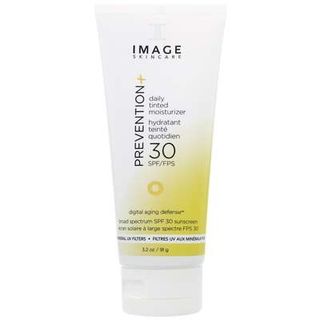
Image skincare Prevention+ Daily Tinted Moisturizer SPF30+
Works for
1 of 3 advertised claims delivered
Sun protectionSPF 30 · 1 UV filter · Partial spectrumWeak protectionLow filter dose
This product does not offer good protection against UVA rays.
This product can be considered "reef safe" because it does not contain the UV filters (oxybenzone and octinoxate) that can be harmful to coral reefs when present in the water in high concentrations.
Anti-aging4 ingredients credited for this claimModerate support
“Helps to reduce redness, dryness, discolouration and other signs of premature ageing.”
This product contains arabidopsis thaliana extract. This ingredient might be able to help reduce and prevent fine lines and wrinkles, improve skin elasticity and firmness, but there is not enough evidence that it actually works. The biggest anti-aging effect in this product comes from sun protection. Sun damage is the main factor causing early signs of skin aging. We, however, do not recommend using this product as a sunscreen because the protection it offers is not strong enough).
Evens skin tone2 ingredients credited for this claimLimited support
“IMAGE Skincare, Prevention+ A daily moisturising treatment that provides the skin with broad-spectrum sun protection whilst adding just a touch of colour, evening out the skin's tone and helping to reduce discolouration.”
This product contains ingredients () that could help reduce hyperpigmentation (for example, post-acne marks or age spots) in theory, but there is not enough evidence that they actually work.
The biggest effect for evening out skin tone in this product comes from sun protection. Sun damage is the main factor causing age spots, darkening of post-acne marks and other discolorations. This is why sun protection is the best strategy for maintaining an even skin tone. We, however, do not recommend using this product as a sunscreen because the protection it offers is not strong enough).
MoisturizingNot advertised by the brand · 22 ingredients credited for this claimGood support
This product can help improve hydration of the skin with the two types of ingredients.
The first type is called “humectants”:
these ingredients help attract water.
When humectants are on the surface of the skin, they “pull in” the moisture from the outside environment, or from
within deeper layers of the skin. The following ingredients in this product do the job:
biosaccharide gum-1, erythritol.
This product also contains ingredients called “occlusives”. They help reduce the speed with which our skin loses moisture to the outside environment. These ingredients also help soften the upper layer of the skin, so it feels less tight and nicer to the touch. The following ingredients in this product do the job: caprylic/capric triglyceride, dimethicone.
Can it cause trouble?
Irritancy5 strong irritants: Citrus aurantium dulcis peel oil expressed, Limonene + 3 more — patch-test recommendedHigh risk
Comedogenic2 ingredients rated 2 or more on the 0–5 pore-clogging scale2 flagged
User reviews
Be the first — your take helps the next person decide.
Ingredients
Filter by role to see what each ingredient is doing.
Water~45–55%
Caprylic/capric triglyceride~5.7–6.9%
- Irritation risk
- Medium
A good mix of fatty acids that forms a protective layer on the skin. Improves the shelf life of products. Derived from coconut and glycerin
More about Caprylic/capric triglycerideCyclopentasiloxane~4.2–5.2%
- Irritation risk
- Low
A silicone that helps improve the product texture and spreadability. Can absorb oil creating a short-term mattifying effect on the skin
More about CyclopentasiloxaneGlycerin~3.1–3.8%
- Irritation risk
- Low
One of the best moisturizing ingredients. Naturally present in skin. It attracts water to the upper layer of the skin working as a humectant
More about GlycerinButyloctyl salicylate~2.3–2.8%
- Irritation risk
- Medium
A synthetic ester of salicylic acid that is used to help disperse pigments and boost effectiveness of sunscreen ingredients. It is able to absorb UV light (working as an organic, or chemical filter), but is not approved as a sunscreen ingredient on its own
More about Butyloctyl salicylateDimethicone~2–2.5%
- Irritation risk
- Low
A silicone that helps to reduce water loss from the surface of the skin. Can temporarily "fill in" lines and wrinkles, absorb oil, and create a nice product finish
More about DimethiconeGlyceryl stearate~1.6–2%
- Irritation risk
- Low
An emollient that softens the skin and forms a protective layer on its surface. Helps water and oil mix together
More about Glyceryl stearatePeg-100 stearate~1.4–1.8%
- Irritation risk
- Low
Helps oil and water mix togehter and creates a nice product texture
More about Peg-100 stearateButyrospermum parkii nut extract~1.1–1.4%
- Irritation risk
- Low
Styrene/acrylates copolymer~0.9–1.1%
- Irritation risk
- Low
Used to create an even product consistency. Can help boost efficiency of sunscreen filters
More about Styrene/acrylates copolymerCi 77891~0.65–0.95%
- Irritation risk
- Low
Lecithin~0.5–0.8%
- Irritation risk
- Low
Used mostly for creating emulsions - helping oil and water mix together. Helps soften the upper layer of the skin
More about LecithinIsostearic acid~0.55–0.85%
- Irritation risk
- Low
Used to create a nice product texture
More about Isostearic acidPolyglyceryl-3 polyricinoleate~0.45–0.65%
- Irritation risk
- Medium
Helps oil and water mix together
More about Polyglyceryl-3 polyricinoleatePolyhydroxystearic acid~0.4–0.6%
- Irritation risk
- Medium
Used to create a thicker product consistency and stabilize the formulation
More about Polyhydroxystearic acidCyclohexasiloxane~0.4–0.6%
- Irritation risk
- Low
A silicone that serves as an emollient. Helps create a nice non-greasy feels
More about CyclohexasiloxaneHelianthus annuus seed oil~0.35–0.65%
- Irritation risk
- Low
A great emollient due to its high linoleic acid content. One of the most effective plant oils in helping skin hydration and repairing skin barrier function
More about Helianthus annuus seed oilPolysilicone-31~0.3–0.6%
- Irritation risk
- Low
Sorbitan stearate~0.3–0.5%
Ci 77492~0.25–0.45%
Cetyl alcohol~0.25–0.5%
- Irritation risk
- Low
A non-drying alcohol that works to soften the skin and stabilize product formulations helping oil and water mix together
More about Cetyl alcoholPhenoxyethanol~0.25–0.45%
- Irritation risk
- Low
A preservative. It helps prevent bacterial growth in cosmetic products
More about PhenoxyethanolHea/sodium acryloyldimethyltaurate/steareth-20 methacrylate copolymer~0.2–0.35%
Citrus aurantium dulcis peel oil expressed~0.15–0.3%
- Irritation risk
- High
Jojoba esters~0.25–0.4%
- Irritation risk
- Medium
An emollient made of jojoba oil. Helps soften the skin and support its barrier function
More about Jojoba estersLimonene~0.15–0.3%
- Irritation risk
- High
A common frangrance that can easily irritate skin, especially if exposed to air, light or heat
More about LimoneneCaprylyl glycol~0.2–0.4%
- Irritation risk
- Medium
Helps preserve products and creates a nice product texture
More about Caprylyl glycolAllantoin~0.15–0.3%
- Irritation risk
- Low
Helps calm down inflammation in skin and can help reduce itching. Helps to repair the skin barrier and keep skin hydrated
More about AllantoinC13-14 isoparaffin~0.2–0.4%
- Irritation risk
- Low
Helps soften the upper layer of the skin, dissolve other ingredients and create a thicker product consistency
More about C13-14 isoparaffinLaminaria digitata extract~0.2–0.4%
- Irritation risk
- Low
- Comedogenicity
- 3/5
Seaweed extract that helps the skin to attract water and make it more smooth for touch. Also shows promise of anti-aging properties, but good research is lacking at the moment
More about Laminaria digitata extractArtemisia vulgaris extract~0.2–0.35%
- Irritation risk
- High
A plant extract that might have some anti-inflammatory and anti-oxidant properties. It can be irritating
More about Artemisia vulgaris extractEthylhexylglycerin~0.2–0.4%
Hexylene glycol~0.2–0.35%
- Irritation risk
- Medium
Helps create a more spreadable product texture
More about Hexylene glycolCi 77491~0.2–0.4%
- Irritation risk
- Low
A red colorant made of iron oxide. Typically is not irritating
More about Ci 77491Citrus nobilis peel oil~0.2–0.35%
- Irritation risk
- High
A plant oil with high content of volatile compounds that, especially when exposed to air, can cause allergic reactions and irritate the skin
More about Citrus nobilis peel oilXanthan gum~0.2–0.4%
- Irritation risk
- Low
Used to create a thicker product consistency
More about Xanthan gumBisabolol~0.15–0.3%
- Irritation risk
- Low
An active component of chamomile plant that historically has been used to calm down irritated skin. A recent study shows that bisabolol indeed can have some anti-inflammatory effect on skin, even though conclusive data is lacking. Bisabolol has a sweet floral scent and can be added to products for its aromatic properties
More about BisabololPolysorbate 80~0.25–0.45%
Tocopheryl acetate~0.2–0.4%
- Irritation risk
- Medium
A more stable but less bio-available form of vitamin E compared to Tocopherol. Might help moisturize and protect the skin from free radicals, but mostly used in low concentrations to stabilize other ingredients.
More about Tocopheryl acetateTriethoxycaprylylsilane~0.2–0.4%
- Irritation risk
- Low
A type of silicone that helps oil and water mix well together. Helps to disperse other ingredients, e.g. pigments, evenly in a formulation
More about TriethoxycaprylylsilaneCi 77499~0.2–0.4%
Camellia sinensis leaf extract~0.2–0.4%
- Irritation risk
- Low
Can contain potent anti-oxidant compounds (abbreviated ECG, GCG, EGC, and EGCG) that might help protect the skin from free radicals. Can help calm down inflammation and has some anti-bacterial properties. Unfortunately, these antioxidants are unstable and lose their effectiveness very quickly in products. The concentration of the antioxidant compounds in the extract also tends to be low to be effective in topical formulation
More about Camellia sinensis leaf extractDecyl glucoside~0.3–0.55%
- Irritation risk
- High
Helps oil and water mix together. Can be irritating
More about Decyl glucosideErythritol~0.2–0.35%
- Irritation risk
- Low
Helps to attract water to the upper layer of the skin
More about ErythritolSodium hyaluronate~0.2–0.4%
- Irritation risk
- Low
One of the best moisturizing ingredients. Attracts water into the upper layer of the skin
More about Sodium hyaluronateBiosaccharide gum-1~0.2–0.4%
- Irritation risk
- Low
Helps attract water to the upper layer of the skin and is claimed to provide a longer-lasting hydration because of its ability to create a water-binding film on the surface of the skin
More about Biosaccharide gum-1Vanilla planifolia fruit extract~0.2–0.35%
- Irritation risk
- High
A plant extract used as a fragrance. Can be irritating
More about Vanilla planifolia fruit extractGlucose~0.2–0.4%
- Irritation risk
- Low
Helps attract water to the upper layer of the skin. Could be helpful in restoring the skin barrier function
More about GlucoseHydrolyzed pea protein~0.25–0.45%
- Irritation risk
- Low
Pyruvic acid~0.2–0.4%
- Irritation risk
- Low
Sodium chloride~0.25–0.4%
- Irritation risk
- Low
Used to stabilize mixtures of oil and water, and create thicker, gel-like product textures
More about Sodium chlorideBarosma betulina leaf oil~0.2–0.35%
- Irritation risk
- Low
Tetrahexyldecyl ascorbate~0.2–0.4%
- Irritation risk
- Medium
Being a lipid soluble form of vitamin C, it is more stable than ascorbic acid, but still degrades quickly and needs to be stabilized in a formulation with another ingredient. It is claimed to penetrate skin better than pure vitamin C and have the the similar benefits, but solid studies of its effectiveness are lacking. Is likely to require a higher concentration in a product than pure vitamin C to be effective. It might be able to help reduce pore clogging.
More about Tetrahexyldecyl ascorbateAlumina~0.3–0.6%
- Irritation risk
- Low
The same compound that is used safely in dental implants and bone cements. In cosmetics, it is used to improve the consistency of products
More about AluminaMagnesium oxide~0.2–0.4%
- Irritation risk
- Low
Potassium sorbate~0.2–0.35%
Sodium benzoate~0.15–0.3%
Homarine hcl~0.15–0.3%
- Irritation risk
- Medium
Might help to improve skin hydration levels
More about Homarine hclSodium succinate~0.15–0.3%
- Irritation risk
- Low
Arabidopsis thaliana extract~0.15–0.3%
- Irritation risk
- Medium
Plant extract that might be helpful in repairing sun damage but evidence of effectiveness in skin are lacking
More about Arabidopsis thaliana extractMicrococcus lysate~0.15–0.3%
- Irritation risk
- Low
Consists of remains of dead bacteria cells. Is likely helpful in attracting water to the upper layer of the skin. Might be helpful in reducing inflammation and neutralizing free radicals in skin. It is claimed to be a "DNA repair enzyme"
More about Micrococcus lysatePlankton extract~0.1–0.2%
- Irritation risk
- Medium
- Comedogenicity
- 3/5
Can help attract water to the upper layer of the skin
More about Plankton extractErgothioneine~0.1–0.15%
- Irritation risk
- Low
Can help neutralize free radicals in skin. Preliminary studies show that it can be more effective than coenzyme Q10 but studies on effective concentration for topical applications are lacking
More about ErgothioneineIngredient list view
Water, Caprylic/capric triglyceride, Cyclopentasiloxane, Glycerin, Butyloctyl salicylate, Dimethicone, Glyceryl stearate, Peg-100 stearate, Butyrospermum parkii nut extract, Styrene/acrylates copolymer, Ci 77891, Lecithin, Isostearic acid, Polyglyceryl-3 polyricinoleate, Polyhydroxystearic acid, Cyclohexasiloxane, Helianthus annuus seed oil, Polysilicone-31, Sorbitan stearate, Ci 77492, Cetyl alcohol, Phenoxyethanol, Hea/sodium acryloyldimethyltaurate/steareth-20 methacrylate copolymer, Citrus aurantium dulcis peel oil expressed, Jojoba esters, Limonene, Caprylyl glycol, Allantoin, C13-14 isoparaffin, Laminaria digitata extract, Artemisia vulgaris extract, Ethylhexylglycerin, Hexylene glycol, Ci 77491, Citrus nobilis peel oil, Xanthan gum, Bisabolol, Polysorbate 80, Tocopheryl acetate, Triethoxycaprylylsilane, Ci 77499, Camellia sinensis leaf extract, Decyl glucoside, Erythritol, Sodium hyaluronate, Biosaccharide gum-1, Vanilla planifolia fruit extract, Glucose, Hydrolyzed pea protein, Pyruvic acid, Sodium chloride, Barosma betulina leaf oil, Tetrahexyldecyl ascorbate, Alumina, Magnesium oxide, Potassium sorbate, Sodium benzoate, Homarine hcl, Sodium succinate, Arabidopsis thaliana extract, Micrococcus lysate, Plankton extract, Ergothioneine
Compare prices
Retailers ranked by price — lowest first.

Product summary
"Image skincare - Prevention+ Daily Tinted Moisturizer SPF30+" does not provide enough UVA protection. UVA rays do not cause sunburn, but still damage the skin, leading to early signs of aging and pigmentation issues.
Because it includes good moisturizing ingredients, it can also work as a hydrating day cream.
Sunscreen filters
This sunscreen uses so-called "chemical", or organic UV filters (organic simply means that their molecules contain atoms of carbon). These filters typically give good sun protection and rarely leave a white cast, but they can be irritating for sensitive skin. The UV filters in this sunscreen are: butyloctyl salicylate 2.30% - 2.80%.
Irritation risk
We assess the overall irritancy of this moisturizer to be high. For a detailed overview of all potential irritants: click here
You can see the detailed formula review with the breakdown of all actives in the product and the full ingredient list with estimated concentrations in the tables below.
Price
The product retails from 32.25£ up to 39.15£ in the United Kingdom.
For a detailed price comparison: click here.
Sources cited in this review
Every concentration estimate and effectiveness label is anchored to one of these 25 studies and safety reviews.
- 1
- 2
- 3
- 4Final Report on the Safety Assessment of Dimethicone Copolyoljournals.sagepub.com
- 5
- 6

Affiliate links · As an Amazon Associate, WIMJ earns from qualifying purchases.