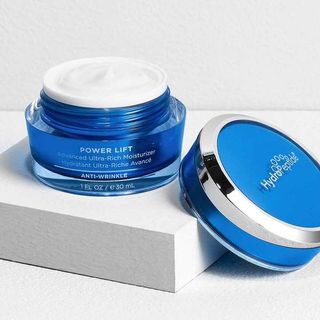
HydroPeptide Power Lift Moisturizer
Works for
1 of 1 advertised claim delivered
Moisturizing16 ingredients credited for this claimStrong support
“Power Lift Moisturizer”
This product can help improve hydration of the skin with the two types of ingredients.
The first type is called “humectants”:
these ingredients help attract water.
When humectants are on the surface of the skin, they “pull in” the moisture from the outside environment, or from
within deeper layers of the skin. The following ingredients in this product do the job:
glycerin, sodium hyaluronate.
This product also contains ingredients called “occlusives”. They help reduce the speed with which our skin loses moisture to the outside environment. These ingredients also help soften the upper layer of the skin, so it feels less tight and nicer to the touch. The following ingredients in this product do the job: butyrospermum parkii butter, caprylic/capric triglyceride.
The following ingredients in this product are especially good for supporting the skin barrier and helping with the hydration level: acetyl dipeptide-1 cetyl ester, dipeptide diaminobutyroyl benzylamide diacetate, panthenol
Anti-oxidationNot advertised by the brand · 7 ingredients credited for this claimModerate support
This product contains antioxidants (arbutin) that might be able to help neutralize free radicals in skin to lessen the damage it gets from the UV light (sun). There is not enough evidence to confirm their effectiveness in skin though.
Anti-agingNot advertised by the brand · 5 ingredients credited for this claimModerate support
This product contains acetyl dipeptide-1 cetyl ester, dipeptide diaminobutyroyl benzylamide diacetate. These ingredients might be able to help reduce and prevent fine lines and wrinkles, improve skin elasticity and firmness, but there is not enough evidence that it actually works.
Evens skin toneNot advertised by the brand · 4 ingredients credited for this claimModerate support
The following ingredient (ingredients) in this product might be helpful, but there is no evidence to confirm that it actually works: arbutin, glycyrrhiza glabra root extract.
Can it cause trouble?
Irritancy2 strong irritants: Parfum, MenthoxypropanediolMedium risk
Comedogenic2 ingredients rated 2 or more on the 0–5 pore-clogging scale2 flagged
User reviews
Be the first — your take helps the next person decide.
Ingredients
Filter by role to see what each ingredient is doing.
Water~45–55%
Butylene glycol~5.4–6.5%
- Irritation risk
- Low
Used to create a nice product texture and help delivery of other ingredients. Might be somewhat helpful in attracting water to the upper layer of the skin
More about Butylene glycolSilybum marianum ethyl ester~4–4.9%
- Irritation risk
- Medium
Helps to create a nice product texture. Used to substitute silicones
More about Silybum marianum ethyl esterGlycerin~3–3.7%
- Irritation risk
- Low
One of the best moisturizing ingredients. Naturally present in skin. It attracts water to the upper layer of the skin working as a humectant
More about GlycerinCaprylic/capric triglyceride~2.3–2.9%
- Irritation risk
- Medium
A good mix of fatty acids that forms a protective layer on the skin. Improves the shelf life of products. Derived from coconut and glycerin
More about Caprylic/capric triglycerideCetearyl alcohol~1.8–2.2%
- Irritation risk
- Low
- Comedogenicity
- 2/5
A non-drying alcohol. Works as an emollient. Helps water and oil mix together and creates a nice product texture
More about Cetearyl alcoholEchinacea purpurea extract~1.5–1.8%
- Irritation risk
- High
Plant extract that might have some anti-oxidant properties. Can be irritating
More about Echinacea purpurea extractBehenyl alcohol~1.4–1.7%
- Irritation risk
- Low
Non-drying alcohol that helps water and oil mix together. Also serves as an emollient
More about Behenyl alcoholButyrospermum parkii butter~1.1–1.4%
- Irritation risk
- Low
- Comedogenicity
- 3/5
A great moisturising ingredient that softens the skin and reduces water loss from its upper layer. It also can be helpful in protecting skin from free radicals
More about Butyrospermum parkii butterCaprylic/capric triglyceride~0.8–1.2%
- Irritation risk
- Medium
A good mix of fatty acids that forms a protective layer on the skin. Improves the shelf life of products. Derived from coconut and glycerin
More about Caprylic/capric triglycerideDipeptide diaminobutyroyl benzylamide diacetate~0.55–0.8%
- Irritation risk
- Low
A type of peptide. Peptides are excellent moisturizers and might be able support collagen production reducing fine lines and wrinkles
More about Dipeptide diaminobutyroyl benzylamide diacetateIsononyl isononanoate~0.5–0.75%
- Irritation risk
- Low
Forms a protective film on the surface of the skin to prevent moisture loss. Gives a velvety feel to products while reducing tackiness
More about Isononyl isononanoateArachidyl alcohol~0.45–0.7%
- Irritation risk
- Low
Used to soften the upper layer of the skin and create a thicker product consistency
More about Arachidyl alcoholEthylhexyl isononanoate~0.4–0.6%
- Irritation risk
- Low
Helps soften the upper layer of the skin and improve the product consistency
More about Ethylhexyl isononanoateOryza sativa bran~0.5–0.75%
- Irritation risk
- Low
Leuconostoc/radish root ferment filtrate~0.3–0.55%
- Irritation risk
- Medium
A preservative that comes from radishes fermented by a bacteria. New research suggests that the preservation properties in the ingredient come from an ammonium salt that is not present naturally in radish root but used in its cultivation. Is problematic because the exact amount of the preservative agents is difficult to determine
More about Leuconostoc/radish root ferment filtratePanthenol~0.3–0.55%
- Irritation risk
- Low
Helps attract water to the upper layer of the skin and can help improve skin barrier function
More about PanthenolTetrahydroxypropyl ethylenediamine~0.25–0.45%
- Irritation risk
- Low
Caprylyl glycol~0.25–0.5%
- Irritation risk
- Medium
Helps preserve products and creates a nice product texture
More about Caprylyl glycol1,2-hexanediol~0.2–0.4%
Arachidyl glucoside~0.2–0.4%
Parfum~0.15–0.3%
- Irritation risk
- High
An aromatic blend of unspecified and possibly irritating ingredients
More about ParfumMenthoxypropanediol~0.15–0.3%
Hydroxyethyl acrylate/sodium acryloyldimethyl taurate copolymer~0.2–0.35%
- Irritation risk
- Medium
A gelling agent that thickens the product consistency and leaves the skin with a velvety finish
More about Hydroxyethyl acrylate/sodium acryloyldimethyl taurate copolymerAcrylates/c10-30 alkyl acrylate crosspolymer~0.2–0.4%
- Irritation risk
- Medium
Maintains the texture of skincare products. Allows the product to spread evenly. Helps oil and water mix together
More about Acrylates/c10-30 alkyl acrylate crosspolymerTocopheryl acetate~0.2–0.35%
- Irritation risk
- Medium
A more stable but less bio-available form of vitamin E compared to Tocopherol. Might help moisturize and protect the skin from free radicals, but mostly used in low concentrations to stabilize other ingredients.
More about Tocopheryl acetateXanthan gum~0.2–0.4%
- Irritation risk
- Low
Used to create a thicker product consistency
More about Xanthan gumCetearyl glucoside~0.2–0.4%
- Irritation risk
- Medium
Helps water and oil in the product mix well together and improves product texture
More about Cetearyl glucosideSorbitan laurate~0.2–0.4%
Squalane~0.25–0.45%
- Irritation risk
- Low
An oil naturally present in skin. Works as an emollient to soften the skin and form a protective layer on its surface without a greasy feeling.
More about SqualaneCyclodextrin~0.2–0.35%
- Irritation risk
- Low
A type of sugar that is used to support delivery of active ingredients and can enhance their penetration into the skin without disrupting the skin's barrier
More about CyclodextrinTetrahexyldecyl ascorbate~0.2–0.4%
- Irritation risk
- Medium
Being a lipid soluble form of vitamin C, it is more stable than ascorbic acid, but still degrades quickly and needs to be stabilized in a formulation with another ingredient. It is claimed to penetrate skin better than pure vitamin C and have the the similar benefits, but solid studies of its effectiveness are lacking. Is likely to require a higher concentration in a product than pure vitamin C to be effective. It might be able to help reduce pore clogging.
More about Tetrahexyldecyl ascorbateBuddleja davidii extract~0.2–0.35%
- Irritation risk
- Low
Disodium edta~0.2–0.35%
O-cymen-5-ol~0.05–0.1%
Sodium hyaluronate~0.2–0.35%
- Irritation risk
- Low
One of the best moisturizing ingredients. Attracts water into the upper layer of the skin
More about Sodium hyaluronatePolysorbate 60~0.2–0.4%
Ananas sativus fruit extract~0.2–0.35%
- Irritation risk
- Medium
A fruit extract that might help to attract water to the upper layer of the skin, but there is no evidence for any other benefits to the skin
More about Ananas sativus fruit extractHydroxyethylcellulose~0.2–0.4%
- Irritation risk
- Low
Used to thicken product formulations and create gel-like textures
More about HydroxyethylcelluloseAcetyl dipeptide-1 cetyl ester~0.2–0.4%
- Irritation risk
- Low
A type of peptide. Peptides are excellent moisturizers and might be able support collagen production reducing fine lines and wrinkles
More about Acetyl dipeptide-1 cetyl esterSodium benzoate~0.2–0.35%
Citric acid~0.2–0.35%
- Irritation risk
- Medium
Can work as an exfoliant but is typically used to adjust the product pH
More about Citric acidPotassium sorbate~0.2–0.4%
Glycyrrhiza glabra root extract~0.2–0.35%
- Irritation risk
- Medium
A plant extract that can help lighten the skin and calm down inflammation. Might be helpful in neutralizing free radicals
More about Glycyrrhiza glabra root extractPyridoxine tris-hexyldecanoate~0.2–0.35%
- Irritation risk
- Low
Arbutin~0.15–0.3%
- Irritation risk
- Medium
Beta-arbutin. Can help to reduce hyperpigmentation and has an anti-oxidant effect when used in high enough concentration. Is less effective compared to alpha-arbutin
More about ArbutinMagnesium ascorbyl phosphate~0.2–0.35%
- Irritation risk
- Medium
A derivative of vitamin C that is more stable, but less bioavailable than the pure form of vitamin C. It does not penetrate the skin well, but has been shown to convert to pure vitamin C once in skin. It can be helpful in stimulating collagen production and lightening the skin tone, but the required concentration is likely to be very high
More about Magnesium ascorbyl phosphateTropolone~0.15–0.3%
- Irritation risk
- Low
Myristoyl tripeptide-31~0.15–0.3%
- Irritation risk
- Low
Phenoxyethanol~0.15–0.3%
- Irritation risk
- Low
A preservative. It helps prevent bacterial growth in cosmetic products
More about PhenoxyethanolSodium metabisulfite~0.1–0.2%
Hexapeptide-10~0.1–0.15%
- Irritation risk
- Low
Diacetyl boldine~0.1–0.15%
- Irritation risk
- Low
Ingredient list view
Water, Butylene glycol, Silybum marianum ethyl ester, Glycerin, Caprylic/capric triglyceride, Cetearyl alcohol, Echinacea purpurea extract, Behenyl alcohol, Butyrospermum parkii butter, Caprylic/capric triglyceride, Dipeptide diaminobutyroyl benzylamide diacetate, Isononyl isononanoate, Arachidyl alcohol, Ethylhexyl isononanoate, Oryza sativa bran, Leuconostoc/radish root ferment filtrate, Panthenol, Tetrahydroxypropyl ethylenediamine, Caprylyl glycol, 1,2-hexanediol, Arachidyl glucoside, Parfum, Menthoxypropanediol, Hydroxyethyl acrylate/sodium acryloyldimethyl taurate copolymer, Acrylates/c10-30 alkyl acrylate crosspolymer, Tocopheryl acetate, Xanthan gum, Cetearyl glucoside, Sorbitan laurate, Squalane, Cyclodextrin, Tetrahexyldecyl ascorbate, Buddleja davidii extract, Disodium edta, O-cymen-5-ol, Sodium hyaluronate, Polysorbate 60, Ananas sativus fruit extract, Hydroxyethylcellulose, Acetyl dipeptide-1 cetyl ester, Sodium benzoate, Citric acid, Potassium sorbate, Glycyrrhiza glabra root extract, Pyridoxine tris-hexyldecanoate, Arbutin, Magnesium ascorbyl phosphate, Tropolone, Myristoyl tripeptide-31, Phenoxyethanol, Sodium metabisulfite, Hexapeptide-10, Diacetyl boldine
Compare prices
Retailers ranked by price — lowest first.

Affiliate links · prices updated regularly
Sources cited in this review
Every concentration estimate and effectiveness label is anchored to one of these 18 studies and safety reviews.
- 1
- 2
- 3
- 4Skin moisturizing effects of panthenol-based formulationspdfs.semanticscholar.org
- 5
- 6

Affiliate links · As an Amazon Associate, WIMJ earns from qualifying purchases.