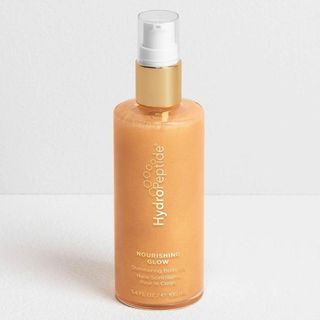
HydroPeptide Nourishing Glow Body Oil

HydroPeptide Nourishing Glow Body Oil

Efficacy75/100IrritancyHigh
Edit

Works for

1 of 1 advertised claim delivered

Moisturizing
14 ingredients credited for this claim
Good support
What the product description says
“A luxurious blend of pure plant oils and squalene soothe skin and drench it with lasting hydration.”
Source: HydroPeptide

This product can help soften the skin and reduce its moisture loss with emollients and occlusives: caprylic/capric triglyceride, helianthus annuus seed oil.

Keep in mind that this product does not contain effective ingredients to attract water to the upper layer of the skin. This is why an additional product with humectants like glycerin or hyaluronic acid can be helpful (apply it before this product for the best results).

SqualaneKey active· Emollient, OcclusiveEffect: HighAn oil naturally present in skin. Works as an emollient to soften the skin and form a protective layer on its surface without a greasy feeling.~0.45–1.1%
Caprylic/capric triglycerideKey active· Emollient, OcclusiveEffect: HighA good mix of fatty acids that forms a protective layer on the skin. Improves the shelf life of products. Derived from coconut and glycerin~5.1–7.6%
Glycine soja oilKey active· EmollientEffect: HighA good emollient that helps soften the skin and helps repair its barrier function. It can clog pores if used in high concentrations.~2.9–4.4%
Helianthus annuus seed oilKey active· Emollient, OcclusiveEffect: HighA great emollient due to its high linoleic acid content. One of the most effective plant oils in helping skin hydration and repairing skin barrier function~5–7.4%
Simmondsia chinensis seed oilKey active· Emollient, OcclusiveEffect: HighSoftens the upper layer of skin and helps restore the healthy skin barrier. Has shown to help calm down inflammation in skin. It is a stable oil, meaning that it retains its properties even when exposed to air.~0.85–1.25%
IsododecaneKey active· Emollient, OcclusiveEffect: MediumAn emollient that helps soften the skin and can decrease moisture loss. Helps create a nice product texture~1.9–2.8%
Isostearyl alcoholKey active· EmollientEffect: MediumHelps soften the upper layer of the skin~1.5–2.2%
C12-15 alkyl benzoateKey active· EmollientEffect: MediumEnhances the product texture and makes it more spreadable. Helps reduce water loss from the outer layer of skin. Extands the shelf life by preventing bacteria growth~4–6%
Cucumis melo cantalupensis fruit extractEffect: LowA fruit extract that might help attract water to the upper layer of the skin and might have some antioxidant properties but evidence of effectiveness in skin is missing~0.15–0.7%
Isopropyl palmitate· EmollientEffect: LowHelps soften the upper layer of the skin and create a thicker product consistency~22–33%
Caprylyl glycol· Humectant, EmollientEffect: LowHelps preserve products and creates a nice product texture~0.15–0.7%
Camellia sinensis leaf extractEffect: LowCan contain potent anti-oxidant compounds (abbreviated ECG, GCG, EGC, and EGCG) that might help protect the skin from free radicals. Can help calm down inflammation and has some anti-bacterial properties. Unfortunately, these antioxidants are unstable and lose their effectiveness very quickly in products. The concentration of the antioxidant compounds in the extract also tends to be low to be effective in topical formulation~0.2–0.7%
Pyrus malus fruit extractUnder-dosedEffect: MediumCan have some moisturizing properties due to its sugar content~0.2–0.75%
Cucumis sativus fruit extractEffect: Low, below effective doseMight be somewhat helpful in reducing hyperpigmentation and neutralizing free radicals but its typical concentration in a product is too low for having an effect~0.15–0.65%
Anti-oxidation
Not advertised by the brand · 9 ingredients credited for this claim
Moderate support

This product contains antioxidants (camellia sinensis leaf extract) that might be able to help neutralize free radicals in skin to lessen the damage it gets from the UV light (sun). There is not enough evidence to confirm their effectiveness in skin though.

Camellia sinensis leaf extractKey activeEffect: MediumCan contain potent anti-oxidant compounds (abbreviated ECG, GCG, EGC, and EGCG) that might help protect the skin from free radicals. Can help calm down inflammation and has some anti-bacterial properties. Unfortunately, these antioxidants are unstable and lose their effectiveness very quickly in products. The concentration of the antioxidant compounds in the extract also tends to be low to be effective in topical formulation~0.2–0.7%
Cucumis melo cantalupensis fruit extractEffect: LowA fruit extract that might help attract water to the upper layer of the skin and might have some antioxidant properties but evidence of effectiveness in skin is missing~0.15–0.7%
Prunus persica fruit extractEffect: LowA fruit extact. Might have some anti-oxidant properties~0.35–0.8%
Rubus idaeus fruit extractEffect: LowA fruit extract that might have some anti-oxidant properties but evidence of effectiveness in skin is lacking~0.2–0.7%
Tetrahexyldecyl ascorbateUnder-dosedEffect: HighBeing a lipid soluble form of vitamin C, it is more stable than ascorbic acid, but still degrades quickly and needs to be stabilized in a formulation with another ingredient. It is claimed to penetrate skin better than pure vitamin C and have the the similar benefits, but solid studies of its effectiveness are lacking. Is likely to require a higher concentration in a product than pure vitamin C to be effective. It might be able to help reduce pore clogging.~0.35–0.85%
Tocopheryl acetateEffect: Low, below effective doseA more stable but less bio-available form of vitamin E compared to Tocopherol. Might help moisturize and protect the skin from free radicals, but mostly used in low concentrations to stabilize other ingredients.~0.4–0.9%
Cucumis sativus fruit extractEffect: Low, below effective doseMight be somewhat helpful in reducing hyperpigmentation and neutralizing free radicals but its typical concentration in a product is too low for having an effect~0.15–0.65%
Pyrus malus fruit extractEffect: Low, below effective doseCan have some moisturizing properties due to its sugar content~0.2–0.75%
Rosmarinus officinalis leaf extractEffect: Low, below effective doseCan be helpful in reducing inflammation in skin, including inflamed acne. It can be irritating~0.15–0.65%

Can it cause trouble?

Irritancy
12 strong irritants: Lavandula angustifolia flower/leaf/stem extract, Santalum album wood extract + 10 more — patch-test recommended
High risk
We flagged 30 ingredients with irritancy potential. Severity depends on your sensitivity threshold; the table lists the worst offenders first.
IngredientFunctionIrritationEst. amount
Lavandula angustifolia flower/leaf/stem extractUsed as a fragranceHigh~0.35–0.75%est.
Santalum album wood extractUsed as a fragrance. Can be irritatingHigh~0.15–0.65%est.
Rose extractUsed as a fragrance. Can be irritatingHigh~0.15–0.7%est.
Elettaria cardamomum seed extractUsed as a fragranceHigh~0.15–0.6%est.
Salvia officinalis leaf extractSage leaf extract. It can be irritatingHigh~0.2–0.8%est.
Rosmarinus officinalis leaf extractCan be helpful in reducing inflammation in skin, including inflamed acne. It can be irritatingHigh~0.15–0.65%est.
Plumeria rubra flower extractUsed to add a nice smell to the product. Can be irritatingHigh~0.15–0.65%est.
Vanilla planifolia fruit extractA plant extract used as a fragrance. Can be irritatingHigh~0.15–0.7%est.
Jasminum officinale flower/leaf extractUsed as a fragranceHigh~0.15–0.55%est.
Prunus persica fruit extractA fruit extact. Might have some anti-oxidant propertiesHigh~0.35–0.8%est.
Phenethyl alcoholA fragrance. Can be irritatingHigh~0.15–0.6%est.
LinaloolA fragrance. Can be irritatingHigh~0.1–0.45%est.
HydroxycitronellalA fragrance. A likely allergen and can be irritatingHigh~0.1–0.4%est.
Amyl cinnamal—High~0.1–0.3%est.
Isopropyl palmitateHelps soften the upper layer of the skin and create a thicker product consistencyMedium~22–33%est.
Caprylic/capric triglycerideA good mix of fatty acids that forms a protective layer on the skin. Improves the shelf life of products. Derived from coconut and glycerinMedium~5.1–7.6%est.
Glycine soja oilA good emollient that helps soften the skin and helps repair its barrier function. It can clog pores if used in high concentrations.Medium~2.9–4.4%est.
Butylene glycol cocoateHelps oil and water mix togetherMedium~1.1–1.7%est.
Simmondsia chinensis seed oilSoftens the upper layer of skin and helps restore the healthy skin barrier. Has shown to help calm down inflammation in skin. It is a stable oil, meaning that it retains its properties even when exposed to air.Medium~0.85–1.25%est.
Tocopheryl acetateA more stable but less bio-available form of vitamin E compared to Tocopherol. Might help moisturize and protect the skin from free radicals, but mostly used in low concentrations to stabilize other ingredients.Medium~0.4–0.9%est.
Tetrahexyldecyl ascorbateBeing a lipid soluble form of vitamin C, it is more stable than ascorbic acid, but still degrades quickly and needs to be stabilized in a formulation with another ingredient. It is claimed to penetrate skin better than pure vitamin C and have the the similar benefits, but solid studies of its effectiveness are lacking. Is likely to require a higher concentration in a product than pure vitamin C to be effective. It might be able to help reduce pore clogging.Medium~0.35–0.85%est.
Pyrus malus fruit extractCan have some moisturizing properties due to its sugar contentMedium~0.2–0.75%est.
Rubus idaeus fruit extractA fruit extract that might have some anti-oxidant properties but evidence of effectiveness in skin is lackingMedium~0.2–0.7%est.
Cucumis melo cantalupensis fruit extractA fruit extract that might help attract water to the upper layer of the skin and might have some antioxidant properties but evidence of effectiveness in skin is missingMedium~0.15–0.7%est.
Cucumis sativus fruit extractMight be somewhat helpful in reducing hyperpigmentation and neutralizing free radicals but its typical concentration in a product is too low for having an effectMedium~0.15–0.65%est.
Calcium sodium borosilicateUsed to add shimmerMedium~0.2–0.7%est.
Caprylyl glycolHelps preserve products and creates a nice product textureMedium~0.15–0.7%est.
EthylhexylglycerinA preservativeMedium~0.1–0.45%est.
BhtA preservativeMedium~0.1–0.3%est.
Comedogenic
3 ingredients rated 2 or more on the 0–5 pore-clogging scale
3 flagged
These ingredients have a comedogenic rating of 2 or more on a 0–5 scale; the table shows each one's rating. In leave-on products they can clog pores in acne-prone skin.
IngredientFunctionRatingEst. amount
Isopropyl palmitateHelps soften the upper layer of the skin and create a thicker product consistency3/5~22–33%est.
Fucus vesiculosus extract—3/5~0.2–0.75%est.
Glycine soja oilA good emollient that helps soften the skin and helps repair its barrier function. It can clog pores if used in high concentrations.2/5~2.9–4.4%est.
Edit
Cheaper Alternatives
Similar formulations, better price
No cheaper similar product found.

User reviews

Would you recommend?
No community reviews yet.

Be the first — your take helps the next person decide.

Write a review · ~30s

Ingredients

Filter by role to see what each ingredient is doing.

Isopropyl palmitate~22–33%
Comedogenic 3/5Irritant · medium
Irritation risk
Medium
Comedogenicity
3/5
Works for
Moisturizing

Helps soften the upper layer of the skin and create a thicker product consistency

More about Isopropyl palmitate
Caprylic/capric triglyceride~5.1–7.6%
Key activeIrritant · medium
Irritation risk
Medium
Works for
Moisturizing

A good mix of fatty acids that forms a protective layer on the skin. Improves the shelf life of products. Derived from coconut and glycerin

More about Caprylic/capric triglyceride
Helianthus annuus seed oil~5–7.4%
Key active
Irritation risk
Low
Works for
Moisturizing

A great emollient due to its high linoleic acid content. One of the most effective plant oils in helping skin hydration and repairing skin barrier function

More about Helianthus annuus seed oil
C12-15 alkyl benzoate~4–6%
Key active
Irritation risk
Low
Works for
Moisturizing

Enhances the product texture and makes it more spreadable. Helps reduce water loss from the outer layer of skin. Extands the shelf life by preventing bacteria growth

More about C12-15 alkyl benzoate
Glycine soja oil~2.9–4.4%
Key activeComedogenic 2/5Irritant · medium
Irritation risk
Medium
Comedogenicity
2/5
Works for
Moisturizing

A good emollient that helps soften the skin and helps repair its barrier function. It can clog pores if used in high concentrations.

More about Glycine soja oil
Ppg-10 butanediol~2.1–3.2%
Formula
Isododecane~1.9–2.8%
Key active
Irritation risk
Low
Works for
Moisturizing

An emollient that helps soften the skin and can decrease moisture loss. Helps create a nice product texture

More about Isododecane
Isostearyl alcohol~1.5–2.2%
Key active
Irritation risk
Low
Works for
Moisturizing

Helps soften the upper layer of the skin

More about Isostearyl alcohol
Butylene glycol cocoate~1.1–1.7%
Irritant · medium
Irritation risk
Medium
Works for
Cleansing

Helps oil and water mix together

More about Butylene glycol cocoate
Silica~1.2–1.8%
Formula
Irritation risk
Low

Used to absorb oil and can temporarily mattify skin

More about Silica
Simmondsia chinensis seed oil~0.85–1.25%
Key activeIrritant · medium
Irritation risk
Medium
Works for
Moisturizing

Softens the upper layer of skin and helps restore the healthy skin barrier. Has shown to help calm down inflammation in skin. It is a stable oil, meaning that it retains its properties even when exposed to air.

More about Simmondsia chinensis seed oil
Polysilicone-31~0.8–1.25%
Formula
Oleyl lactate~0.5–1.15%
Formula
Irritation risk
Low
More about Oleyl lactate
Squalane~0.45–1.1%
Key active
Irritation risk
Low
Works for
Moisturizing

An oil naturally present in skin. Works as an emollient to soften the skin and form a protective layer on its surface without a greasy feeling.

More about Squalane
Tocopheryl acetate~0.4–0.9%
Irritant · medium
Irritation risk
Medium
Works for
Anti-oxidation

A more stable but less bio-available form of vitamin E compared to Tocopherol. Might help moisturize and protect the skin from free radicals, but mostly used in low concentrations to stabilize other ingredients.

More about Tocopheryl acetate
Tetrahexyldecyl ascorbate~0.35–0.85%
Under-dosedIrritant · medium
Irritation risk
Medium
Works for
Evens skin toneAnti-agingAnti-oxidation

Being a lipid soluble form of vitamin C, it is more stable than ascorbic acid, but still degrades quickly and needs to be stabilized in a formulation with another ingredient. It is claimed to penetrate skin better than pure vitamin C and have the the similar benefits, but solid studies of its effectiveness are lacking. Is likely to require a higher concentration in a product than pure vitamin C to be effective. It might be able to help reduce pore clogging.

More about Tetrahexyldecyl ascorbate
Ethylcellulose~0.45–1.05%
Formula
Irritation risk
Low
More about Ethylcellulose
Lavandula angustifolia flower/leaf/stem extract~0.35–0.75%
Irritant · high
Camellia sinensis leaf extract~0.3–0.75%
Key active
Irritation risk
Low
Works for
Anti-oxidationAntibacterialAnti-agingEvens skin toneMoisturizingAnti-blemish

Can contain potent anti-oxidant compounds (abbreviated ECG, GCG, EGC, and EGCG) that might help protect the skin from free radicals. Can help calm down inflammation and has some anti-bacterial properties. Unfortunately, these antioxidants are unstable and lose their effectiveness very quickly in products. The concentration of the antioxidant compounds in the extract also tends to be low to be effective in topical formulation

More about Camellia sinensis leaf extract
Pyrus malus fruit extract~0.2–0.75%
Under-dosedIrritant · medium
Irritation risk
Medium
Works for
MoisturizingAnti-oxidation

Can have some moisturizing properties due to its sugar content

More about Pyrus malus fruit extract
Rubus idaeus fruit extract~0.2–0.7%
Irritant · medium
Irritation risk
Medium
Works for
Anti-oxidation

A fruit extract that might have some anti-oxidant properties but evidence of effectiveness in skin is lacking

More about Rubus idaeus fruit extract
Santalum album wood extract~0.15–0.65%
Irritant · high
Irritation risk
High

Used as a fragrance. Can be irritating

More about Santalum album wood extract
Rose extract~0.15–0.7%
Irritant · high
Irritation risk
High

Used as a fragrance. Can be irritating

More about Rose extract
Elettaria cardamomum seed extract~0.15–0.6%
Irritant · high
Irritation risk
High

Used as a fragrance

More about Elettaria cardamomum seed extract
Cucumis melo cantalupensis fruit extract~0.15–0.7%
Irritant · medium
Irritation risk
Medium
Works for
Anti-oxidationMoisturizing

A fruit extract that might help attract water to the upper layer of the skin and might have some antioxidant properties but evidence of effectiveness in skin is missing

More about Cucumis melo cantalupensis fruit extract
Camellia sinensis leaf extract~0.2–0.7%
Key active
Irritation risk
Low
Works for
Anti-oxidationAntibacterialAnti-agingMoisturizingAnti-blemishEvens skin tone

Can contain potent anti-oxidant compounds (abbreviated ECG, GCG, EGC, and EGCG) that might help protect the skin from free radicals. Can help calm down inflammation and has some anti-bacterial properties. Unfortunately, these antioxidants are unstable and lose their effectiveness very quickly in products. The concentration of the antioxidant compounds in the extract also tends to be low to be effective in topical formulation

More about Camellia sinensis leaf extract
Salvia officinalis leaf extract~0.2–0.8%
Irritant · high
Irritation risk
High

Sage leaf extract. It can be irritating

More about Salvia officinalis leaf extract
Rosmarinus officinalis leaf extract~0.15–0.65%
Irritant · high
Irritation risk
High
Works for
Anti-blemishAnti-oxidationAntibacterial

Can be helpful in reducing inflammation in skin, including inflamed acne. It can be irritating

More about Rosmarinus officinalis leaf extract
Cucumis sativus fruit extract~0.15–0.65%
Irritant · medium
Irritation risk
Medium
Works for
MoisturizingAnti-oxidation

Might be somewhat helpful in reducing hyperpigmentation and neutralizing free radicals but its typical concentration in a product is too low for having an effect

More about Cucumis sativus fruit extract
Plumeria rubra flower extract~0.15–0.65%
Irritant · high
Irritation risk
High

Used to add a nice smell to the product. Can be irritating

More about Plumeria rubra flower extract
Vanilla planifolia fruit extract~0.15–0.7%
Irritant · high
Irritation risk
High

A plant extract used as a fragrance. Can be irritating

More about Vanilla planifolia fruit extract
Jasminum officinale flower/leaf extract~0.15–0.55%
Irritant · high
Irritation risk
High

Used as a fragrance

More about Jasminum officinale flower/leaf extract
Fucus vesiculosus extract~0.2–0.75%
Comedogenic 3/5
Irritation risk
Low
Comedogenicity
3/5
More about Fucus vesiculosus extract
Citrus aurantium bergamia fruit extract~0.15–0.7%
Irritant · high
Cupressus sempervirens leaf/stem extract~0.15–0.65%
Formula
Prunus persica fruit extract~0.35–0.8%
Irritant · high
Irritation risk
High
Works for
Anti-oxidation

A fruit extact. Might have some anti-oxidant properties

More about Prunus persica fruit extract
Coriandrum sativum fruit/leaf extract~0.15–0.65%
Formula
Calcium sodium borosilicate~0.2–0.7%
Irritant · medium
Irritation risk
Medium

Used to add shimmer

More about Calcium sodium borosilicate
Mica~0.2–0.75%
Formula
Irritation risk
Low

Creates an illusion of smoother and more radiant skin tone. Adds shimmer to the skin by reflecting light

More about Mica
Tin oxide~0.35–0.85%
Formula
Irritation risk
Low

A colorant that can add a pearl-like appearance to the formulation

More about Tin oxide
Titanium dioxide~0.35–0.8%
Formula
Irritation risk
Low
Works for
Sun protection

Works as a UV filter when used in high concentrations. It is photostable and is effective mostly against the UVB light, with some protection in the UVA range. In small concentrations, used for its ability to improve the color of cosmetic products. Is usually well tolerated by the skin

More about Titanium dioxide
Ci 77491~0.15–0.6%
Formula
Irritation risk
Low

A red colorant made of iron oxide. Typically is not irritating

More about Ci 77491
Phenethyl alcohol~0.15–0.6%
Irritant · high
Irritation risk
High

A fragrance. Can be irritating

More about Phenethyl alcohol
Caprylyl glycol~0.15–0.7%
Irritant · medium
Irritation risk
Medium
Works for
Moisturizing

Helps preserve products and creates a nice product texture

More about Caprylyl glycol
Ethylhexylglycerin~0.1–0.45%
Irritant · medium
Irritation risk
Medium

A preservative

More about Ethylhexylglycerin
Linalool~0.1–0.45%
Irritant · high
Irritation risk
High

A fragrance. Can be irritating

More about Linalool
Hydroxycitronellal~0.1–0.4%
Irritant · high
Irritation risk
High

A fragrance. A likely allergen and can be irritating

More about Hydroxycitronellal
Amyl cinnamal~0.1–0.3%
Irritant · high
Irritation risk
High
More about Amyl cinnamal
Bht~0.1–0.3%
Irritant · medium
Irritation risk
Medium

A preservative

More about Bht
Ingredient list view

Isopropyl palmitate, Caprylic/capric triglyceride, Helianthus annuus seed oil, C12-15 alkyl benzoate, Glycine soja oil, Ppg-10 butanediol, Isododecane, Isostearyl alcohol, Butylene glycol cocoate, Silica, Simmondsia chinensis seed oil, Polysilicone-31, Oleyl lactate, Squalane, Tocopheryl acetate, Tetrahexyldecyl ascorbate, Ethylcellulose, Lavandula angustifolia flower/leaf/stem extract, Camellia sinensis leaf extract, Pyrus malus fruit extract, Rubus idaeus fruit extract, Santalum album wood extract, Rose extract, Elettaria cardamomum seed extract, Cucumis melo cantalupensis fruit extract, Camellia sinensis leaf extract, Salvia officinalis leaf extract, Rosmarinus officinalis leaf extract, Cucumis sativus fruit extract, Plumeria rubra flower extract, Vanilla planifolia fruit extract, Jasminum officinale flower/leaf extract, Fucus vesiculosus extract, Citrus aurantium bergamia fruit extract, Cupressus sempervirens leaf/stem extract, Prunus persica fruit extract, Coriandrum sativum fruit/leaf extract, Calcium sodium borosilicate, Mica, Tin oxide, Titanium dioxide, Ci 77491, Phenethyl alcohol, Caprylyl glycol, Ethylhexylglycerin, Linalool, Hydroxycitronellal, Amyl cinnamal, Bht

Compare prices

Retailers ranked by price — lowest first.

HydroPeptide
$79.00
Buy

Affiliate links · prices updated regularly

Cheaper alternatives? See how this stacks up against similar formulas.
We compare ingredient profiles across our catalog — pick the closest match for your budget.
Open dupe finder

Sources cited in this review

Every concentration estimate and effectiveness label is anchored to one of these 13 studies and safety reviews.

  1. 1
  2. 2
  3. 3
  4. 4
  5. 5
  6. 6
HydroPeptide Nourishing Glow Body Oil
HydroPeptideNourishing Glow Body Oil

Affiliate links · As an Amazon Associate, WIMJ earns from qualifying purchases.

As an Amazon Associate, WIMJ earns from qualifying purchases.