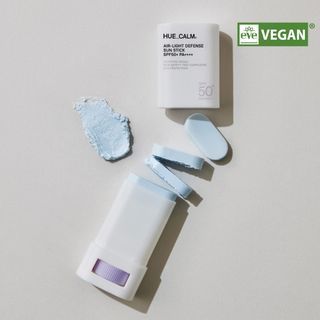
HUE_CALM Air Light Defense Sun Stick
Works for
1 of 1 advertised claim delivered
Sun protectionSPF 50 · 2 UV filtersBroad spectrum
This product offers a good level of protection against both UVB and UVA rays.
This sunscreen uses organic (so-called "chemical") sunscreen filters. Organic, or "chemical" filters usually provide reliable sun protection and rarely leave a white cast. Sunscreens with organic filters can sting eyes.
This product can be considered "reef safe" because it does not contain the UV filters (oxybenzone and octinoxate) that can be harmful to coral reefs when present in the water in high concentrations.
Anti-agingNot advertised by the brand · 2 ingredients credited for this claimStrong support
This product can help reduce and prevent fine lines and wrinkles, improve skin elasticity and firmness because it contains adenosine.
These ingredients in the product can also be helpful, even though there is less evidence for their effectiveness: centella asiatica leaf extract.
Keep in mind that it typically takes at least 6 weeks to notice any results because the changes that are needed to improve fine lines and elasticity happen in the deeper layers of the skin. No topical anti-aging product can “erase” wrinkles or fully reverse signs of aging.
This product can also help prevent early signs of skin aging because it offers a good level of broad spectrum sun protection. Sun damage is the main cause of premature skin aging, and protecting your skin from the sun is the best anti-aging strategy.
Evens skin toneNot advertised by the brand · No ingredient credited for this claimStrong support
This product offers broad spectrum sun protection. It means that it can prevent hyperpigmentation and help keep the skin tone even (sun damage is the main factor causing age spots, darkening of post-acne marks and other discolorations).
MoisturizingNot advertised by the brand · 14 ingredients credited for this claimGood support
This product can help soften the skin and reduce its moisture loss with emollients and occlusives: helianthus annuus seed oil, vinyl dimethicone.
Keep in mind that this product does not contain effective ingredients to attract water to the upper layer of the skin. This is why an additional product with humectants like glycerin or hyaluronic acid can be helpful (apply it before this product for the best results).
Can it cause trouble?
Irritancy1 strong irritant: Rosmarinus officinalis leaf oilMedium risk
Comedogenic1 ingredient rated 2 or more on the 0–5 pore-clogging scale1 flagged
User reviews
Be the first — your take helps the next person decide.
Ingredients
Filter by role to see what each ingredient is doing.
Zinc oxide~44–54%
- Irritation risk
- Low
A broad spectrum sunblock (protects from both UVA and UVB rays). Is suitable for most sensitive skins. In small concentrations, can be used as a colorant
More about Zinc oxideCi 77947~11–14%
- Irritation risk
- Low
Isopropyl palmitate~5.2–6.4%
- Irritation risk
- Medium
- Comedogenicity
- 3/5
Helps soften the upper layer of the skin and create a thicker product consistency
More about Isopropyl palmitateSynthetic wax~3.9–4.8%
- Irritation risk
- Low
Used to stabilize product formulations and thicken product consistency
More about Synthetic waxCoco-caprylate/caprate~3.2–3.9%
- Irritation risk
- Low
Helps to soften the upper layer of the skin without creating a greasy texture
More about Coco-caprylate/caprateSilica~2.9–3.5%
Vinyl dimethicone/methicone silsesquioxane crosspolymer~2.4–2.9%
- Irritation risk
- Low
A type of silicone that create a smooth product finish and can create an optical soft-focus effect on the skin. Helps to thicken the product consistency
More about Vinyl dimethicone/methicone silsesquioxane crosspolymerAcrylates copolymer~2–2.4%
- Irritation risk
- Medium
Used to stabilize product formulation, help create an even product layer over skin (for example, in sunscreen) and create a thicker product consistency
More about Acrylates copolymerBenzotriazolyl dodecyl p-cresol~1.5–1.9%
- Irritation risk
- Medium
Used to stabilize the product formulation protecting it from sun light
More about Benzotriazolyl dodecyl p-cresolC12-15 alkyl benzoate~1.1–1.4%
- Irritation risk
- Low
Enhances the product texture and makes it more spreadable. Helps reduce water loss from the outer layer of skin. Extands the shelf life by preventing bacteria growth
More about C12-15 alkyl benzoateButylene glycol dicaprylate/dicaprate~0.95–1.15%
- Irritation risk
- Low
Helps soften the upper layer of the skin
More about Butylene glycol dicaprylate/dicaprateButyloctyl salicylate~0.7–1%
- Irritation risk
- Medium
A synthetic ester of salicylic acid that is used to help disperse pigments and boost effectiveness of sunscreen ingredients. It is able to absorb UV light (working as an organic, or chemical filter), but is not approved as a sunscreen ingredient on its own
More about Butyloctyl salicylateC12-15 alkyl benzoate~0.65–1%
- Irritation risk
- Low
Enhances the product texture and makes it more spreadable. Helps reduce water loss from the outer layer of skin. Extands the shelf life by preventing bacteria growth
More about C12-15 alkyl benzoateCaprylic/capric triglyceride~0.65–1%
- Irritation risk
- Medium
A good mix of fatty acids that forms a protective layer on the skin. Improves the shelf life of products. Derived from coconut and glycerin
More about Caprylic/capric triglyceridePolymethyl methacrylate~0.65–0.95%
- Irritation risk
- Low
Is used to enhance product texture and can help to optically mask skin imperfections
More about Polymethyl methacrylateMicrocrystalline wax~0.65–0.95%
Synthetic fluorphlogopite~0.6–0.95%
- Irritation risk
- Low
A mineral that is used as an optical filter (makes the skin looks nicer through light reflection) and to improve the texture of cosmetic products
More about Synthetic fluorphlogopiteVinyl dimethicone~0.6–0.9%
- Irritation risk
- Low
A type of silicone that helps to create a nice product texture and soften the upper layer of the skin
More about Vinyl dimethiconePolyhydroxystearic acid~0.55–0.85%
- Irritation risk
- Medium
Used to create a thicker product consistency and stabilize the formulation
More about Polyhydroxystearic acidPolymethylsilsesquioxane~0.55–0.8%
- Irritation risk
- Low
A silicone that improves product texture and helps dissolve other ingredients. Can form a non-greasy film on the skin to prevent moisture loss
More about PolymethylsilsesquioxaneTriethoxycaprylylsilane~0.5–0.75%
- Irritation risk
- Low
A type of silicone that helps oil and water mix well together. Helps to disperse other ingredients, e.g. pigments, evenly in a formulation
More about TriethoxycaprylylsilaneOlea europaea fruit oil~0.5–0.75%
- Irritation risk
- Medium
An emollient that helps soften the skin but is not effective for restoring its barrier function. Might be helpful to calm down inflammation
More about Olea europaea fruit oilArtemisia vulgaris oil~0.35–0.65%
- Irritation risk
- Low
Rosmarinus officinalis leaf oil~0.45–0.7%
- Irritation risk
- High
A plant oil with high content of volatile compounds that can irritate the skin. Can be used as a fragrance. Has anti-bacterial properties and might help neutralize free radicals on the surface of the skin
More about Rosmarinus officinalis leaf oilJuniperus communis fruit oil~0.35–0.65%
- Irritation risk
- Low
Ferula galbaniflua resin oil~0.35–0.6%
- Irritation risk
- Low
Candida bombicola/glucose/methyl rapeseedate ferment~0.5–0.75%
- Irritation risk
- Low
Helps water and oil mix together and preserve the product formulation
More about Candida bombicola/glucose/methyl rapeseedate fermentVitis vinifera seed oil~0.5–0.75%
- Irritation risk
- Medium
A great emollient that can also have anti-oxidant properties
More about Vitis vinifera seed oilCentella asiatica leaf extract~0.35–0.65%
- Irritation risk
- Medium
A plant extract that has been shown to be able to reduce inflammation in skin, support restoration of skin barrier function, as well as support collagen production. It can be irritating to sensitive skin. Might be helpful in preventing stretch marks. It could, however, itself be irritating.
More about Centella asiatica leaf extractBrassica oleracea acephala leaf extract~0.3–0.6%
- Irritation risk
- Medium
Might be helpful in neutralizing free radicals in skin but solid research is lacking. Helps attract water to the upper layer of the skin
More about Brassica oleracea acephala leaf extractHelianthus annuus seed oil~0.35–0.6%
- Irritation risk
- Low
A great emollient due to its high linoleic acid content. One of the most effective plant oils in helping skin hydration and repairing skin barrier function
More about Helianthus annuus seed oilAdenosine~0.25–0.4%
- Irritation risk
- Low
Might help improve cell turnover and reduce inflammation in skin. One study shows that the ingredients might be able to help reduce dynamic wrinkles (for example, in the corners of the eyes or on the forehead)
More about AdenosineWater~0.2–0.4%
Butylene glycol~0.15–0.3%
- Irritation risk
- Low
Used to create a nice product texture and help delivery of other ingredients. Might be somewhat helpful in attracting water to the upper layer of the skin
More about Butylene glycol1,2-hexanediol~0.1–0.2%
Ethylhexylglycerin~0.1–0.15%
Guaiazulene~0.1–0.15%
- Irritation risk
- Low
A blue-colored ingredient that is traditionally used as a colorant. It has anti-inflammatory properties. For example, it is successfully used to treat diaper rash for new borns. It can help support the skin barrier by reducing inflammation
More about GuaiazuleneIngredient list view
Zinc oxide, Ci 77947, Isopropyl palmitate, Synthetic wax, Coco-caprylate/caprate, Silica, Vinyl dimethicone/methicone silsesquioxane crosspolymer, Acrylates copolymer, Benzotriazolyl dodecyl p-cresol, C12-15 alkyl benzoate, Butylene glycol dicaprylate/dicaprate, Butyloctyl salicylate, C12-15 alkyl benzoate, Caprylic/capric triglyceride, Polymethyl methacrylate, Microcrystalline wax, Synthetic fluorphlogopite, Vinyl dimethicone, Polyhydroxystearic acid, Polymethylsilsesquioxane, Triethoxycaprylylsilane, Olea europaea fruit oil, Artemisia vulgaris oil, Rosmarinus officinalis leaf oil, Juniperus communis fruit oil, Ferula galbaniflua resin oil, Candida bombicola/glucose/methyl rapeseedate ferment, Vitis vinifera seed oil, Centella asiatica leaf extract, Brassica oleracea acephala leaf extract, Helianthus annuus seed oil, Unknown, Adenosine, Water, Butylene glycol, 1,2-hexanediol, Ethylhexylglycerin, Guaiazulene
Compare prices
Retailers ranked by price — lowest first.

Affiliate links · prices updated regularly
Worth comparing, line by line.
Match % combines shared ingredients, the first five ingredients, shared actives and hero ingredients, irritancy (lower counts in the alternative's favour), texture and body area. Only products in the same routine step are compared.
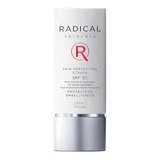
| HUE_CALMAir Light Defense Sun StickYOUR PRODUCT | ACWELLSolar Defense Licorice Sun Cream | Radical SkincareUV Skin Perfecting Screen SPF 30 | SKIN 1004.Centella Air-Fit Suncream Light SPF30 PA++++ | |
|---|---|---|---|---|
| Match | — | 52% | 50% | 50% |
| Price | $18.00 | $28.00+$10.00 | $50.24+$32.24 | — |
| Shared key ingredients | — | 4 of 10 | 4 of 10 | 3 of 10 |
| Key difference | — | Niacinamide | Niacinamide | Niacinamide |
| Irritancy | Medium | Low | Low | Low |
| SPF | SPF 50 | SPF 50 | SPF 30 | SPF 30 |
| Drying alcohol | — | — | Contains drying alcohol | — |
| View product | Shop | Shop | Shop |


Product summary
The ingredient list suggests that "HUE_CALM - Air Light Defense Sun Stick" can provide reliable sun protection. It can protect from both UVA and UVB rays. This is great news because not all sunscreens with SPF ratings give UVA protection. (UVA rays do not cause sunburn, but still damage our skin and lead to early aging).
It also works as a moisturizer, so you do not have to use an additional hydrating product. Like all broad-spectrum sunscreens, this product helps prevent early signs of aging.
Sunscreen filters
This sunscreen uses a mixture of both mineral and organic (so-called "chemical") UV filters. Here are the organic filters this product uses: butyloctyl salicylate. As for the mineral filters, this sunscreen uses zinc oxide.
Irritation risk
This moisturizer contains actives that can be irritating. We assess the overall irritancy of this moisturizer to be medium. For a detailed overview of all potential irritants: click here
You can see the detailed formula review with the breakdown of all actives in the product and the full ingredient list with estimated concentrations in the tables below.
Price
The product retails for 18.00$ in the United States.
For a detailed price comparison: click here.
Sources cited in this review
Every concentration estimate and effectiveness label is anchored to one of these 27 studies and safety reviews.
- 1A review of inorganic UV filters zinc oxide and titanium dioxideonlinelibrary.wiley.com
- 2
- 3
- 4
- 5
- 6Final Report on the Safety Assessment of Isopropyl Isostearatejournals.sagepub.com

Affiliate links · As an Amazon Associate, WIMJ earns from qualifying purchases.