Works for
CleansingDecyl glucoside, Sodium cocoyl glutamate + 4 moreCleanses gently
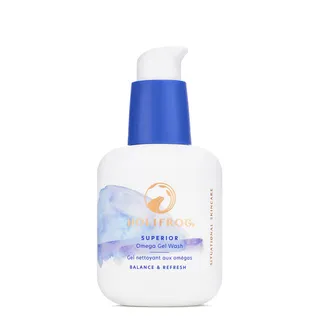
“With Holifrog Superior Omega Gel Wash, you can cleanse and tone in one step.”
This product works by removing dirt and oil from the surface of the skin. It uses a combination of mild cleansing agents (caprylyl/capryl glucoside, coco-glucoside, decyl glucoside, glyceryl oleate, sodium cocoyl glutamate, xanthan gum) and should be able to cleanse the skin gently. Still keep in mind that any cleansing can disrupt the skin barrier, and most people do not need to cleanse their skin more than once per day.
Even though this formulation is mild, the following cleansing agents could trigger an irritation or allergy for some people: coco-glucoside, decyl glucoside, glyceryl oleate
Anti-blemishAloe barbadensis leaf juiceNot delivered
“Natural antibacterial properties prevent breakouts and clogs.”
Effective ingredients missing or their concentration is too low.
Can it cause trouble?
Irritancy15 flagged ingredientsLow risk
Comedogenic2 ingredients rated 2 or more on the 0–5 pore-clogging scale2 flagged
User reviews
Be the first — your take helps the next person decide.
Ingredients
Filter by role to see what each ingredient is doing.
Water~45–55%
Glycerin~5.1–6.3%
- Irritation risk
- Low
One of the best moisturizing ingredients. Naturally present in skin. It attracts water to the upper layer of the skin working as a humectant
More about GlycerinOryza sativa extract~4.1–5%
- Irritation risk
- Low
A grain extract that helps to create a thicker product consistency. It might have some anti-oxidant properties and help attract water to the upper layer of the skin
More about Oryza sativa extractDecyl glucoside~3.7–4.6%
- Irritation risk
- High
Helps oil and water mix together. Can be irritating
More about Decyl glucosideSodium cocoyl glutamate~2.4–2.9%
- Irritation risk
- Medium
Helps oil and water mix together
More about Sodium cocoyl glutamateAloe barbadensis leaf juice~1.8–2.3%
- Irritation risk
- Medium
Traditionally used to treat sunburns, dermatitis and inflammation, but evidence for its effectiveness is lacking. The extract can contain humectants that help attract water into the skin
More about Aloe barbadensis leaf juiceCaprylyl/capryl glucoside~1.7–2.1%
- Irritation risk
- Medium
Helps oil and water mix together. Can be used as a cleansing agent
More about Caprylyl/capryl glucosideVitis vinifera seed oil~1.4–1.8%
- Irritation risk
- Medium
A great emollient that can also have anti-oxidant properties
More about Vitis vinifera seed oilHippophae rhamnoides fruit oil~1.2–1.4%
- Irritation risk
- High
A plant oil that might somewhat help to neutralize free radicals. It could be irritating
More about Hippophae rhamnoides fruit oilCocos nucifera fruit extract~0.95–1.2%
- Irritation risk
- Low
- Comedogenicity
- 3/5
An emollient. Found to be as effective as a moisturizer for dry skin as mineral oil. Could be comedogenic
More about Cocos nucifera fruit extractBrassica oleracea italica seed oil~0.7–1.05%
- Irritation risk
- Medium
A plant seed oil that consists mainly of erucic acid and used to help soften the upper layer of the skin. This fatty acid can enhance penetration of other ingredients into the skin but it is not a good moisturizer on its own
More about Brassica oleracea italica seed oilCamellia oleifera seed oil~0.6–0.9%
- Irritation risk
- Medium
An emollient that does not leave a greasy finish
More about Camellia oleifera seed oilLinum usitatissimum seed oil~0.45–0.7%
Saccharomyces/xylinum/black tea ferment~0.45–0.65%
- Irritation risk
- Low
A fermented sweet black tea. There is no studies on particular benefits of this ingredient in skin. It can help attract water to the upper layer of the skin, and might have some anti-oxidant effect. It is used in skincare for mostly marketing purposes because of the popularity of kombucha drinks
More about Saccharomyces/xylinum/black tea fermentLactobacillus ferment~0.4–0.6%
- Irritation risk
- Low
A fermentation product created by bacteria Lactobacillus. The fermented product has anti-bacterial properties and might be helpful in calming down inflammation, but studies are lacking. Helps attract water to the upper layer of the skin. Can be used as a preservative
More about Lactobacillus fermentLactobacillus ferment lysate~0.35–0.65%
- Irritation risk
- Low
A "broth" with parts of dead cells of lactobacteria. Might be helpful supporting diverse microbiome in skin, but evidence is lacking
More about Lactobacillus ferment lysateLactobacillus~0.4–0.6%
- Irritation risk
- Low
A non-living ingredient made by fermentation with the bacteria Lactobacillus. It can help attract water to the upper layer of the skin and might help reduce inflammation
More about LactobacillusCoco-glucoside~0.45–0.7%
- Irritation risk
- High
Used as a cleansing agent (surfactant) in cleansers. Helps water and oil mix together in lotions. Can be irritating
More about Coco-glucosideApple cider vinegar~0.35–0.65%
- Irritation risk
- Low
Tocopherol~0.3–0.55%
- Irritation risk
- Low
Pure form of vitamin E. Can help moisturise and protect the skin from free radicals. Often used to help stabilise other ingredients or the formula itself
More about TocopherolGlucose~0.25–0.45%
- Irritation risk
- Low
Helps attract water to the upper layer of the skin. Could be helpful in restoring the skin barrier function
More about GlucoseHydrogenated palm glycerides citrate~0.25–0.5%
- Irritation risk
- Low
Helps soften the upper layer of the skin
More about Hydrogenated palm glycerides citrateCitric acid~0.2–0.4%
- Irritation risk
- Medium
Can work as an exfoliant but is typically used to adjust the product pH
More about Citric acidGlyceryl oleate~0.25–0.4%
- Irritation risk
- High
Helps oil and water mix together. Can be irritating
More about Glyceryl oleateXanthan gum~0.2–0.35%
- Irritation risk
- Low
Used to create a thicker product consistency
More about Xanthan gumCarrageenan~0.2–0.35%
- Irritation risk
- Medium
- Comedogenicity
- 3/5
Helps thicken the product formula and create a nice product formulation
More about CarrageenanLeuconostoc/radish root ferment filtrate~0.15–0.25%
- Irritation risk
- Medium
A preservative that comes from radishes fermented by a bacteria. New research suggests that the preservation properties in the ingredient come from an ammonium salt that is not present naturally in radish root but used in its cultivation. Is problematic because the exact amount of the preservative agents is difficult to determine
More about Leuconostoc/radish root ferment filtrateSodium benzoate~0.1–0.2%
Potassium sorbate~0.1–0.2%
Sodium levulinate~0.1–0.15%
Sodium phytate~0.05–0.1%
Ingredient list view
Water, Glycerin, Oryza sativa extract, Decyl glucoside, Sodium cocoyl glutamate, Aloe barbadensis leaf juice, Caprylyl/capryl glucoside, Vitis vinifera seed oil, Hippophae rhamnoides fruit oil, Cocos nucifera fruit extract, Brassica oleracea italica seed oil, Camellia oleifera seed oil, Linum usitatissimum seed oil, Saccharomyces/xylinum/black tea ferment, Lactobacillus ferment, Lactobacillus ferment lysate, Lactobacillus, Coco-glucoside, Apple cider vinegar, Tocopherol, Glucose, Hydrogenated palm glycerides citrate, Citric acid, Glyceryl oleate, Xanthan gum, Carrageenan, Leuconostoc/radish root ferment filtrate, Sodium benzoate, Potassium sorbate, Sodium levulinate, Sodium phytate
Compare prices
Retailers ranked by price — lowest first.
Affiliate links · As an Amazon Associate, WIMJ earns from qualifying purchases.
Worth comparing, line by line.
Match % combines shared ingredients, the first five ingredients, shared actives and hero ingredients, irritancy (lower counts in the alternative's favour), texture and body area. Only products in the same routine step are compared.
| HoliFrogSuperior Omega Gel WashYOUR PRODUCT | AlphanovaBaby Organic Nourishing Foaming Gel | SensiBiafinePro-Tolerance Face Cleansing Gel | DIMEGentle Jelly Cleanser | |
|---|---|---|---|---|
| Match | — | 35% | 33% | 32% |
| Price | — | $11.14 | — | $24.00 |
| Shared key ingredients | — | 6 of 14 | 6 of 14 | 5 of 14 |
| Key difference | — | Butyrospermum Parkii Butter | Lecithin | Lycopene |
| Irritancy | Low | Low | Low | Low |
| Drying alcohol | — | — | — | — |
| View product | Shop | Shop | Shop |


More alternatives: Uriage Xemose Gentle Cleansing Syndet GelA-DERMA Dermalibour+ Purifying Foaming CICA-Gel
Sources cited in this review
Every concentration estimate and effectiveness label is anchored to one of these 16 studies and safety reviews.
- 1
- 2
- 3
- 4
- 5
- 6

Affiliate links · As an Amazon Associate, WIMJ earns from qualifying purchases.