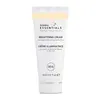
Herbal Essentials Brightening Cream
Works for
1 of 2 advertised claims delivered
MoisturizingHelianthus annuus seed oil, Glycerin + 10 moreGood evidence
“Aloe Vera to help calm and moisturise the skin.”
This product can help improve hydration of the skin with the two types of ingredients.
The first type is called “humectants”:
these ingredients help attract water.
When humectants are on the surface of the skin, they “pull in” the moisture from the outside environment, or from
within deeper layers of the skin. The following ingredients in this product do the job:
glycerin.
This product also contains ingredients called “occlusives”. They help reduce the speed with which our skin loses moisture to the outside environment. These ingredients also help soften the upper layer of the skin, so it feels less tight and nicer to the touch. The following ingredients in this product do the job: caprylic/capric triglyceride, helianthus annuus seed oil.
Evens skin toneGlycyrrhiza glabra root extract, Lactic acidLimited evidence
“liquorice Root Liquorice Root Contains Powerful Natural Antioxidants That Helps Brighten Skin, By Diminishing Age Spots Or Sun Damage Areas.”
This product contains ingredients (glycyrrhiza glabra root extract) that could help reduce hyperpigmentation (for example, post-acne marks or age spots) in theory, but there is not enough evidence that they actually work.
Can it cause trouble?
Irritancy4 strong irritants: Parfum, Hexyl cinnamal + 2 more — patch-test recommendedHigh risk
Comedogenic2 ingredients rated 2 or more on the 0–5 pore-clogging scale2 flagged


User reviews
Be the first — your take helps the next person decide.
Ingredients
Filter by role to see what each ingredient is doing.
Water~45–55%
Caprylic/capric triglyceride~6.6–8.1%
- Irritation risk
- Medium
A good mix of fatty acids that forms a protective layer on the skin. Improves the shelf life of products. Derived from coconut and glycerin
More about Caprylic/capric triglycerideHelianthus annuus seed oil~4.3–5.3%
- Irritation risk
- Low
A great emollient due to its high linoleic acid content. One of the most effective plant oils in helping skin hydration and repairing skin barrier function
More about Helianthus annuus seed oilDicaprylyl ether~3.3–4%
- Irritation risk
- Low
Helps soften the upper layer of the skin while creating a non-greasy feel on the skin. Helps to dissolve other ingredients
More about Dicaprylyl etherC10-18 triglycerides~2.5–3%
- Irritation risk
- Low
Helps soften the skin and attract water to its upper layer. Helps create nice product texture
More about C10-18 triglyceridesGlycerin~2.1–2.5%
- Irritation risk
- Low
One of the best moisturizing ingredients. Naturally present in skin. It attracts water to the upper layer of the skin working as a humectant
More about GlycerinLactic acid~1.7–2.1%
- Irritation risk
- Medium
An exfoliating and moisturizing alpha-hydroxy acid (AHA). Typically causes less irritation than other AHAs, for example, glycolic acid. At high concentrations (about 15%), lactic acid can help reduce lines and wrinkles. Recent studies show that lactic acid can support the "good" bacteria living on skin's surface (healthy skin microbiome)
More about Lactic acidCetearyl alcohol~1.5–1.9%
- Irritation risk
- Low
- Comedogenicity
- 2/5
A non-drying alcohol. Works as an emollient. Helps water and oil mix together and creates a nice product texture
More about Cetearyl alcoholGlyceryl stearate~1.3–1.5%
- Irritation risk
- Low
An emollient that softens the skin and forms a protective layer on its surface. Helps water and oil mix together
More about Glyceryl stearatePeg-100 stearate~1.1–1.3%
- Irritation risk
- Low
Helps oil and water mix togehter and creates a nice product texture
More about Peg-100 stearateHydroxyethyl acrylate/sodium acryloyldimethyl taurate copolymer~0.7–1.05%
- Irritation risk
- Medium
A gelling agent that thickens the product consistency and leaves the skin with a velvety finish
More about Hydroxyethyl acrylate/sodium acryloyldimethyl taurate copolymerTitanium dioxide~0.8–1.2%
- Irritation risk
- Low
Works as a UV filter when used in high concentrations. It is photostable and is effective mostly against the UVB light, with some protection in the UVA range. In small concentrations, used for its ability to improve the color of cosmetic products. Is usually well tolerated by the skin
More about Titanium dioxidePhenoxyethanol~0.5–0.75%
- Irritation risk
- Low
A preservative. It helps prevent bacterial growth in cosmetic products
More about PhenoxyethanolSodium hydroxide~0.45–0.7%
Parfum~0.4–0.6%
- Irritation risk
- High
An aromatic blend of unspecified and possibly irritating ingredients
More about ParfumCitric acid~0.4–0.65%
- Irritation risk
- Medium
Can work as an exfoliant but is typically used to adjust the product pH
More about Citric acidDisodium edta~0.4–0.6%
Xanthan gum~0.35–0.65%
- Irritation risk
- Low
Used to create a thicker product consistency
More about Xanthan gumEthylhexylglycerin~0.3–0.55%
Polysorbate 60~0.3–0.55%
Sorbitan isostearate~0.25–0.5%
- Irritation risk
- Low
Helps oil and water mix together
More about Sorbitan isostearateLauroyl lysine~0.25–0.4%
- Irritation risk
- Low
Helps soften the upper layer of the skin and creates a nice product texture
More about Lauroyl lysineHexyl cinnamal~0.2–0.35%
Tocopherol~0.2–0.4%
- Irritation risk
- Low
Pure form of vitamin E. Can help moisturise and protect the skin from free radicals. Often used to help stabilise other ingredients or the formula itself
More about TocopherolAloe barbadensis leaf juice powder~0.2–0.35%
- Irritation risk
- Medium
Traditionally used to treat sunburns, dermatitis and inflammation, but evidence for its effectiveness is lacking. The extract can contain humectants that help attract water into the skin
More about Aloe barbadensis leaf juice powderLinalool~0.15–0.3%
Glycyrrhiza glabra root extract~0.15–0.3%
- Irritation risk
- Medium
A plant extract that can help lighten the skin and calm down inflammation. Might be helpful in neutralizing free radicals
More about Glycyrrhiza glabra root extractHydroxycitronellal~0.15–0.25%
- Irritation risk
- High
A fragrance. A likely allergen and can be irritating
More about HydroxycitronellalPotassium sorbate~0.15–0.25%
Sodium benzoate~0.1–0.2%
Glycine soja oil~0.1–0.25%
- Irritation risk
- Medium
- Comedogenicity
- 2/5
A good emollient that helps soften the skin and helps repair its barrier function. It can clog pores if used in high concentrations.
More about Glycine soja oilIngredient list view
Water, Caprylic/capric triglyceride, Helianthus annuus seed oil, Dicaprylyl ether, C10-18 triglycerides, Glycerin, Lactic acid, Cetearyl alcohol, Glyceryl stearate, Peg-100 stearate, Hydroxyethyl acrylate/sodium acryloyldimethyl taurate copolymer, Titanium dioxide, Phenoxyethanol, Sodium hydroxide, Parfum, Citric acid, Disodium edta, Xanthan gum, Ethylhexylglycerin, Polysorbate 60, Sorbitan isostearate, Lauroyl lysine, Hexyl cinnamal, Tocopherol, Aloe barbadensis leaf juice powder, Linalool, Glycyrrhiza glabra root extract, Hydroxycitronellal, Potassium sorbate, Sodium benzoate, Glycine soja oil
Compare prices
Retailers ranked by price — lowest first.
.png)
Worth comparing, line by line.
Match % combines shared ingredients, the first five ingredients, shared actives and hero ingredients, irritancy (lower counts in the alternative's favour), texture and body area. Only products in the same routine step are compared.
| Herbal EssentialsBrightening CreamYOUR PRODUCT | January LabsRetexturizing Night Cream | Maria ÅkerbergFace Cream Sensitive | Laboratoire ACMBoréade Global Anti-Blemish Skincare | |
|---|---|---|---|---|
| Match | — | 58% | 55% | 54% |
| Price | $9.34 | — | $29.87+$20.53 | $17.65+$8.31 |
| Shared key ingredients | — | 3 of 7 | 2 of 7 | 4 of 7 |
| Key difference | — | Niacinamide | Beeswax | Salicylic Acid |
| Irritancy | High | Medium | Medium | Medium |
| Drying alcohol | — | — | — | — |
| View product | Shop | Shop | Shop |

Sources cited in this review
Every concentration estimate and effectiveness label is anchored to one of these 9 studies and safety reviews.
- 1
- 2
- 3Effect of topically applied lipids on surfactant-irritated skinonlinelibrary.wiley.com
- 4
- 5
- 6Epidermal and dermal effects of topical lactic acidncbi.nlm.nih.gov

Affiliate links · As an Amazon Associate, WIMJ earns from qualifying purchases.