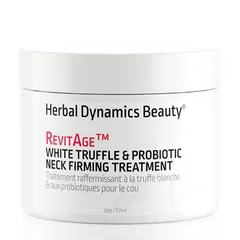
Works for:
based on ingredients and %- Moisturizing
- Anti-aging
Can it cause trouble?
- Irritation risk: high
- Comedogenic risk ingredients: 5
Key actives
Works for
Anti-aging
What does the product description say?
This Herbal Dynamics Beauty RevitAgeTM White Truffle & Probiotic Neck Firming Treatment has been enriched with over 30 powerhouse botanicals to deliver intense hydration and antioxidant benefits, promoting the look of youthful firmness in delicate neck and décolletage areas.
Source: Feelunique
This product contains threonine. This ingredient might be able to help reduce and prevent fine lines and wrinkles, improve skin elasticity and firmness, but there is not enough evidence that it actually works.
An amino-acid that helps to attract water to the upper layer of the skin. In combination with other amino-acids, might help to reduce fine lines and wrinkles
A great moisturising ingredient that softens the skin and reduces water loss from its upper layer. It also can be helpful in protecting skin from free radicals
Traditionally used to treat sunburns, dermatitis and inflammation, but evidence for its effectiveness is lacking. The extract can contain humectants that help attract water into the skin
Can contain potent anti-oxidant compounds (abbreviated ECG, GCG, EGC, and EGCG) that might help protect the skin from free radicals. Can help calm down inflammation and has some anti-bacterial properties. Unfortunately, these antioxidants are unstable and lose their effectiveness very quickly in products. The concentration of the antioxidant compounds in the extract also tends to be low to be effective in topical formulation
Moisturizing
What does the product description say?
White truffle provides a plethora of vitamins and amino acids that nourish skin with hydration, while squalane gives skin a smoother appearance.
Source: Feelunique
This product can help improve hydration of the skin with the two types of ingredients.
The first type is called “humectants”:
these ingredients help attract water.
When humectants are on the surface of the skin, they “pull in” the moisture from the outside environment, or from
within deeper layers of the skin. The following ingredients in this product do the job:
glutamic acid, glycerin.
This product also contains ingredients called “occlusives”. They help reduce the speed with which our skin loses moisture to the outside environment. These ingredients also help soften the upper layer of the skin, so it feels less tight and nicer to the touch. The following ingredients in this product do the job: butyrospermum parkii butter, helianthus annuus seed oil.
A great moisturising ingredient that softens the skin and reduces water loss from its upper layer. It also can be helpful in protecting skin from free radicals
An oil naturally present in skin. Works as an emollient to soften the skin and form a protective layer on its surface without a greasy feeling.
Helps soften the upper layer of the skin and can be helpful in restoring the skin barrier function. Might have some anti-oxidant effect
An amino-acid that helps to attract water to the upper layer of the skin. In combination with other amino-acids, might help to reduce fine lines and wrinkles
One of the best moisturizing ingredients. Naturally present in skin. It attracts water to the upper layer of the skin working as a humectant
An emollient that helps soften the skin and might help calm down inflammation
Helps to attract water to the upper layer of the skin and can help restore the skin barrier function
A great emollient due to its high linoleic acid content. One of the most effective plant oils in helping skin hydration and repairing skin barrier function
A fermentation product created by bacteria Lactobacillus. The fermented product has anti-bacterial properties and might be helpful in calming down inflammation, but studies are lacking. Helps attract water to the upper layer of the skin. Can be used as a preservative
Helps attract water to the upper layer of the skin. Can have some anti-inflammatory effect
Helps attract water to the upper layer of the skin
An amino-acid that helps attract water to the upper layer of the skin
Helps attract water to the upper layer of the skin. Could be helpful in restoring the skin barrier function
Emollients that are naturaly present in skin. In addition, they help water and oil mix together in the product
A non-drying alcohol. Works as an emollient. Helps water and oil mix together and creates a nice product texture
Helps attract water to the upper layer of the skin. Might have some anti-oxidant properties
An emollient that helps soften the skin
Helps to soften the upper layer of the skin without creating a greasy texture
Helps preserve products and creates a nice product texture
An emollient that softens the skin and forms a protective layer on its surface. Helps water and oil mix together
Traditionally used to treat sunburns, dermatitis and inflammation, but evidence for its effectiveness is lacking. The extract can contain humectants that help attract water into the skin
Used to preserve products, dissolve other ingredients and create a nice product texture
A plant extract that helps attract water to the upper layer of the skin and might have some anti-oxidant properties
Helps to soften the upper layer of the skin and create a nice product texture
Used as a fragrance. Can be irritating
Can contain potent anti-oxidant compounds (abbreviated ECG, GCG, EGC, and EGCG) that might help protect the skin from free radicals. Can help calm down inflammation and has some anti-bacterial properties. Unfortunately, these antioxidants are unstable and lose their effectiveness very quickly in products. The concentration of the antioxidant compounds in the extract also tends to be low to be effective in topical formulation
How honest is this product?
| Promise | Can it deliver? |
|---|---|
| Anti-aging | |
| Moisturizing |
Total Promises Fulfilled score: 75/100.
Potential irritants
Comedogenic ingredients
User reviews (0)
Averages from community submissions.
No reviews yet for this product.
Be the first to share your experience!
Tried this product?
Help capture what the ingredient list can't—texture, finish, pilling, scent, and more. Answer what you can, skip the rest.
Takes ~30 seconds.
Reviews are shown in aggregate. No personal details.
Key Actives
Can contain potent anti-oxidant compounds (abbreviated ECG, GCG, EGC, and EGCG) that might help protect the skin from free radicals. Can help calm down inflammation and has some anti-bacterial properties. Unfortunately, these antioxidants are unstable and lose their effectiveness very quickly in products. The concentration of the antioxidant compounds in the extract also tends to be low to be effective in topical formulation
A fermentation product created by bacteria Lactobacillus. The fermented product has anti-bacterial properties and might be helpful in calming down inflammation, but studies are lacking. Helps attract water to the upper layer of the skin. Can be used as a preservative
A great moisturising ingredient that softens the skin and reduces water loss from its upper layer. It also can be helpful in protecting skin from free radicals
Helps soften the upper layer of the skin and can be helpful in restoring the skin barrier function. Might have some anti-oxidant effect
An emollient that helps soften the skin and might help calm down inflammation
An amino-acid that helps to attract water to the upper layer of the skin. In combination with other amino-acids, might help to reduce fine lines and wrinkles
One of the best moisturizing ingredients. Naturally present in skin. It attracts water to the upper layer of the skin working as a humectant
An oil naturally present in skin. Works as an emollient to soften the skin and form a protective layer on its surface without a greasy feeling.
Helps attract water to the upper layer of the skin
A great emollient due to its high linoleic acid content. One of the most effective plant oils in helping skin hydration and repairing skin barrier function
Helps attract water to the upper layer of the skin. Can have some anti-inflammatory effect
An amino-acid that helps attract water to the upper layer of the skin
Helps to attract water to the upper layer of the skin and can help restore the skin barrier function
Used to create a gel-like product texture, as well as to stabilize emulsions
Potential irritants
An essential oil that is used as a fragrance and can be irritating. It might have some anti-oxidant effect in skin
A plant oil with a high content of volatile compounds that can irritate the skin and lead to allergic reactions. Can lead to photosensitivity
An essential oil that can be very irritating. Has some anti-bacterial properties
An essential oil. Can be irritating. Can become an allergen with oxidation
An essential oil. Potential allergen and can be irritating. It has some anti-bacterial properties
Plant extract that can be irritating and is a known allergen
A plant extract that helps attract water to the upper layer of the skin and might have some anti-oxidant properties
Used as a cleansing agent (surfactant) in cleansers. Helps water and oil mix together in lotions. Can be irritating
A common frangrance that can easily irritate skin, especially if exposed to air, light or heat
Can be drying and contribute to skin irritation. Used in formulars to dissolve other ingredients, create a thinner product consistency or for its antibacterial properties
Traditionally used to treat sunburns, dermatitis and inflammation, but evidence for its effectiveness is lacking. The extract can contain humectants that help attract water into the skin
A fruit extract that might have some anti-oxidant effect in skin
A plant extract that might have some anti-oxidant properties but evidence of effectiveness in skin is lacking
Helps preserve products and creates a nice product texture
Helps oil and water mix together. Has some emollient properties
Can work as an exfoliant but is typically used to adjust the product pH
Used to preserve products, dissolve other ingredients and create a nice product texture
Comedogenic ingredients
A great moisturising ingredient that softens the skin and reduces water loss from its upper layer. It also can be helpful in protecting skin from free radicals
Helps soften the upper layer of the skin and can be helpful in restoring the skin barrier function. Might have some anti-oxidant effect
A non-drying alcohol. Works as an emollient. Helps water and oil mix together and creates a nice product texture
Helps oil and water mix together. Has some emollient properties
All ingredients
Traditionally used to treat sunburns, dermatitis and inflammation, but evidence for its effectiveness is lacking. The extract can contain humectants that help attract water into the skin
A great moisturising ingredient that softens the skin and reduces water loss from its upper layer. It also can be helpful in protecting skin from free radicals
One of the best moisturizing ingredients. Naturally present in skin. It attracts water to the upper layer of the skin working as a humectant
An emollient that helps soften the skin and might help calm down inflammation
An emollient that softens the skin and forms a protective layer on its surface. Helps water and oil mix together
Helps oil and water mix togehter and creates a nice product texture
An oil naturally present in skin. Works as an emollient to soften the skin and form a protective layer on its surface without a greasy feeling.
Helps attract water to the upper layer of the skin
Helps soften the upper layer of the skin and can be helpful in restoring the skin barrier function. Might have some anti-oxidant effect
A non-drying alcohol. Works as an emollient. Helps water and oil mix together and creates a nice product texture
An essential oil that is used as a fragrance and can be irritating. It might have some anti-oxidant effect in skin
Can contain potent anti-oxidant compounds (abbreviated ECG, GCG, EGC, and EGCG) that might help protect the skin from free radicals. Can help calm down inflammation and has some anti-bacterial properties. Unfortunately, these antioxidants are unstable and lose their effectiveness very quickly in products. The concentration of the antioxidant compounds in the extract also tends to be low to be effective in topical formulation
A plant oil with a high content of volatile compounds that can irritate the skin and lead to allergic reactions. Can lead to photosensitivity
A great emollient due to its high linoleic acid content. One of the most effective plant oils in helping skin hydration and repairing skin barrier function
An essential oil that can be very irritating. Has some anti-bacterial properties
Helps attract water to the upper layer of the skin. Might have some anti-oxidant properties
An essential oil. Can be irritating. Can become an allergen with oxidation
An essential oil. Potential allergen and can be irritating. It has some anti-bacterial properties
Plant extract that can be irritating and is a known allergen
A plant extract that helps attract water to the upper layer of the skin and might have some anti-oxidant properties
A fruit extract that might have some anti-oxidant effect in skin
A plant extract that might have some anti-oxidant properties but evidence of effectiveness in skin is lacking
Emollients that are naturaly present in skin. In addition, they help water and oil mix together in the product
A fermentation product created by bacteria Lactobacillus. The fermented product has anti-bacterial properties and might be helpful in calming down inflammation, but studies are lacking. Helps attract water to the upper layer of the skin. Can be used as a preservative
Helps preserve products and creates a nice product texture
Helps oil and water mix together. Has some emollient properties
Can work as an exfoliant but is typically used to adjust the product pH
Helps to soften the upper layer of the skin without creating a greasy texture
Helps attract water to the upper layer of the skin. Can have some anti-inflammatory effect
Used as a cleansing agent (surfactant) in cleansers. Helps water and oil mix together in lotions. Can be irritating
Helps attract water to the upper layer of the skin. Could be helpful in restoring the skin barrier function
An amino-acid that helps attract water to the upper layer of the skin
Helps to attract water to the upper layer of the skin and can help restore the skin barrier function
Helps to soften the upper layer of the skin and create a nice product texture
Used to thicken product formulations and create gel-like textures
Used to stabilize the product formulation and can help absorb oil
Used to preserve products, dissolve other ingredients and create a nice product texture
Used to create a gel-like product texture, as well as to stabilize emulsions
An amino-acid that helps to attract water to the upper layer of the skin. In combination with other amino-acids, might help to reduce fine lines and wrinkles
A type of silicone that create a smooth product finish and can create an optical soft-focus effect on the skin. Helps to thicken the product consistency
A preservative. It helps prevent bacterial growth in cosmetic products
A common frangrance that can easily irritate skin, especially if exposed to air, light or heat
Can be drying and contribute to skin irritation. Used in formulars to dissolve other ingredients, create a thinner product consistency or for its antibacterial properties
Ingredient list view
Aloe barbadensis leaf juice, Butyrospermum parkii butter, Glycerin, Carthamus tinctorius seed oil, Glyceryl stearate, Peg-100 stearate, Squalane, Water, Alpha-glucan oligosaccharide, Theobroma cacao seed butter, Coconut alkanes, Cetearyl alcohol, Aesculus hippocastanum bark extract, Anthemis nobilis flower oil, Camellia sinensis leaf extract, Cananga odorata flower oil, Citrus aurantium bergamia fruit oil, Citrus limon peel oil, Helianthus annuus seed oil, Eucalyptus globulus leaf oil, Hydrolyzed rice protein, Pelargonium graveolens flower oil, Lavandula angustifolia oil, Lavandula hybrida oil, Pinus sylvestris cone extract, Polymnia sonchifolia root juice, Ribes nigrum fruit extract, Ribes nigrum leaf extract, Rosa damascena flower oil, Menyanthes trifoliata leaf extract, Phospholipids, Lactobacillus ferment, Calcium hydroxymethionine, Caprylyl glycol, Ceteareth-20, Citric acid, Coco-caprylate/caprate, Saccharomyces lysate extract, Coco-glucoside, Glaucine, Glucose, Glutamic acid, Glycine, Hydrogenated polydecene, Hydroxyethylcellulose, Maltodextrin, Pentylene glycol, Polysorbate 20, Sodium polyacrylate, Tamarindus indica seed polysaccharide, Threonine, Trideceth-6, Tuber magnatum extract, Valine, Vinyl dimethicone/methicone silsesquioxane crosspolymer, Disodium edta, Disodium succinate, Ethylhexylglycerin, Chlorphenesin, Phenoxyethanol, Potassium sorbate, Sodium benzoate, Citronellol, Geraniol, Limonene, Linalool, Alcohol, 3-aminopropane sulfonic acid
- Glycerol and the skin: holistic approach to its origin and functions
- Cocoa polyphenols and their influence on parameters involved in ex vivo skin restructuring
- Safety Assessment of Anthemis nobilis– Derived Ingredients as Used in Cosmetics
- Safety Assessment of Citrus-Derived Peel Oils as Used in Cosmetics
- Oxidized citrus oil (R-limonene): A frequent skin sensitizer in Europe
- Air oxidation increases skin irritation from fragrance terpenes
- Effect of Olive and Sunflower Seed Oil on the Adult Skin Barrier: Implications for Neonatal Skin Care
- Topically Applied Sunflower Seed Oil Prevents Invasive Bacterial Infections in Preterm Infants in Egypt
- Effect of topically applied lipids on surfactant-irritated skin
- Impact of topical oils on the skin barrier: possible implications for neonatal health in developing countries
- Protection Against Free Radicals (UVB Irradiation) of a Water-Soluble Enzymatic Extract from Rice Bran. Study Using Human Keratinocyte Monolayer and Reconstructed Human Epidermis
- Amended final report on the safety assessment of Oryza Sativa (rice) Bran Oil, Oryza Sativa (rice) Germ Oil, Rice Bran Acid,Oryza Sativa (rice) Bran Wax, Hydrogenated Rice Bran Wax, Oryza Sativa (rice)Bran Extract, Oryza Sativa (rice) Extract, Oryza Sativa (rice) Germ Powder, Oryza Sativa (rice) Starch, Oryza Sativa (rice) Bran, Hydrolyzed Rice Bran Extract, Hydrolyzed Rice Bran Protein, Hydrolyzed Rice Extract, and Hydrolyzed Rice Protein
- Fragrance Compound Geraniol Forms Contact Allergens on Air Exposure. Identification and Quantification of Oxidation Products and Effect on Skin Sensitization
- Biological Activity of Blackcurrant Extracts (Ribes nigrum L.) in Relation to Erythrocyte Membranes
- Extract from Ribes nigrum leaves in vitro activates nitric oxide synthase (eNOS) and increases CD39 expression in human endothelial cells
- Annex I: Clinical evidence regarding sensitisation to individual fragrance chemicals and to natural extracts
- The effect of probiotics on immune regulation, acne, and photoaging
- Comparison of clinical and histological effects between lactobacillus-fermented Chamaecyparis obtusa and tea tree oil for the treatment of acne: an eight-week double-blind randomized controlled split-face study
- Use of Probiotics for Dermal Applications
- Safety Assessment of Alkyl Esters as Used in Cosmetics
- In Vitro Assessment of Skin Irritation Potential of Surfactant-based Formulations by Using a 3-D Skin Reconstructed Tissue Model and Cytokine Response
- Allergen of the Year—Alkyl Glucoside
- Topical Glucose Induces Claudin-1 and Filaggrin Expression in a Mouse Model of Atopic Dermatitis and in Keratinocyte Culture, Exerting Anti-inflammatory Effects by Repairing Skin Barrier Function
- Effect of Topical Application of Glycine and Proline on Recalcitrant Leg Ulcers of Prolidase Deficiency
- Functional glycine receptor in cultured human keratinocytes
- Safety Assessment of Polyene Group as Used in Cosmetics
- Topical palmitoyl pentapeptide provides improvement in photoaged human facial skin