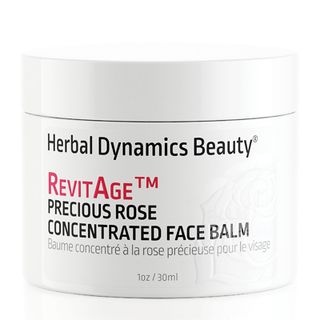
Herbal Dynamics Beauty RevitAge Precious Rose Concentrated Face Balm
Works for
2 of 2 advertised claims delivered
Moisturizing24 ingredients credited for this claimStrong support
“RevitAge Precious Rose Concentrated Face Balm”
This product can help improve hydration of the skin with the two types of ingredients.
The first type is called “humectants”:
these ingredients help attract water.
When humectants are on the surface of the skin, they “pull in” the moisture from the outside environment, or from
within deeper layers of the skin. The following ingredients in this product do the job:
alanyl glutamine, carnosine.
This product also contains ingredients called “occlusives”. They help reduce the speed with which our skin loses moisture to the outside environment. These ingredients also help soften the upper layer of the skin, so it feels less tight and nicer to the touch. The following ingredients in this product do the job: beeswax, bis-diglyceryl polyacyladipate-2.
The following ingredients in this product are especially good for supporting the skin barrier and helping with the hydration level: isosorbide dicaprylate
Anti-aging7 ingredients credited for this claimModerate support
“Indian gentian extract promotes a smoother appearance, reducing the look of wrinkles over time.”
This product contains alanyl glutamine, carnosine. These ingredients might be able to help reduce and prevent fine lines and wrinkles, improve skin elasticity and firmness, but there is not enough evidence that it actually works.
Anti-oxidationNot advertised by the brand · 8 ingredients credited for this claimStrong support
This product contains antioxidants (carnosine) that can help neutralize free radicals in skin. By doing so, they can lessen the damage the skin gets from the UV light (sun).
Can it cause trouble?
Irritancy8 strong irritants: Rosa centifolia flower cera, Rosa damascena flower cera + 6 more — patch-test recommendedHigh risk
Comedogenic2 ingredients rated 2 or more on the 0–5 pore-clogging scale2 flagged
User reviews
Be the first — your take helps the next person decide.
Ingredients
Filter by role to see what each ingredient is doing.
Shea butter ethyl esters~25–38%
- Irritation risk
- Low
Helps soften the upper layer of the skin
More about Shea butter ethyl estersHeptyl undecylenate~5–7.4%
- Irritation risk
- Medium
Helps soften the upper layer of the skin, reduce water loss from the skin surface over time and create a nice product finish
More about Heptyl undecylenateCaprylic/capric triglyceride~4.6–6.9%
- Irritation risk
- Medium
A good mix of fatty acids that forms a protective layer on the skin. Improves the shelf life of products. Derived from coconut and glycerin
More about Caprylic/capric triglycerideC18-38 alkyl hydroxystearoyl stearate~3.3–4.9%
- Irritation risk
- Low
Butyrospermum parkii butter~2.5–3.8%
- Irritation risk
- Low
- Comedogenicity
- 3/5
A great moisturising ingredient that softens the skin and reduces water loss from its upper layer. It also can be helpful in protecting skin from free radicals
More about Butyrospermum parkii butterCarthamus tinctorius seed oil~1.9–2.9%
- Irritation risk
- Low
An emollient that helps soften the skin and might help calm down inflammation
More about Carthamus tinctorius seed oilOlea europaea fruit oil~1.5–2.2%
- Irritation risk
- Medium
An emollient that helps soften the skin but is not effective for restoring its barrier function. Might be helpful to calm down inflammation
More about Olea europaea fruit oilBeeswax~1.5–2.2%
- Irritation risk
- Low
Forms a protective barrier that holds water and keeps dry skin hydrated. Keeps an emulsion from separating into its oil and liquid components, and increases the thickness of a product. Can be an allergen
More about BeeswaxBis-diglyceryl polyacyladipate-2~1.3–1.9%
- Irritation risk
- Low
Helps soften the upper layer of the skin and reduce water loss from its surface
More about Bis-diglyceryl polyacyladipate-2Rosa canina fruit oil~0.9–1.35%
- Irritation risk
- Medium
A great emollient. Contains vitamin E (tocopherol) which may give it some anti-oxidant properties. Can contain volatile compounds and can be irritating
More about Rosa canina fruit oilRosa centifolia flower cera~0.5–1.15%
- Irritation risk
- High
Rosa damascena flower cera~0.4–0.95%
- Irritation risk
- High
Rosa damascena flower oil~0.35–0.85%
- Irritation risk
- High
Used as a fragrance. Can be irritating
More about Rosa damascena flower oilAlanyl glutamine~0.3–0.75%
- Irritation risk
- Low
A type of peptide. Peptides are excellent moisturizers and might be able support collagen production reducing fine lines and wrinkles
More about Alanyl glutamineRosa gallica flower extract~0.2–0.8%
- Irritation risk
- High
Rosa hybrid flower extract~0.2–0.75%
- Irritation risk
- High
Rosa centifolia flower extract~0.2–0.75%
- Irritation risk
- High
Contains essential oil. Can be irritating
More about Rosa centifolia flower extractRosa multiflora fruit extract~0.15–0.7%
Rose extract~0.15–0.65%
Swertia chirata extract~0.15–0.6%
- Irritation risk
- Medium
A plant extract that can have an anti-bacterial and anti-inflammatory effect, but evidence of effectiveness is lacking
More about Swertia chirata extractCylindrotheca fusiformis extract~0.15–0.55%
- Irritation risk
- Low
Helps skin moisturization by attracting water to the upper layer of the skin. Might have some anti-oxidant properties but research confirming effectiveness in skin is lacking
More about Cylindrotheca fusiformis extractLimnanthes alba seed oil~0.15–0.7%
- Irritation risk
- Low
This oil's cmposition is closest to rapeseed oil. It is a very stable oil and serves as an emoillient
More about Limnanthes alba seed oilMelia azadirachta leaf extract~0.1–0.45%
- Irritation risk
- High
A plant extract that has anti-bacterial properties. Can be used to preserve the product. Can be irritating
More about Melia azadirachta leaf extractEclipta prostrata extract~0.1–0.45%
- Irritation risk
- High
A plant extract that might help neutralize free radicals in skin. It can be irritating
More about Eclipta prostrata extractErgothioneine~0.1–0.5%
- Irritation risk
- Low
Can help neutralize free radicals in skin. Preliminary studies show that it can be more effective than coenzyme Q10 but studies on effective concentration for topical applications are lacking
More about ErgothioneineLactic acid~0.1–0.45%
- Irritation risk
- Medium
An exfoliating and moisturizing alpha-hydroxy acid (AHA). Typically causes less irritation than other AHAs, for example, glycolic acid. At high concentrations (about 15%), lactic acid can help reduce lines and wrinkles. Recent studies show that lactic acid can support the "good" bacteria living on skin's surface (healthy skin microbiome)
More about Lactic acidRhodiola rosea root extract~0.15–0.6%
- Irritation risk
- Low
Rhododendron ferrugineum leaf cell culture extract~0.1–0.45%
- Irritation risk
- Low
Rosa damascena flower extract~0.1–0.45%
Tapioca starch~0.1–0.45%
Carnosine~0.1–0.45%
- Irritation risk
- Low
A type of peptide. It attracts water to the upper layer of the skin. It can help neutralize free radicals in skin combatting the sun damage
More about CarnosineLecithin~0.15–0.65%
- Irritation risk
- Low
Used mostly for creating emulsions - helping oil and water mix together. Helps soften the upper layer of the skin
More about LecithinEthylhexylglycerin~0.1–0.45%
Glycerin~0.15–0.55%
- Irritation risk
- Low
One of the best moisturizing ingredients. Naturally present in skin. It attracts water to the upper layer of the skin working as a humectant
More about GlycerinIsomalt~0.1–0.5%
- Irritation risk
- Low
Helps attract water to the upper layer of the skin
More about IsomaltIsosorbide dicaprylate~0.15–0.6%
- Irritation risk
- Low
Helps soften the upper layer of the skin. Early studies suggest that it can help strengthen the skin barrier
More about Isosorbide dicaprylatePanthenyl triacetate~0.1–0.5%
- Irritation risk
- Low
A stable oil-soluble derivative of vitamin B5. It can help support skin barrier and reduce inflammation in skin
More about Panthenyl triacetatePolymethylsilsesquioxane~0.15–0.55%
- Irritation risk
- Low
A silicone that improves product texture and helps dissolve other ingredients. Can form a non-greasy film on the skin to prevent moisture loss
More about PolymethylsilsesquioxaneCitric acid~0.1–0.45%
- Irritation risk
- Medium
Can work as an exfoliant but is typically used to adjust the product pH
More about Citric acidTetrahexyldecyl ascorbate~0.1–0.45%
- Irritation risk
- Medium
Being a lipid soluble form of vitamin C, it is more stable than ascorbic acid, but still degrades quickly and needs to be stabilized in a formulation with another ingredient. It is claimed to penetrate skin better than pure vitamin C and have the the similar benefits, but solid studies of its effectiveness are lacking. Is likely to require a higher concentration in a product than pure vitamin C to be effective. It might be able to help reduce pore clogging.
More about Tetrahexyldecyl ascorbateIsopropyl palmitate~0.15–0.55%
- Irritation risk
- Medium
- Comedogenicity
- 3/5
Helps soften the upper layer of the skin and create a thicker product consistency
More about Isopropyl palmitatePhenoxyethanol~0.1–0.4%
- Irritation risk
- Low
A preservative. It helps prevent bacterial growth in cosmetic products
More about PhenoxyethanolWater~0.1–0.4%
Butylene glycol~0.1–0.4%
- Irritation risk
- Low
Used to create a nice product texture and help delivery of other ingredients. Might be somewhat helpful in attracting water to the upper layer of the skin
More about Butylene glycolPotassium sorbate~0.1–0.4%
Sodium benzoate~0.1–0.35%
Propylene glycol~0.05–0.25%
- Irritation risk
- High
Helps oil and water mix together and can enhance the penetration of other ingredients into the skin. It can be irritating
More about Propylene glycolIngredient list view
Shea butter ethyl esters, Heptyl undecylenate, Caprylic/capric triglyceride, C18-38 alkyl hydroxystearoyl stearate, Butyrospermum parkii butter, Carthamus tinctorius seed oil, Olea europaea fruit oil, Beeswax, Bis-diglyceryl polyacyladipate-2, Rosa canina fruit oil, Rosa centifolia flower cera, Rosa damascena flower cera, Rosa damascena flower oil, Alanyl glutamine, Rosa gallica flower extract, Rosa hybrid flower extract, Rosa centifolia flower extract, Rosa multiflora fruit extract, Rose extract, Swertia chirata extract, Cylindrotheca fusiformis extract, Limnanthes alba seed oil, Melia azadirachta leaf extract, Unknown, Eclipta prostrata extract, Ergothioneine, Lactic acid, Rhodiola rosea root extract, Rhododendron ferrugineum leaf cell culture extract, Rosa damascena flower extract, Tapioca starch, Carnosine, Lecithin, Ethylhexylglycerin, Glycerin, Isomalt, Isosorbide dicaprylate, Panthenyl triacetate, Polymethylsilsesquioxane, Citric acid, Tetrahexyldecyl ascorbate, Isopropyl palmitate, Phenoxyethanol, Water, Butylene glycol, Potassium sorbate, Sodium benzoate, Propylene glycol
Compare prices
Retailers ranked by price — lowest first.
Sources cited in this review
Every concentration estimate and effectiveness label is anchored to one of these 24 studies and safety reviews.
- 1Use of “natural” oils for moisturization: Review of olive, coconut, and sunflower seed oilonlinelibrary.wiley.com
- 2
- 3
- 4
- 5Therapeutic Swertia chirata - An Overviewsearch.proquest.com
- 6

Affiliate links · As an Amazon Associate, WIMJ earns from qualifying purchases.