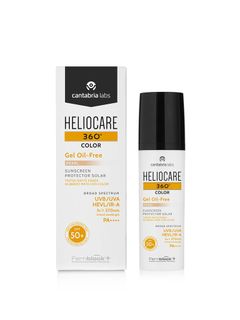
Heliocare 360° Pearl Color Oil Free Gel
Works for
1 of 1 advertised claim delivered
Moisturizing13 ingredients credited for this claimGood support
“If you have dry skin, you may find that you need to apply a hydrator to the skin before use.”
This product can help improve hydration of the skin with the two types of ingredients.
The first type is called “humectants”:
these ingredients help attract water.
When humectants are on the surface of the skin, they “pull in” the moisture from the outside environment, or from
within deeper layers of the skin. The following ingredients in this product do the job:
arginine, glycerin.
This product also contains ingredients called “occlusives”. They help reduce the speed with which our skin loses moisture to the outside environment. These ingredients also help soften the upper layer of the skin, so it feels less tight and nicer to the touch. The following ingredients in this product do the job: arginine, ethyl linoleate.
Anti-oxidationNot advertised by the brand · 5 ingredients credited for this claimStrong support
This product contains antioxidants (ferulic acid) that can help neutralize free radicals in skin. By doing so, they can lessen the damage the skin gets from the UV light (sun).
The following ingredients - camellia sinensis extract also can have an antioxidant effect, but there is less evidence to confirm their effectiveness in skin.
Anti-agingNot advertised by the brand · 4 ingredients credited for this claimModerate support
This product contains ferulic acid. This ingredient might be able to help reduce and prevent fine lines and wrinkles, improve skin elasticity and firmness, but there is not enough evidence that it actually works.
Anti-blemishNot advertised by the brand · 1 ingredient credited for this claimGood support
This product might be able to help reduce blemishes and clogged pores because it contains ethyl linoleate.
Evens skin toneNot advertised by the brand · 4 ingredients credited for this claimModerate support
The following ingredient (ingredients) in this product might be helpful, but there is no evidence to confirm that it actually works: ethyl linoleate, ferulic acid, polypodium leucotomos leaf extract.
Can it cause trouble?
Irritancy3 strong irritants: Parfum, Linalool + 1 more — patch-test recommendedHigh risk
Comedogenic2 ingredients rated 2 or more on the 0–5 pore-clogging scale2 flagged
User reviews
Be the first — your take helps the next person decide.
Ingredients
Filter by role to see what each ingredient is doing.
Water~45–55%
Titanium dioxide~8.1–9.9%
- Irritation risk
- Low
Works as a UV filter when used in high concentrations. It is photostable and is effective mostly against the UVB light, with some protection in the UVA range. In small concentrations, used for its ability to improve the color of cosmetic products. Is usually well tolerated by the skin
More about Titanium dioxideC12-15 alkyl benzoate~5–6.1%
- Irritation risk
- Low
Enhances the product texture and makes it more spreadable. Helps reduce water loss from the outer layer of skin. Extands the shelf life by preventing bacteria growth
More about C12-15 alkyl benzoateDisodium phenyl dibenzimidazole tetrasulfonate~3.9–4.7%
- Irritation risk
- Medium
Neo Heliopan AP. A UV filter. Effective against UVA II rays. It is stable. It is water-soluble, which helps to create lightweight sunscreen formulations. Unfortunately, not approved by FDA (US) yet
More about Disodium phenyl dibenzimidazole tetrasulfonateDicaprylyl carbonate~2.6–3.2%
- Irritation risk
- Low
Helps products spread more easily and works as an emollient to soften skin
More about Dicaprylyl carbonateC13-15 alkane~2.2–2.7%
Arginine~1.9–2.3%
- Irritation risk
- Low
An amino acid that is naturally present in skin and helps keep it hydrated. When used together with AHAs, it can reduce their irritating effect on the skin
More about ArginineC14-22 alcohols~1.7–2%
- Irritation risk
- Low
A non-drying alcohol that helps stabilize product formulations
More about C14-22 alcoholsBis-ethylhexyloxyphenol methoxyphenyl triazine~1.8–2.3%
- Irritation risk
- Medium
Tinosorb S. One of the most effective broad spectrum sunscreen ingredients. Protects from both UVA and UVB rays. It is photostable. Unfortunately, not approved by FDA (US) yet.
More about Bis-ethylhexyloxyphenol methoxyphenyl triazineHexylene glycol~1.1–1.3%
- Irritation risk
- Medium
Helps create a more spreadable product texture
More about Hexylene glycolDiethylamino hydroxybenzoyl hexyl benzoate~1.2–1.5%
- Irritation risk
- Medium
Uvinul A Plus. A new generation broad spectrum sunscreen that offers an effective protection especially in the UVA range. It is stable in formulations. Unfortunately, is not approved by the FDA (US) yet
More about Diethylamino hydroxybenzoyl hexyl benzoateDipropylene glycol dibenzoate~0.75–1.1%
- Irritation risk
- Low
Butylene glycol cocoate~0.7–1%
- Irritation risk
- Medium
Helps oil and water mix together
More about Butylene glycol cocoatePhenylbenzimidazole sulfonic acid~0.95–1.15%
- Irritation risk
- Medium
Ensulizole. A UV filter that is effective against UVB rays. Does not protect against UVA light. It is photostable and can be used to help stabilize other sunscreen ingredients. It is water-soluble meaning that it can help create lighter sunscreen formulations
More about Phenylbenzimidazole sulfonic acidTrilaureth-4 phosphate~0.6–0.9%
- Irritation risk
- Medium
Helps oil and water mix together
More about Trilaureth-4 phosphateCeteareth-25~0.7–1.05%
C12-20 alkyl glucoside~0.6–0.9%
- Irritation risk
- Medium
Helps water and oil mix together
More about C12-20 alkyl glucosidePolypodium leucotomos leaf extract~0.55–0.85%
- Irritation risk
- Medium
A plant extract that has been shown to be effective in helping boost skin's ability to protect against UV radiation and reduce hyperpigmentation when taken orally. No conclusive evidence for its effectiveness and effective concentration in topical application
More about Polypodium leucotomos leaf extractFerulic acid~0.5–0.75%
- Irritation risk
- Low
A potent anti-oxidant that has been shown to be effective in neutralizing free radicals in skin. There seem to have a synergetic effect of ferulic acid, vitamin E and C, meaning that when the ingredients are used together, they enhance each other's ability protect the skin against free radicals. Ferulic acid also helps to stabilize other ingredients - including vitamins C and E. It can help to even out the skin tone. Ferulic acid is approved for use as a sunscreen ingredient in Japan in concentrations up to 10%
More about Ferulic acidCaffeic acid~0.5–0.75%
- Irritation risk
- Low
Physalis angulata extract~0.5–0.75%
- Irritation risk
- Low
Ethylhexyl triazone~0.6–0.95%
- Irritation risk
- Medium
Uvinul T. A UV filter. Effective against UVB rays. It is photostable. Can increase water resistance properties of the sunscreen. Unfortunately, not approved by the FDA (US) yet
More about Ethylhexyl triazoneCaprylyl glycol~0.5–0.7%
- Irritation risk
- Medium
Helps preserve products and creates a nice product texture
More about Caprylyl glycolPropylene glycol~0.45–0.65%
- Irritation risk
- High
Helps oil and water mix together and can enhance the penetration of other ingredients into the skin. It can be irritating
More about Propylene glycolMelanin~0.45–0.7%
- Irritation risk
- Low
Camellia sinensis extract~0.45–0.65%
- Irritation risk
- Low
Tea extract. Might be helpful in neutralizing free radicals in skin
More about Camellia sinensis extractPlankton extract~0.45–0.65%
- Irritation risk
- Medium
- Comedogenicity
- 3/5
Can help attract water to the upper layer of the skin
More about Plankton extract3-o-ethyl ascorbic acid~0.45–0.65%
- Irritation risk
- High
A vitamin C derivative that is more stable but less potent than pure form of vitamin C. Can help neutralize free radicals and help reduce hyperpigmentation, but the required concentration is likely to be much higher than for the pure form of vitamin C, limiting the ingredient's effectiveness in products
More about 3-o-ethyl ascorbic acidOxothiazolidine~0.45–0.7%
- Irritation risk
- Low
Phenylpropanol~0.4–0.65%
- Irritation risk
- High
Helps mask the smell of other ingredients and helps preserve the product formulation
More about PhenylpropanolDisodium ethylene dicocamide peg-15 disulfate~0.55–0.8%
- Irritation risk
- Medium
Helps oil and water mix together
More about Disodium ethylene dicocamide peg-15 disulfateDiethylhexyl butamido triazone~0.6–0.9%
- Irritation risk
- Medium
Uvasorb HEB. A UV filter. Is effective against UVB and UVA II rays (but not UVA I). It is photostable. Unfortunately, is not approved by FDA (US) yet
More about Diethylhexyl butamido triazoneHydrolyzed wheat protein/pvp crosspolymer~0.45–0.7%
- Irritation risk
- Low
Ppg-15 stearyl ether benzoate~0.5–0.75%
- Irritation risk
- Low
Troxerutin~0.45–0.65%
- Irritation risk
- Low
Glycerin~0.5–0.75%
- Irritation risk
- Low
One of the best moisturizing ingredients. Naturally present in skin. It attracts water to the upper layer of the skin working as a humectant
More about GlycerinSilica~0.55–0.85%
Propanediol~0.45–0.7%
- Irritation risk
- Low
Acts as a solvent for other ingredients. Speeds up the absorption of other ingredients into the skin
More about PropanediolStearalkonium hectorite~0.45–0.65%
Propylene carbonate~0.5–0.75%
- Irritation risk
- Low
Is used to dissolve other ingredients and create nice product texture
More about Propylene carbonateTocopheryl acetate~0.45–0.7%
- Irritation risk
- Medium
A more stable but less bio-available form of vitamin E compared to Tocopherol. Might help moisturize and protect the skin from free radicals, but mostly used in low concentrations to stabilize other ingredients.
More about Tocopheryl acetateDisodium edta~0.45–0.65%
Ethyl lauroyl arginate hcl~0.45–0.65%
- Irritation risk
- Low
Phytosphingosine hcl~0.45–0.7%
- Irritation risk
- Low
Caprylic/capric triglyceride~0.5–0.75%
- Irritation risk
- Medium
A good mix of fatty acids that forms a protective layer on the skin. Improves the shelf life of products. Derived from coconut and glycerin
More about Caprylic/capric triglyceridePanthenyl triacetate~0.45–0.65%
- Irritation risk
- Low
A stable oil-soluble derivative of vitamin B5. It can help support skin barrier and reduce inflammation in skin
More about Panthenyl triacetateButylene glycol~0.45–0.65%
- Irritation risk
- Low
Used to create a nice product texture and help delivery of other ingredients. Might be somewhat helpful in attracting water to the upper layer of the skin
More about Butylene glycolEthyl linoleate~0.4–0.65%
- Irritation risk
- Medium
Helps reduce acne and blemishes. Helps to soften the upper layer of the skin and reduce inflammation. Might be helpful in reducing hyperpigmentation and evening out the skin tone, but evidence of effectiveness in skin are lacking
More about Ethyl linoleateOleyl alcohol~0.4–0.6%
Lecithin~0.45–0.65%
- Irritation risk
- Low
Used mostly for creating emulsions - helping oil and water mix together. Helps soften the upper layer of the skin
More about LecithinSodium benzoate~0.25–0.5%
Tocopherol~0.3–0.55%
- Irritation risk
- Low
Pure form of vitamin E. Can help moisturise and protect the skin from free radicals. Often used to help stabilise other ingredients or the formula itself
More about TocopherolPhenoxyethanol~0.2–0.4%
- Irritation risk
- Low
A preservative. It helps prevent bacterial growth in cosmetic products
More about PhenoxyethanolCi 77491~0.2–0.4%
- Irritation risk
- Low
A red colorant made of iron oxide. Typically is not irritating
More about Ci 77491Ci 77492~0.2–0.35%
Parfum~0.15–0.3%
- Irritation risk
- High
An aromatic blend of unspecified and possibly irritating ingredients
More about ParfumLinalool~0.1–0.2%
Limonene~0.1–0.2%
- Irritation risk
- High
A common frangrance that can easily irritate skin, especially if exposed to air, light or heat
More about LimoneneIngredient list view
Water, Titanium dioxide, C12-15 alkyl benzoate, Disodium phenyl dibenzimidazole tetrasulfonate, Dicaprylyl carbonate, C13-15 alkane, Arginine, C14-22 alcohols, Bis-ethylhexyloxyphenol methoxyphenyl triazine, Hexylene glycol, Diethylamino hydroxybenzoyl hexyl benzoate, Dipropylene glycol dibenzoate, Butylene glycol cocoate, Phenylbenzimidazole sulfonic acid, Trilaureth-4 phosphate, Ceteareth-25, C12-20 alkyl glucoside, Polypodium leucotomos leaf extract, Ferulic acid, Caffeic acid, Physalis angulata extract, Ethylhexyl triazone, Caprylyl glycol, Propylene glycol, Melanin, Camellia sinensis extract, Plankton extract, 3-o-ethyl ascorbic acid, Oxothiazolidine, Phenylpropanol, Disodium ethylene dicocamide peg-15 disulfate, Diethylhexyl butamido triazone, Hydrolyzed wheat protein/pvp crosspolymer, Ppg-15 stearyl ether benzoate, Troxerutin, Glycerin, Silica, Propanediol, Stearalkonium hectorite, Propylene carbonate, Tocopheryl acetate, Disodium edta, Ethyl lauroyl arginate hcl, Phytosphingosine hcl, Caprylic/capric triglyceride, Panthenyl triacetate, Butylene glycol, Ethyl linoleate, Oleyl alcohol, Lecithin, Sodium benzoate, Tocopherol, Phenoxyethanol, Ci 77491, Ci 77492, Parfum, Linalool, Limonene
Compare prices
Retailers ranked by price — lowest first.
Sources cited in this review
Every concentration estimate and effectiveness label is anchored to one of these 17 studies and safety reviews.
- 1
- 2
- 3Safety Assessment of Decyl Glucoside and Other Alkyl Glucosides as Used in Cosmeticsciteseerx.ist.psu.edu
- 4
- 5
- 6

Affiliate links · As an Amazon Associate, WIMJ earns from qualifying purchases.