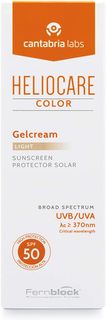
Heliocare 360° Heliocare Gelcream Colour Light SPF 50
Works for
2 of 2 advertised claims delivered
Sun protectionSPF 50 · 7 UV filtersBroad spectrum
This product offers a good level of protection against both UVB and UVA rays.
This sunscreen uses organic (so-called "chemical") sunscreen filters. Organic, or "chemical" filters usually provide reliable sun protection and rarely leave a white cast. Sunscreens with organic filters can sting eyes.
This product can be considered "reef safe" because it does not contain the UV filters (oxybenzone and octinoxate) that can be harmful to coral reefs when present in the water in high concentrations.
Evens skin tonePolypodium leucotomos leaf extractStrong evidence
“Ideal for daily use and all skin types, it provides optimum photoageing protection whilst mask uneven areas of skin tone and blemishes.”
This product offers broad spectrum sun protection. It means that it can prevent hyperpigmentation and help keep the skin tone even (sun damage is the main factor causing age spots, darkening of post-acne marks and other discolorations).
Can it cause trouble?
Irritancy3 strong irritants: Parfum, Linalool + 1 more — patch-test recommendedHigh risk
Comedogenic1 ingredient rated 2 or more on the 0–5 pore-clogging scale1 flagged

User reviews
Be the first — your take helps the next person decide.
Ingredients
Filter by role to see what each ingredient is doing.
Water~45–55%
Butylene glycol cocoate~5.6–6.8%
- Irritation risk
- Medium
Helps oil and water mix together
More about Butylene glycol cocoateC12-15 alkyl benzoate~4.8–5.9%
- Irritation risk
- Low
Enhances the product texture and makes it more spreadable. Helps reduce water loss from the outer layer of skin. Extands the shelf life by preventing bacteria growth
More about C12-15 alkyl benzoateBis-ethylhexyloxyphenol methoxyphenyl triazine~3.7–4.6%
- Irritation risk
- Medium
Tinosorb S. One of the most effective broad spectrum sunscreen ingredients. Protects from both UVA and UVB rays. It is photostable. Unfortunately, not approved by FDA (US) yet.
More about Bis-ethylhexyloxyphenol methoxyphenyl triazineCi 77891~2.9–3.5%
- Irritation risk
- Low
Diethylhexyl butamido triazone~2.8–3.4%
- Irritation risk
- Medium
Uvasorb HEB. A UV filter. Is effective against UVB and UVA II rays (but not UVA I). It is photostable. Unfortunately, is not approved by FDA (US) yet
More about Diethylhexyl butamido triazoneCetearyl alcohol~2–2.4%
- Irritation risk
- Low
- Comedogenicity
- 2/5
A non-drying alcohol. Works as an emollient. Helps water and oil mix together and creates a nice product texture
More about Cetearyl alcoholEthylhexyl salicylate~2.1–2.6%
- Irritation risk
- Low
Octisalate. A UV filter. It offers some protection against the sun rays that cause sunburn (UVB), but does not protect against the most aging sun rays (UVA). It loses its effectiveness quickly when exposed to sunlight. It is an organic, or so called "chemical" sunscreen
More about Ethylhexyl salicylateButyl methoxydibenzoylmethane~1.8–2.2%
- Irritation risk
- Medium
Avobenzone. An organic, or so-called "chemical" UV filter. Protects against both UVA and UVB rays. Needs to be combined with other filters in a formulation to be stable.
More about Butyl methoxydibenzoylmethaneTitanium dioxide~1.5–1.8%
- Irritation risk
- Low
Works as a UV filter when used in high concentrations. It is photostable and is effective mostly against the UVB light, with some protection in the UVA range. In small concentrations, used for its ability to improve the color of cosmetic products. Is usually well tolerated by the skin
More about Titanium dioxidePolysilicone-15~1.1–1.3%
- Irritation risk
- Medium
A UV filter. Effective against UVB rays, but does not protect against the most aging UVA light
More about Polysilicone-15Hexylene glycol~0.6–0.9%
- Irritation risk
- Medium
Helps create a more spreadable product texture
More about Hexylene glycolStearalkonium hectorite~0.45–0.7%
Myristyl alcohol~0.45–0.7%
- Irritation risk
- High
Helps to stabilize the product formulation while softening the upper layer of the skin. Can be irritating
More about Myristyl alcoholCi 77492~0.4–0.6%
Coco-glucoside~0.45–0.7%
- Irritation risk
- High
Used as a cleansing agent (surfactant) in cleansers. Helps water and oil mix together in lotions. Can be irritating
More about Coco-glucosideDipropylene glycol dibenzoate~0.4–0.6%
- Irritation risk
- Low
Ceteareth-25~0.45–0.65%
Ethylhexyl triazone~0.5–0.75%
- Irritation risk
- Medium
Uvinul T. A UV filter. Effective against UVB rays. It is photostable. Can increase water resistance properties of the sunscreen. Unfortunately, not approved by the FDA (US) yet
More about Ethylhexyl triazonePolypodium leucotomos leaf extract~0.25–0.5%
- Irritation risk
- Medium
A plant extract that has been shown to be effective in helping boost skin's ability to protect against UV radiation and reduce hyperpigmentation when taken orally. No conclusive evidence for its effectiveness and effective concentration in topical application
More about Polypodium leucotomos leaf extractPhenoxyethanol~0.25–0.45%
- Irritation risk
- Low
A preservative. It helps prevent bacterial growth in cosmetic products
More about PhenoxyethanolCi 77491~0.25–0.45%
- Irritation risk
- Low
A red colorant made of iron oxide. Typically is not irritating
More about Ci 77491Myristyl glucoside~0.25–0.5%
- Irritation risk
- Low
Disodium ethylene dicocamide peg-15 disulfate~0.3–0.55%
- Irritation risk
- Medium
Helps oil and water mix together
More about Disodium ethylene dicocamide peg-15 disulfatePpg-15 stearyl ether benzoate~0.25–0.5%
- Irritation risk
- Low
Dicaprylyl carbonate~0.25–0.45%
- Irritation risk
- Low
Helps products spread more easily and works as an emollient to soften skin
More about Dicaprylyl carbonatePanthenol~0.25–0.45%
- Irritation risk
- Low
Helps attract water to the upper layer of the skin and can help improve skin barrier function
More about PanthenolPropylene glycol~0.25–0.45%
- Irritation risk
- High
Helps oil and water mix together and can enhance the penetration of other ingredients into the skin. It can be irritating
More about Propylene glycolTocopheryl acetate~0.25–0.5%
- Irritation risk
- Medium
A more stable but less bio-available form of vitamin E compared to Tocopherol. Might help moisturize and protect the skin from free radicals, but mostly used in low concentrations to stabilize other ingredients.
More about Tocopheryl acetateSodium hyaluronate~0.25–0.45%
- Irritation risk
- Low
One of the best moisturizing ingredients. Attracts water into the upper layer of the skin
More about Sodium hyaluronateCamellia sinensis extract~0.25–0.45%
- Irritation risk
- Low
Tea extract. Might be helpful in neutralizing free radicals in skin
More about Camellia sinensis extractManganese oxide~0.25–0.45%
- Irritation risk
- Low
Methylparaben~0.15–0.3%
Propylparaben~0.15–0.25%
Disodium edta~0.15–0.3%
Parfum~0.1–0.2%
- Irritation risk
- High
An aromatic blend of unspecified and possibly irritating ingredients
More about ParfumPropylene carbonate~0.15–0.3%
- Irritation risk
- Low
Is used to dissolve other ingredients and create nice product texture
More about Propylene carbonateBht~0.1–0.15%
Linalool~0.05–0.1%
Limonene~0.05–0.1%
- Irritation risk
- High
A common frangrance that can easily irritate skin, especially if exposed to air, light or heat
More about LimoneneIngredient list view
Water, Butylene glycol cocoate, C12-15 alkyl benzoate, Bis-ethylhexyloxyphenol methoxyphenyl triazine, Ci 77891, Diethylhexyl butamido triazone, Cetearyl alcohol, Ethylhexyl salicylate, Butyl methoxydibenzoylmethane, Titanium dioxide, Polysilicone-15, Hexylene glycol, Stearalkonium hectorite, Myristyl alcohol, Ci 77492, Coco-glucoside, Dipropylene glycol dibenzoate, Ceteareth-25, Ethylhexyl triazone, Polypodium leucotomos leaf extract, Phenoxyethanol, Ci 77491, Myristyl glucoside, Disodium ethylene dicocamide peg-15 disulfate, Ppg-15 stearyl ether benzoate, Dicaprylyl carbonate, Panthenol, Propylene glycol, Unknown, Tocopheryl acetate, Sodium hyaluronate, Camellia sinensis extract, Manganese oxide, Methylparaben, Propylparaben, Disodium edta, Parfum, Propylene carbonate, Bht, Linalool, Limonene
Compare prices
Retailers ranked by price — lowest first.

Worth comparing, line by line.
Match % combines shared ingredients, the first five ingredients, shared actives and hero ingredients, irritancy (lower counts in the alternative's favour), texture and body area. Only products in the same routine step are compared.
| Heliocare 360°Heliocare Gelcream Colour Light SPF 50YOUR PRODUCT | SolaitSensitive Face Fluid SPF30 | FaceGymHydrate + Protect SPF 50 | EUBOSCool & Calm - Redness Relieving CC Cream SPF 50 | |
|---|---|---|---|---|
| Match | — | 55% | 55% | 55% |
| Price | $34.78 | $8.02−$26.76 | — | — |
| Shared key ingredients | — | 5 of 9 | 4 of 9 | 4 of 9 |
| Key difference | — | Caprylic/Capric Triglyceride | Niacinamide | Caprylic/Capric Triglyceride |
| Irritancy | High | Medium | Low | Low |
| SPF | SPF 50 | SPF 30 | SPF 50 | SPF 50 |
| Drying alcohol | — | — | — | — |
| View product | Shop | Shop | Shop |
Product summary
The ingredient list suggests that "Heliocare 360° - Heliocare Gelcream Colour Light SPF 50" can provide reliable sun protection. It can protect from both UVA and UVB rays. This is great news because not all sunscreens with SPF ratings give UVA protection. (UVA rays do not cause sunburn, but still damage our skin and lead to early aging).
Sunscreen filters
This sunscreen uses a mixture of both mineral and organic (so-called "chemical") UV filters. The organic filters in the product are: tinosorb s, avobenzone, uvasorb heb, octisalate, uvinul t and polysilicone-15. As for the mineral filters, this sunscreen uses titanium dioxide.
Irritation risk
There are quite a few common irritants in this product, including ingredients without particular skin benefits. We would not recommend it for sensitive skin. We assess the overall irritancy of it to be high. For a detailed overview of all potential irritants: click here
You can see the detailed formula review with the breakdown of all actives in the product and the full ingredient list with estimated concentrations in the tables below.
Price
The product retails for 19.94$ in the United States and from 13.90£ up to 26.00£ in the United Kingdom.
For a detailed price comparison: click here.
Sources cited in this review
Every concentration estimate and effectiveness label is anchored to one of these 14 studies and safety reviews.
- 1Cosmetic allergy from myristyl alcoholncbi.nlm.nih.gov
- 2
- 3Patch testing with myristyl alcoholresearchgate.net
- 4
- 5Allergen of the Year—Alkyl Glucosidepracticeupdate.com
- 6

Affiliate links · As an Amazon Associate, WIMJ earns from qualifying purchases.