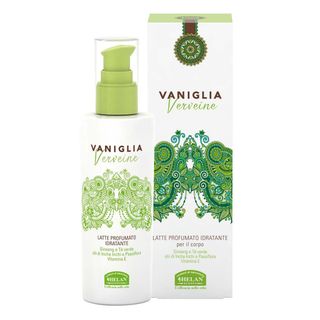
Helan Natural Vanilla Vervain Hydrating Body Milk
Works for
1 of 1 advertised claim delivered
Moisturizing13 ingredients credited for this claimGood support
“Vanilla Vervain Hydrating Body Milk”
This product can help improve hydration of the skin with the two types of ingredients.
The first type is called “humectants”:
these ingredients help attract water.
When humectants are on the surface of the skin, they “pull in” the moisture from the outside environment, or from
within deeper layers of the skin. The following ingredients in this product do the job:
glycerin, dextrin.
This product also contains ingredients called “occlusives”. They help reduce the speed with which our skin loses moisture to the outside environment. These ingredients also help soften the upper layer of the skin, so it feels less tight and nicer to the touch. The following ingredients in this product do the job: plukenetia volubilis seed oil, cetearyl alcohol.
Can it cause trouble?
Irritancy8 strong irritants: Parfum, Passiflora incarnata seed oil + 6 more — patch-test recommendedHigh risk
Comedogenic2 ingredients rated 2 or more on the 0–5 pore-clogging scale2 flagged
User reviews
Be the first — your take helps the next person decide.
Ingredients
Filter by role to see what each ingredient is doing.
Water~40–60%
Glycerin~4.2–6.3%
- Irritation risk
- Low
One of the best moisturizing ingredients. Naturally present in skin. It attracts water to the upper layer of the skin working as a humectant
More about GlycerinDicaprylyl carbonate~3.7–5.5%
- Irritation risk
- Low
Helps products spread more easily and works as an emollient to soften skin
More about Dicaprylyl carbonateDicaprylyl ether~2.8–4.2%
- Irritation risk
- Low
Helps soften the upper layer of the skin while creating a non-greasy feel on the skin. Helps to dissolve other ingredients
More about Dicaprylyl etherHydrogenated vegetable glycerides citrate~2–3%
Shea butter ethyl esters~1.7–2.6%
- Irritation risk
- Low
Helps soften the upper layer of the skin
More about Shea butter ethyl estersParfum~1.4–2.1%
- Irritation risk
- High
An aromatic blend of unspecified and possibly irritating ingredients
More about ParfumPassiflora incarnata seed oil~1.3–1.9%
- Irritation risk
- High
A plant oil that can help soften the upper layer of the skin. Contains essential oil that can be irritating
More about Passiflora incarnata seed oilPlukenetia volubilis seed oil~1.1–1.7%
- Irritation risk
- Low
A plant oil that works as a good moisturizer by softening the upper layer of the skin. Might be helpful in reducing inflammation in skin and reducing blemishes due to the large content of linoleic acid
More about Plukenetia volubilis seed oilCocoglycerides~0.9–1.35%
- Irritation risk
- High
Help soften the upper layer of the skin and make it easier for oil and water mix together. Recently, a rising number of allergic reactions to cocoglycerides and other coconut-derived surfactants has been reported. As there is a significant overlap between frequent irritants and allergens, we flag this ingredient for attention of those with very sensitive, reactive skin
More about CocoglyceridesCamellia sinensis leaf/panax ginseng root extract~0.55–1.25%
- Irritation risk
- Low
Polyglyceryl-3 diisostearate~0.45–1.05%
- Irritation risk
- Medium
- Comedogenicity
- 3/5
Helps oil and water mix together
More about Polyglyceryl-3 diisostearateBenzyl alcohol~0.35–0.85%
- Irritation risk
- High
A preservative. Can be used to mask unpleasant smell. Can be irritating
More about Benzyl alcoholXanthan gum~0.35–0.85%
- Irritation risk
- Low
Used to create a thicker product consistency
More about Xanthan gumCetearyl alcohol~0.4–0.9%
- Irritation risk
- Low
- Comedogenicity
- 2/5
A non-drying alcohol. Works as an emollient. Helps water and oil mix together and creates a nice product texture
More about Cetearyl alcoholGlyceryl undecylenate~0.35–0.85%
- Irritation risk
- Medium
Helps oil and water mix together and helps preserve the product formulation
More about Glyceryl undecylenateGlyceryl caprylate~0.35–0.85%
- Irritation risk
- Low
An emollient that can also help water and oil mix together, as well as prevent bacteria growth in products
More about Glyceryl caprylateTetrasodium glutamate diacetate~0.2–0.75%
- Irritation risk
- Low
Helps stabilize the product formulation
More about Tetrasodium glutamate diacetateAscorbyl palmitate~0.15–0.7%
- Irritation risk
- Medium
Being a lipid soluble form of vitamin C, it is more stable and can penetrate the skin better than L-Ascorbic acid. It is effective in protecting the skin from free radicals, as well as evening the skin tone, but is less effective in stimulating collagen production compared to L-Ascorbic acid.
More about Ascorbyl palmitateLecithin~0.2–0.75%
- Irritation risk
- Low
Used mostly for creating emulsions - helping oil and water mix together. Helps soften the upper layer of the skin
More about LecithinTocopheryl acetate~0.15–0.6%
- Irritation risk
- Medium
A more stable but less bio-available form of vitamin E compared to Tocopherol. Might help moisturize and protect the skin from free radicals, but mostly used in low concentrations to stabilize other ingredients.
More about Tocopheryl acetateTocopherol~0.15–0.6%
- Irritation risk
- Low
Pure form of vitamin E. Can help moisturise and protect the skin from free radicals. Often used to help stabilise other ingredients or the formula itself
More about TocopherolDextrin~0.15–0.55%
- Irritation risk
- Low
A sugar that is used to stabilize the product formulation. Can help attract water to the upper layer of the skin
More about DextrinMaltodextrin~0.15–0.5%
- Irritation risk
- Low
Used to stabilize the product formulation and can help absorb oil
More about MaltodextrinCitric acid~0.1–0.45%
- Irritation risk
- Medium
Can work as an exfoliant but is typically used to adjust the product pH
More about Citric acidLinalool~0.1–0.4%
Coumarin~0.1–0.35%
Citral~0.05–0.3%
Limonene~0.05–0.3%
- Irritation risk
- High
A common frangrance that can easily irritate skin, especially if exposed to air, light or heat
More about LimoneneAlpha-isomethyl ionone~0.05–0.2%
- Irritation risk
- High
A fragrance. Potential allergen and can be irritating
More about Alpha-isomethyl iononeGeraniol~0.05–0.15%
Ingredient list view
Water, Glycerin, Dicaprylyl carbonate, Dicaprylyl ether, Hydrogenated vegetable glycerides citrate, Shea butter ethyl esters, Parfum, Passiflora incarnata seed oil, Plukenetia volubilis seed oil, Cocoglycerides, Camellia sinensis leaf/panax ginseng root extract, Polyglyceryl-3 diisostearate, Benzyl alcohol, Xanthan gum, Cetearyl alcohol, Glyceryl undecylenate, Glyceryl caprylate, Tetrasodium glutamate diacetate, Ascorbyl palmitate, Lecithin, Tocopheryl acetate, Tocopherol, Dextrin, Maltodextrin, Citric acid, Linalool, Coumarin, Citral, Limonene, Alpha-isomethyl ionone, Geraniol
Compare prices
Retailers ranked by price — lowest first.
Sources cited in this review
Every concentration estimate and effectiveness label is anchored to one of these 6 studies and safety reviews.
- 1
- 2
- 3
- 4Vitamin E in dermatologyncbi.nlm.nih.gov
- 5Vitamin E and Skin Healthlpi.oregonstate.edu
- 6

Affiliate links · As an Amazon Associate, WIMJ earns from qualifying purchases.