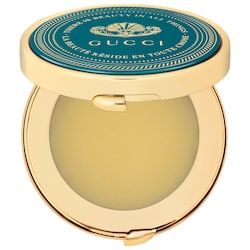
Gucci Baume Nourrissant Universal Nourishing Balm
Works for
1 of 1 advertised claim delivered
Moisturizing12 ingredients credited for this claimGood evidence
“Baume Nourrissant Universal Nourishing Balm”
This product can help soften the skin and reduce its moisture loss with emollients and occlusives: butyrospermum parkii butter, caprylic/capric triglyceride.
Keep in mind that this product does not contain effective ingredients to attract water to the upper layer of the skin. This is why an additional product with humectants like glycerin or hyaluronic acid can be helpful (apply it before this product for the best results).
Can it cause trouble?
Irritancy2 strong irritants: Calendula officinalis flower extract, Rosa hybrid flower extractMedium risk
Comedogenic3 ingredients rated 2 or more on the 0–5 pore-clogging scale3 flagged
User reviews
Be the first — your take helps the next person decide.
Ingredients
Filter by role to see what each ingredient is doing.
Caprylic/capric triglyceride~23–34%
- Irritation risk
- Medium
A good mix of fatty acids that forms a protective layer on the skin. Improves the shelf life of products. Derived from coconut and glycerin
More about Caprylic/capric triglycerideHelianthus annuus seed oil~5.1–7.6%
- Irritation risk
- Low
A great emollient due to its high linoleic acid content. One of the most effective plant oils in helping skin hydration and repairing skin barrier function
More about Helianthus annuus seed oilButyrospermum parkii butter~4.7–7.1%
- Irritation risk
- Low
- Comedogenicity
- 3/5
A great moisturising ingredient that softens the skin and reduces water loss from its upper layer. It also can be helpful in protecting skin from free radicals
More about Butyrospermum parkii butterTribehenin~3.9–5.8%
- Irritation risk
- Low
Used to create a thicker product consistency and soften the upper layer of the skin
More about TribeheninRicinus communis seed oil~3.1–4.6%
- Irritation risk
- Medium
A plant oil that can help soften the skin. It might be helpful in calming down inflammation, but solid research is lacking. Is often used in lip products to create the needed product consistency
More about Ricinus communis seed oilHelianthus annuus seed wax~2.2–3.3%
- Irritation risk
- Low
Helps soften the upper layer of the skin and support skin's barrier function while creating a thicker product consistency
More about Helianthus annuus seed waxEuphorbia cerifera wax~2–3%
- Irritation risk
- Low
Copernicia cerifera cera~1.5–2.2%
- Irritation risk
- Low
Brazilian palm wax. Helps soften the upper layer of the skin
More about Copernicia cerifera ceraSilica~1.4–2%
Bisabolol~0.8–1.2%
- Irritation risk
- Low
An active component of chamomile plant that historically has been used to calm down irritated skin. A recent study shows that bisabolol indeed can have some anti-inflammatory effect on skin, even though conclusive data is lacking. Bisabolol has a sweet floral scent and can be added to products for its aromatic properties
More about BisabololPolyglyceryl-3 diisostearate~0.55–1.3%
- Irritation risk
- Medium
- Comedogenicity
- 3/5
Helps oil and water mix together
More about Polyglyceryl-3 diisostearateSimmondsia chinensis seed oil~0.6–1.4%
- Irritation risk
- Medium
Softens the upper layer of skin and helps restore the healthy skin barrier. Has shown to help calm down inflammation in skin. It is a stable oil, meaning that it retains its properties even when exposed to air.
More about Simmondsia chinensis seed oilGlycine soja oil~0.55–1.25%
- Irritation risk
- Medium
- Comedogenicity
- 2/5
A good emollient that helps soften the skin and helps repair its barrier function. It can clog pores if used in high concentrations.
More about Glycine soja oilHydrogenated castor oil~0.5–1.2%
- Irritation risk
- Medium
A plant oil that can help soften the skin. It might be helpful in calming down inflammation, but solid research is lacking. Is often used in lip products to create the needed product consistency
More about Hydrogenated castor oilLecithin~0.5–1.1%
- Irritation risk
- Low
Used mostly for creating emulsions - helping oil and water mix together. Helps soften the upper layer of the skin
More about LecithinTocopherol~0.2–0.75%
- Irritation risk
- Low
Pure form of vitamin E. Can help moisturise and protect the skin from free radicals. Often used to help stabilise other ingredients or the formula itself
More about TocopherolAscorbyl palmitate~0.15–0.65%
- Irritation risk
- Medium
Being a lipid soluble form of vitamin C, it is more stable and can penetrate the skin better than L-Ascorbic acid. It is effective in protecting the skin from free radicals, as well as evening the skin tone, but is less effective in stimulating collagen production compared to L-Ascorbic acid.
More about Ascorbyl palmitateCalendula officinalis flower extract~0.15–0.5%
- Irritation risk
- High
A plant extract that has some anti-oxidant and anti-bacterial properties. Can be irritating
More about Calendula officinalis flower extractRosa hybrid flower extract~0.15–0.5%
- Irritation risk
- High
Malva sylvestris flower/leaf extract~0.1–0.45%
- Irritation risk
- Low
Citric acid~0.1–0.3%
- Irritation risk
- Medium
Can work as an exfoliant but is typically used to adjust the product pH
More about Citric acidBenzyl alcohol~0.05–0.3%
- Irritation risk
- High
A preservative. Can be used to mask unpleasant smell. Can be irritating
More about Benzyl alcoholIron oxides~0.05–0.3%
- Irritation risk
- Low
An umbrella term for the following three colorants: CI 77491, CI 77492, CI 77499. They might be able to offer some protection against visible light, but the degree of the protection is not clear
More about Iron oxidesIngredient list view
Caprylic/capric triglyceride, Helianthus annuus seed oil, Butyrospermum parkii butter, Tribehenin, Ricinus communis seed oil, Helianthus annuus seed wax, Euphorbia cerifera wax, Copernicia cerifera cera, Silica, Bisabolol, Polyglyceryl-3 diisostearate, Simmondsia chinensis seed oil, Glycine soja oil, Hydrogenated castor oil, Lecithin, Tocopherol, Ascorbyl palmitate, Calendula officinalis flower extract, Rosa hybrid flower extract, Malva sylvestris flower/leaf extract, Citric acid, Benzyl alcohol, Iron oxides
Compare prices
Retailers ranked by price — lowest first.
Affiliate links · prices updated regularly
Sources cited in this review
Every concentration estimate and effectiveness label is anchored to one of these 14 studies and safety reviews.
- 1
- 2
- 3Effect of topically applied lipids on surfactant-irritated skinonlinelibrary.wiley.com
- 4
- 5
- 6

Affiliate links · As an Amazon Associate, WIMJ earns from qualifying purchases.