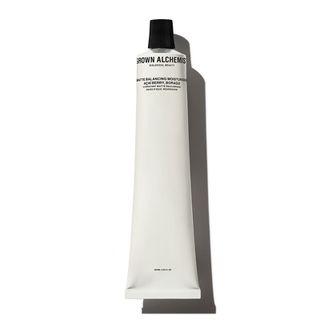
Grown Alchemist Matte Balancing Moisturiser Acai Berry and Borago
Works for
1 of 1 advertised claim delivered
MoisturizingSesamum indicum seed oil, Borago officinalis seed oil + 8 moreGood evidence
“Matte Balancing Moisturiser Acai Berry and Borago”
This product can help improve hydration of the skin with the two types of ingredients.
The first type is called “humectants”:
these ingredients help attract water.
When humectants are on the surface of the skin, they “pull in” the moisture from the outside environment, or from
within deeper layers of the skin. The following ingredients in this product do the job:
glycerin, aloe barbadensis leaf extract.
This product also contains ingredients called “occlusives”. They help reduce the speed with which our skin loses moisture to the outside environment. These ingredients also help soften the upper layer of the skin, so it feels less tight and nicer to the touch. The following ingredients in this product do the job: dimethicone, borago officinalis seed oil.
Can it cause trouble?
Irritancy2 strong irritants: Lavandula angustifolia oil, LinaloolMedium risk
ComedogenicClean of flagged comedogenic ingredientsNone flagged
User reviews
Be the first — your take helps the next person decide.
Ingredients
Filter by role to see what each ingredient is doing.
Aloe barbadensis leaf extract~23–34%
- Irritation risk
- Medium
Traditionally used to treat sunburns, dermatitis and inflammation, but evidence for its effectiveness is lacking. The extract can contain humectants that help attract water into the skin
More about Aloe barbadensis leaf extractWater~12–18%
Camellia oleifera seed oil~5.2–7.7%
- Irritation risk
- Medium
An emollient that does not leave a greasy finish
More about Camellia oleifera seed oilCetearyl olivate~3.1–4.7%
Sorbitan olivate~2.4–3.6%
Cetyl alcohol~1.8–2.7%
- Irritation risk
- Low
A non-drying alcohol that works to soften the skin and stabilize product formulations helping oil and water mix together
More about Cetyl alcoholGlycerin~1.4–2.1%
- Irritation risk
- Low
One of the best moisturizing ingredients. Naturally present in skin. It attracts water to the upper layer of the skin working as a humectant
More about GlycerinDimethicone~1.4–2%
- Irritation risk
- Low
A silicone that helps to reduce water loss from the surface of the skin. Can temporarily "fill in" lines and wrinkles, absorb oil, and create a nice product finish
More about DimethiconeBenzyl alcohol~0.5–1%
- Irritation risk
- High
A preservative. Can be used to mask unpleasant smell. Can be irritating
More about Benzyl alcoholSodium dehydroacetate~0.3–0.6%
Xanthan gum~0.55–1.25%
- Irritation risk
- Low
Used to create a thicker product consistency
More about Xanthan gumLactic acid~0.45–1.05%
- Irritation risk
- Medium
An exfoliating and moisturizing alpha-hydroxy acid (AHA). Typically causes less irritation than other AHAs, for example, glycolic acid. At high concentrations (about 15%), lactic acid can help reduce lines and wrinkles. Recent studies show that lactic acid can support the "good" bacteria living on skin's surface (healthy skin microbiome)
More about Lactic acidTocopherol~0.5–1.15%
- Irritation risk
- Low
Pure form of vitamin E. Can help moisturise and protect the skin from free radicals. Often used to help stabilise other ingredients or the formula itself
More about TocopherolLavandula angustifolia oil~0.4–0.9%
- Irritation risk
- High
An essential oil. Potential allergen and can be irritating. It has some anti-bacterial properties
More about Lavandula angustifolia oilBorago officinalis seed oil~0.4–1%
- Irritation risk
- Low
A plant oil that is effective in reducing irritation in skin, restore the barrier function and support its hydration
More about Borago officinalis seed oilEuterpe oleracea fruit oil~0.3–0.7%
- Irritation risk
- Medium
A plant oil that might help neutralize free radicals, but evidence of effectiveness in skin is lacking
More about Euterpe oleracea fruit oilOryza sativa bran oil~0.2–0.8%
- Irritation risk
- Low
Helps soften the upper layer of the skin and might have some anti-oxidant properties
More about Oryza sativa bran oilSesamum indicum seed oil~0.15–0.6%
- Irritation risk
- Low
A good moisturizing plant oil. Due to the high linoleic acid content, it helps soften the upper layer of the skin, reduce water loss and support skin barrier function
More about Sesamum indicum seed oilSolanum centrale fruit extract~0.1–0.4%
- Irritation risk
- Low
Carum petroselinum seed oil~0.1–0.3%
- Irritation risk
- Low
Linalool~0.05–0.3%
Ingredient list view
Aloe barbadensis leaf extract, Water, Camellia oleifera seed oil, Cetearyl olivate, Sorbitan olivate, Cetyl alcohol, Glycerin, Dimethicone, Benzyl alcohol, Sodium dehydroacetate, Xanthan gum, Lactic acid, Tocopherol, Lavandula angustifolia oil, Borago officinalis seed oil, Euterpe oleracea fruit oil, Oryza sativa bran oil, Sesamum indicum seed oil, Solanum centrale fruit extract, Carum petroselinum seed oil, Linalool, Unknown
Compare prices
Retailers ranked by price — lowest first.
Affiliate links · prices updated regularly · As an Amazon Associate, WIMJ earns from qualifying purchases.
Sources cited in this review
Every concentration estimate and effectiveness label is anchored to one of these 15 studies and safety reviews.
- 1
- 2
- 3Final Report on the Safety Assessment of Dimethicone Copolyoljournals.sagepub.com
- 4
- 5Epidermal and dermal effects of topical lactic acidncbi.nlm.nih.gov
- 6Dual Effects of Alpha-Hydroxy Acids on the Skinpdfs.semanticscholar.org

Affiliate links · As an Amazon Associate, WIMJ earns from qualifying purchases.