Works for:
based on ingredients and %- Anti-aging
- Moisturizing
- Evens skin tone
- Exfoliation
Doesn't work for:
based on ingredients and %- Sun protection
Can it cause trouble?
- Irritation risk: low
- Comedogenic risk ingredients: 0
Key actives
Product Summary
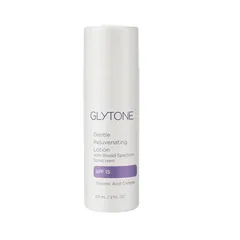
"Glytone - Gentle Rejuvenating Lotion SPF 15" offers broad spectrum protection. It means that it protects from both UVA and UVB rays (you can remember UVB as "burning" sunlight - they cause sunburn. You can remember UVA rays as "aging" - they do not lead to sunburn, but they cause photodamage and contribute to early signs of skin aging and hyperpigmentation). On the negative side, the SPF of this moisturizer is not high enough. We recommend to use a sunscreen with at least SPF 30 daily.
It also works as a moisturizer, so you do not have to use an additional hydrating product. Like all broad-spectrum sunscreens, this product helps prevent early signs of aging.
Sunscreen filters
This is a so-called "chemical" sunscreen. It means that it uses organic UV filters. They typically offer good sun protection and rarely leave a white cast, but they can be irritating for some people with sensitive skin. The UV filters in this sunscreen are: avobenzone 2.00% (declared), butyloctyl salicylate 3.30% - 4.90% and octinoxate 7.00% (declared).
Irritation risk
This moisturizer contains actives that can be irritating. We assess the overall irritancy of this moisturizer to be low. For a detailed overview of all potential irritants: click here
You can see the detailed formula review with the breakdown of all actives in the product and the full ingredient list with estimated concentrations in the tables below.
Price
The product retails for 56.00$ in the United States.
For a detailed price comparison: click here.
Anti-aging
What does the product description say?
This lightweight, oil-free lotion helps to neutralize the effects of damaging UVA/UVB rays and visibly reduces the appearance of fine lines and wrinkles.
Source: Skinstore
This product can help reduce and prevent fine lines and wrinkles, improve skin elasticity and firmness because it contains glycolic acid.
Keep in mind that it typically takes at least 6 weeks to notice any results because the changes that are needed to improve fine lines and elasticity happen in the deeper layers of the skin. No topical anti-aging product can “erase” wrinkles or fully reverse signs of aging.
An alpha-hydroxy acid (AHA) that helps to remove the dead skin cells on the surface of the skin reveling a more even, smoother complexation. It is also able to stimulate collagen production with long-term use. Could help to reduce pore congestion. It can be irritating to the skin. Apply sunscreen daily if using products with glycolic acid
Evens skin tone
This product can help reduce hypepigmentation and even out the skin tone because it contains the following effective ingredients: glycolic acid
Keep in mind that you would need to apply any topical skincare targetted at hypigmentation consistently for a couple of months to get a result. No topical skincare product can help get rid of hyperpigmentation (including post-acne marks and age spots) instantly.
This product can also help with skin tone because it offers sun protection. Sun damage is the main factor causing age spots, darkening of post-acne marks and other discolorations. This is why sun protection is the best strategy for maintaining an even skin tone. We, however, do not recommend using this product as a sunscreen because the protection it offers is not strong enough).
An alpha-hydroxy acid (AHA) that helps to remove the dead skin cells on the surface of the skin reveling a more even, smoother complexation. It is also able to stimulate collagen production with long-term use. Could help to reduce pore congestion. It can be irritating to the skin. Apply sunscreen daily if using products with glycolic acid
Exfoliation
This product can help exfoliate the skin. In other words, it helps break down the bonds between dead cells on the surface of the skin and speed up the skin turnover. Skin often appears softer and brighter after exfoliation, but overdoing it can result in disrupted skin barrier. The following ingredient is doing the exfoliating job in this product: glycolic acid.
An alpha-hydroxy acid (AHA) that helps to remove the dead skin cells on the surface of the skin reveling a more even, smoother complexation. It is also able to stimulate collagen production with long-term use. Could help to reduce pore congestion. It can be irritating to the skin. Apply sunscreen daily if using products with glycolic acid
Moisturizing
What does the product description say?
Gentle Rejuvenating Lotion SPF 15
Source: From product name
This product can help improve hydration of the skin with the two types of ingredients.
The first type is called “humectants”:
these ingredients help attract water.
When humectants are on the surface of the skin, they “pull in” the moisture from the outside environment, or from
within deeper layers of the skin. The following ingredients in this product do the job:
cyclomethicone, glycerin.
This product also contains ingredients called “occlusives”. They help reduce the speed with which our skin loses moisture to the outside environment. These ingredients also help soften the upper layer of the skin, so it feels less tight and nicer to the touch. The following ingredients in this product do the job: dimethiconol, cyclomethicone.
A type of silicone that leaves a nice silky finish on the skin and can help soften its upper layer
A silicone that makes products more spreadable and keeps skin smooth. Helps to add gloss to skin and may visually fill in fine lines/wrinkles for short time
One of the best moisturizing ingredients. Naturally present in skin. It attracts water to the upper layer of the skin working as a humectant
A non-drying alcohol that works to soften the skin and stabilize product formulations helping oil and water mix together
Helps soften the upper layer of the skin, dissolve other ingredients and create a thicker product consistency
An emollient that softens the skin and forms a protective layer on its surface. Helps water and oil mix together
Sun protection
This product offers broad spectrum sun protection, but it is weak. We recommend to use a broad spectrum sunscreen with at least SPF 30.
Avobenzone. An organic, or so-called "chemical" UV filter. Protects against both UVA and UVB rays. Needs to be combined with other filters in a formulation to be stable.
A synthetic ester of salicylic acid that is used to help disperse pigments and boost effectiveness of sunscreen ingredients. It is able to absorb UV light (working as an organic, or chemical filter), but is not approved as a sunscreen ingredient on its own
Octinoxate. When used in higher concentrations, works as a sunscreen protecting the skin from UVB rays. When used in lower concentration, helps to preserve the product formulation. Is shown to be harmful to coral reefs - consider avoiding bathing in coral reef areas when wearing a product with this ingredient. It can be irritating
How honest is this product?
| Promise | Can it deliver? |
|---|---|
| Sun protection | |
| Anti-aging | |
| Moisturizing |
Total Promises Fulfilled score: 75/100.
Potential irritants
Comedogenic ingredients
No comedogenic ingredients detected
User reviews (0)
Averages from community submissions.
No reviews yet for this product.
Be the first to share your experience!
Tried this product?
Help capture what the ingredient list can't—texture, finish, pilling, scent, and more. Answer what you can, skip the rest.
Takes ~30 seconds.
Reviews are shown in aggregate. No personal details.
Key Actives
An alpha-hydroxy acid (AHA) that helps to remove the dead skin cells on the surface of the skin reveling a more even, smoother complexation. It is also able to stimulate collagen production with long-term use. Could help to reduce pore congestion. It can be irritating to the skin. Apply sunscreen daily if using products with glycolic acid
Avobenzone. An organic, or so-called "chemical" UV filter. Protects against both UVA and UVB rays. Needs to be combined with other filters in a formulation to be stable.
Octinoxate. When used in higher concentrations, works as a sunscreen protecting the skin from UVB rays. When used in lower concentration, helps to preserve the product formulation. Is shown to be harmful to coral reefs - consider avoiding bathing in coral reef areas when wearing a product with this ingredient. It can be irritating
A type of silicone that leaves a nice silky finish on the skin and can help soften its upper layer
A synthetic ester of salicylic acid that is used to help disperse pigments and boost effectiveness of sunscreen ingredients. It is able to absorb UV light (working as an organic, or chemical filter), but is not approved as a sunscreen ingredient on its own
One of the best moisturizing ingredients. Naturally present in skin. It attracts water to the upper layer of the skin working as a humectant
A silicone that makes products more spreadable and keeps skin smooth. Helps to add gloss to skin and may visually fill in fine lines/wrinkles for short time
Potential irritants
Octinoxate. When used in higher concentrations, works as a sunscreen protecting the skin from UVB rays. When used in lower concentration, helps to preserve the product formulation. Is shown to be harmful to coral reefs - consider avoiding bathing in coral reef areas when wearing a product with this ingredient. It can be irritating
An alpha-hydroxy acid (AHA) that helps to remove the dead skin cells on the surface of the skin reveling a more even, smoother complexation. It is also able to stimulate collagen production with long-term use. Could help to reduce pore congestion. It can be irritating to the skin. Apply sunscreen daily if using products with glycolic acid
Avobenzone. An organic, or so-called "chemical" UV filter. Protects against both UVA and UVB rays. Needs to be combined with other filters in a formulation to be stable.
A synthetic ester of salicylic acid that is used to help disperse pigments and boost effectiveness of sunscreen ingredients. It is able to absorb UV light (working as an organic, or chemical filter), but is not approved as a sunscreen ingredient on its own
Used to improve product texture and help oil and water mix together
A more stable but less bio-available form of vitamin E compared to Tocopherol. Might help moisturize and protect the skin from free radicals, but mostly used in low concentrations to stabilize other ingredients.
Comedogenic ingredients
We couldn't find any comedogenic ingredients in this product
All ingredients
Avobenzone. An organic, or so-called "chemical" UV filter. Protects against both UVA and UVB rays. Needs to be combined with other filters in a formulation to be stable.
Octinoxate. When used in higher concentrations, works as a sunscreen protecting the skin from UVB rays. When used in lower concentration, helps to preserve the product formulation. Is shown to be harmful to coral reefs - consider avoiding bathing in coral reef areas when wearing a product with this ingredient. It can be irritating
An alpha-hydroxy acid (AHA) that helps to remove the dead skin cells on the surface of the skin reveling a more even, smoother complexation. It is also able to stimulate collagen production with long-term use. Could help to reduce pore congestion. It can be irritating to the skin. Apply sunscreen daily if using products with glycolic acid
A type of silicone that leaves a nice silky finish on the skin and can help soften its upper layer
A synthetic ester of salicylic acid that is used to help disperse pigments and boost effectiveness of sunscreen ingredients. It is able to absorb UV light (working as an organic, or chemical filter), but is not approved as a sunscreen ingredient on its own
An emollient that softens the skin and forms a protective layer on its surface. Helps water and oil mix together
One of the best moisturizing ingredients. Naturally present in skin. It attracts water to the upper layer of the skin working as a humectant
A non-drying alcohol that works to soften the skin and stabilize product formulations helping oil and water mix together
A silicone that makes products more spreadable and keeps skin smooth. Helps to add gloss to skin and may visually fill in fine lines/wrinkles for short time
A preservative. It helps prevent bacterial growth in cosmetic products
Used to improve product texture and help oil and water mix together
A more stable but less bio-available form of vitamin E compared to Tocopherol. Might help moisturize and protect the skin from free radicals, but mostly used in low concentrations to stabilize other ingredients.
Helps soften the upper layer of the skin, dissolve other ingredients and create a thicker product consistency
Ingredient list view
Butyl methoxydibenzoylmethane, Ethylhexyl methoxycinnamate, Water, Glycolic acid, Cyclomethicone, Butyloctyl salicylate, Glyceryl stearate, Glycerin, Stearoxy dimethicone, Ammonium hydroxide, Peg-150 stearate, Cetyl alcohol, Dimethiconol, Glycine soja extract, Unknown, Phenoxyethanol, Xanthan gum, Methylparaben, Polyacrylamide, Tocopheryl acetate, Disodium edta, C13-14 isoparaffin, Laureth-7
- Photoprotective and antiinflammatory effects of topical glycolic acid
- Glycolic acid peel therapy – a current review
- Dual Effects of Alpha-Hydroxy Acids on the Skin
- Safety assessment of Salicylic Acid, Butyloctyl Salicylate, Calcium Salicylate, C12-15 Alkyl Salicylate, Capryloyl Salicylic Acid, Hexyldodecyl Salicylate, Isocetyl Salicylate, Isodecyl Salicylate, Magnesium Salicylate, MEA-Salicylate, Ethylhexyl Salicylate, Potassium Salicylate, Methyl Salicylate, Myristyl Salicylate, Sodium Salicylate, TEA-Salicylate, and Tridecyl Salicylate
- Glycerol and the skin: holistic approach to its origin and functions
- Safety Assessment of Isoparaffins as Used in Cosmetics