Works for:
based on ingredients and %- Cleansing
Can it cause trouble?
- Irritation risk: high
- Comedogenic risk ingredients: 0
Key actives

Works for
Cleansing
What does the product description say?
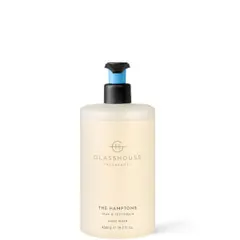
Glasshouse The Hamptons Hand Wash
Source: Recreate Yourself
This product works by removing dirt and oil from the surface of the skin. It uses a combination of mild cleansing agents (cocamidopropyl betaine, decyl glucoside, glyceryl caprylate, peg-120 methyl glucose dioleate, sodium coco-sulfate, sodium lauroyl methyl isethionate) and should be able to cleanse the skin gently. Still keep in mind that any cleansing can disrupt the skin barrier, and most people do not need to cleanse their skin more than once per day.
Even though this formulation is mild, the following cleansing agents could trigger an irritation or allergy for some people: cocamidopropyl betaine, decyl glucoside
Helps water and oil mix together. Used as a cleansing ingredient. Could be an allergen
Helps oil and water mix together. Can be irritating
An emollient that can also help water and oil mix together, as well as prevent bacteria growth in products
Works as a cleansing agent
How honest is this product?
| Promise | Can it deliver? |
|---|---|
| Cleansing |
Total Promises Fulfilled score: 100/100.
We receive a small commission for purchases made through these links at no cost for you. Thank you for your support! Learn more
Potential irritants
Comedogenic ingredients
No comedogenic ingredients detected
User reviews (0)
Averages from community submissions.
No reviews yet for this product.
Be the first to share your experience!
Tried this product?
Help capture what the ingredient list can't—texture, finish, pilling, scent, and more. Answer what you can, skip the rest.
Takes ~30 seconds.
Reviews are shown in aggregate. No personal details.
Key Actives
An exfoliating and moisturizing alpha-hydroxy acid (AHA). Typically causes less irritation than other AHAs, for example, glycolic acid. At high concentrations (about 15%), lactic acid can help reduce lines and wrinkles. Recent studies show that lactic acid can support the "good" bacteria living on skin's surface (healthy skin microbiome)
Can be helpful in reducing inflammation in skin, including inflamed acne. It can be irritating
Helps attract water to the upper layer of the skin and can help improve skin barrier function
An emollient that can also help water and oil mix together, as well as prevent bacteria growth in products
Helps oil and water mix together. Can be irritating
One of the best moisturizing ingredients. Naturally present in skin. It attracts water to the upper layer of the skin working as a humectant
Works as a cleansing agent
Helps water and oil mix together. Used as a cleansing ingredient. Could be an allergen
Softens the upper layer of skin and helps restore the healthy skin barrier. Has shown to help calm down inflammation in skin. It is a stable oil, meaning that it retains its properties even when exposed to air.
Naturally present in skin and helps to attract water to its upper layer
Helps attract water to the upper layer of the skin
Potential irritants
Helps water and oil mix together. Used as a cleansing ingredient. Could be an allergen
An aromatic blend of unspecified and possibly irritating ingredients
Can be helpful in reducing inflammation in skin, including inflamed acne. It can be irritating
A plant extract that might have some anti-oxidant effect in skin, but evidence is lacking
Softens the upper layer of skin and helps restore the healthy skin barrier. Has shown to help calm down inflammation in skin. It is a stable oil, meaning that it retains its properties even when exposed to air.
An exfoliating and moisturizing alpha-hydroxy acid (AHA). Typically causes less irritation than other AHAs, for example, glycolic acid. At high concentrations (about 15%), lactic acid can help reduce lines and wrinkles. Recent studies show that lactic acid can support the "good" bacteria living on skin's surface (healthy skin microbiome)
Can work as an exfoliant but is typically used to adjust the product pH
Comedogenic ingredients
We couldn't find any comedogenic ingredients in this product
All ingredients
One of the best moisturizing ingredients. Naturally present in skin. It attracts water to the upper layer of the skin working as a humectant
Helps water and oil mix together. Used as a cleansing ingredient. Could be an allergen
A plant extract that might have some anti-oxidant effect in skin, but evidence is lacking
Softens the upper layer of skin and helps restore the healthy skin barrier. Has shown to help calm down inflammation in skin. It is a stable oil, meaning that it retains its properties even when exposed to air.
An aromatic blend of unspecified and possibly irritating ingredients
An exfoliating and moisturizing alpha-hydroxy acid (AHA). Typically causes less irritation than other AHAs, for example, glycolic acid. At high concentrations (about 15%), lactic acid can help reduce lines and wrinkles. Recent studies show that lactic acid can support the "good" bacteria living on skin's surface (healthy skin microbiome)
Can work as an exfoliant but is typically used to adjust the product pH
Can be helpful in reducing inflammation in skin, including inflamed acne. It can be irritating
Naturally present in skin and helps to attract water to its upper layer
An emollient that can also help water and oil mix together, as well as prevent bacteria growth in products
Helps attract water to the upper layer of the skin and can help improve skin barrier function
A preservative. It helps prevent bacterial growth in cosmetic products
Ingredient list view
Water, Decyl glucoside, Glycerin, Sodium lauroyl methyl isethionate, Peg-120 methyl glucose dioleate, Cocamidopropyl betaine, Sodium coco-sulfate, Terminalia ferdinandiana fruit extract, Citrus australasica fruit extract, Simmondsia chinensis seed oil, Parfum, Lactic acid, Citric acid, Rosmarinus officinalis leaf extract, Sodium pca, Hydroxyacetophenone, Glyceryl caprylate, Panthenol, Disodium edta, Sodium metabisulfite, Pantolactone, Sodium benzoate, Sodium hydroxide, Phenoxyethanol, Coumarin, Eugenol, Linalool, Linalyl acetate, Pogostemon cablin oil, Tetramethyl acetyloctahydronaphthalenes, Vanillin
- Ecofriendly surfactant is allergen of the year
- Glycerol and the skin: holistic approach to its origin and functions
- The chemotherapeutic potential of Terminalia ferdinandiana: Phytochemistry and bioactivity
- Epidermal and dermal effects of topical lactic acid
- Dual Effects of Alpha-Hydroxy Acids on the Skin
- Allergic contact dermatitis induced by rosemary leaf extract in a cleansing gel
- Safety Assessment of Rosmarinus officinalis (Rosemary)-Derived Ingredients as Used in Cosmetics
- Rosmarinus officinalis Extract Suppresses Propionibacterium acnes–Induced Inflammatory Responses
- Skin moisturizing effects of panthenol-based formulations
- Safety Assessment of Panthenol, Pantothenic Acid, and Derivatives as Used in Cosmetics
- Final report on the safety assessment of sodium sulfite, potassium sulfite, ammonium sulfite, sodium bisulfite, ammonium bisulfite, sodium metabisulfite and potassium metabisulfite
- Safety Assessment of Panthenol, Pantothenic Acid, and Derivatives as Used in Cosmetics