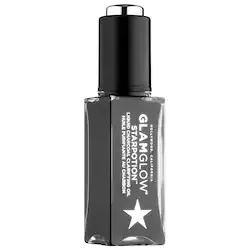
GLAMGLOW STARPOTION Liquid Charcoal Clarifying Oil
Works for
1 of 1 advertised claim delivered
MoisturizingHelianthus annuus seed oil, Argania spinosa kernel oil + 5 moreGood evidence
“What it is: A liquid charcoal magic potion that clarifies the complexion and protects skin from pollution with antioxidants while it nourishes.”
This product can help soften the skin and reduce its moisture loss with emollients and occlusives: helianthus annuus seed oil, argania spinosa kernel oil.
Keep in mind that this product does not contain effective ingredients to attract water to the upper layer of the skin. This is why an additional product with humectants like glycerin or hyaluronic acid can be helpful (apply it before this product for the best results).
ExfoliationNot advertised by the brand · Salicylic acidStrong evidence
This product can help exfoliate the skin. In other words, it helps break down the bonds between dead cells on the surface of the skin and speed up the skin turnover. Skin often appears softer and brighter after exfoliation, but overdoing it can result in disrupted skin barrier. The following ingredient is doing the exfoliating job in this product: salicylic acid.
Anti-blemishNot advertised by the brand · Salicylic acid, Rosmarinus officinalis leaf extractStrong evidence
This product can help reduce breakouts and clogged pores because it contains the following ingredient: salicylic acid. This ingredient is used for treating acne and can have a noticeable effect.
The following ingredient (ingredients) in this product might be helpful, but there is no evidence to confirm that it actually works: rosmarinus officinalis leaf extract
Can it cause trouble?
Irritancy6 strong irritants: Rosmarinus officinalis leaf extract, Citrus aurantium dulcis peel oil + 4 more — patch-test recommendedHigh risk
ComedogenicClean of flagged comedogenic ingredientsNone flagged


User reviews
Be the first — your take helps the next person decide.
Ingredients
Filter by role to see what each ingredient is doing.
Helianthus annuus seed oil~22–33%
- Irritation risk
- Low
A great emollient due to its high linoleic acid content. One of the most effective plant oils in helping skin hydration and repairing skin barrier function
More about Helianthus annuus seed oilHeptyl undecylenate~5.2–7.9%
- Irritation risk
- Medium
Helps soften the upper layer of the skin, reduce water loss from the skin surface over time and create a nice product finish
More about Heptyl undecylenateIsostearyl linoleate~4.6–7%
- Irritation risk
- Low
Dextrin palmitate~3.3–5%
- Irritation risk
- Medium
Helps water and oil mix together
More about Dextrin palmitateIsodecyl salicylate~2.7–4%
- Irritation risk
- Low
Charcoal powder~2.1–3.2%
Argania spinosa kernel oil~1.7–2.5%
- Irritation risk
- Medium
An emollient that helps soften the upper layer of the skin. Might have some weak anti-oxidant properties
More about Argania spinosa kernel oilCurcuma longa root extract~1.3–1.9%
- Irritation risk
- High
A plant extract that can contain an active compound curcumin, that may have some anti-inflammatory properties when applied to the skin, but solid research is lacking and the typical concentration used in skincare products is too low. Can be an irritant
More about Curcuma longa root extractSalicylic acid~0.85–1.3%
- Irritation risk
- High
Used for skin exfoliation. It has an anti-inflammatory and anti-bacterial effect, helps to unclog pores, prevent blemishes and speed up healing of the existing ones. Sometimes referred to as a BHA (beta-hydroxy acid)
More about Salicylic acidTetrahexyldecyl ascorbate~0.9–1.35%
- Irritation risk
- Medium
Being a lipid soluble form of vitamin C, it is more stable than ascorbic acid, but still degrades quickly and needs to be stabilized in a formulation with another ingredient. It is claimed to penetrate skin better than pure vitamin C and have the the similar benefits, but solid studies of its effectiveness are lacking. Is likely to require a higher concentration in a product than pure vitamin C to be effective. It might be able to help reduce pore clogging.
More about Tetrahexyldecyl ascorbateCalendula officinalis extract~0.55–1.3%
- Irritation risk
- High
A plant extract that might help neutralize free radicals in skin
More about Calendula officinalis extractRosmarinus officinalis leaf extract~0.45–1.05%
- Irritation risk
- High
Can be helpful in reducing inflammation in skin, including inflamed acne. It can be irritating
More about Rosmarinus officinalis leaf extractSesamum indicum seed oil~0.5–1.1%
- Irritation risk
- Low
A good moisturizing plant oil. Due to the high linoleic acid content, it helps soften the upper layer of the skin, reduce water loss and support skin barrier function
More about Sesamum indicum seed oilCitrus aurantium dulcis peel oil~0.4–0.95%
- Irritation risk
- High
An essentil oil from orange peel. Potential allergen and can be irritating
More about Citrus aurantium dulcis peel oilLavandula angustifolia oil~0.35–0.8%
- Irritation risk
- High
An essential oil. Potential allergen and can be irritating. It has some anti-bacterial properties
More about Lavandula angustifolia oilPelargonium graveolens flower oil~0.3–0.7%
- Irritation risk
- High
An essential oil. Can be irritating. Can become an allergen with oxidation
More about Pelargonium graveolens flower oilAloe barbadensis leaf extract~0.4–0.9%
- Irritation risk
- Medium
Traditionally used to treat sunburns, dermatitis and inflammation, but evidence for its effectiveness is lacking. The extract can contain humectants that help attract water into the skin
More about Aloe barbadensis leaf extractTocopherol~0.15–0.65%
- Irritation risk
- Low
Pure form of vitamin E. Can help moisturise and protect the skin from free radicals. Often used to help stabilise other ingredients or the formula itself
More about TocopherolBisabolol~0.15–0.5%
- Irritation risk
- Low
An active component of chamomile plant that historically has been used to calm down irritated skin. A recent study shows that bisabolol indeed can have some anti-inflammatory effect on skin, even though conclusive data is lacking. Bisabolol has a sweet floral scent and can be added to products for its aromatic properties
More about BisabololDiisopropyl adipate~0.2–0.7%
- Irritation risk
- Low
Helps soften the upper layer of the skin
More about Diisopropyl adipateLimonene~0.1–0.4%
- Irritation risk
- High
A common frangrance that can easily irritate skin, especially if exposed to air, light or heat
More about LimoneneLinalool~0.1–0.35%
Bht~0.05–0.25%
Ci 77499~0.05–0.3%
Ingredient list view
Helianthus annuus seed oil, Heptyl undecylenate, Isostearyl linoleate, Dextrin palmitate, Isodecyl salicylate, Charcoal powder, Argania spinosa kernel oil, Curcuma longa root extract, Salicylic acid, Tetrahexyldecyl ascorbate, Calendula officinalis extract, Rosmarinus officinalis leaf extract, Sesamum indicum seed oil, Citrus aurantium dulcis peel oil, Lavandula angustifolia oil, Pelargonium graveolens flower oil, Aloe barbadensis leaf extract, Tocopherol, Bisabolol, Diisopropyl adipate, Limonene, Linalool, Bht, Ci 77499
Compare prices
Retailers ranked by price — lowest first.
Affiliate links · prices updated regularly · As an Amazon Associate, WIMJ earns from qualifying purchases.
Worth comparing, line by line.
Match % combines shared ingredients, the first five ingredients, shared actives and hero ingredients, irritancy (lower counts in the alternative's favour), texture and body area. Only products in the same routine step are compared.
| GLAMGLOWSTARPOTION Liquid Charcoal Clarifying OilYOUR PRODUCT | UpCircle BeautyNight Cream with Blueberry Extract | Green PeopleSkin Day Solution Moisturiser | Brickell Men's ProductsAcne Controlling Face Moisturizer Treatment for Men | |
|---|---|---|---|---|
| Match | — | 68% | 66% | 63% |
| Price | — | $25.39 | $24.06 | $23.00 |
| Shared key ingredients | — | 2 of 7 | 3 of 7 | 2 of 7 |
| Key difference | — | Niacinamide | Butyrospermum Parkii Butter | Panthenol |
| Irritancy | High | Medium | High | High |
| Drying alcohol | — | — | — | — |
| View product | Shop | Shop | Shop |


Sources cited in this review
Every concentration estimate and effectiveness label is anchored to one of these 24 studies and safety reviews.
- 1
- 2
- 3Effect of topically applied lipids on surfactant-irritated skinonlinelibrary.wiley.com
- 4
- 5
- 6

Affiliate links · As an Amazon Associate, WIMJ earns from qualifying purchases.