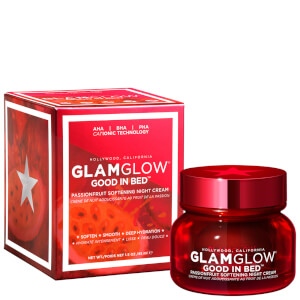
GLAMGLOW Good in Bed Night Cream
Works for
3 of 4 advertised claims delivered
Evens skin tone3 ingredients credited for this claimStrong support
“Dryness and Dullness and Uneven Texture Formulation.”
This product can help reduce hypepigmentation and even out the skin tone because it contains the following effective ingredients: glycolic acid
Keep in mind that you would need to apply any topical skincare targetted at hypigmentation consistently for a couple of months to get a result. No topical skincare product can help get rid of hyperpigmentation (including post-acne marks and age spots) instantly.
Exfoliation4 ingredients credited for this claimStrong support
“Treat your complexion to the GLAMGLOW Good in BedTM Night Cream; a skin-refining formula infused with exfoliating acids that work around the clock to promote a smoother, softer texture.”
This product can help exfoliate the skin. In other words, it helps break down the bonds between dead cells on the surface of the skin and speed up the skin turnover. Skin often appears softer and brighter after exfoliation, but overdoing it can result in disrupted skin barrier. The following ingredient is doing the exfoliating job in this product: glycolic acid.
Moisturizing17 ingredients credited for this claimGood support
“A blend of Passionfruit Oil and Hyaluronic Acid deliver plumping and hydrating properties to leave skin looking radiant and healthy with an even tone come morning.”
This product can help improve hydration of the skin with the two types of ingredients.
The first type is called “humectants”:
these ingredients help attract water.
When humectants are on the surface of the skin, they “pull in” the moisture from the outside environment, or from
within deeper layers of the skin. The following ingredients in this product do the job:
algae extract, biosaccharide gum-1.
This product also contains ingredients called “occlusives”. They help reduce the speed with which our skin loses moisture to the outside environment. These ingredients also help soften the upper layer of the skin, so it feels less tight and nicer to the touch. The following ingredients in this product do the job: simmondsia chinensis seed oil, squalane.
Anti-blemish3 ingredients credited for this claimLimited support
“Nourishes. . AHA/BHA/PHA Acids.”
This product contains ingredients (glycolic acid) that could help reduce blemishes and clogged pores in theory, but there is not enough evidence that they actually work.
Anti-agingNot advertised by the brand · 5 ingredients credited for this claimStrong support
This product can help reduce and prevent fine lines and wrinkles, improve skin elasticity and firmness because it contains glycolic acid.
Keep in mind that it typically takes at least 6 weeks to notice any results because the changes that are needed to improve fine lines and elasticity happen in the deeper layers of the skin. No topical anti-aging product can “erase” wrinkles or fully reverse signs of aging.
Anti-oxidationNot advertised by the brand · 6 ingredients credited for this claimModerate support
This product contains antioxidants (tartaric acid) that might be able to help neutralize free radicals in skin to lessen the damage it gets from the UV light (sun). There is not enough evidence to confirm their effectiveness in skin though.
Can it cause trouble?
Irritancy3 strong irritants: Parfum, Limonene + 1 more — patch-test recommendedHigh risk
Comedogenic4 ingredients rated 2 or more on the 0–5 pore-clogging scale4 flagged


User reviews
Be the first — your take helps the next person decide.
Ingredients
Filter by role to see what each ingredient is doing.
Water~45–55%
Simmondsia chinensis seed oil~5.9–7.2%
- Irritation risk
- Medium
Softens the upper layer of skin and helps restore the healthy skin barrier. Has shown to help calm down inflammation in skin. It is a stable oil, meaning that it retains its properties even when exposed to air.
More about Simmondsia chinensis seed oilGlycolic acid~4.1–5%
- Irritation risk
- High
An alpha-hydroxy acid (AHA) that helps to remove the dead skin cells on the surface of the skin reveling a more even, smoother complexation. It is also able to stimulate collagen production with long-term use. Could help to reduce pore congestion. It can be irritating to the skin. Apply sunscreen daily if using products with glycolic acid
More about Glycolic acidButylene glycol~3–3.6%
- Irritation risk
- Low
Used to create a nice product texture and help delivery of other ingredients. Might be somewhat helpful in attracting water to the upper layer of the skin
More about Butylene glycolPersea gratissima oil~2.4–2.9%
- Irritation risk
- Medium
An emollient that helps soften the skin and could be helpful in repairing its barrier function
More about Persea gratissima oilGlycerin~2–2.4%
- Irritation risk
- Low
One of the best moisturizing ingredients. Naturally present in skin. It attracts water to the upper layer of the skin working as a humectant
More about GlycerinCetearyl alcohol~1.6–2%
- Irritation risk
- Low
- Comedogenicity
- 2/5
A non-drying alcohol. Works as an emollient. Helps water and oil mix together and creates a nice product texture
More about Cetearyl alcoholButyrospermum parkii oil~1.4–1.8%
- Irritation risk
- Low
- Comedogenicity
- 3/5
Peg-150 distearate~1.2–1.4%
- Irritation risk
- Medium
Helps oil and water mix together
More about Peg-150 distearatePolyquaternium-37~1–1.3%
- Irritation risk
- Low
Helps soften the upper layer of the skin and create a nice product finish
More about Polyquaternium-37Sodium hydroxide~0.7–1.05%
Passiflora edulis seed oil~0.65–0.95%
- Irritation risk
- High
A good emollient helping to soften the skin. Might have some anti-oxidant properties. Adds a fragrance to the product
More about Passiflora edulis seed oilCitric acid~0.55–0.8%
- Irritation risk
- Medium
Can work as an exfoliant but is typically used to adjust the product pH
More about Citric acidTartaric acid~0.5–0.8%
- Irritation risk
- Medium
An AHA (alpha-hydroxy acid). It oxidizes quickly which makes it less effective in skincare formulations. It can support skin's barrier and moisture levels
More about Tartaric acidLactic acid~0.45–0.7%
- Irritation risk
- Medium
An exfoliating and moisturizing alpha-hydroxy acid (AHA). Typically causes less irritation than other AHAs, for example, glycolic acid. At high concentrations (about 15%), lactic acid can help reduce lines and wrinkles. Recent studies show that lactic acid can support the "good" bacteria living on skin's surface (healthy skin microbiome)
More about Lactic acidSalicylic acid~0.45–0.7%
- Irritation risk
- High
Used for skin exfoliation. It has an anti-inflammatory and anti-bacterial effect, helps to unclog pores, prevent blemishes and speed up healing of the existing ones. Sometimes referred to as a BHA (beta-hydroxy acid)
More about Salicylic acidSodium hyaluronate~0.45–0.7%
- Irritation risk
- Low
One of the best moisturizing ingredients. Attracts water into the upper layer of the skin
More about Sodium hyaluronateSqualane~0.5–0.75%
- Irritation risk
- Low
An oil naturally present in skin. Works as an emollient to soften the skin and form a protective layer on its surface without a greasy feeling.
More about SqualaneHordeum vulgare extract~0.45–0.65%
- Irritation risk
- Medium
A plant extract that might have some anti-oxidant properties. Avoid if you are sensitive to gluten
More about Hordeum vulgare extractTriticum vulgare germ extract~0.35–0.65%
- Irritation risk
- Medium
- Comedogenicity
- 3/5
Plant extract that might have moisturizing properties. Avoid if you suffer from wheat or gluten intolerance
More about Triticum vulgare germ extractAloe barbadensis leaf juice~0.3–0.55%
- Irritation risk
- Medium
Traditionally used to treat sunburns, dermatitis and inflammation, but evidence for its effectiveness is lacking. The extract can contain humectants that help attract water into the skin
More about Aloe barbadensis leaf juiceAlgae extract~0.35–0.65%
- Irritation risk
- Low
- Comedogenicity
- 3/5
Plant extract that helps the skin to attract water and make it more smooth for touch. Also shows promise of anti-aging properties, but research is not extensive yet
More about Algae extractTocopheryl acetate~0.25–0.5%
- Irritation risk
- Medium
A more stable but less bio-available form of vitamin E compared to Tocopherol. Might help moisturize and protect the skin from free radicals, but mostly used in low concentrations to stabilize other ingredients.
More about Tocopheryl acetateCaffeine~0.25–0.45%
- Irritation risk
- Medium
Might be helpful in neutralizing free radicals. Can have a dehydration effect that might somewhat decrease the look of puffy eyes
More about CaffeineSucrose~0.2–0.4%
- Irritation risk
- Low
Can help attract water to the upper layer of the skin. In crystal form, it can work as a gentle exfoliant, gentler than the salt scrub. Helps stabilize the emulsion
More about SucroseBiosaccharide gum-1~0.2–0.4%
- Irritation risk
- Low
Helps attract water to the upper layer of the skin and is claimed to provide a longer-lasting hydration because of its ability to create a water-binding film on the surface of the skin
More about Biosaccharide gum-1Pantethine~0.25–0.45%
- Irritation risk
- Low
Helps to hydrate the skin by improving its barrier funciton
More about PantethineXanthan gum~0.2–0.35%
- Irritation risk
- Low
Used to create a thicker product consistency
More about Xanthan gumParfum~0.1–0.25%
- Irritation risk
- High
An aromatic blend of unspecified and possibly irritating ingredients
More about ParfumLimonene~0.1–0.2%
- Irritation risk
- High
A common frangrance that can easily irritate skin, especially if exposed to air, light or heat
More about LimoneneLinalool~0.1–0.2%
Phenoxyethanol~0.1–0.2%
- Irritation risk
- Low
A preservative. It helps prevent bacterial growth in cosmetic products
More about PhenoxyethanolCi 19140~0.05–0.1%
Ci 15985~0.05–0.1%
Ingredient list view
Water, Simmondsia chinensis seed oil, Glycolic acid, Butylene glycol, Persea gratissima oil, Glycerin, Cetearyl alcohol, Butyrospermum parkii oil, Peg-150 distearate, Polyquaternium-37, Sodium hydroxide, Passiflora edulis seed oil, Citric acid, Tartaric acid, Lactic acid, Salicylic acid, Sodium hyaluronate, Squalane, Hordeum vulgare extract, Triticum vulgare germ extract, Aloe barbadensis leaf juice, Algae extract, Tocopheryl acetate, Caffeine, Sucrose, Biosaccharide gum-1, Pantethine, Xanthan gum, Parfum, Limonene, Linalool, Phenoxyethanol, Ci 19140, Ci 15985
Compare prices
Retailers ranked by price — lowest first.

Worth comparing, line by line.
Match % combines shared ingredients, the first five ingredients, shared actives and hero ingredients, irritancy (lower counts in the alternative's favour), texture and body area. Only products in the same routine step are compared.
| GLAMGLOWGood in Bed Night CreamYOUR PRODUCT | Paula's choiceResist Advanced Smoothing Treatment 10% AHA | EmerginCTriple-Threat Peel | Beauty DropsAHA 30% + BHA 2% Peeling | |
|---|---|---|---|---|
| Match | — | 84% | 83% | 82% |
| Price | $13.50 | $29.60+$16.10 | $122.95+$109.45 | — |
| Shared key ingredients | — | 5 of 16 | 4 of 16 | 5 of 16 |
| Key difference | — | Adenosine | Retinol | Panthenol |
| Irritancy | High | Medium | Medium | Medium |
| Drying alcohol | — | — | — | — |
| View product | Shop | Shop | Shop |


Sources cited in this review
Every concentration estimate and effectiveness label is anchored to one of these 20 studies and safety reviews.
- 1
- 2Glycolic acid peel therapy – a current reviewncbi.nlm.nih.gov
- 3
- 4
- 5
- 6Method of treating wrinkles using tartaric acidpatents.google.com

Affiliate links · As an Amazon Associate, WIMJ earns from qualifying purchases.