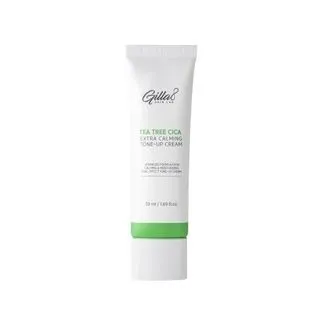
gilla8 Tea Tree Cica Extra Calming Tone Up Cream
Works for
Sun protectionSPF 50 · 1 UV filter · Partial spectrumWeak protectionLow filter dose
This product does not offer good protection against UVA rays.
This product can be considered "reef safe" because it does not contain the UV filters (oxybenzone and octinoxate) that can be harmful to coral reefs when present in the water in high concentrations.
Anti-oxidationSide benefit · Centella asiatica extract, Madecassoside + 6 moreWorks well
This product contains antioxidants (asiaticoside, madecassoside) that can help neutralize free radicals in skin. By doing so, they can lessen the damage the skin gets from the UV light (sun).
The following ingredients - centella asiatica extract also can have an antioxidant effect, but there is less evidence to confirm their effectiveness in skin.
MoisturizingSide benefit the brand mentions · Madecassoside, Glycerin + 15 moreWorks well
“Kill two birds in one stone with this tone-up cream which also offers SPF 50+ PA++++ sun protection plus soothing effect from tea tree extract, cica extract and hyaluronic acid.”
This product contains good ingredients to attract water to the upper layer of the skin. These ingredients are called "humectants": glycerin, hydrolyzed hyaluronic acid.
When humectants are on the surface of the skin, they “pull in” the moisture from the outside environment, or from within deeper layers of the skin. If the air is dry, humectants can speed up the moisture loss from the skin. This is why it is a good idea to use another product on top of this one to help "seal in" the moisture (look for ingredients like dimethicone, squalane, oils and butters).
The following ingredients in this product are especially good for supporting the skin barrier and helping with the hydration level: madecassoside
Anti-agingSide benefit · Centella asiatica extract, Madecassoside + 1 moreMay help
This product contains asiaticoside, centella asiatica extract, madecassoside. There is some human evidence that these ingredients help reduce and prevent fine lines and wrinkles and improve skin elasticity and firmness, though it is smaller or less consistent than the evidence for the best anti-aging ingredients. The biggest anti-aging effect in this product comes from sun protection. Sun damage is the main factor causing early signs of skin aging. We, however, do not recommend using this product as a sunscreen because the protection it offers is not strong enough).
Can it cause trouble?
Irritancy2 strong irritants: Melaleuca alternifolia leaf oil, Ocimum sanctum leaf extractMedium risk
Comedogenic1 ingredient rated 2 or more on the 0–5 pore-clogging scale1 flagged

User reviews
Be the first — your take helps the next person decide.
Ingredients
Filter by role to see what each ingredient is doing.
Water~45–55%
Butylene glycol~7–8.5%
- Irritation risk
- Low
Used to create a nice product texture and help delivery of other ingredients. Might be somewhat helpful in attracting water to the upper layer of the skin
More about Butylene glycolGlycerin~4.5–5.5%
- Irritation risk
- Low
One of the best moisturizing ingredients. Naturally present in skin. It attracts water to the upper layer of the skin working as a humectant
More about GlycerinDicaprylyl carbonate~3.2–3.9%
- Irritation risk
- Low
Helps products spread more easily and works as an emollient to soften skin
More about Dicaprylyl carbonateTitanium dioxide~3.2–3.9%
- Irritation risk
- Low
Works as a UV filter when used in high concentrations. It is photostable and is effective mostly against the UVB light, with some protection in the UVA range. In small concentrations, used for its ability to improve the color of cosmetic products. Is usually well tolerated by the skin
More about Titanium dioxide1,2-hexanediol~0.75–1.1%
Ethylhexyl olivate~1.6–2%
- Irritation risk
- Low
Helps soften the upper layer of the skin
More about Ethylhexyl olivateCentella asiatica extract~1.3–1.6%
- Irritation risk
- Medium
A plant extract that has been shown to be able to reduce inflammation in skin, support restoration of skin barrier function, as well as support collagen production. Contains active compounds called centelloids: asiaticoside, madecasosside, asiatic acid and madecassic acid. Might be helpful in preventing stretch marks. It can be itself be irritating though.
More about Centella asiatica extractCaprylyl methicone~1.1–1.4%
- Irritation risk
- Low
A type of silicone that helps to soften the upper layer of the skin and create a nice product finish on the skin
More about Caprylyl methiconeSodium acrylates copolymer~1–1.2%
- Irritation risk
- Medium
Used to create a thicker product consistency
More about Sodium acrylates copolymerOleic/linoleic/linolenic polyglycerides~0.7–1.1%
- Irritation risk
- Low
Helps soften the upper layer of the skin
More about Oleic/linoleic/linolenic polyglyceridesPolyglyceryl-4 oleate~0.6–0.9%
- Irritation risk
- Medium
Helps oil and water mix together
More about Polyglyceryl-4 oleateAluminum hydroxide~0.6–0.9%
- Irritation risk
- Low
Is used to add opaque (non-transparent) appearance to formulations. Can be used to coat other ingredients for even dispersion. This is a different ingredient compared to the ones used in antipersperants (aluminium chloride and aluminium chlorohydrate)
More about Aluminum hydroxideMelaleuca alternifolia leaf oil~0.45–0.7%
- Irritation risk
- High
An essential oil that can be irritating. Has some anti-bacterial properties
More about Melaleuca alternifolia leaf oilMelia azadirachta branch/leaf extract~0.45–0.7%
- Irritation risk
- Low
Triethoxycaprylylsilane~0.45–0.65%
- Irritation risk
- Low
A type of silicone that helps oil and water mix well together. Helps to disperse other ingredients, e.g. pigments, evenly in a formulation
More about TriethoxycaprylylsilaneMelia azadirachta flower extract~0.4–0.6%
- Irritation risk
- Medium
A plant extract that might be helpful to neutralize free radicals in skin
More about Melia azadirachta flower extractTriethoxysilylethyl polydimethylsiloxyethyl hexyl dimethicone~0.35–0.6%
- Irritation risk
- Low
Disodium edta~0.3–0.6%
Coccinia indica fruit extract~0.3–0.55%
- Irritation risk
- Medium
A plant extract that might have some anti-oxidant effect helping neutralize free radicals in skin
More about Coccinia indica fruit extractSodium hyaluronate~0.3–0.5%
- Irritation risk
- Low
One of the best moisturizing ingredients. Attracts water into the upper layer of the skin
More about Sodium hyaluronateMelaleuca alternifolia (tea tree) extract~0.3–0.55%
- Irritation risk
- Low
Cucurbita pepo powder~0.25–0.45%
- Irritation risk
- Low
Solanum melongena fruit extract~0.25–0.45%
- Irritation risk
- Medium
Eggplant fruit extract. Might have some anti-oxidant effect
More about Solanum melongena fruit extractOcimum sanctum leaf extract~0.25–0.5%
- Irritation risk
- High
A plant extract that is rich in a fragrance compound eugenol that is a frequent allergen and can be irritating. It might also contain anti-oxidants to help neutralize free radicals
More about Ocimum sanctum leaf extractCurcuma longa root extract~0.25–0.5%
- Irritation risk
- High
A plant extract that can contain an active compound curcumin, that may have some anti-inflammatory properties when applied to the skin, but solid research is lacking and the typical concentration used in skincare products is too low. Can be an irritant
More about Curcuma longa root extractMoringa oleifera seed oil~0.3–0.55%
- Irritation risk
- Medium
A plant oil that helps soften the upper layer of the skin. Is unlikely to be helpful in restoring skin barrier function due to the low content of linoleic acid
More about Moringa oleifera seed oilCorallina officinalis extract~0.3–0.55%
- Irritation risk
- Low
- Comedogenicity
- 3/5
Red algae extract that helps attract water to the upper layer of the skin and might contain antioxidants
More about Corallina officinalis extractAsiaticoside~0.25–0.45%
- Irritation risk
- Medium
An active compound of Centella Asiatica plant extract. In combination with other active compounds of Centella Asiatica extract (madecasosside, asiatic acid and madecassic acid), asiaticoside has been shown to be helpful in wound-healing, restoring skin barrier function and supporting collagen production in skin. It can, however, itself be irritating
More about AsiaticosideAsiatic acid~0.3–0.55%
- Irritation risk
- Medium
An active compound of Centella Asiatica plant extract. In combination with other active compounds of Centella Asiatica extract (asiaticoside, madecasosside and madecassic acid) asiatic acid has been shown to be helpful in wound-healing, restoring skin barrier function and supporting collagen production in skin. It can, however, itself be irritating
More about Asiatic acidMadecassic acid~0.3–0.5%
- Irritation risk
- Medium
An active compound of Centella Asiatica plant extract. In combination with other active compounds of Centella Asiatica extract (asiaticoside, madecasosside and asiatic acid), madecassic acid has been shown to be helpful in wound-healing, restoring skin barrier function and supporting collagen production in skin. It can, however, itself be irritating
More about Madecassic acidHydrolyzed hyaluronic acid~0.25–0.5%
- Irritation risk
- Low
One of the best moisturizing ingredients. Attracts water into the upper layer of the skin. A version of it is naturally present in skin
More about Hydrolyzed hyaluronic acidCaprylic/capric triglyceride~0.3–0.6%
- Irritation risk
- Medium
A good mix of fatty acids that forms a protective layer on the skin. Improves the shelf life of products. Derived from coconut and glycerin
More about Caprylic/capric triglycerideMadecassoside~0.25–0.45%
- Irritation risk
- Medium
An antioxidant that is typically derived from plant Centella Asiatica. It can help neutralize free radicals in skin and support skin barrier function. It could, however, itself be irritating. It is often unstable in formulations
More about MadecassosideHydrogenated lecithin~0.2–0.4%
- Irritation risk
- Low
Helps to retain moisture by creating a protective barrier on the skin. Rich in fatty acids. Improves product texture and helps with the penetration of other ingredients.
More about Hydrogenated lecithinSodium acetylated hyaluronate~0.2–0.35%
- Irritation risk
- Low
A type of hyaluronic acid that works as an excellent moisturizer by attracting water into the upper layer of the skin. Is typically feels less sticky on the skin compared to the usual hyaluronic acid
More about Sodium acetylated hyaluronateIngredient list view
Water, Butylene glycol, Glycerin, Dicaprylyl carbonate, Titanium dioxide, 1,2-hexanediol, Ethylhexyl olivate, Centella asiatica extract, Caprylyl methicone, Sodium acrylates copolymer, Oleic/linoleic/linolenic polyglycerides, Polyglyceryl-4 oleate, Aluminum hydroxide, Melaleuca alternifolia leaf oil, Melia azadirachta branch/leaf extract, Triethoxycaprylylsilane, Melia azadirachta flower extract, Triethoxysilylethyl polydimethylsiloxyethyl hexyl dimethicone, Disodium edta, Coccinia indica fruit extract, Sodium hyaluronate, Melaleuca alternifolia (tea tree) extract, Cucurbita pepo powder, Solanum melongena fruit extract, Ocimum sanctum leaf extract, Curcuma longa root extract, Moringa oleifera seed oil, Corallina officinalis extract, Asiaticoside, Asiatic acid, Madecassic acid, Hydrolyzed hyaluronic acid, Caprylic/capric triglyceride, Madecassoside, Hydrogenated lecithin, Sodium acetylated hyaluronate, Unknown
Compare prices
Retailers ranked by price — lowest first.

Worth comparing, line by line.
Match % combines shared ingredients, the first five ingredients, shared actives and hero ingredients, irritancy (lower counts in the alternative's favour), texture and body area. Only products in the same routine step are compared.
| gilla8Tea Tree Cica Extra Calming Tone Up CreamYOUR PRODUCT | innisfreeDaily UV Mineral Korean Sunscreen SPF 45 with Hyaluronic Acid for Face & Body | Dr. AltheaGreen Tea Fresh Sunscreen | Purito SEOULComfy Water Sun Block | |
|---|---|---|---|---|
| Match | — | 60% | 57% | 56% |
| Price | — | $22.00 | $17.33 | — |
| Shared key ingredients | — | 8 of 13 | 6 of 13 | 6 of 13 |
| Key difference | — | Niacinamide | Niacinamide | Niacinamide |
| Irritancy | Medium | Low | Low | Low |
| SPF | SPF 50 | SPF 45 | SPF 50 | SPF 50 |
| Drying alcohol | — | — | — | — |
| View product | Shop | Shop | Shop |

More alternatives: Ottie Water Barrier SunscreenDr. Jart+ Cicapair Soothing Color Correcting Treatment SPF 30 with Centella Asiatica Extracts
Product summary
We do not recommend "gilla8 - Tea Tree Cica Extra Calming Tone Up Cream" because it does not provide good UVA protection. UVA sun rays don't burn the skin, but they still lead to photoaging and hyperpigmentation.
It also works as a moisturizer, so you do not have to use an additional hydrating product.
Sunscreen filters
This moisturizer is a mineral sunscreen. It uses titanium dioxide for sun protection. Titanium dioxide almost never irritates the skin or stings eyes, but it can leave a white cast.
Irritation risk
There are some common irritants in this product, including ingredients that do not have benefits for the skin. We assess the overall irritancy of this moisturizer to be medium. For a detailed overview of all potential irritants: click here
You can see the detailed formula review with the breakdown of all actives in the product and the full ingredient list with estimated concentrations in the tables below.
Price
The product retails for 17.20$ in the United States.
For a detailed price comparison: click here.
Sources cited in this review
Every concentration estimate and effectiveness label is anchored to one of these 28 studies and safety reviews.
- 1
- 2
- 3
- 4Centella asiatica in cosmetologyncbi.nlm.nih.gov
- 5
- 6

Affiliate links · As an Amazon Associate, WIMJ earns from qualifying purchases.