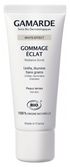
Gamarde Organic White Effect Radiance Scrub
Works for
0 of 2 advertised claims delivered
Evens skin toneGlycyrrhiza glabra root extractLimited evidence
“This scrub illuminates the complezxion of dull skins and/or dark spots, thanks to GWE lightening complex which diminishes the production of Melanin reponsible of dark spots and vegetable cellulose that exfoliates in gentleness without assault.”
This product contains ingredients (glycyrrhiza glabra root extract) that could help reduce hyperpigmentation (for example, post-acne marks or age spots) in theory, but there is not enough evidence that they actually work.
ExfoliationNo ingredient credited for this claimNo evidence
“Organic White Effect Radiance Scrub”
This product does not contain effective exfoliating ingredients. It might be able to deliver physical exfoliation, that is scrub off some of the dead cells on the surface of the skin. We do not recommend physical exfoliation, because it is not uniform (some bits of skin can get exfoliated too much while others not at all). It can also traumatize the skin and aggrevate acne and other skin conditions.
MoisturizingNot advertised by the brand · Helianthus annuus seed oil, Glycerin + 8 moreGood evidence
This product can help improve hydration of the skin with the two types of ingredients.
The first type is called “humectants”:
these ingredients help attract water.
When humectants are on the surface of the skin, they “pull in” the moisture from the outside environment, or from
within deeper layers of the skin. The following ingredients in this product do the job:
glycerin.
This product also contains ingredients called “occlusives”. They help reduce the speed with which our skin loses moisture to the outside environment. These ingredients also help soften the upper layer of the skin, so it feels less tight and nicer to the touch. The following ingredients in this product do the job: helianthus annuus seed oil, glycine soja oil.
Anti-oxidationNot advertised by the brand · Malpighia punicifolia fruit extract, Daucus carota sativa seed oil + 5 moreModerate evidence
This product contains antioxidants (malpighia punicifolia fruit extract) that might be able to help neutralize free radicals in skin to lessen the damage it gets from the UV light (sun). There is not enough evidence to confirm their effectiveness in skin though.
Can it cause trouble?
Irritancy15 strong irritants: Parfum, Citrus aurantium amara leaf/twig oil + 13 more — patch-test recommendedHigh risk
Comedogenic2 ingredients rated 2 or more on the 0–5 pore-clogging scale2 flagged
User reviews
Be the first — your take helps the next person decide.
Ingredients
Filter by role to see what each ingredient is doing.
Water~40–60%
Cellulose~3.6–5.4%
- Irritation risk
- Low
Can be used to help absorb oil as well as add volume and imporve texture of products.
More about CelluloseCoco-caprylate/caprate~3.5–5.3%
- Irritation risk
- Low
Helps to soften the upper layer of the skin without creating a greasy texture
More about Coco-caprylate/caprateHelianthus annuus seed oil~2.8–4.1%
- Irritation risk
- Low
A great emollient due to its high linoleic acid content. One of the most effective plant oils in helping skin hydration and repairing skin barrier function
More about Helianthus annuus seed oilArctostaphylos uva-ursi leaf extract~2–3%
- Irritation risk
- Low
Sucrose distearate~1.7–2.6%
Parfum~1.4–2%
- Irritation risk
- High
An aromatic blend of unspecified and possibly irritating ingredients
More about ParfumGlycerin~1.3–2%
- Irritation risk
- Low
One of the best moisturizing ingredients. Naturally present in skin. It attracts water to the upper layer of the skin working as a humectant
More about GlycerinElaeis guineensis oil~1.1–1.6%
- Irritation risk
- Low
Helps soften the upper layer of the skin
More about Elaeis guineensis oilSucrose stearate~0.85–1.3%
Cetearyl alcohol~0.55–1.3%
- Irritation risk
- Low
- Comedogenicity
- 2/5
A non-drying alcohol. Works as an emollient. Helps water and oil mix together and creates a nice product texture
More about Cetearyl alcoholWater~0.4–0.9%
Glycyrrhiza glabra root extract~0.15–0.65%
- Irritation risk
- Medium
A plant extract that can help lighten the skin and calm down inflammation. Might be helpful in neutralizing free radicals
More about Glycyrrhiza glabra root extractGlyceryl stearate citrate~0.35–0.8%
- Irritation risk
- Low
Helps oil and water mix together while softening the upper layer of the skin
More about Glyceryl stearate citrateGlycine soja oil~0.2–0.8%
- Irritation risk
- Medium
- Comedogenicity
- 2/5
A good emollient that helps soften the skin and helps repair its barrier function. It can clog pores if used in high concentrations.
More about Glycine soja oilArgania spinosa kernel oil~0.2–0.8%
- Irritation risk
- Medium
An emollient that helps soften the upper layer of the skin. Might have some weak anti-oxidant properties
More about Argania spinosa kernel oilGlyceryl caprylate~0.3–0.7%
- Irritation risk
- Low
An emollient that can also help water and oil mix together, as well as prevent bacteria growth in products
More about Glyceryl caprylateMalpighia punicifolia fruit extract~0.15–0.65%
- Irritation risk
- Low
A fruit extract that might help neutralize free radicals. The concentrations typically used in cosmetics are too small to have an effect
More about Malpighia punicifolia fruit extractMaltodextrin~0.15–0.6%
- Irritation risk
- Low
Used to stabilize the product formulation and can help absorb oil
More about MaltodextrinTocopherol~0.15–0.55%
- Irritation risk
- Low
Pure form of vitamin E. Can help moisturise and protect the skin from free radicals. Often used to help stabilise other ingredients or the formula itself
More about TocopherolBisabolol~0.1–0.45%
- Irritation risk
- Low
An active component of chamomile plant that historically has been used to calm down irritated skin. A recent study shows that bisabolol indeed can have some anti-inflammatory effect on skin, even though conclusive data is lacking. Bisabolol has a sweet floral scent and can be added to products for its aromatic properties
More about BisabololCitrus aurantium amara leaf/twig oil~0.1–0.45%
- Irritation risk
- High
Pelargonium graveolens flower oil~0.1–0.4%
- Irritation risk
- High
An essential oil. Can be irritating. Can become an allergen with oxidation
More about Pelargonium graveolens flower oilLavandula hybrida oil~0.1–0.4%
- Irritation risk
- High
Plant extract that can be irritating and is a known allergen
More about Lavandula hybrida oilCymbopogon martini oil~0.1–0.35%
- Irritation risk
- High
Aromatic plant oil used in cosmetics as a fragrance. A likely irritant
More about Cymbopogon martini oilAchillea millefolium oil~0.1–0.45%
Carum petroselinum seed oil~0.1–0.3%
- Irritation risk
- Low
Cinnamomum camphora bark oil~0.1–0.3%
- Irritation risk
- High
Gaultheria procumbens leaf oil~0.05–0.3%
Daucus carota sativa seed oil~0.1–0.45%
- Irritation risk
- Low
A plant oil that might help neutralize free radicals and have an anti-bacterial effect
More about Daucus carota sativa seed oilApium graveolens seed oil~0.1–0.35%
- Irritation risk
- Low
Ocimum basilicum oil~0.1–0.4%
Xanthan gum~0.1–0.45%
- Irritation risk
- Low
Used to create a thicker product consistency
More about Xanthan gumCitric acid~0.1–0.35%
- Irritation risk
- Medium
Can work as an exfoliant but is typically used to adjust the product pH
More about Citric acidCitral~0.1–0.3%
Citronellol~0.05–0.3%
Farnesol~0.05–0.3%
Geraniol~0.05–0.2%
Limonene~0.05–0.15%
- Irritation risk
- High
A common frangrance that can easily irritate skin, especially if exposed to air, light or heat
More about LimoneneLinalool~0.05–0.15%
Ingredient list view
Water, Cellulose, Coco-caprylate/caprate, Helianthus annuus seed oil, Arctostaphylos uva-ursi leaf extract, Sucrose distearate, Parfum, Glycerin, Elaeis guineensis oil, Sucrose stearate, Cetearyl alcohol, Water, Glycyrrhiza glabra root extract, Glyceryl stearate citrate, Glycine soja oil, Argania spinosa kernel oil, Glyceryl caprylate, Malpighia punicifolia fruit extract, Maltodextrin, Tocopherol, Bisabolol, Citrus aurantium amara leaf/twig oil, Pelargonium graveolens flower oil, Lavandula hybrida oil, Cymbopogon martini oil, Achillea millefolium oil, Carum petroselinum seed oil, Cinnamomum camphora bark oil, Gaultheria procumbens leaf oil, Daucus carota sativa seed oil, Apium graveolens seed oil, Ocimum basilicum oil, Xanthan gum, Citric acid, Citral, Citronellol, Farnesol, Geraniol, Limonene, Linalool
Compare prices
Retailers ranked by price — lowest first.
Affiliate links · prices updated regularly · As an Amazon Associate, WIMJ earns from qualifying purchases.
Sources cited in this review
Every concentration estimate and effectiveness label is anchored to one of these 16 studies and safety reviews.
- 1Safety Assessment of Alkyl Esters as Used in Cosmeticscir-safety.org
- 2
- 3
- 4Effect of topically applied lipids on surfactant-irritated skinonlinelibrary.wiley.com
- 5
- 6

Affiliate links · As an Amazon Associate, WIMJ earns from qualifying purchases.