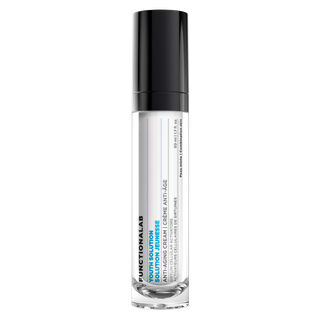
Works for
1 of 2 advertised claims delivered
Moisturizing10-hydroxydecanoic acid, Glycerin + 11 moreGood evidence
“Youth Solution Cream”
This product can help improve hydration of the skin with the two types of ingredients.
The first type is called “humectants”:
these ingredients help attract water.
When humectants are on the surface of the skin, they “pull in” the moisture from the outside environment, or from
within deeper layers of the skin. The following ingredients in this product do the job:
glycerin, hydrolyzed soy protein.
This product also contains ingredients called “occlusives”. They help reduce the speed with which our skin loses moisture to the outside environment. These ingredients also help soften the upper layer of the skin, so it feels less tight and nicer to the touch. The following ingredients in this product do the job: myristyl myristate, ricinus communis seed oil.
Anti-agingTRIPEPTIDE-3Weak evidence
“Specially formulated with innovative sirtuin cellular activators—sophisticated proteins that extend the lifespan of cellular DNA by re-energizing skin cell metabolism to protect against early signs of aging—it detoxifies the skin’s surface and promotes repair from within by stimulating production of collagen and elastin and improving hydration.”
Effective ingredients missing or their concentration is too low.
Can it cause trouble?
Irritancy7 strong irritants: Citrus aurantium dulcis peel oil, Citrus nobilis peel oil + 5 more — patch-test recommendedHigh risk
Comedogenic4 ingredients rated 2 or more on the 0–5 pore-clogging scale4 flagged
User reviews
Be the first — your take helps the next person decide.
Ingredients
Filter by role to see what each ingredient is doing.
Water~45–55%
Glycerin~4.6–5.7%
- Irritation risk
- Low
One of the best moisturizing ingredients. Naturally present in skin. It attracts water to the upper layer of the skin working as a humectant
More about GlycerinIsodecyl neopentanoate~4.2–5.1%
- Irritation risk
- Low
An emollient that helps soften the skin. It also forms a protective on its surface to reduce water loss.
More about Isodecyl neopentanoateGlyceryl dilaurate~2.8–3.4%
- Irritation risk
- Medium
Helps oil and water mix together
More about Glyceryl dilaurateOctyldodecyl stearate~2.3–2.9%
- Irritation risk
- Low
Helps soften the upper layer of the skin
More about Octyldodecyl stearateMyristyl myristate~2–2.4%
- Irritation risk
- Medium
- Comedogenicity
- 3/5
An emollient. Is not recommended for acne-prone skin as it can be comedogenic
More about Myristyl myristateCetearyl alcohol~1.6–2%
- Irritation risk
- Low
- Comedogenicity
- 2/5
A non-drying alcohol. Works as an emollient. Helps water and oil mix together and creates a nice product texture
More about Cetearyl alcoholGlyceryl stearate~1.5–1.8%
- Irritation risk
- Low
An emollient that softens the skin and forms a protective layer on its surface. Helps water and oil mix together
More about Glyceryl stearatePotassium olivoyl hydrolyzed oat protein~1.2–1.5%
Hydrolyzed soy protein~0.9–1.1%
- Irritation risk
- Low
Helps attract water to the upper layer of the skin. Might have some anti-aging, anti-oxidant, and skin lightening properties, but solid evidence is missing
More about Hydrolyzed soy proteinOryza sativa extract~0.7–1.1%
- Irritation risk
- Low
A grain extract that helps to create a thicker product consistency. It might have some anti-oxidant properties and help attract water to the upper layer of the skin
More about Oryza sativa extractDimer tripeptide-43~0.55–0.8%
- Irritation risk
- Low
Tetrapeptide-26~0.45–0.7%
- Irritation risk
- Low
Butylene glycol~0.45–0.65%
- Irritation risk
- Low
Used to create a nice product texture and help delivery of other ingredients. Might be somewhat helpful in attracting water to the upper layer of the skin
More about Butylene glycolPolyacrylamide~0.45–0.65%
- Irritation risk
- Medium
Used to improve product texture and help oil and water mix together
More about PolyacrylamideMyristyl laurate~0.4–0.6%
C13-14 isoparaffin~0.4–0.65%
- Irritation risk
- Low
Helps soften the upper layer of the skin, dissolve other ingredients and create a thicker product consistency
More about C13-14 isoparaffinCaprylyl glycol~0.35–0.6%
- Irritation risk
- Medium
Helps preserve products and creates a nice product texture
More about Caprylyl glycolGlyceryl oleate~0.3–0.55%
- Irritation risk
- High
Helps oil and water mix together. Can be irritating
More about Glyceryl oleateAcrylates/c10-30 alkyl acrylate crosspolymer~0.3–0.5%
- Irritation risk
- Medium
Maintains the texture of skincare products. Allows the product to spread evenly. Helps oil and water mix together
More about Acrylates/c10-30 alkyl acrylate crosspolymerDisodium edta~0.25–0.45%
Laureth-7~0.25–0.45%
Sodium benzoate~0.2–0.4%
Potassium sorbate~0.25–0.45%
Sorbic acid~0.2–0.4%
Benzyl alcohol~0.2–0.35%
- Irritation risk
- High
A preservative. Can be used to mask unpleasant smell. Can be irritating
More about Benzyl alcoholSodium hydroxide~0.2–0.4%
Ricinus communis seed oil~0.25–0.45%
- Irritation risk
- Medium
A plant oil that can help soften the skin. It might be helpful in calming down inflammation, but solid research is lacking. Is often used in lip products to create the needed product consistency
More about Ricinus communis seed oilCitrus aurantium dulcis peel oil~0.25–0.45%
- Irritation risk
- High
An essentil oil from orange peel. Potential allergen and can be irritating
More about Citrus aurantium dulcis peel oilCitrus nobilis peel oil~0.25–0.45%
- Irritation risk
- High
A plant oil with high content of volatile compounds that, especially when exposed to air, can cause allergic reactions and irritate the skin
More about Citrus nobilis peel oilCitrus aurantium bergamia fruit oil~0.25–0.45%
- Irritation risk
- High
A plant oil with a high content of volatile compounds that can irritate the skin and lead to allergic reactions. Can lead to photosensitivity
More about Citrus aurantium bergamia fruit oil3-hexenol~0.2–0.4%
- Irritation risk
- Low
Carum carvi seed oil~0.25–0.45%
- Irritation risk
- Low
Lavandula angustifolia oil~0.25–0.45%
- Irritation risk
- High
An essential oil. Potential allergen and can be irritating. It has some anti-bacterial properties
More about Lavandula angustifolia oilPelargonium graveolens flower oil~0.25–0.5%
- Irritation risk
- High
An essential oil. Can be irritating. Can become an allergen with oxidation
More about Pelargonium graveolens flower oilMenthol~0.25–0.45%
- Irritation risk
- High
Limonene~0.25–0.45%
- Irritation risk
- High
A common frangrance that can easily irritate skin, especially if exposed to air, light or heat
More about LimonenePhenoxyethanol~0.25–0.5%
- Irritation risk
- Low
A preservative. It helps prevent bacterial growth in cosmetic products
More about PhenoxyethanolWater~0.25–0.45%
Glycerin~0.3–0.55%
- Irritation risk
- Low
One of the best moisturizing ingredients. Naturally present in skin. It attracts water to the upper layer of the skin working as a humectant
More about GlycerinIsodecyl neopentanoate~0.3–0.5%
- Irritation risk
- Low
An emollient that helps soften the skin. It also forms a protective on its surface to reduce water loss.
More about Isodecyl neopentanoateButylene glycol~0.25–0.45%
- Irritation risk
- Low
Used to create a nice product texture and help delivery of other ingredients. Might be somewhat helpful in attracting water to the upper layer of the skin
More about Butylene glycolGlyceryl dilaurate~0.3–0.55%
- Irritation risk
- Medium
Helps oil and water mix together
More about Glyceryl dilaurateOctyldodecyl stearate~0.3–0.55%
- Irritation risk
- Low
Helps soften the upper layer of the skin
More about Octyldodecyl stearatePotassium olivoyl hydrolyzed oat protein~0.3–0.6%
Cetearyl alcohol~0.3–0.55%
- Irritation risk
- Low
- Comedogenicity
- 2/5
A non-drying alcohol. Works as an emollient. Helps water and oil mix together and creates a nice product texture
More about Cetearyl alcoholGlyceryl stearate~0.3–0.55%
- Irritation risk
- Low
An emollient that softens the skin and forms a protective layer on its surface. Helps water and oil mix together
More about Glyceryl stearateMyristyl myristate~0.3–0.5%
- Irritation risk
- Medium
- Comedogenicity
- 3/5
An emollient. Is not recommended for acne-prone skin as it can be comedogenic
More about Myristyl myristateGlyceryl oleate~0.3–0.5%
- Irritation risk
- High
Helps oil and water mix together. Can be irritating
More about Glyceryl oleateMyristyl laurate~0.25–0.5%
Acrylates/c10-30 alkyl acrylate crosspolymer~0.25–0.5%
- Irritation risk
- Medium
Maintains the texture of skincare products. Allows the product to spread evenly. Helps oil and water mix together
More about Acrylates/c10-30 alkyl acrylate crosspolymerPolyacrylamide~0.3–0.55%
- Irritation risk
- Medium
Used to improve product texture and help oil and water mix together
More about PolyacrylamideC13-14 isoparaffin~0.3–0.55%
- Irritation risk
- Low
Helps soften the upper layer of the skin, dissolve other ingredients and create a thicker product consistency
More about C13-14 isoparaffinLaureth-7~0.25–0.5%
Hydrolyzed soy protein~0.25–0.45%
- Irritation risk
- Low
Helps attract water to the upper layer of the skin. Might have some anti-aging, anti-oxidant, and skin lightening properties, but solid evidence is missing
More about Hydrolyzed soy proteinOryza sativa extract~0.3–0.5%
- Irritation risk
- Low
A grain extract that helps to create a thicker product consistency. It might have some anti-oxidant properties and help attract water to the upper layer of the skin
More about Oryza sativa extractTetrapeptide-26~0.25–0.45%
- Irritation risk
- Low
Dimer tripeptide-43~0.25–0.5%
- Irritation risk
- Low
10-hydroxydecanoic acid~0.25–0.45%
- Irritation risk
- Low
Helps soften the upper layer of the skin and slow down the water loss from its surface
More about 10-hydroxydecanoic acidSebacic acid~0.25–0.45%
- Irritation risk
- Low
1,10-decanediol~0.25–0.45%
Disodium edta~0.25–0.45%
Sodium hydroxide~0.25–0.45%
Ricinus communis seed oil~0.25–0.5%
- Irritation risk
- Medium
A plant oil that can help soften the skin. It might be helpful in calming down inflammation, but solid research is lacking. Is often used in lip products to create the needed product consistency
More about Ricinus communis seed oilCitrus aurantium dulcis peel oil~0.25–0.45%
- Irritation risk
- High
An essentil oil from orange peel. Potential allergen and can be irritating
More about Citrus aurantium dulcis peel oilCitrus nobilis peel oil~0.25–0.4%
- Irritation risk
- High
A plant oil with high content of volatile compounds that, especially when exposed to air, can cause allergic reactions and irritate the skin
More about Citrus nobilis peel oilCitrus aurantium bergamia fruit oil~0.2–0.4%
- Irritation risk
- High
A plant oil with a high content of volatile compounds that can irritate the skin and lead to allergic reactions. Can lead to photosensitivity
More about Citrus aurantium bergamia fruit oil3-hexenol~0.2–0.4%
- Irritation risk
- Low
Carum carvi seed oil~0.2–0.35%
- Irritation risk
- Low
Lavandula angustifolia oil~0.2–0.4%
- Irritation risk
- High
An essential oil. Potential allergen and can be irritating. It has some anti-bacterial properties
More about Lavandula angustifolia oilPelargonium graveolens flower oil~0.25–0.4%
- Irritation risk
- High
An essential oil. Can be irritating. Can become an allergen with oxidation
More about Pelargonium graveolens flower oilMenthol~0.15–0.3%
- Irritation risk
- High
Caprylyl glycol~0.2–0.4%
- Irritation risk
- Medium
Helps preserve products and creates a nice product texture
More about Caprylyl glycolSorbic acid~0.15–0.25%
Sodium benzoate~0.15–0.3%
Potassium sorbate~0.15–0.3%
Limonene~0.1–0.15%
- Irritation risk
- High
A common frangrance that can easily irritate skin, especially if exposed to air, light or heat
More about LimonenePhenoxyethanol~0.15–0.25%
- Irritation risk
- Low
A preservative. It helps prevent bacterial growth in cosmetic products
More about PhenoxyethanolIngredient list view
Water, Glycerin, Isodecyl neopentanoate, Glyceryl dilaurate, Octyldodecyl stearate, Myristyl myristate, Cetearyl alcohol, Glyceryl stearate, Potassium olivoyl hydrolyzed oat protein, Hydrolyzed soy protein, Oryza sativa extract, Dimer tripeptide-43, Tetrapeptide-26, Butylene glycol, Polyacrylamide, Myristyl laurate, C13-14 isoparaffin, Caprylyl glycol, Glyceryl oleate, Acrylates/c10-30 alkyl acrylate crosspolymer, Disodium edta, Laureth-7, Sodium benzoate, Potassium sorbate, Sorbic acid, Benzyl alcohol, Sodium hydroxide, Ricinus communis seed oil, Citrus aurantium dulcis peel oil, Citrus nobilis peel oil, Citrus aurantium bergamia fruit oil, 3-hexenol, Carum carvi seed oil, Lavandula angustifolia oil, Pelargonium graveolens flower oil, Menthol, Limonene, Phenoxyethanol, Water, Glycerin, Isodecyl neopentanoate, Butylene glycol, Glyceryl dilaurate, Octyldodecyl stearate, Potassium olivoyl hydrolyzed oat protein, Cetearyl alcohol, Glyceryl stearate, Myristyl myristate, Glyceryl oleate, Myristyl laurate, Acrylates/c10-30 alkyl acrylate crosspolymer, Polyacrylamide, C13-14 isoparaffin, Laureth-7, Hydrolyzed soy protein, Oryza sativa extract, Tetrapeptide-26, Dimer tripeptide-43, 10-hydroxydecanoic acid, Sebacic acid, 1,10-decanediol, Disodium edta, Sodium hydroxide, Ricinus communis seed oil, Citrus aurantium dulcis peel oil, Citrus nobilis peel oil, Citrus aurantium bergamia fruit oil, 3-hexenol, Carum carvi seed oil, Lavandula angustifolia oil, Pelargonium graveolens flower oil, Menthol, Caprylyl glycol, Sorbic acid, Sodium benzoate, Potassium sorbate, Limonene, Phenoxyethanol
Compare prices
Retailers ranked by price — lowest first.

Affiliate links · prices updated regularly
Sources cited in this review
Every concentration estimate and effectiveness label is anchored to one of these 17 studies and safety reviews.
- 1
- 2Extracts from Glycine max (soybean) induce elastin synthesis and inhibit elastase activityonlinelibrary.wiley.com
- 3
- 4Safety Assessment of Soy Peptides as Used in Cosmeticscir-safety.org
- 5
- 6

Affiliate links · As an Amazon Associate, WIMJ earns from qualifying purchases.