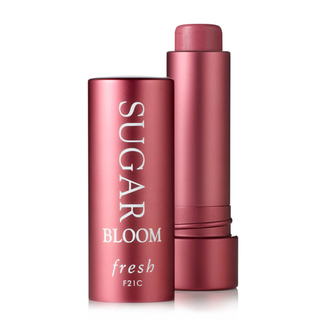
Fresh Sugar Bloom Tinted Lip Treatment Sunscreen SPF 15

Fresh Sugar Bloom Tinted Lip Treatment Sunscreen SPF 15

SPF 15Efficacy62/100IrritancyHigh·2 UV filters
Edit

Works for

1 of 2 advertised claims delivered

Sun protection
SPF 15 · 2 UV filters · Partial spectrum
Weak protectionSPF under 30
SPF 15Partial spectrumChemical filtersTinted

This product does not offer good protection against UVA rays.

UV spectrum
UVB290–320 nmUVA II320–340 nmUVA I340–400 nm
Octinoxate
Titanium Dioxide
FilterCoverageWhat it doesEst. amount
OctinoxateEthylhexyl MethoxycinnamateUVBOctinoxate. When used in higher concentrations, works as a sunscreen protecting the skin from UVB rays. When used in lower concentration, helps to preserve the product formulation. Is shown to be harmful to coral reefs - consider avoiding bathing in coral reef areas when wearing a product with this ingredient. It can be irritating6.74%
Titanium Dioxide Mineral UVBUVA2 Photo-stable Works as a UV filter when used in high concentrations. It is photostable and is effective mostly against the UVB light, with some protection in the UVA range. In small concentrations, used for its ability to improve the color of cosmetic products. Is usually well tolerated by the skin~0.15–0.6%
~ marks concentrations estimated from label position and typical use levels
Moisturizing
12 ingredients credited for this claim
Good support
What the product description says
“A cult-favorite hydrating and smoothing lip balm that offers clear, sheer, or effortless color with long-lasting moisture and essential sun protection Key Benefits The original, award-winning sugar lip treatments let you easily customize your look—swipe once for a hint of hue; more for buildable color.”
Source: Bluemercury

This product can help soften the skin and reduce its moisture loss with emollients and occlusives: beeswax, cera alba.

Keep in mind that this product does not contain effective ingredients to attract water to the upper layer of the skin. This is why an additional product with humectants like glycerin or hyaluronic acid can be helpful (apply it before this product for the best results).

Ricinus communis seed oilKey active· Emollient, OcclusiveEffect: HighA plant oil that can help soften the skin. It might be helpful in calming down inflammation, but solid research is lacking. Is often used in lip products to create the needed product consistency~4.6–6.9%
Simmondsia chinensis seed oilKey active· Emollient, OcclusiveEffect: HighSoftens the upper layer of skin and helps restore the healthy skin barrier. Has shown to help calm down inflammation in skin. It is a stable oil, meaning that it retains its properties even when exposed to air.~3.9–5.8%
Persea gratissima oilKey active· EmollientEffect: HighAn emollient that helps soften the skin and could be helpful in repairing its barrier function~0.9–1.35%
Ribes nigrum seed oilKey active· EmollientEffect: HighAn emollient. Can be helpful for restoring skin barrier function.~0.4–0.9%
Vitis vinifera seed oilKey active· EmollientEffect: HighA great emollient that can also have anti-oxidant properties~2.2–3.2%
BeeswaxKey active· Emollient, OcclusiveEffect: HighForms a protective barrier that holds water and keeps dry skin hydrated. Keeps an emulsion from separating into its oil and liquid components, and increases the thickness of a product. Can be an allergen~4.7–7.1%
Cera albaKey active· Emollient, OcclusiveEffect: HighForms a protective barrier that holds water and keeps dry skin hydrated. Keeps an emulsion from separating into its oil and liquid components, and increases the thickness of a product. Can be an allergen~22–33%
Copernicia cerifera waxKey active· Emollient, OcclusiveEffect: HighHelps to soften the upper layer of the skin and create a nice product consistency~1.3–2%
Limnanthes alba seed oilKey active· EmollientEffect: HighThis oil's cmposition is closest to rapeseed oil. It is a very stable oil and serves as an emoillient~0.55–1.3%
Passiflora incarnata seed oilEffect: LowA plant oil that can help soften the upper layer of the skin. Contains essential oil that can be irritating~0.4–0.95%
TocopherolEffect: Low, below effective dosePure form of vitamin E. Can help moisturise and protect the skin from free radicals. Often used to help stabilise other ingredients or the formula itself~0.35–0.85%
Ascorbyl tetraisopalmitateEffect: Low, below effective doseA vitamin C derivative. Studies show that is might be effective in reducing hyperpigmentation, but there are no studies confirming that it is effectively converted into the bioavailable form of Vitamin C in skin. It is not clear how this derivative compares in effectiveness to the topical application of bioavailable form of vitamin C (L-ascorbic acid)~0.4–0.95%

Can it cause trouble?

Irritancy
6 strong irritants: Parfum, Passiflora incarnata seed oil + 4 more — patch-test recommended
High risk
We flagged 26 ingredients with irritancy potential. Severity depends on your sensitivity threshold; the table lists the worst offenders first.
IngredientFunctionIrritationEst. amount
Ethylhexyl methoxycinnamateOctinoxate. When used in higher concentrations, works as a sunscreen protecting the skin from UVB rays. When used in lower concentration, helps to preserve the product formulation. Is shown to be harmful to coral reefs - consider avoiding bathing in coral reef areas when wearing a product with this ingredient. It can be irritatingHigh6.74%
ParfumAn aromatic blend of unspecified and possibly irritating ingredientsHigh~1.5–2.3%est.
Passiflora incarnata seed oilA plant oil that can help soften the upper layer of the skin. Contains essential oil that can be irritatingHigh~0.4–0.95%est.
LimoneneA common frangrance that can easily irritate skin, especially if exposed to air, light or heatHigh~0.15–0.55%est.
CitralA fragrance with a lemon scent. A likely irritantHigh~0.15–0.5%est.
Benzyl alcoholA preservative. Can be used to mask unpleasant smell. Can be irritatingHigh~0.15–0.5%est.
LinaloolA fragrance. Can be irritatingHigh~0.15–0.5%est.
GeraniolA fragrance. Can be irritatingHigh~0.15–0.5%est.
Ci 15850A red colorantHigh~0.15–0.55%est.
Ci 15985A colorantHigh~0.15–0.55%est.
Ci 19140A yellow dyeHigh~0.2–0.8%est.
Ci 45410A red colorantHigh~0.2–0.75%est.
Cera albaForms a protective barrier that holds water and keeps dry skin hydrated. Keeps an emulsion from separating into its oil and liquid components, and increases the thickness of a product. Can be an allergenMedium~22–33%est.
Ricinus communis seed oilA plant oil that can help soften the skin. It might be helpful in calming down inflammation, but solid research is lacking. Is often used in lip products to create the needed product consistencyMedium~4.6–6.9%est.
Simmondsia chinensis seed oilSoftens the upper layer of skin and helps restore the healthy skin barrier. Has shown to help calm down inflammation in skin. It is a stable oil, meaning that it retains its properties even when exposed to air.Medium~3.9–5.8%est.
Hydrogenated olive oil decyl estersHelps stabilize the product formulationMedium~2.7–4.1%est.
Vitis vinifera seed oilA great emollient that can also have anti-oxidant propertiesMedium~2.2–3.2%est.
Persea gratissima oilAn emollient that helps soften the skin and could be helpful in repairing its barrier functionMedium~0.9–1.35%est.
Ribes nigrum seed oilAn emollient. Can be helpful for restoring skin barrier function.Medium~0.4–0.9%est.
Ascorbyl tetraisopalmitateA vitamin C derivative. Studies show that is might be effective in reducing hyperpigmentation, but there are no studies confirming that it is effectively converted into the bioavailable form of Vitamin C in skin. It is not clear how this derivative compares in effectiveness to the topical application of bioavailable form of vitamin C (L-ascorbic acid)Medium~0.4–0.95%est.
Ascorbyl palmitateBeing a lipid soluble form of vitamin C, it is more stable and can penetrate the skin better than L-Ascorbic acid. It is effective in protecting the skin from free radicals, as well as evening the skin tone, but is less effective in stimulating collagen production compared to L-Ascorbic acid.Medium~0.35–0.8%est.
Polyglyceryl-3 polyricinoleateHelps oil and water mix togetherMedium~0.2–0.75%est.
BhtA preservativeMedium~0.2–0.7%est.
Propyl gallateHelps preserve product formulations and can mask the smell of other ingredients in a productMedium~0.2–0.75%est.
Ci 42090A colorant (dye)Medium~0.2–0.8%est.
Blue 1 lakeA colorantMedium~0.2–0.75%est.
Comedogenic
2 ingredients rated 2 or more on the 0–5 pore-clogging scale
2 flagged
These ingredients have a comedogenic rating of 2 or more on a 0–5 scale; the table shows each one's rating. In leave-on products they can clog pores in acne-prone skin.
IngredientFunctionRatingEst. amount
Ci 45410A red colorant3/5~0.2–0.75%est.
Ci 45410A red colorant3/5~0.15–0.55%est.
Edit
Cheaper Alternatives
Similar formulations, better price
No cheaper similar product found.

User reviews

Would you recommend?
No community reviews yet.

Be the first — your take helps the next person decide.

Write a review · ~30s

Ingredients

Filter by role to see what each ingredient is doing.

Ethylhexyl methoxycinnamate6.74%
UV filterKey activeIrritant · high
Irritation risk
High
Works for
Sun protection

Octinoxate. When used in higher concentrations, works as a sunscreen protecting the skin from UVB rays. When used in lower concentration, helps to preserve the product formulation. Is shown to be harmful to coral reefs - consider avoiding bathing in coral reef areas when wearing a product with this ingredient. It can be irritating

More about Ethylhexyl methoxycinnamate
Cera alba~22–33%
Key activeIrritant · medium
Irritation risk
Medium
Works for
CleansingMoisturizing

Forms a protective barrier that holds water and keeps dry skin hydrated. Keeps an emulsion from separating into its oil and liquid components, and increases the thickness of a product. Can be an allergen

More about Cera alba
Beeswax~4.7–7.1%
Key active
Irritation risk
Low
Works for
Moisturizing

Forms a protective barrier that holds water and keeps dry skin hydrated. Keeps an emulsion from separating into its oil and liquid components, and increases the thickness of a product. Can be an allergen

More about Beeswax
Ricinus communis seed oil~4.6–6.9%
Key activeIrritant · medium
Irritation risk
Medium
Works for
MoisturizingAnti-inflammatory

A plant oil that can help soften the skin. It might be helpful in calming down inflammation, but solid research is lacking. Is often used in lip products to create the needed product consistency

More about Ricinus communis seed oil
Simmondsia chinensis seed oil~3.9–5.8%
Key activeIrritant · medium
Irritation risk
Medium
Works for
Moisturizing

Softens the upper layer of skin and helps restore the healthy skin barrier. Has shown to help calm down inflammation in skin. It is a stable oil, meaning that it retains its properties even when exposed to air.

More about Simmondsia chinensis seed oil
Hydrogenated olive oil decyl esters~2.7–4.1%
Irritant · medium
Irritation risk
Medium

Helps stabilize the product formulation

More about Hydrogenated olive oil decyl esters
Vitis vinifera seed oil~2.2–3.2%
Key activeIrritant · medium
Irritation risk
Medium
Works for
MoisturizingAnti-oxidation

A great emollient that can also have anti-oxidant properties

More about Vitis vinifera seed oil
Parfum~1.5–2.3%
Irritant · high
Irritation risk
High

An aromatic blend of unspecified and possibly irritating ingredients

More about Parfum
Synthetic fluorphlogopite~1.3–2%
Formula
Irritation risk
Low

A mineral that is used as an optical filter (makes the skin looks nicer through light reflection) and to improve the texture of cosmetic products

More about Synthetic fluorphlogopite
Copernicia cerifera wax~1.3–2%
Key active
Irritation risk
Low
Works for
Moisturizing

Helps to soften the upper layer of the skin and create a nice product consistency

More about Copernicia cerifera wax
Persea gratissima oil~0.9–1.35%
Key activeIrritant · medium
Irritation risk
Medium
Works for
Moisturizing

An emollient that helps soften the skin and could be helpful in repairing its barrier function

More about Persea gratissima oil
Limnanthes alba seed oil~0.55–1.3%
Key active
Irritation risk
Low
Works for
MoisturizingAnti-oxidationAnti-aging

This oil's cmposition is closest to rapeseed oil. It is a very stable oil and serves as an emoillient

More about Limnanthes alba seed oil
Passiflora incarnata seed oil~0.4–0.95%
Irritant · high
Irritation risk
High
Works for
Moisturizing

A plant oil that can help soften the upper layer of the skin. Contains essential oil that can be irritating

More about Passiflora incarnata seed oil
Sucrose tetrastearate triacetate~0.45–1%
Formula
Irritation risk
Low
Works for
Cleansing
More about Sucrose tetrastearate triacetate
Ribes nigrum seed oil~0.4–0.9%
Key activeIrritant · medium
Irritation risk
Medium
Works for
MoisturizingAnti-oxidation

An emollient. Can be helpful for restoring skin barrier function.

More about Ribes nigrum seed oil
Tocopherol~0.35–0.85%
Formula
Irritation risk
Low
Works for
Anti-oxidationAnti-agingAnti-inflammatoryMoisturizing

Pure form of vitamin E. Can help moisturise and protect the skin from free radicals. Often used to help stabilise other ingredients or the formula itself

More about Tocopherol
Ascorbyl tetraisopalmitate~0.4–0.95%
Irritant · medium
Irritation risk
Medium
Works for
Anti-oxidationEvens skin toneAnti-agingMoisturizing

A vitamin C derivative. Studies show that is might be effective in reducing hyperpigmentation, but there are no studies confirming that it is effectively converted into the bioavailable form of Vitamin C in skin. It is not clear how this derivative compares in effectiveness to the topical application of bioavailable form of vitamin C (L-ascorbic acid)

More about Ascorbyl tetraisopalmitate
Ascorbyl palmitate~0.35–0.8%
Irritant · medium
Irritation risk
Medium
Works for
Anti-agingAnti-oxidation

Being a lipid soluble form of vitamin C, it is more stable and can penetrate the skin better than L-Ascorbic acid. It is effective in protecting the skin from free radicals, as well as evening the skin tone, but is less effective in stimulating collagen production compared to L-Ascorbic acid.

More about Ascorbyl palmitate
Ammonium glycyrrhizate~0.2–0.75%
Formula
Polyglyceryl-3 polyricinoleate~0.2–0.75%
Irritant · medium
Irritation risk
Medium
Works for
Cleansing

Helps oil and water mix together

More about Polyglyceryl-3 polyricinoleate
Vanillin~0.15–0.65%
Formula
Irritation risk
Low
More about Vanillin
Bht~0.2–0.7%
Irritant · medium
Irritation risk
Medium

A preservative

More about Bht
Propyl gallate~0.2–0.75%
Irritant · medium
Irritation risk
Medium

Helps preserve product formulations and can mask the smell of other ingredients in a product

More about Propyl gallate
Limonene~0.15–0.55%
Irritant · high
Irritation risk
High

A common frangrance that can easily irritate skin, especially if exposed to air, light or heat

More about Limonene
Citral~0.15–0.5%
Irritant · high
Irritation risk
High

A fragrance with a lemon scent. A likely irritant

More about Citral
Benzyl alcohol~0.15–0.5%
Irritant · high
Irritation risk
High

A preservative. Can be used to mask unpleasant smell. Can be irritating

More about Benzyl alcohol
Linalool~0.15–0.5%
Irritant · high
Irritation risk
High

A fragrance. Can be irritating

More about Linalool
Geraniol~0.15–0.5%
Irritant · high
Irritation risk
High

A fragrance. Can be irritating

More about Geraniol
Ci 15850~0.15–0.55%
Irritant · high
Irritation risk
High

A red colorant

More about Ci 15850
Ci 15985~0.15–0.55%
Irritant · high
Irritation risk
High

A colorant

More about Ci 15985
Ci 19140~0.2–0.8%
Irritant · high
Irritation risk
High

A yellow dye

More about Ci 19140
Ci 42090~0.2–0.8%
Irritant · medium
Irritation risk
Medium

A colorant (dye)

More about Ci 42090
Blue 1 lake~0.2–0.75%
Irritant · medium
Irritation risk
Medium

A colorant

More about Blue 1 lake
Ci 45410~0.2–0.75%
Comedogenic 3/5Irritant · high
Irritation risk
High
Comedogenicity
3/5

A red colorant

More about Ci 45410
Ci 15850~0.15–0.6%
Irritant · high
Irritation risk
High

A red colorant

More about Ci 15850
Ci 45410~0.15–0.55%
Comedogenic 3/5Irritant · high
Irritation risk
High
Comedogenicity
3/5

A red colorant

More about Ci 45410
Iron oxides~0.1–0.4%
Formula
Irritation risk
Low
Works for
Sun protection

An umbrella term for the following three colorants: CI 77491, CI 77492, CI 77499. They might be able to offer some protection against visible light, but the degree of the protection is not clear

More about Iron oxides
Ci 77891~0.1–0.35%
Formula
Irritation risk
Low
More about Ci 77891
Titanium dioxide~0.15–0.6%
UV filterUnder-dosed
Irritation risk
Low
Works for
Sun protection

Works as a UV filter when used in high concentrations. It is photostable and is effective mostly against the UVB light, with some protection in the UVA range. In small concentrations, used for its ability to improve the color of cosmetic products. Is usually well tolerated by the skin

More about Titanium dioxide
Tin~0.05–0.25%
Formula
Irritation risk
Low
Works for
Cleansing
More about Tin
Ingredient list view

Ethylhexyl methoxycinnamate, Cera alba, Beeswax, Ricinus communis seed oil, Simmondsia chinensis seed oil, Hydrogenated olive oil decyl esters, Vitis vinifera seed oil, Parfum, Synthetic fluorphlogopite, Copernicia cerifera wax, Persea gratissima oil, Limnanthes alba seed oil, Passiflora incarnata seed oil, Sucrose tetrastearate triacetate, Ribes nigrum seed oil, Tocopherol, Ascorbyl tetraisopalmitate, Ascorbyl palmitate, Ammonium glycyrrhizate, Polyglyceryl-3 polyricinoleate, Vanillin, Bht, Propyl gallate, Limonene, Citral, Benzyl alcohol, Linalool, Geraniol, Ci 15850, Ci 15985, Ci 19140, Ci 42090, Blue 1 lake, Ci 45410, Ci 15850, Ci 45410, Iron oxides, Ci 77891, Titanium dioxide, Tin

Compare prices

Retailers ranked by price — lowest first.

Amazon US
Price unavailable
Check

Affiliate links · prices updated regularly · As an Amazon Associate, WIMJ earns from qualifying purchases.

Cheaper alternatives? See how this stacks up against similar formulas.
We compare ingredient profiles across our catalog — pick the closest match for your budget.
Open dupe finder

Product summary

"Fresh - Sugar Bloom Tinted Lip Treatment Sunscreen SPF 15" does not provide enough UVA protection. UVA rays do not cause sunburn, but still damage the skin, leading to early signs of aging and pigmentation issues.

Sunscreen filters

This is a "mixed" sunscreen in the sense that it uses both mineral and organic (so-called "chemical") sun filters. The organic filters in the product are: octinoxate. As for the mineral filters, this sunscreen uses titanium dioxide.

Irritation risk

There are quite a few common irritants in this product, including ingredients without particular skin benefits. We would not recommend it for sensitive skin. We assess the overall irritancy of this lip sunscreen to be high. For a detailed overview of all potential irritants: click here

You can see the detailed formula review with the breakdown of all actives in the product and the full ingredient list with estimated concentrations in the tables below.

Price

The product retails for 28.50$ in the United States.

For a detailed price comparison: click here.

Sources cited in this review

Every concentration estimate and effectiveness label is anchored to one of these 14 studies and safety reviews.

  1. 1
  2. 2
  3. 3
  4. 4
  5. 5
  6. 6
    Vitamin E in dermatologyncbi.nlm.nih.gov
Fresh Sugar Bloom Tinted Lip Treatment Sunscreen SPF 15
FreshSugar Bloom Tinted Lip Treatment Sunscreen SPF 15

Affiliate links · As an Amazon Associate, WIMJ earns from qualifying purchases.

As an Amazon Associate, WIMJ earns from qualifying purchases.