Works for
Sun protectionSPF 15 · 2 UV filters · Partial spectrumWeak protectionSPF under 30
This product does not offer good protection against UVA rays.
MoisturizingBeeswax, Cera alba + 19 moreWorks
“Brown sugar works to seal in moisture and buff away dry skin as shea butter and jojoba oil help hydrate and nourish the skin.”
This product can help improve hydration of the skin with the two types of ingredients.
The first type is called “humectants”:
these ingredients help attract water.
When humectants are on the surface of the skin, they “pull in” the moisture from the outside environment, or from
within deeper layers of the skin. The following ingredients in this product do the job:
sucrose.
This product also contains ingredients called “occlusives”. They help reduce the speed with which our skin loses moisture to the outside environment. These ingredients also help soften the upper layer of the skin, so it feels less tight and nicer to the touch. The following ingredients in this product do the job: beeswax, bis-diglyceryl polyacyladipate-2.
ExfoliationNo ingredient credited for this claimNot delivered
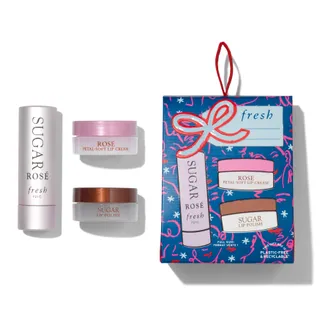
“Conditions and relieves dry lips for instant comfort Sugar Lip Polish 2g Gently exfoliates, conditions, leaves lips soft and smooth Key Benefits A lip care kit that aims to protect and nourish the lips Works to comfort and restore the skin Suitable for all skin types, including dry and sensitive Includes rose for its hydrating qualities Fresh is a brand that uses natural ingredients for beauty products UK200032195”
This product does not contain effective exfoliating ingredients. It might be able to deliver physical exfoliation, that is scrub off some of the dead cells on the surface of the skin. We do not recommend physical exfoliation, because it is not uniform (some bits of skin can get exfoliated too much while others not at all). It can also traumatize the skin and aggrevate acne and other skin conditions.
Can it cause trouble?
Irritancy9 strong irritants: Parfum, Passiflora incarnata seed oil + 7 more — patch-test recommendedHigh risk
Comedogenic3 ingredients rated 2 or more on the 0–5 pore-clogging scale3 flagged
User reviews
Be the first — your take helps the next person decide.
Ingredients
Filter by role to see what each ingredient is doing.
Sucrose~29–35%
- Irritation risk
- Low
Can help attract water to the upper layer of the skin. In crystal form, it can work as a gentle exfoliant, gentler than the salt scrub. Helps stabilize the emulsion
More about SucroseCera alba~4.9–6%
- Irritation risk
- Medium
Forms a protective barrier that holds water and keeps dry skin hydrated. Keeps an emulsion from separating into its oil and liquid components, and increases the thickness of a product. Can be an allergen
More about Cera albaBeeswax~5.5–6.7%
- Irritation risk
- Low
Forms a protective barrier that holds water and keeps dry skin hydrated. Keeps an emulsion from separating into its oil and liquid components, and increases the thickness of a product. Can be an allergen
More about BeeswaxRicinus communis seed oil~4–4.9%
- Irritation risk
- Medium
A plant oil that can help soften the skin. It might be helpful in calming down inflammation, but solid research is lacking. Is often used in lip products to create the needed product consistency
More about Ricinus communis seed oilSimmondsia chinensis seed oil~2.9–3.6%
- Irritation risk
- Medium
Softens the upper layer of skin and helps restore the healthy skin barrier. Has shown to help calm down inflammation in skin. It is a stable oil, meaning that it retains its properties even when exposed to air.
More about Simmondsia chinensis seed oilHydrogenated olive oil decyl esters~2.3–2.8%
- Irritation risk
- Medium
Helps stabilize the product formulation
More about Hydrogenated olive oil decyl estersEthylhexyl methoxycinnamate~2.3–2.8%
- Irritation risk
- High
Octinoxate. When used in higher concentrations, works as a sunscreen protecting the skin from UVB rays. When used in lower concentration, helps to preserve the product formulation. Is shown to be harmful to coral reefs - consider avoiding bathing in coral reef areas when wearing a product with this ingredient. It can be irritating
More about Ethylhexyl methoxycinnamateVitis vinifera seed oil~1.6–2%
- Irritation risk
- Medium
A great emollient that can also have anti-oxidant properties
More about Vitis vinifera seed oilParfum~1.2–1.5%
- Irritation risk
- High
An aromatic blend of unspecified and possibly irritating ingredients
More about ParfumCopernicia cerifera wax~1.1–1.4%
- Irritation risk
- Low
Helps to soften the upper layer of the skin and create a nice product consistency
More about Copernicia cerifera waxPersea gratissima oil~0.9–1.1%
- Irritation risk
- Medium
An emollient that helps soften the skin and could be helpful in repairing its barrier function
More about Persea gratissima oilLimnanthes alba seed oil~0.7–1.05%
- Irritation risk
- Low
This oil's cmposition is closest to rapeseed oil. It is a very stable oil and serves as an emoillient
More about Limnanthes alba seed oilPassiflora incarnata seed oil~0.55–0.85%
- Irritation risk
- High
A plant oil that can help soften the upper layer of the skin. Contains essential oil that can be irritating
More about Passiflora incarnata seed oilSucrose tetrastearate triacetate~0.6–0.9%
Ribes nigrum seed oil~0.55–0.85%
- Irritation risk
- Medium
An emollient. Can be helpful for restoring skin barrier function.
More about Ribes nigrum seed oilTocopherol~0.5–0.7%
- Irritation risk
- Low
Pure form of vitamin E. Can help moisturise and protect the skin from free radicals. Often used to help stabilise other ingredients or the formula itself
More about TocopherolAscorbyl tetraisopalmitate~0.5–0.8%
- Irritation risk
- Medium
A vitamin C derivative. Studies show that is might be effective in reducing hyperpigmentation, but there are no studies confirming that it is effectively converted into the bioavailable form of Vitamin C in skin. It is not clear how this derivative compares in effectiveness to the topical application of bioavailable form of vitamin C (L-ascorbic acid)
More about Ascorbyl tetraisopalmitateAscorbyl palmitate~0.4–0.6%
- Irritation risk
- Medium
Being a lipid soluble form of vitamin C, it is more stable and can penetrate the skin better than L-Ascorbic acid. It is effective in protecting the skin from free radicals, as well as evening the skin tone, but is less effective in stimulating collagen production compared to L-Ascorbic acid.
More about Ascorbyl palmitateAmmonium glycyrrhizate~0.35–0.65%
- Irritation risk
- Low
Vanillin~0.35–0.6%
- Irritation risk
- Low
Bht~0.3–0.6%
Polyglyceryl-3 polyricinoleate~0.35–0.65%
- Irritation risk
- Medium
Helps oil and water mix together
More about Polyglyceryl-3 polyricinoleatePropyl gallate~0.3–0.55%
- Irritation risk
- Medium
Helps preserve product formulations and can mask the smell of other ingredients in a product
More about Propyl gallateLimonene~0.3–0.55%
- Irritation risk
- High
A common frangrance that can easily irritate skin, especially if exposed to air, light or heat
More about LimoneneCitral~0.3–0.55%
Benzyl alcohol~0.25–0.5%
- Irritation risk
- High
A preservative. Can be used to mask unpleasant smell. Can be irritating
More about Benzyl alcoholLinalool~0.3–0.55%
Geraniol~0.3–0.55%
Citronellol~0.3–0.55%
Ci 15850~0.3–0.55%
Ci 15985~0.3–0.55%
Ci 19140~0.3–0.55%
Ci 42090~0.3–0.55%
Blue 1 lake~0.3–0.55%
Ci 45410~0.3–0.55%
Ci 15850~0.3–0.55%
Ci 45410~0.3–0.55%
Iron oxides~0.3–0.5%
- Irritation risk
- Low
An umbrella term for the following three colorants: CI 77491, CI 77492, CI 77499. They might be able to offer some protection against visible light, but the degree of the protection is not clear
More about Iron oxidesCi 77891~0.3–0.5%
- Irritation risk
- Low
Titanium dioxide~0.45–0.7%
- Irritation risk
- Low
Works as a UV filter when used in high concentrations. It is photostable and is effective mostly against the UVB light, with some protection in the UVA range. In small concentrations, used for its ability to improve the color of cosmetic products. Is usually well tolerated by the skin
More about Titanium dioxideRosa damascena extract~0.3–0.6%
- Irritation risk
- High
Oil of a very fragrant pink rose used as fragrance in cosmetics. Extensive research has shown it has mixed benefits. In the pro column, inhaling this flower’s scent seems to have relaxing properties and the plant’s petals contain skin-soothing and antioxidant compounds that can benefit skin. On the flipside, the numerous chemicals that create this rose’s distinctive fragrance pose a risk of causing skin aggravation.
More about Rosa damascena extractCream~0.4–0.65%
- Irritation risk
- Low
Isononyl isononanoate~0.4–0.6%
- Irritation risk
- Low
Forms a protective film on the surface of the skin to prevent moisture loss. Gives a velvety feel to products while reducing tackiness
More about Isononyl isononanoateC10-30 cholesterol/lanosterol esters~0.3–0.6%
Bis-diglyceryl polyacyladipate-2~0.45–0.65%
- Irritation risk
- Low
Helps soften the upper layer of the skin and reduce water loss from its surface
More about Bis-diglyceryl polyacyladipate-2Cera microcristallina~0.45–0.7%
- Irritation risk
- Low
Helps to soften the upper layer of the skin, reduce water loss from its surface and create a thicker product consistency
More about Cera microcristallinaMicrocrystalline wax~0.35–0.65%
Polybutene~0.3–0.6%
Ethylene/propylene/styrene copolymer~0.3–0.55%
- Irritation risk
- Low
Used to create a thicker product consistency
More about Ethylene/propylene/styrene copolymerGlyceryl behenate/eicosadioate~0.45–0.65%
Prunus armeniaca kernel oil~0.4–0.65%
- Irritation risk
- Medium
An emollient that helps soften the skin
More about Prunus armeniaca kernel oilButylene/ethylene/styrene copolymer~0.3–0.6%
- Irritation risk
- Low
Used to create a gel-like product texture
More about Butylene/ethylene/styrene copolymerRibes nigrum~0.4–0.65%
- Irritation risk
- Low
Ribes nigrum seed oil~0.45–0.65%
- Irritation risk
- Medium
An emollient. Can be helpful for restoring skin barrier function.
More about Ribes nigrum seed oilVitis vinifera seed oil~0.45–0.65%
- Irritation risk
- Medium
A great emollient that can also have anti-oxidant properties
More about Vitis vinifera seed oilRosa damascena extract~0.35–0.6%
- Irritation risk
- High
Oil of a very fragrant pink rose used as fragrance in cosmetics. Extensive research has shown it has mixed benefits. In the pro column, inhaling this flower’s scent seems to have relaxing properties and the plant’s petals contain skin-soothing and antioxidant compounds that can benefit skin. On the flipside, the numerous chemicals that create this rose’s distinctive fragrance pose a risk of causing skin aggravation.
More about Rosa damascena extractRosa damascena flower oil~0.3–0.6%
- Irritation risk
- High
Used as a fragrance. Can be irritating
More about Rosa damascena flower oilTocopherol~0.3–0.6%
- Irritation risk
- Low
Pure form of vitamin E. Can help moisturise and protect the skin from free radicals. Often used to help stabilise other ingredients or the formula itself
More about TocopherolAscorbyl palmitate~0.3–0.55%
- Irritation risk
- Medium
Being a lipid soluble form of vitamin C, it is more stable and can penetrate the skin better than L-Ascorbic acid. It is effective in protecting the skin from free radicals, as well as evening the skin tone, but is less effective in stimulating collagen production compared to L-Ascorbic acid.
More about Ascorbyl palmitateSilica silylate~0.45–0.7%
Benzotriazolyl dodecyl p-cresol~0.3–0.6%
- Irritation risk
- Medium
Used to stabilize the product formulation protecting it from sun light
More about Benzotriazolyl dodecyl p-cresolParfum~0.3–0.55%
- Irritation risk
- High
An aromatic blend of unspecified and possibly irritating ingredients
More about ParfumPentaerythrityl tetra-di-t-butyl hydroxyhydrocinnamate~0.35–0.6%
- Irritation risk
- Low
Used to increase stability of product formulations
More about Pentaerythrityl tetra-di-t-butyl hydroxyhydrocinnamateCi 77891~0.3–0.55%
- Irritation risk
- Low
Titanium dioxide~0.5–0.7%
- Irritation risk
- Low
Works as a UV filter when used in high concentrations. It is photostable and is effective mostly against the UVB light, with some protection in the UVA range. In small concentrations, used for its ability to improve the color of cosmetic products. Is usually well tolerated by the skin
More about Titanium dioxideBht~0.3–0.55%
Polyglyceryl-2 triisostearate~0.35–0.65%
- Irritation risk
- Low
Helps to soften the upper layer of the skin and create a nice product texture
More about Polyglyceryl-2 triisostearateWater~0.3–0.6%
Trimethylolpropane triisostearate~0.45–0.65%
- Irritation risk
- Low
Ci 15850~0.3–0.6%
Ci 15985~0.3–0.6%
Ci 19140~0.3–0.6%
Propyl gallate~0.3–0.6%
- Irritation risk
- Medium
Helps preserve product formulations and can mask the smell of other ingredients in a product
More about Propyl gallateCitronellol~0.3–0.55%
Geraniol~0.3–0.55%
Limonene~0.3–0.55%
- Irritation risk
- High
A common frangrance that can easily irritate skin, especially if exposed to air, light or heat
More about LimoneneSucrose~0.25–0.5%
- Irritation risk
- Low
Can help attract water to the upper layer of the skin. In crystal form, it can work as a gentle exfoliant, gentler than the salt scrub. Helps stabilize the emulsion
More about SucroseSimmondsia chinensis seed oil~0.45–0.7%
- Irritation risk
- Medium
Softens the upper layer of skin and helps restore the healthy skin barrier. Has shown to help calm down inflammation in skin. It is a stable oil, meaning that it retains its properties even when exposed to air.
More about Simmondsia chinensis seed oilIsononyl isononanoate~0.45–0.65%
- Irritation risk
- Low
Forms a protective film on the surface of the skin to prevent moisture loss. Gives a velvety feel to products while reducing tackiness
More about Isononyl isononanoateHydrogenated castor oil~0.45–0.65%
- Irritation risk
- Medium
A plant oil that can help soften the skin. It might be helpful in calming down inflammation, but solid research is lacking. Is often used in lip products to create the needed product consistency
More about Hydrogenated castor oilMolasses~0.3–0.6%
- Irritation risk
- Low
Ethylene/propylene/styrene copolymer~0.3–0.6%
- Irritation risk
- Low
Used to create a thicker product consistency
More about Ethylene/propylene/styrene copolymerParfum~0.3–0.5%
- Irritation risk
- High
An aromatic blend of unspecified and possibly irritating ingredients
More about ParfumSilica~0.5–0.75%
Butyrospermum parkii butter~0.45–0.65%
- Irritation risk
- Low
- Comedogenicity
- 3/5
A great moisturising ingredient that softens the skin and reduces water loss from its upper layer. It also can be helpful in protecting skin from free radicals
More about Butyrospermum parkii butterLimnanthes alba seed oil~0.45–0.65%
- Irritation risk
- Low
This oil's cmposition is closest to rapeseed oil. It is a very stable oil and serves as an emoillient
More about Limnanthes alba seed oilVitis vinifera seed oil~0.45–0.65%
- Irritation risk
- Medium
A great emollient that can also have anti-oxidant properties
More about Vitis vinifera seed oilTocopheryl acetate~0.25–0.45%
- Irritation risk
- Medium
A more stable but less bio-available form of vitamin E compared to Tocopherol. Might help moisturize and protect the skin from free radicals, but mostly used in low concentrations to stabilize other ingredients.
More about Tocopheryl acetateButylene/ethylene/styrene copolymer~0.2–0.4%
- Irritation risk
- Low
Used to create a gel-like product texture
More about Butylene/ethylene/styrene copolymerBht~0.15–0.3%
Citric acid~0.15–0.3%
- Irritation risk
- Medium
Can work as an exfoliant but is typically used to adjust the product pH
More about Citric acidPhenoxyethanol~0.15–0.3%
- Irritation risk
- Low
A preservative. It helps prevent bacterial growth in cosmetic products
More about PhenoxyethanolLimonene~0.15–0.25%
- Irritation risk
- High
A common frangrance that can easily irritate skin, especially if exposed to air, light or heat
More about LimoneneCitral~0.1–0.15%
Benzyl alcohol~0.1–0.15%
- Irritation risk
- High
A preservative. Can be used to mask unpleasant smell. Can be irritating
More about Benzyl alcoholIngredient list view
Sucrose, Cera alba, Beeswax, Ricinus communis seed oil, Simmondsia chinensis seed oil, Hydrogenated olive oil decyl esters, Ethylhexyl methoxycinnamate, Vitis vinifera seed oil, Parfum, Copernicia cerifera wax, Persea gratissima oil, Limnanthes alba seed oil, Passiflora incarnata seed oil, Sucrose tetrastearate triacetate, Ribes nigrum seed oil, Tocopherol, Ascorbyl tetraisopalmitate, Ascorbyl palmitate, Ammonium glycyrrhizate, Vanillin, Bht, Polyglyceryl-3 polyricinoleate, Propyl gallate, Limonene, Citral, Benzyl alcohol, Linalool, Geraniol, Citronellol, Ci 15850, Ci 15985, Ci 19140, Ci 42090, Blue 1 lake, Ci 45410, Ci 15850, Ci 45410, Iron oxides, Ci 77891, Titanium dioxide, Rosa damascena extract, Cream, Isononyl isononanoate, C10-30 cholesterol/lanosterol esters, Bis-diglyceryl polyacyladipate-2, Cera microcristallina, Microcrystalline wax, Polybutene, Ethylene/propylene/styrene copolymer, Glyceryl behenate/eicosadioate, Prunus armeniaca kernel oil, Butylene/ethylene/styrene copolymer, Ribes nigrum, Ribes nigrum seed oil, Vitis vinifera seed oil, Rosa damascena extract, Rosa damascena flower oil, Tocopherol, Ascorbyl palmitate, Silica silylate, Benzotriazolyl dodecyl p-cresol, Parfum, Pentaerythrityl tetra-di-t-butyl hydroxyhydrocinnamate, Ci 77891, Titanium dioxide, Bht, Polyglyceryl-2 triisostearate, Water, Trimethylolpropane triisostearate, Ci 15850, Ci 15985, Ci 19140, Propyl gallate, Citronellol, Geraniol, Limonene, Sucrose, Simmondsia chinensis seed oil, Isononyl isononanoate, Hydrogenated castor oil, Molasses, Ethylene/propylene/styrene copolymer, Parfum, Silica, Butyrospermum parkii butter, Limnanthes alba seed oil, Vitis vinifera seed oil, Tocopheryl acetate, Butylene/ethylene/styrene copolymer, Bht, Citric acid, Phenoxyethanol, Limonene, Citral, Benzyl alcohol
Compare prices
Retailers ranked by price — lowest first.

Worth comparing, line by line.
Match % combines shared ingredients, the first five ingredients, shared actives and hero ingredients, irritancy (lower counts in the alternative's favour), texture and body area. Only products in the same routine step are compared.
| FreshRose Lip RitualYOUR PRODUCT | Super Healthy Skin™Nourishing Lip Balm SPF 30 | LanolipsLip Ointment SPF30 - Rose | MooGoo Skin CareEdible Lip Balm – SPF 15 | |
|---|---|---|---|---|
| Match | — | 35% | 32% | 32% |
| Price | $19.20 | $13.40−$5.80 | $10.50−$8.70 | $6.00−$13.20 |
| Shared key ingredients | — | 9 of 17 | 7 of 17 | 3 of 17 |
| Key difference | — | Avobenzone | Lanolin | Caprylic/Capric Triglyceride |
| Irritancy | High | Medium | Medium | Low |
| SPF | SPF 15 | SPF 30 | SPF 30 | SPF 15 |
| Drying alcohol | — | — | — | — |
| View product | Shop | Shop | Shop |


More alternatives: Sun Bum Mineral SPF 30 Lip BalmCoola Mineral Tinted Liplux SPF 30
Product summary
"Fresh - Rose Lip Ritual" does not provide enough UVA protection. UVA rays do not cause sunburn, but still damage the skin, leading to early signs of aging and pigmentation issues.
Sunscreen filters
This sunscreen uses so-called "chemical", or organic UV filters (organic simply means that their molecules contain atoms of carbon). These filters typically give good sun protection and rarely leave a white cast, but they can be irritating for sensitive skin. These are the sun protection ingredients in this sunscreen: octinoxate 2.30% - 2.80%.
Irritation risk
It contains a bunch of common irritants, including ingredients that do not provide any known benefit for the skin. It might not be the best choice if your skin is sensitive. We assess the overall irritancy of this lip sunscreen to be high. For a detailed overview of all potential irritants: click here
You can see the detailed formula review with the breakdown of all actives in the product and the full ingredient list with estimated concentrations in the tables below.
Price
The product retails for 16.00£ in the United Kingdom and for 19.20$ in the United States.
For a detailed price comparison: click here.
Sources cited in this review
Every concentration estimate and effectiveness label is anchored to one of these 19 studies and safety reviews.
- 1
- 2
- 3
- 4
- 5
- 6Vitamin E in dermatologyncbi.nlm.nih.gov

Affiliate links · As an Amazon Associate, WIMJ earns from qualifying purchases.